
Optimizing Potassium Sodium Niobate Content in PVDF Composite Films for Enhanced $\beta$-Phase Crystallization, Ferroelectric Hysteresis, and Energy Storage Performance



Article Information
Abstract
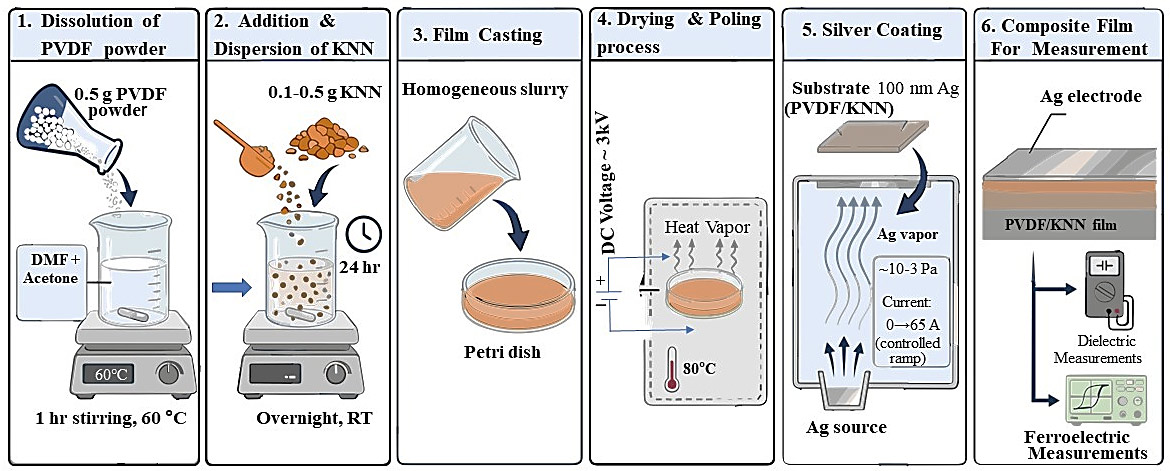
Lead-free polymer-ceramic composites that combine the flexibility of poly(vinylidene fluoride) (PVDF) with the strong polarization of ferroelectric ceramic fillers are candidates for flexible energy-storage devices. In this work, PVDF/potassium sodium niobate (K0.5Na0.5NbO3, KNN) composite films were prepared by solvent casting. The KNN loading was varied from 0.1 to 0.5 g at a fixed PVDF content of 0.5 g, and a 3 kV DC voltage was applied during drying. X-ray diffraction and Fourier-transform infrared spectroscopy showed that the electroactive β-phase of PVDF coexists with the perovskite KNN phase; the β-phase fraction reached a maximum of 83.7% at a PVDF:KNN mass ratio of 0.5:0.4. Polarization-electric field (P-E) loops measured between 100 and 350 kV cm-1 showed that this composition gave the highest maximum polarization (Pmax = 0.321 μC cm-2) and the largest polarization difference (ΔP = 0.211 μC cm-2). At 350 kV cm-1 it delivered a recoverable energy density (Urec) of 0.0154 J cm-3, an efficiency (η) of 36.05%, and a total energy density (UT) of ≈0.043 J cm-3. Field-emission scanning electron microscopy showed a rougher, more heterogeneous surface after KNN addition, consistent with filler dispersion in the PVDF matrix. Within this series, the 0.5:0.4 composition offers the best balance between polarization and stored energy. The absolute energy densities remain low because the films were tested only up to 350 kV cm-1; higher-field testing is required before PVDF/KNN films can be judged against other lead-free dielectric composites.
Graphical Abstract
Keywords
Data Availability Statement
Funding
Conflicts of Interest
AI Use Statement
Ethical Approval and Consent to Participate
References
- Nie, L., Fu, P., Cai, K., Deng, P., Bai, Y., Cai, C., ... & Guo, D. (2025). Tailoring the polyvinylidene fluoride phase structure in high permittivity MXene/polyvinylidene fluoride composite films via supercooling of the polymer melt. Polymer Composites, 46(10), 9634-9645.
[CrossRef] [Google Scholar] - Golriz, M., Moghari, S., Pourheidar, D., Othman, R. S., & Khonakdar, H. A. (2026). Dielectric, ferroelectric, and electric applications of polymers: recent advances and progress. Polymers for Advanced Technologies, 37(2), e70536.
[CrossRef] [Google Scholar] - Ali, N., Ali, A., Yousaf, J., Khan, S., Din, J. U., Shah, S. K., & Hayat, K. (2026). Strategies for $\beta$-phase enhancement in PVDF toward advanced flexible ferroelectric and piezoelectric devices. Energy Technology, 14(4), e202502400.
[CrossRef] [Google Scholar] - Wu, J. J., Li, D., Lai, Q., Bian, J., Zhang, A. P., Yang, S. K., ... & Chen, D. Q. (2026). Polyvinylidene Fluoride (PVDF)-Based Composite for Energy and Environmental Applications: A Comprehensive Review. Polymer Composites, 47(10), 8745-8775.
[CrossRef] [Google Scholar] - Bahuguna, A. S., & Panwar, V. (2026). A review on vital importance of beta phase in PVDF based carbon nanomaterial for sensing applications. Discover Applied Sciences, 8, 578.
[CrossRef] [Google Scholar] - Din, J. U., Khan, S., Shah, S. K., Ali, N., Yousaf, J., Ahmed, E., ... & Hayat, K. (2026). Electrospun PVDF/BaTiO3 composite nanofibers with enhanced $\beta$-phase for flexible piezoelectric nanogenerator applications. Journal of Materials Science: Materials in Electronics, 37(15), 1156.
[CrossRef] [Google Scholar] - Athira, B. S., George, A., Vaishna Priya, K., Hareesh, U. S., Gowd, E. B., Surendran, K. P., & Chandran, A. (2022). High-performance flexible piezoelectric nanogenerator based on electrospun PVDF-BaTiO$_3$ nanofibers for self-powered vibration sensing applications. ACS Applied Materials & Interfaces, 14(39), 44239-44250.
[CrossRef] [Google Scholar] - Yousaf, J., Hayat, K., Khan, S., Din, J. U., Ali, N., Ali, S., Khan, Y., & Shah, S. K. (2025). Ti$_3$C$_2$-MXene/ZnO/PVDF composite fibers as renewable energy materials for piezoelectric nanogenerator applications. Journal of Alloys and Compounds, 1039, 183392.
[CrossRef] [Google Scholar] - El-Aassar, M. R., Hassan, H. M. A., & Essawy, A. A. (2026). Development of PVDF@ZnO hybrid nanofibers with improved $\beta$-phase crystallinity and photocatalytic efficiency. Inorganic Chemistry Communications, 188, 116558.
[CrossRef] [Google Scholar] - Kaplan, M., Alp, E., Borazan, I., Krause, B., & Pötschke, P. (2025). Enhanced piezoelectric performance of poly (vinylidene fluoride) nanocomposites with synthesized zinc oxide nanowires and branched carbon nanotubes via melt mixing process. Macromolecular Materials and Engineering, 310(9), e00122.
[CrossRef] [Google Scholar] - Lopes, A. C., Costa, C. M., Tavares, C. J., Neves, I. C., & Lanceros-Mendez, S. (2011). Nucleation of the electroactive $\gamma$ phase and enhancement of the optical transparency in low filler content poly (vinylidene)/clay nanocomposites. The Journal of Physical Chemistry C, 115(37), 18076-18082.
[CrossRef] [Google Scholar] - Sukumaran, S., Szewczyk, P. K., & Stachewicz, U. (2026). Triboelectric Performance of Electrospun PVDF Fibers for Energy Harvesting: A Comparative Study of Boron Nitride (BN) and Reduced Graphene Oxide (rGO) Fillers. Materials, 19(3), 475.
[CrossRef] [Google Scholar] - Zhang, L., Li, S., Zhu, Z., Rui, G., Du, B., Chen, D., ... & Zhu, L. (2023). Recent progress on structure manipulation of poly (vinylidene fluoride)-based ferroelectric polymers for enhanced piezoelectricity and applications. Advanced Functional Materials, 33(38), 2301302.
[CrossRef] [Google Scholar] - Huang, Y., Rui, G., Li, Q., Allahyarov, E., Li, R., Fukuto, M., ... & Zhu, L. (2021). Enhanced piezoelectricity from highly polarizable oriented amorphous fractions in biaxially oriented poly (vinylidene fluoride) with pure $\beta$ crystals. Nature communications, 12(1), 675.
[CrossRef] [Google Scholar] - Chen, X., Qin, H., Qian, X., Zhu, W., Li, B., Zhang, B., ... & Zhang, Q. M. (2022). Relaxor ferroelectric polymer exhibits ultrahigh electromechanical coupling at low electric field. Science, 375(6587), 1418-1422.
[CrossRef] [Google Scholar] - Zhu, Z., Rui, G., Li, Q., Allahyarov, E., Li, R., Soulestin, T., ... & Zhu, L. (2021). Electrostriction-enhanced giant piezoelectricity via relaxor-like secondary crystals in extended-chain ferroelectric polymers. Matter, 4(11), 3696-3709.
[CrossRef] [Google Scholar] - Chang, J., Dommer, M., Chang, C., & Lin, L. (2012). Piezoelectric nanofibers for energy scavenging applications. Nano energy, 1(3), 356-371.
[CrossRef] [Google Scholar] - Cao, W., Li, T., Chen, P., & Wang, C. (2021). Outstanding energy storage performance of Na$_{0.5$Bi$_{0.5$TiO$_3$-BaTiO$_3$-(Sr$_{0.85$Bi$_{0.1$)(Mg$_{1/3$Nb$_{2/3$)O$_3$ lead-free ceramics. ACS Applied Energy Materials, 4(9), 9362-9367.
[CrossRef] [Google Scholar] - Lu, Z., Wang, G., Bao, W., Li, J., Li, L., Mostaed, A., ... & Reaney, I. M. (2020). Superior energy density through tailored dopant strategies in multilayer ceramic capacitors. Energy & Environmental Science, 13(9), 2938-2948.
[CrossRef] [Google Scholar] - Zhang, H., Wei, T., Zhang, Q., Ma, W., Fan, P., Salamon, D., ... & Ye, Z. G. (2020). A review on the development of lead-free ferroelectric energy-storage ceramics and multilayer capacitors. Journal of Materials Chemistry C, 8(47), 16648-16667.
[CrossRef] [Google Scholar] - Yang, Z., Gao, F., Du, H., Jin, L., Yan, L., Hu, Q., ... & Wang, Y. J. (2019). Grain size engineered lead-free ceramics with both large energy storage density and ultrahigh mechanical properties. Nano Energy, 58, 768-777.
[CrossRef] [Google Scholar] - Hu, Q., Tian, Y., Zhu, Q., Bian, J., Jin, L., Du, H., ... & Wei, X. (2020). Achieve ultrahigh energy storage performance in BaTiO$_3$-Bi(Mg$_{1/2$Ti$_{1/2$)O$_3$ relaxor ferroelectric ceramics via nano-scale polarization mismatch and reconstruction. Nano Energy, 67, 104264.
[CrossRef] [Google Scholar] - Prateek, N., Thakur, V. K., & Gupta, R. K. (2016). Recent progress on ferroelectric polymer-based nanocomposites for high energy density capacitors: synthesis, dielectric properties, and future aspects. Chemical reviews, 116(7), 4260-4317.
[CrossRef] [Google Scholar] - Tripathy, A., Maria Joseph Raj, N. P., Kim, S. J., & Ramadoss, A. (2023). Elucidating the piezoelectric, ferroelectric, and dielectric performance of lead-free KNN/PVDF and its copolymer-based flexible composite films. ACS Applied Electronic Materials, 5(10), 5422-5431.
[CrossRef] [Google Scholar] - Hai, Q., Ren, F., Zhong, P., Dou, X., Li, J., & Mao, J. (2026). Molecular Engineering of DAP Grafted Polypropylene for Ultrahigh-Energy-Density Film Capacitors and Smart Electrostatic Adhesion. Advanced Functional Materials, 36(16), e20883.
[CrossRef] [Google Scholar] - Wang, L., Zhang, Y., Li, S., Yao, Z., Hao, H., Cao, M., ... & Liu, H. (2026). Trace BaTiO3 Doping-Derived PVDF-Based Composite Thick Film for Dielectric Energy Storage. Materials, 19(6), 1137.
[CrossRef] [Google Scholar] - Chen, C., Wang, L., Liu, X., Yang, W., Lin, J., Chen, G., & Yang, X. (2019). K$_{0.5$Na$_{0.5$NbO$_3$-SrTiO$_3$/PVDF polymer composite film with low remnant polarization and high discharge energy storage density. Polymers, 11(2), 310.
[CrossRef] [Google Scholar] - Yang, L., Kong, X., Li, F., Hao, H., Cheng, Z., Liu, H., ... & Zhang, S. (2019). Perovskite lead-free dielectrics for energy storage applications. Progress in Materials Science, 102, 72-108.
[CrossRef] [Google Scholar] - Martins, P., Lopes, A. C., & Lanceros-Mendez, S. (2014). Electroactive phases of poly (vinylidene fluoride): Determination, processing and applications. Progress in polymer science, 39(4), 683-706.
[CrossRef] [Google Scholar] - Gregorio, Jr, R., & Cestari, M. (1994). Effect of crystallization temperature on the crystalline phase content and morphology of poly (vinylidene fluoride). Journal of Polymer Science Part B: Polymer Physics, 32(5), 859-870.
[CrossRef] [Google Scholar] - Cai, X., Lei, T., Sun, D., & Lin, L. (2017). A critical analysis of the $\alpha$, $\beta$ and $\gamma$ phases in poly(vinylidene fluoride) using FTIR. RSC Advances, 7(25), 15382-15389.
[CrossRef] [Google Scholar] - Jena, L. K., Chahal, S., Sahoo, S., Boomishankar, R., & Asthana, S. (2025). Energy storage and harvesting potential of eco-friendly Ca-substituted Ba$_{0.8$Sr$_{0.2$TiO$_3$/PVDF ferro-flexible composite films. ACS Applied Electronic Materials, 7(3), 1314-1328.
[CrossRef] [Google Scholar] - Ait Laasri, H., Fasquelle, D., Tachafine, A., Carru, J. C., Rguiti, M., & Elaatmani, M. (2021). Ferroelectric BT–PVDF Composite Thick Films for Electrical Energy Storage. Journal of Electronic Materials, 50(3), 1132-1139.
[CrossRef] [Google Scholar] - Guan, L., Zhao, X., Ji, Z., Jiang, M., Cui, Y., Weng, L., ... & Liu, J. (2023). Preparation of 3D BN-BT/PVDF skeleton structure composites for high thermal conductivity and energy storage. Polymer Testing, 125, 108126.
[CrossRef] [Google Scholar] - Tong, Y., Lai, J., Tian, Y., Liu, J., Pei, W., Yong, H., ... & Hu, J. (2025). Dielectric energy storage properties of 0–3 type BST/PVDF composite films. Ceramics International, 51(7), 8362-8375.
[CrossRef] [Google Scholar] - Meng, N., Ren, X., Santagiuliana, G., Ventura, L., Zhang, H., Wu, J., Yan, H., Reece, M. J., & Bilotti, E. (2019). Ultrahigh $\beta$-phase content poly(vinylidene fluoride) with relaxor-like ferroelectricity for high energy density capacitors. Nature Communications, 10, 4535.
[CrossRef] [Google Scholar] - Kumar, R. N., & Hemalatha, J. (2025). Preparation and characterization of PVDF/CoFe$_2$O$_4$/g-C$_3$N$_4$ nanocomposite films for multi-functional applications. Journal of Magnetism and Magnetic Materials, 624, 173029.
[CrossRef] [Google Scholar] - Liu, Q., Yu, H., Guan, M., Zhi, X., & Qin, S. (2025). Enhanced Dielectric Response in Poly (Vinylidene Fluoride) (PVDF) Ferroelectric Films via Zinc-Based Metal-Organic Complex. Journal of Applied Polymer Science, 142(47), e57863.
[CrossRef] [Google Scholar] - Nayak, B., Anwar, S., & Anwar, S. (2026). Free-standing PVDF film for piezoelectric energy harvesting and sensing applications. Materials Science and Engineering: B, 323, 118777.
[CrossRef] [Google Scholar] - Zain Karimy, N. H., Li, H., Lee, H. B., Ojha, D. P., Ovhal, M. M., Devaraj, V., ... & Kang, J. W. (2025). Highly Efficient 3D-Printed PVDF-Based Triboelectric Nanogenerators Featuring Polymorphic Perovskite Nanofillers. Advanced Functional Materials, 35(39), 2424271.
[CrossRef] [Google Scholar]
Cite This Article
TY  - JOUR
AU  - Ali, Numan
AU  - Hayat, Khizar
AU  - Uzair, Muhammad
AU  - Khattak, Aisha
AU  - Shah, Said Karim
PY  - 2026
DA  - 2026/11/20
TI  - Optimizing Potassium Sodium Niobate Content in PVDF Composite Films for Enhanced $\beta$-Phase Crystallization, Ferroelectric Hysteresis, and Energy Storage Performance
JO  - Journal of Advanced Electronic Materials
T2  - Journal of Advanced Electronic Materials
JF  - Journal of Advanced Electronic Materials
VL  - 2
IS  - 4
SP  - 120
EP  - 136
DO  - 10.62762/JAEM.2026.500870
UR  - https://www.icck.org/article/abs/jaem.2026.500870
KW  - PVDF
KW  - potassium sodium niobate (KNN)
KW  - $\beta$-phase
KW  - ferroelectric composite
KW  - polarization-electric field hysteresis
KW  - energy storage density
AB  - Lead-free polymer-ceramic composites that combine the flexibility of poly(vinylidene fluoride) (PVDF) with the strong polarization of ferroelectric ceramic fillers are candidates for flexible energy-storage devices. In this work, PVDF/potassium sodium niobate (K0.5Na0.5NbO3, KNN) composite films were prepared by solvent casting. The KNN loading was varied from 0.1 to 0.5 g at a fixed PVDF content of 0.5 g, and a 3 kV DC voltage was applied during drying. X-ray diffraction and Fourier-transform infrared spectroscopy showed that the electroactive β-phase of PVDF coexists with the perovskite KNN phase; the β-phase fraction reached a maximum of 83.7% at a PVDF:KNN mass ratio of 0.5:0.4. Polarization-electric field (P-E) loops measured between 100 and 350 kV cm-1 showed that this composition gave the highest maximum polarization (Pmax = 0.321 μC cm-2) and the largest polarization difference (ΔP = 0.211 μC cm-2). At 350 kV cm-1 it delivered a recoverable energy density (Urec) of 0.0154 J cm-3, an efficiency (η) of 36.05%, and a total energy density (UT) of ≈0.043 J cm-3. Field-emission scanning electron microscopy showed a rougher, more heterogeneous surface after KNN addition, consistent with filler dispersion in the PVDF matrix. Within this series, the 0.5:0.4 composition offers the best balance between polarization and stored energy. The absolute energy densities remain low because the films were tested only up to 350 kV cm-1; higher-field testing is required before PVDF/KNN films can be judged against other lead-free dielectric composites.
SN  - 3070-5649
PB  - Institute of Central Computation and Knowledge
LA  - English
ER  -
@article{Ali2026Optimizing,
  author = {Numan Ali and Khizar Hayat and Muhammad Uzair and Aisha Khattak and Said Karim Shah},
  title = {Optimizing Potassium Sodium Niobate Content in PVDF Composite Films for Enhanced \$\beta\$-Phase Crystallization, Ferroelectric Hysteresis, and Energy Storage Performance},
  journal = {Journal of Advanced Electronic Materials},
  year = {2026},
  volume = {2},
  number = {4},
  pages = {120-136},
  doi = {10.62762/JAEM.2026.500870},
  url = {https://www.icck.org/article/abs/jaem.2026.500870},
  abstract = {Lead-free polymer-ceramic composites that combine the flexibility of poly(vinylidene fluoride) (PVDF) with the strong polarization of ferroelectric ceramic fillers are candidates for flexible energy-storage devices. In this work, PVDF/potassium sodium niobate (K0.5Na0.5NbO3, KNN) composite films were prepared by solvent casting. The KNN loading was varied from 0.1 to 0.5 g at a fixed PVDF content of 0.5 g, and a 3 kV DC voltage was applied during drying. X-ray diffraction and Fourier-transform infrared spectroscopy showed that the electroactive β-phase of PVDF coexists with the perovskite KNN phase; the β-phase fraction reached a maximum of 83.7\% at a PVDF:KNN mass ratio of 0.5:0.4. Polarization-electric field (P-E) loops measured between 100 and 350 kV cm-1 showed that this composition gave the highest maximum polarization (Pmax = 0.321 μC cm-2) and the largest polarization difference (ΔP = 0.211 μC cm-2). At 350 kV cm-1 it delivered a recoverable energy density (Urec) of 0.0154 J cm-3, an efficiency (η) of 36.05\%, and a total energy density (UT) of ≈0.043 J cm-3. Field-emission scanning electron microscopy showed a rougher, more heterogeneous surface after KNN addition, consistent with filler dispersion in the PVDF matrix. Within this series, the 0.5:0.4 composition offers the best balance between polarization and stored energy. The absolute energy densities remain low because the films were tested only up to 350 kV cm-1; higher-field testing is required before PVDF/KNN films can be judged against other lead-free dielectric composites.},
  keywords = {PVDF, potassium sodium niobate (KNN), \$\beta\$-phase, ferroelectric composite, polarization-electric field hysteresis, energy storage density},
  issn = {3070-5649},
  publisher = {Institute of Central Computation and Knowledge}
}
Article Metrics
Publisher's Note
ICCK stays neutral with regard to jurisdictional claims in published maps and institutional affiliations.
Rights and Permissions
 Copyright © 2026 by the Author(s). Published by Institute of Central Computation and Knowledge. This article is an open access article distributed under the terms and conditions of the Creative Commons Attribution (CC BY) license (https://creativecommons.org/licenses/by/4.0/), which permits use, sharing, adaptation, distribution and reproduction in any medium or format, as long as you give appropriate credit to the original author(s) and the source, provide a link to the Creative Commons licence, and indicate if changes were made.


Portico
