
Synergistic Optoelectronic Engineering of Dual-Layer PEDOT:PSS Hole Transport Layers for High-Performance Organic/Silicon Heterojunction Solar Cells



Article Information
Abstract
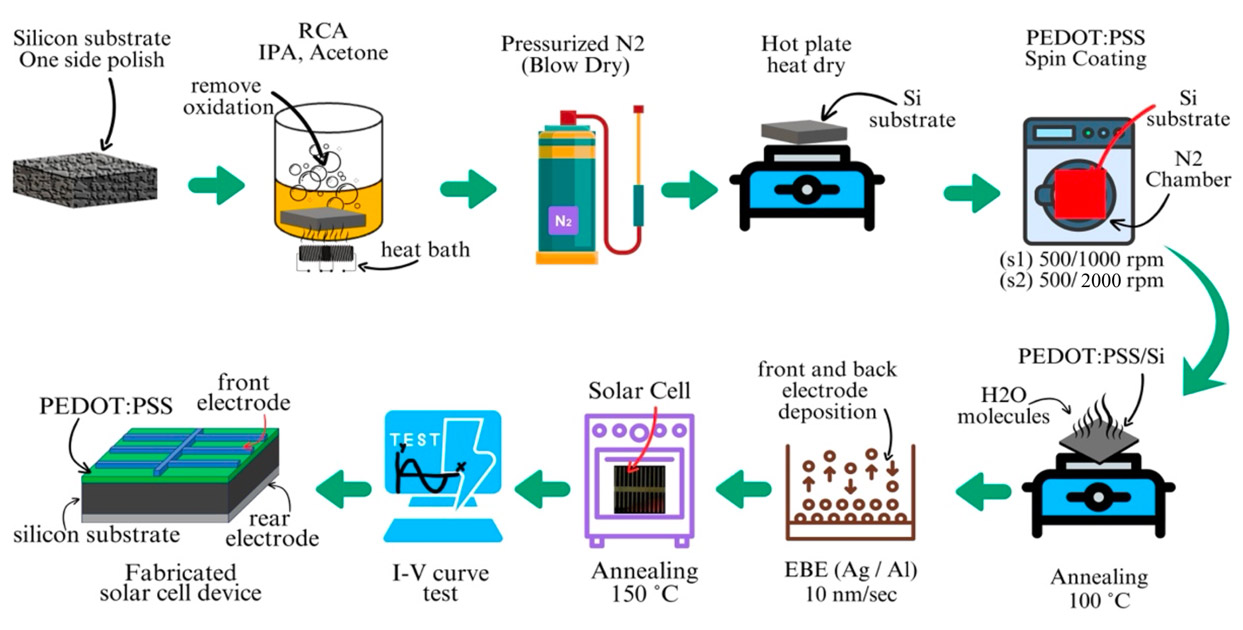
Poly(3,4-ethylenedioxythiophene):poly(styrene sulfonate) (PEDOT:PSS)/silicon (Si) hybrid heterojunction solar cells have attracted considerable interest because of their potential for high efficiency, low material cost, and simple fabrication. Their wider adoption, however, is limited by a restricted spectral response and by suboptimal charge transfer at the organic/inorganic interface. Here we address these limitations with a dual-layer PEDOT:PSS (PH1000) film in which ethylene glycol (EG) and dimethyl sulfoxide (DMSO) are added to the bottom and top layers, respectively. The bilayer is designed to tune the optical and electronic properties of the hole transport layer, aiming at small optical losses and better carrier extraction at the organic/inorganic interface. The optimized device, with a total PEDOT:PSS thickness of $\leq$ 150 nm, shows an open-circuit voltage ($V_{oc}$) of 605 mV, a short-circuit current density ($J_{sc}$) of 18.55 mA cm$^{-2}$, and a fill factor (FF) of 62.03%, giving a power conversion efficiency (PCE) of 6.96%, a relative improvement of 112.8% over the single-layer reference (3.27%). Kelvin probe force microscopy (KPFM), atomic force microscopy (AFM) and transmittance measurements indicate a uniform surface potential, a smooth film and only a small optical penalty. These results point to the dual-layer PEDOT:PSS architecture as a practical route to better interfacial charge transport in low-cost hybrid solar cells.
Graphical Abstract
Keywords
Data Availability Statement
Funding
Conflicts of Interest
AI Use Statement
Ethical Approval and Consent to Participate
References
- Xia, Y., & Ouyang, J. (2011). PEDOT:PSS films with significantly enhanced conductivities induced by preferential solvation with cosolvents and their application in polymer photovoltaic cells. Journal of Materials Chemistry, 21(13), 4927–4936.
[CrossRef] [Google Scholar] - Chen, T., Guo, H., Yu, L., Sun, T., & Yang, Y. (2020). Silicon substrate treated with diluted NaOH aqueous for Si/PEDOT:PSS heterojunction solar cell with performance enhancement. Energies, 13(18), 4659.
[CrossRef] [Google Scholar] - Kim, N., Kee, S., Lee, S. H., Lee, B. H., Kahng, Y. H., Jo, Y. R., ... & Lee, K. (2014). Highly conductive PEDOT: PSS nanofibrils induced by solution‐processed crystallization. Advanced materials, 26(14), 2268-2272.
[CrossRef] [Google Scholar] - Park, K. T., Kim, H. J., Park, M. J., Jeong, J. H., Lee, J., Choi, D. G., ... & Choi, J. H. (2015). 13.2\% efficiency Si nanowire/PEDOT: PSS hybrid solar cell using a transfer-imprinted Au mesh electrode. Scientific Reports, 5(1), 12093.
[CrossRef] [Google Scholar] - Thomas, J. P., & Leung, K. T. (2016). Mixed co-solvent engineering of PEDOT:PSS to enhance its conductivity and hybrid solar cell properties. Journal of Materials Chemistry A, 4(44), 17537–17542.
[CrossRef] [Google Scholar] - Sun, Z., He, Y., Xiong, B., Chen, S., Li, M., Zhou, Y., Zheng, Y., Sun, K., & Yang, C. (2021). Performance-enhancing approaches for PEDOT:PSS-Si hybrid solar cells. Angewandte Chemie International Edition, 60(10), 5036–5055.
[CrossRef] [Google Scholar] - Shen, X., Sun, B., Liu, D., & Lee, S. T. (2011). Hybrid heterojunction solar cell based on organic–inorganic silicon nanowire array architecture. Journal of the American Chemical Society, 133(48), 19408-19415.
[CrossRef] [Google Scholar] - Avasthi, S., Lee, S., Loo, Y. L., & Sturm, J. C. (2011). Role of majority and minority carrier barriers silicon/organic hybrid heterojunction solar cells. Advanced materials, 23(48), 5762-5766.
[CrossRef] [Google Scholar] - Kirchmeyer, S., & Reuter, K. (2005). Scientific importance, properties and growing applications of poly(3,4-ethylenedioxythiophene). Journal of Materials Chemistry, 15(21), 2077–2088.
[CrossRef] [Google Scholar] - Jiang, X., Zhang, P., Zhang, J., Wang, J., Li, G., Fang, X., ... & Chen, X. (2018). High performance of PEDOT: PSS/n-Si solar cells based on textured surface with AgNWs electrodes. Nanoscale Research Letters, 13(1), 53.
[CrossRef] [Google Scholar] - Thomas, J. P., & Leung, K. T. (2014). Defect-minimized PEDOT:PSS/planar-Si solar cell with very high efficiency. Advanced Functional Materials, 24(31), 4978–4985.
[CrossRef] [Google Scholar] - Zhang, C., Zhang, Y., Guo, H., Jiang, Q., Dong, P., & Zhang, C. (2018). Efficient planar hybrid n-Si/PEDOT:PSS solar cells with power conversion efficiency up to 13.31\% achieved by controlling the SiO$_x$ interlayer. Energies, 11(6), 1397.
[CrossRef] [Google Scholar] - Punia, U., Kumari, P., Sharma, R. K., Laxmi, S., Srivastava, R., & Srivastava, S. K. (2024). Fabrication of low-cost and efficient PEDOT: PSS-silicon hybrid heterojunction solar cell via tailoring the organic layer thickness. Journal of Materials Science: Materials in Electronics, 35(1), 42.
[CrossRef] [Google Scholar] - Zhang, X., Yang, D., Yang, Z., Guo, X., Liu, B., Ren, X., & Liu, S. (2016). Improved PEDOT: PSS/c-Si hybrid solar cell using inverted structure and effective passivation. Scientific reports, 6(1), 35091.
[CrossRef] [Google Scholar] - Liu, Q., Ishikawa, R., Funada, S., Ohki, T., Ueno, K., & Shirai, H. (2015). Highly efficient solution‐processed poly (3, 4‐ethylenedio‐xythiophene): poly (styrenesulfonate)/Crystalline–Silicon heterojunction solar cells with improved light‐induced stability. Advanced Energy Materials, 5(17), 1500744.
[CrossRef] [Google Scholar] - Jäckle, S., Liebhaber, M., Niederhausen, J., Buchele, M., Félix, R., Wilks, R. G., ... & Christiansen, S. (2016). Unveiling the hybrid n-Si/PEDOT: PSS interface. ACS applied materials & interfaces, 8(13), 8841-8848.
[CrossRef] [Google Scholar] - Sugano, Y., Sato, K., Fukata, N., & Hirakuri, K. (2017). Improved separation and collection of charge carriers in micro-pyramidal-structured silicon/PEDOT:PSS hybrid solar cells. Energies, 10(4), 420.
[CrossRef] [Google Scholar] - He, L., Jiang, C., Wang, H., Lai, D., & Rusli. (2012). High efficiency planar Si/organic heterojunction hybrid solar cells. Applied Physics Letters, 100(7), 073503.
[CrossRef] [Google Scholar] - Pietsch, M., Jäckle, S., & Christiansen, S. (2014). Interface investigation of planar hybrid n-Si/PEDOT:PSS solar cells with open circuit voltages up to 645 mV and efficiencies of 12.6\%. Applied Physics A, 115(4), 1109–1113.
[CrossRef] [Google Scholar] - Iqbal, S., Su, D., Yang, Y., Ullah, F., Zhou, H., Hussain, A., & Zhang, T. (2019). Fabrication of an efficient planar organic-silicon hybrid solar cell with a 150 nm thick film of PEDOT: PSS. Micromachines, 10(10), 648.
[CrossRef] [Google Scholar] - Kim, Y. H., Sachse, C., Machala, M. L., May, C., Müller-Meskamp, L., & Leo, K. (2011). Highly conductive PEDOT:PSS electrode with optimized solvent and thermal post-treatment for ITO-free organic solar cells. Advanced Functional Materials, 21(6), 1076–1081.
[CrossRef] [Google Scholar] - Lin, Y. J., Ni, W. S., & Lee, J. Y. (2015). Effect of incorporation of ethylene glycol into PEDOT:PSS on electron phonon coupling and conductivity. Journal of Applied Physics, 117(21), 215501.
[CrossRef] [Google Scholar] - Mahato, S., Puigdollers, J., Voz, C., Mukhopadhyay, M., Mukherjee, M., & Hazra, S. (2020). Near 5\% DMSO is the best: A structural investigation of PEDOT: PSS thin films with strong emphasis on surface and interface for hybrid solar cell. Applied Surface Science, 499, 143967.
[CrossRef] [Google Scholar] - Nardes, A. M., Janssen, R. A. J., & Kemerink, M. (2008). A morphological model for the solvent-enhanced conductivity of PEDOT:PSS thin films. Advanced Functional Materials, 18(6), 865–871.
[CrossRef] [Google Scholar] - Zhang, T., Iqbal, S., Zhang, X. Y., Wu, W., Su, D., & Zhou, H. L. (2020). Recent advances in highly efficient organic-silicon hybrid solar cells. Solar Energy Materials and Solar Cells, 204, 110245.
[CrossRef] [Google Scholar] - Zhu, J., Yang, X., Sheng, J., Gao, P., & Ye, J. (2018). Double-layered PEDOT:PSS films inducing strong inversion layers in organic/silicon hybrid heterojunction solar cells. ACS Applied Energy Materials, 1(6), 2874–2881.
[CrossRef] [Google Scholar] - Krebs, F. C. (2009). Fabrication and processing of polymer solar cells: A review of printing and coating techniques. Solar Energy Materials and Solar Cells, 93(4), 394–412.
[CrossRef] [Google Scholar] - Tait, J. G., Worfolk, B. J., Maloney, S. A., Hauger, T. C., Elias, A. L., Buriak, J. M., & Harris, K. D. (2013). Spray coated high-conductivity PEDOT:PSS transparent electrodes for stretchable and mechanically-robust organic solar cells. Solar Energy Materials and Solar Cells, 110, 98–106.
[CrossRef] [Google Scholar] - He, J., Gao, P., Ling, Z., Ding, L., Yang, Z., Ye, J., & Cui, Y. (2016). High-efficiency silicon/organic heterojunction solar cells with improved junction quality and interface passivation. ACS nano, 10(12), 11525-11531.
[CrossRef] [Google Scholar] - Yu, Z., Xia, Y., Du, D., & Ouyang, J. (2016). PEDOT: PSS films with metallic conductivity through a treatment with common organic solutions of organic salts and their application as a transparent electrode of polymer solar cells. ACS applied materials & interfaces, 8(18), 11629-11638.
[CrossRef] [Google Scholar] - Zhang, Y., Zu, F., Lee, S.-T., Liao, L., Zhao, N., & Sun, B. (2014). Heterojunction with organic thin layers on silicon for record efficiency hybrid solar cells. Advanced Energy Materials, 4(2), 1300923.
[CrossRef] [Google Scholar] - Yu, P., Tsai, C. Y., Chang, J. K., Lai, C. C., Chen, P. H., Lai, Y. C., ... & Meng, H. F. (2013). 13\% efficiency hybrid organic/silicon-nanowire heterojunction solar cell via interface engineering. ACS nano, 7(12), 10780-10787.
[CrossRef] [Google Scholar] - Zhu, Z., Liu, C., Xu, J., Jiang, Q., Shi, H., & Liu, E. (2016). Improving the electrical conductivity of PEDOT:PSS films by binary secondary doping. Electronic Materials Letters, 12(1), 54–58.
[CrossRef] [Google Scholar] - Schmidt, J., Titova, V., & Zielke, D. (2013). Organic-silicon heterojunction solar cells: Open-circuit voltage potential and stability. Applied Physics Letters, 103(18), 183901.
[CrossRef] [Google Scholar] - Iqbal, S., Iqbal, M., Yang, Z., Guo, X., & Zhang, T. (2026, May). Spectral Management in Organic-Si Heterojunction Solar Cells via Dual-Layer Architecture for Enhanced Charge Extraction and Optical Optimization. In Innovative Approaches for Global Sustainability: Selected Papers from the 2025 International Conference on Sustainable Innovations and Partnerships (SIP 2025) (pp. 27-40). Cham: Springer Nature Switzerland.
[CrossRef] [Google Scholar] - Iqbal, S., Yang, Y., Su, D., Yang, Z., Guo, X., & Zhang, T. (2025). Tailored spectral management in PEDOT: PSS-based organic-Si heterojunction solar cells via dual-layer architecture for enhanced charge extraction and optical optimization. Optical and Quantum Electronics, 58(1), 45.
[CrossRef] [Google Scholar]
Cite This Article
TY  - JOUR
AU  - Iqbal, Sami
AU  - Ullah, Fahim
AU  - Iqbal, Mazhar
AU  - Yang, Zongru
AU  - Yang, Yi
PY  - 2026
DA  - 2026/11/25
TI  - Synergistic Optoelectronic Engineering of Dual-Layer PEDOT:PSS Hole Transport Layers for High-Performance Organic/Silicon Heterojunction Solar Cells
JO  - Journal of Advanced Materials Research
T2  - Journal of Advanced Materials Research
JF  - Journal of Advanced Materials Research
VL  - 3
IS  - 1
SP  - 1
EP  - 13
DO  - 10.62762/JAMR.2026.419536
UR  - https://www.icck.org/article/abs/jamr.2026.419536
KW  - hole transport layer
KW  - optical absorption
KW  - charge extraction
KW  - interface engineering
AB  - Poly(3,4-ethylenedioxythiophene):poly(styrene sulfonate) (PEDOT:PSS)/silicon (Si) hybrid heterojunction solar cells have attracted considerable interest because of their potential for high efficiency, low material cost, and simple fabrication. Their wider adoption, however, is limited by a restricted spectral response and by suboptimal charge transfer at the organic/inorganic interface. Here we address these limitations with a dual-layer PEDOT:PSS (PH1000) film in which ethylene glycol (EG) and dimethyl sulfoxide (DMSO) are added to the bottom and top layers, respectively. The bilayer is designed to tune the optical and electronic properties of the hole transport layer, aiming at small optical losses and better carrier extraction at the organic/inorganic interface. The optimized device, with a total PEDOT:PSS thickness of $\leq$ 150 nm, shows an open-circuit voltage ($V_{oc}$) of 605 mV, a short-circuit current density ($J_{sc}$) of 18.55 mA cm$^{-2}$, and a fill factor (FF) of 62.03%, giving a power conversion efficiency (PCE) of 6.96%, a relative improvement of 112.8% over the single-layer reference (3.27%). Kelvin probe force microscopy (KPFM), atomic force microscopy (AFM) and transmittance measurements indicate a uniform surface potential, a smooth film and only a small optical penalty. These results point to the dual-layer PEDOT:PSS architecture as a practical route to better interfacial charge transport in low-cost hybrid solar cells.
SN  - 3070-5851
PB  - Institute of Central Computation and Knowledge
LA  - English
ER  -
@article{Iqbal2026Synergisti,
  author = {Sami Iqbal and Fahim Ullah and Mazhar Iqbal and Zongru Yang and Yi Yang},
  title = {Synergistic Optoelectronic Engineering of Dual-Layer PEDOT:PSS Hole Transport Layers for High-Performance Organic/Silicon Heterojunction Solar Cells},
  journal = {Journal of Advanced Materials Research},
  year = {2026},
  volume = {3},
  number = {1},
  pages = {1-13},
  doi = {10.62762/JAMR.2026.419536},
  url = {https://www.icck.org/article/abs/jamr.2026.419536},
  abstract = {Poly(3,4-ethylenedioxythiophene):poly(styrene sulfonate) (PEDOT:PSS)/silicon (Si) hybrid heterojunction solar cells have attracted considerable interest because of their potential for high efficiency, low material cost, and simple fabrication. Their wider adoption, however, is limited by a restricted spectral response and by suboptimal charge transfer at the organic/inorganic interface. Here we address these limitations with a dual-layer PEDOT:PSS (PH1000) film in which ethylene glycol (EG) and dimethyl sulfoxide (DMSO) are added to the bottom and top layers, respectively. The bilayer is designed to tune the optical and electronic properties of the hole transport layer, aiming at small optical losses and better carrier extraction at the organic/inorganic interface. The optimized device, with a total PEDOT:PSS thickness of \$\leq\$ 150 nm, shows an open-circuit voltage (\$V\_{oc}\$) of 605 mV, a short-circuit current density (\$J\_{sc}\$) of 18.55 mA cm\$^{-2}\$, and a fill factor (FF) of 62.03\%, giving a power conversion efficiency (PCE) of 6.96\%, a relative improvement of 112.8\% over the single-layer reference (3.27\%). Kelvin probe force microscopy (KPFM), atomic force microscopy (AFM) and transmittance measurements indicate a uniform surface potential, a smooth film and only a small optical penalty. These results point to the dual-layer PEDOT:PSS architecture as a practical route to better interfacial charge transport in low-cost hybrid solar cells.},
  keywords = {hole transport layer, optical absorption, charge extraction, interface engineering},
  issn = {3070-5851},
  publisher = {Institute of Central Computation and Knowledge}
}
Article Metrics
Publisher's Note
ICCK stays neutral with regard to jurisdictional claims in published maps and institutional affiliations.
Rights and Permissions
 Copyright © 2026 by the Author(s). Published by Institute of Central Computation and Knowledge. This article is an open access article distributed under the terms and conditions of the Creative Commons Attribution (CC BY) license (https://creativecommons.org/licenses/by/4.0/), which permits use, sharing, adaptation, distribution and reproduction in any medium or format, as long as you give appropriate credit to the original author(s) and the source, provide a link to the Creative Commons licence, and indicate if changes were made.


Portico
