



Journal of Advanced Materials Research
ISSN: 3070-5851 (Online)
Email: [email protected]

 Submit Manuscript
Edit a Special Issue
Submit Manuscript
Edit a Special Issue


TY  - JOUR
AU  - Wu, Jie
AU  - Wu, Zhangyu
AU  - Qiao, Yanjie
AU  - Dong, Weiqi
AU  - Yu, Rena C.
AU  - Huang, Yujie
AU  - Zhang, Hui
PY  - 2026
DA  - 2026/02/24
TI  - Engineering 3D-Printed UHPC: Optimising Fibre Content and Printing Direction for Enhanced Mechanical Performance
JO  - Journal of Advanced Materials Research
T2  - Journal of Advanced Materials Research
JF  - Journal of Advanced Materials Research
VL  - 2
IS  - 1
SP  - 40
EP  - 54
DO  - 10.62762/JAMR.2026.817012
UR  - https://www.icck.org/article/abs/JAMR.2026.817012
KW  - 3D printed ultra-high-performance concrete (3DP-UHPC)
KW  - mechanical anisotropy
KW  - compressive and flexural behaviour
KW  - steel fibre orientation
KW  - multi-scale damage evolution
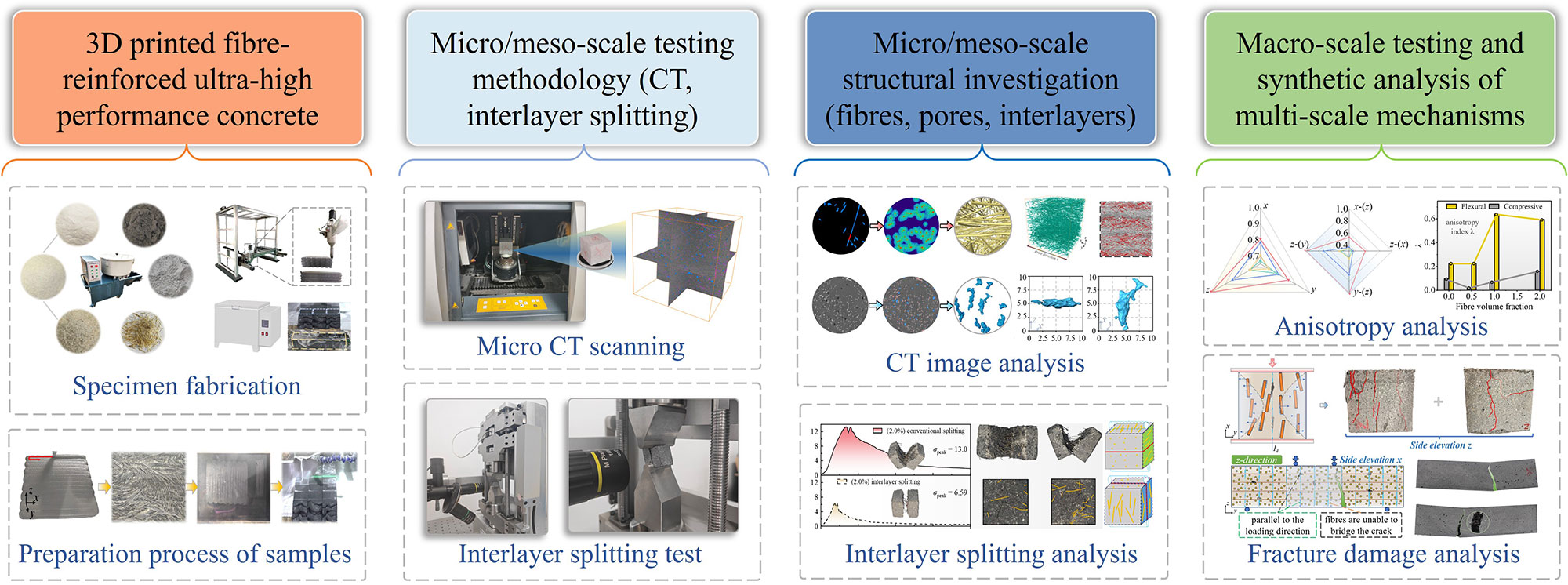
AB  - 3D-printed ultra-high-performance concrete (3DP-UHPC), which combines high strength, high toughness, and construction flexibility, provides a solution to the reinforcement difficulty of conventional printed concrete. However, the layer-by-layer printing process induces pronounced anisotropy in compressive and flexural properties, which remains a key challenge for engineering applications. We used X-ray computed tomography (X-CT) to quantitatively analyse the internal pores and to reveal the orientation and distribution of steel fibres in 3DP-UHPC. Splitting tensile tests showed that the interlayer splitting tensile strength is approximately 49.3% lower than the conventional splitting tensile strength, and increasing fibre content has a limited strengthening effect. Analysis of the compressive anisotropy index \( \lambda_\text{c} \) indicates that, at \( V_\text{f} = 0% \), anisotropy is mainly influenced by weak interlayer interfaces and pore distribution. Linear fitting shows that a small fibre addition (\( V_\text{f} \leq 1.28% \)) reduces compressive anisotropy, whereas higher \( V_\text{f} \) leads to an increase in \( \lambda_\text{c} \) due to fibre orientation. For the flexural anisotropy index \( \lambda_\text{f} \), interstrip interfaces and pores dominate at \( V_\text{f} = 0% \) and \( 0.5% \), while fibre distribution governs \( \lambda_\text{f} \) when \( V_\text{f} \geq 1.0% \), with an increase exceeding 60%. Within \( V_\text{f} = 0%-2.0% \), \( \lambda_\text{c} \) remains higher than \( \lambda_\text{f} \), indicating relatively stable compressive performance. These results provide experimental evidence for optimising the compressive and flexural performance of 3DP-UHPC components in engineering applications.
SN  - 3070-5851
PB  - Institute of Central Computation and Knowledge
LA  - English
ER  -
@article{Wu2026Engineerin,
  author = {Jie Wu and Zhangyu Wu and Yanjie Qiao and Weiqi Dong and Rena C. Yu and Yujie Huang and Hui Zhang},
  title = {Engineering 3D-Printed UHPC: Optimising Fibre Content and Printing Direction for Enhanced Mechanical Performance},
  journal = {Journal of Advanced Materials Research},
  year = {2026},
  volume = {2},
  number = {1},
  pages = {40-54},
  doi = {10.62762/JAMR.2026.817012},
  url = {https://www.icck.org/article/abs/JAMR.2026.817012},
  abstract = {3D-printed ultra-high-performance concrete (3DP-UHPC), which combines high strength, high toughness, and construction flexibility, provides a solution to the reinforcement difficulty of conventional printed concrete. However, the layer-by-layer printing process induces pronounced anisotropy in compressive and flexural properties, which remains a key challenge for engineering applications. We used X-ray computed tomography (X-CT) to quantitatively analyse the internal pores and to reveal the orientation and distribution of steel fibres in 3DP-UHPC. Splitting tensile tests showed that the interlayer splitting tensile strength is approximately 49.3\% lower than the conventional splitting tensile strength, and increasing fibre content has a limited strengthening effect. Analysis of the compressive anisotropy index \( \lambda\_\text{c} \) indicates that, at \( V\_\text{f} = 0\% \), anisotropy is mainly influenced by weak interlayer interfaces and pore distribution. Linear fitting shows that a small fibre addition (\( V\_\text{f} \leq 1.28\% \)) reduces compressive anisotropy, whereas higher \( V\_\text{f} \) leads to an increase in \( \lambda\_\text{c} \) due to fibre orientation. For the flexural anisotropy index \( \lambda\_\text{f} \), interstrip interfaces and pores dominate at \( V\_\text{f} = 0\% \) and \( 0.5\% \), while fibre distribution governs \( \lambda\_\text{f} \) when \( V\_\text{f} \geq 1.0\% \), with an increase exceeding 60\%. Within \( V\_\text{f} = 0\%-2.0\% \), \( \lambda\_\text{c} \) remains higher than \( \lambda\_\text{f} \), indicating relatively stable compressive performance. These results provide experimental evidence for optimising the compressive and flexural performance of 3DP-UHPC components in engineering applications.},
  keywords = {3D printed ultra-high-performance concrete (3DP-UHPC), mechanical anisotropy, compressive and flexural behaviour, steel fibre orientation, multi-scale damage evolution},
  issn = {3070-5851},
  publisher = {Institute of Central Computation and Knowledge}
}
 Copyright © 2026 by the Author(s). Published by Institute of Central Computation and Knowledge. This article is an open access article distributed under the terms and conditions of the Creative Commons Attribution (CC BY) license (https://creativecommons.org/licenses/by/4.0/), which permits use, sharing, adaptation, distribution and reproduction in any medium or format, as long as you give appropriate credit to the original author(s) and the source, provide a link to the Creative Commons licence, and indicate if changes were made.

Portico
All published articles are preserved here permanently:
https://www.portico.org/publishers/icck/