
Carbon Recovery, Characterization, and Kinetic Modeling for Hydrogen Production and Phenol Adsorption





Article Information
Abstract
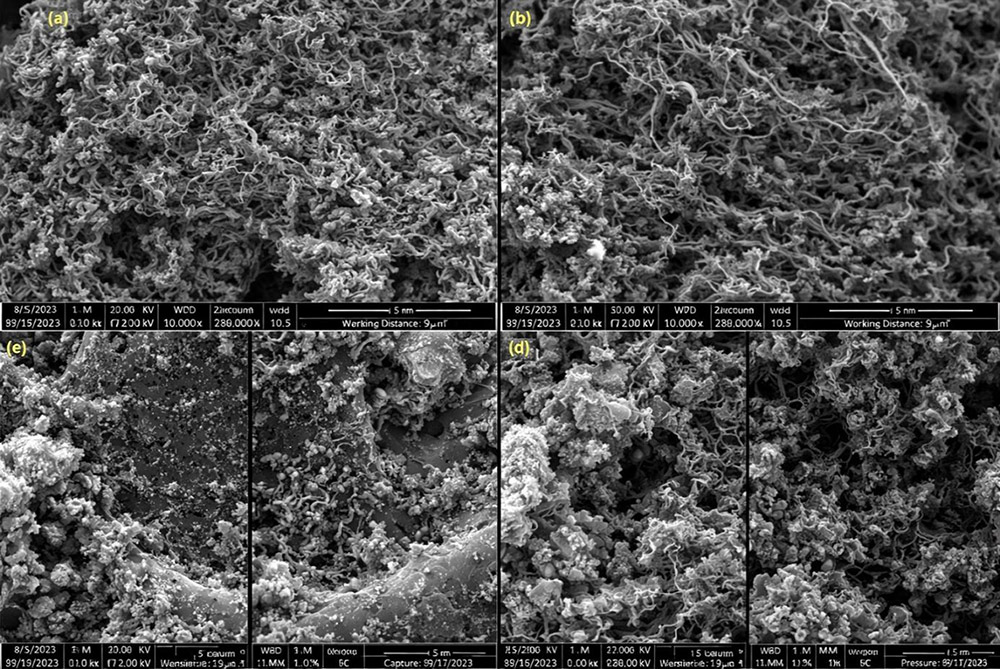
Catalytic methane decomposition (CMD) produces CO$_x$-free hydrogen together with solid carbon, but the carbon that accumulates on the catalyst is usually discarded with the spent material. Here, carbon deposited on a spent 30Ni-5Cu/activated-carbon (30Ni-5Cu/AC) CMD catalyst was recovered by nitric acid leaching as a functional carbon material and assessed as an adsorbent for phenol, with reuse as a catalyst support proposed. Leaching was carried out with 4--14~M HNO$_3$ at 75--105~$^{\circ}$C, and the products were characterized by X-ray diffraction (XRD), N$_2$ physisorption, Fourier-transform infrared spectroscopy, and field-emission scanning electron microscopy. Treatment with 4~M HNO$_3$ at 90~$^{\circ}$C or above removed the Ni and Ni-Cu phases while the graphitic (002) reflection at $2\theta \approx 26.4^{\circ}$ was retained. Stronger acid fragmented the filamentous carbon. After functionalization with sodium thiosulfate, the recovered carbon (MLC-S) had a BET surface area of 1052~m$^2$\,g$^{-1}$. Phenol uptake on MLC-S at 30--70~$^{\circ}$C followed the Langmuir model ($R^2 \geq 0.995$) and was higher than that on thiosulfate-treated commercial activated carbon (VAC-S) at every temperature. Uptake fell as temperature increased, which is consistent with exothermic adsorption. A Langmuir-Hinshelwood rate expression with first-order deactivation is proposed for the CMD step. These results show that carbon from spent CMD catalysts can be recovered and converted into a sustainable functional carbon material, linking hydrogen production with wastewater treatment.
Graphical Abstract
Keywords
Data Availability Statement
Funding
Conflicts of Interest
AI Use Statement
Ethical Approval and Consent to Participate
References
- International Energy Agency. (2023). World Energy Outlook 2023. IEA, Paris. Retrieved from https://www.iea.org/reports/world-energy-outlook-2023
[Google Scholar] - IPCC. (2023). Climate Change 2023: Synthesis Report. Contribution of Working Groups I, II and III to the Sixth Assessment Report of the Intergovernmental Panel on Climate Change. IPCC, Geneva.
[CrossRef] [Google Scholar] - UNFCCC. (2015). Paris Agreement. United Nations Framework Convention on Climate Change, Bonn. Retrieved from https://unfccc.int/sites/default/files/resource/parisagreement_publication.pdf
[Google Scholar] - Spath, P. L., & Mann, M. K. (2001). Life Cycle Assessment of Hydrogen Production via Natural Gas Steam Reforming (Technical Report NREL/TP-570-27637). National Renewable Energy Laboratory, Golden, CO. Available online at: {https://www.fischer-tropsch.org/DOE/DOE_reports/NREL/TP-570/TP-570-27637/TP-570-27637.pdf
[Google Scholar] - Abánades, A., Rubbia, C., & Salmieri, D. (2013). Thermal cracking of methane into hydrogen for a CO$_2$-free utilization of natural gas. International Journal of Hydrogen Energy, 38(20), 8491-8496.
[CrossRef] [Google Scholar] - Muradov, N. (2001). Hydrogen via methane decomposition: an application for decarbonization of fossil fuels. International Journal of Hydrogen Energy, 26(11), 1165-1175.
[CrossRef] [Google Scholar] - Snoeck, J.-W., Froment, G. F., & Fowles, M. (1997). Kinetic study of the carbon filament formation by methane cracking on a nickel catalyst. Journal of Catalysis, 169(1), 250-262.
[CrossRef] [Google Scholar] - Muradov, N., Smith, F., & T-Raissi, A. (2005). Catalytic activity of carbons for methane decomposition reaction. Catalysis Today, 102-103, 225-233.
[CrossRef] [Google Scholar] - Dresselhaus, M. S., Dresselhaus, G., & Avouris, Ph. (Eds.). (2001). Carbon Nanotubes: Synthesis, Structure, Properties, and Applications (Topics in Applied Physics, Vol. 80). Springer, Berlin.
[CrossRef] [Google Scholar] - Keipi, T., Tolvanen, H., & Konttinen, J. (2018). Economic analysis of hydrogen production by methane thermal decomposition: Comparison to competing technologies. Energy Conversion and Management, 159, 264-273.
[CrossRef] [Google Scholar] - Ashik, U. P. M., Daud, W. W., & Abbas, H. F. (2015). Production of greenhouse gas free hydrogen by thermocatalytic decomposition of methane–A review. Renewable and Sustainable Energy Reviews, 44, 221-256.
[CrossRef] [Google Scholar] - Datsyuk, V., Kalyva, M., Papagelis, K., Parthenios, J., Tasis, D., Siokou, A., Kallitsis, I., & Galiotis, C. (2008). Chemical oxidation of multiwalled carbon nanotubes. Carbon, 46(6), 833-840.
[CrossRef] [Google Scholar] - Chiang, Y. C., Lin, W. H., & Chang, Y. C. (2011). The influence of treatment duration on multi-walled carbon nanotubes functionalized by H$_2$SO$_4$/HNO$_3$ oxidation. Applied Surface Science, 257(6), 2401-2410.
[CrossRef] [Google Scholar] - Michałowicz, J., & Duda, W. (2007). Phenols - sources and toxicity. Polish Journal of Environmental Studies, 16(3), 347-362. https://www.pjoes.com/pdf-87995-21854
[Google Scholar] - Busca, G., Berardinelli, S., Resini, C., & Arrighi, L. (2008). Technologies for the removal of phenol from fluid streams: A short review of recent developments. Journal of Hazardous Materials, 160(2-3), 265-288.
[CrossRef] [Google Scholar] - Dąbrowski, A., Podkościelny, P., Hubicki, Z., & Barczak, M. (2005). Adsorption of phenolic compounds by activated carbon - a critical review. Chemosphere, 58(8), 1049-1070.
[CrossRef] [Google Scholar] - Ahmaruzzaman, M. (2008). Adsorption of phenolic compounds on low-cost adsorbents: A review. Advances in Colloid and Interface Science, 143(1-2), 48-67.
[CrossRef] [Google Scholar] - Marsh, H., & Rodríguez-Reinoso, F. (2006). Activated Carbon. Elsevier, Amsterdam.
[CrossRef] [Google Scholar] - Bansal, R. C., & Goyal, M. (2005). Activated Carbon Adsorption. CRC Press, Boca Raton, FL. https://api.taylorfrancis.com/content/books/mono/download?identifierName=doi&identifierValue=10.1201/9781420028812&type=googlepdf
[Google Scholar] - Ioannidou, O., & Zabaniotou, A. (2007). Agricultural residues as precursors for activated carbon production - A review. Renewable and Sustainable Energy Reviews, 11(9), 1966-2005.
[CrossRef] [Google Scholar] - Lin, D., & Xing, B. (2008). Adsorption of phenolic compounds by carbon nanotubes: Role of aromaticity and substitution of hydroxyl groups. Environmental Science & Technology, 42(19), 7254-7259.
[CrossRef] [Google Scholar] - Gupta, V. K., & Saleh, T. A. (2013). Sorption of pollutants by porous carbon, carbon nanotubes and fullerene-an overview. Environmental Science and Pollution Research, 20(5), 2828-2843.
[CrossRef] [Google Scholar] - Yang, K., Wu, W., Jing, Q., & Zhu, L. (2008). Aqueous adsorption of aniline, phenol, and their substitutes by multi-walled carbon nanotubes. Environmental Science & Technology, 42(21), 7931-7936.
[CrossRef] [Google Scholar] - Bandosz, T. J. (Ed.). (2006). Activated Carbon Surfaces in Environmental Remediation (Interface Science and Technology, Vol. 7). Elsevier, Amsterdam. https://www.sciencedirect.com/bookseries/interface-science-and-technology/vol/7/suppl/C
[Google Scholar] - Rodríguez-Reinoso, F. (1998). The role of carbon materials in heterogeneous catalysis. Carbon, 36(3), 159-175.
[CrossRef] [Google Scholar] - Thommes, M., Kaneko, K., Neimark, A. V., Olivier, J. P., Rodríguez-Reinoso, F., Rouquerol, J., & Sing, K. S. W. (2015). Physisorption of gases, with special reference to the evaluation of surface area and pore size distribution (IUPAC Technical Report). Pure and Applied Chemistry, 87(9-10), 1051-1069.
[CrossRef] [Google Scholar] - Ruthven, D. M. (1984). Principles of Adsorption and Adsorption Processes. Wiley, New York. https://www.wiley.com/en-us/shop/general-chemistry/principles-of-adsorption-and-adsorption-processes-p-9780471866060
[Google Scholar] - Foo, K. Y., & Hameed, B. H. (2010). Insights into the modeling of adsorption isotherm systems. Chemical Engineering Journal, 156(1), 2-10.
[CrossRef] [Google Scholar] - Ho, Y. S., & McKay, G. (1999). Pseudo-second order model for sorption processes. Process Biochemistry, 34(5), 451-465.
[CrossRef] [Google Scholar] - Liu, Q.-S., Zheng, T., Wang, P., Jiang, J.-P., & Li, N. (2010). Adsorption isotherm, kinetic and mechanism studies of some substituted phenols on activated carbon fibers. Chemical Engineering Journal, 157(2-3), 348-356.
[CrossRef] [Google Scholar] - Patil, P., Jeppu, G., Vallabha, M. S., & Girish, C. R. (2024). Enhanced adsorption of phenolic compounds using biomass-derived high surface area activated carbon: Isotherms, kinetics and thermodynamics. Environmental Science and Pollution Research, 31(60), 67442-67460.
[CrossRef] [Google Scholar]
Cite This Article
TY  - JOUR
AU  - Abraham, Taniya Rose
AU  - Johny, Davis
AU  - Anurag, Kumar
AU  - Varughese, Mary
AU  - Thomas, Sabu
PY  - 2026
DA  - 2026/11/24
TI  - Carbon Recovery, Characterization, and Kinetic Modeling for Hydrogen Production and Phenol Adsorption
JO  - Journal of Advanced Materials Research
T2  - Journal of Advanced Materials Research
JF  - Journal of Advanced Materials Research
VL  - 2
IS  - 4
SP  - 313
EP  - 322
DO  - 10.62762/JAMR.2026.675203
UR  - https://www.icck.org/article/abs/jamr.2026.675203
KW  - catalytic methane decomposition
KW  - hydrogen
KW  - spent catalyst
KW  - carbon recovery
KW  - acid leaching
KW  - phenol adsorption
KW  - Langmuir isotherm
KW  - sustainable functional carbon
AB  - Catalytic methane decomposition (CMD) produces CO$_x$-free hydrogen together with solid carbon, but the carbon that accumulates on the catalyst is usually discarded with the spent material. Here, carbon deposited on a spent 30Ni-5Cu/activated-carbon (30Ni-5Cu/AC) CMD catalyst was recovered by nitric acid leaching as a functional carbon material and assessed as an adsorbent for phenol, with reuse as a catalyst support proposed. Leaching was carried out with 4--14~M HNO$_3$ at 75--105~$^{\circ}$C, and the products were characterized by X-ray diffraction (XRD), N$_2$ physisorption, Fourier-transform infrared spectroscopy, and field-emission scanning electron microscopy. Treatment with 4~M HNO$_3$ at 90~$^{\circ}$C or above removed the Ni and Ni-Cu phases while the graphitic (002) reflection at $2\theta \approx 26.4^{\circ}$ was retained. Stronger acid fragmented the filamentous carbon. After functionalization with sodium thiosulfate, the recovered carbon (MLC-S) had a BET surface area of 1052~m$^2$\,g$^{-1}$. Phenol uptake on MLC-S at 30--70~$^{\circ}$C followed the Langmuir model ($R^2 \geq 0.995$) and was higher than that on thiosulfate-treated commercial activated carbon (VAC-S) at every temperature. Uptake fell as temperature increased, which is consistent with exothermic adsorption. A Langmuir-Hinshelwood rate expression with first-order deactivation is proposed for the CMD step. These results show that carbon from spent CMD catalysts can be recovered and converted into a sustainable functional carbon material, linking hydrogen production with wastewater treatment.
SN  - 3070-5851
PB  - Institute of Central Computation and Knowledge
LA  - English
ER  -
@article{Abraham2026Carbon,
  author = {Taniya Rose Abraham and Davis Johny and Kumar Anurag and Mary Varughese and Sabu Thomas},
  title = {Carbon Recovery, Characterization, and Kinetic Modeling for Hydrogen Production and Phenol Adsorption},
  journal = {Journal of Advanced Materials Research},
  year = {2026},
  volume = {2},
  number = {4},
  pages = {313-322},
  doi = {10.62762/JAMR.2026.675203},
  url = {https://www.icck.org/article/abs/jamr.2026.675203},
  abstract = {Catalytic methane decomposition (CMD) produces CO\$\_x\$-free hydrogen together with solid carbon, but the carbon that accumulates on the catalyst is usually discarded with the spent material. Here, carbon deposited on a spent 30Ni-5Cu/activated-carbon (30Ni-5Cu/AC) CMD catalyst was recovered by nitric acid leaching as a functional carbon material and assessed as an adsorbent for phenol, with reuse as a catalyst support proposed. Leaching was carried out with 4--14~M HNO\$\_3\$ at 75--105~\$^{\circ}\$C, and the products were characterized by X-ray diffraction (XRD), N\$\_2\$ physisorption, Fourier-transform infrared spectroscopy, and field-emission scanning electron microscopy. Treatment with 4~M HNO\$\_3\$ at 90~\$^{\circ}\$C or above removed the Ni and Ni-Cu phases while the graphitic (002) reflection at \$2\theta \approx 26.4^{\circ}\$ was retained. Stronger acid fragmented the filamentous carbon. After functionalization with sodium thiosulfate, the recovered carbon (MLC-S) had a BET surface area of 1052~m\$^2\$\,g\$^{-1}\$. Phenol uptake on MLC-S at 30--70~\$^{\circ}\$C followed the Langmuir model (\$R^2 \geq 0.995\$) and was higher than that on thiosulfate-treated commercial activated carbon (VAC-S) at every temperature. Uptake fell as temperature increased, which is consistent with exothermic adsorption. A Langmuir-Hinshelwood rate expression with first-order deactivation is proposed for the CMD step. These results show that carbon from spent CMD catalysts can be recovered and converted into a sustainable functional carbon material, linking hydrogen production with wastewater treatment.},
  keywords = {catalytic methane decomposition, hydrogen, spent catalyst, carbon recovery, acid leaching, phenol adsorption, Langmuir isotherm, sustainable functional carbon},
  issn = {3070-5851},
  publisher = {Institute of Central Computation and Knowledge}
}
Article Metrics
Publisher's Note
ICCK stays neutral with regard to jurisdictional claims in published maps and institutional affiliations.
Rights and Permissions
 Copyright © 2026 by the Author(s). Published by Institute of Central Computation and Knowledge. This article is an open access article distributed under the terms and conditions of the Creative Commons Attribution (CC BY) license (https://creativecommons.org/licenses/by/4.0/), which permits use, sharing, adaptation, distribution and reproduction in any medium or format, as long as you give appropriate credit to the original author(s) and the source, provide a link to the Creative Commons licence, and indicate if changes were made.


Portico
