

Phenol Photodegradation over Ni/MCM-41: Effect of the Ni Incorporation Method



Article Information
Abstract
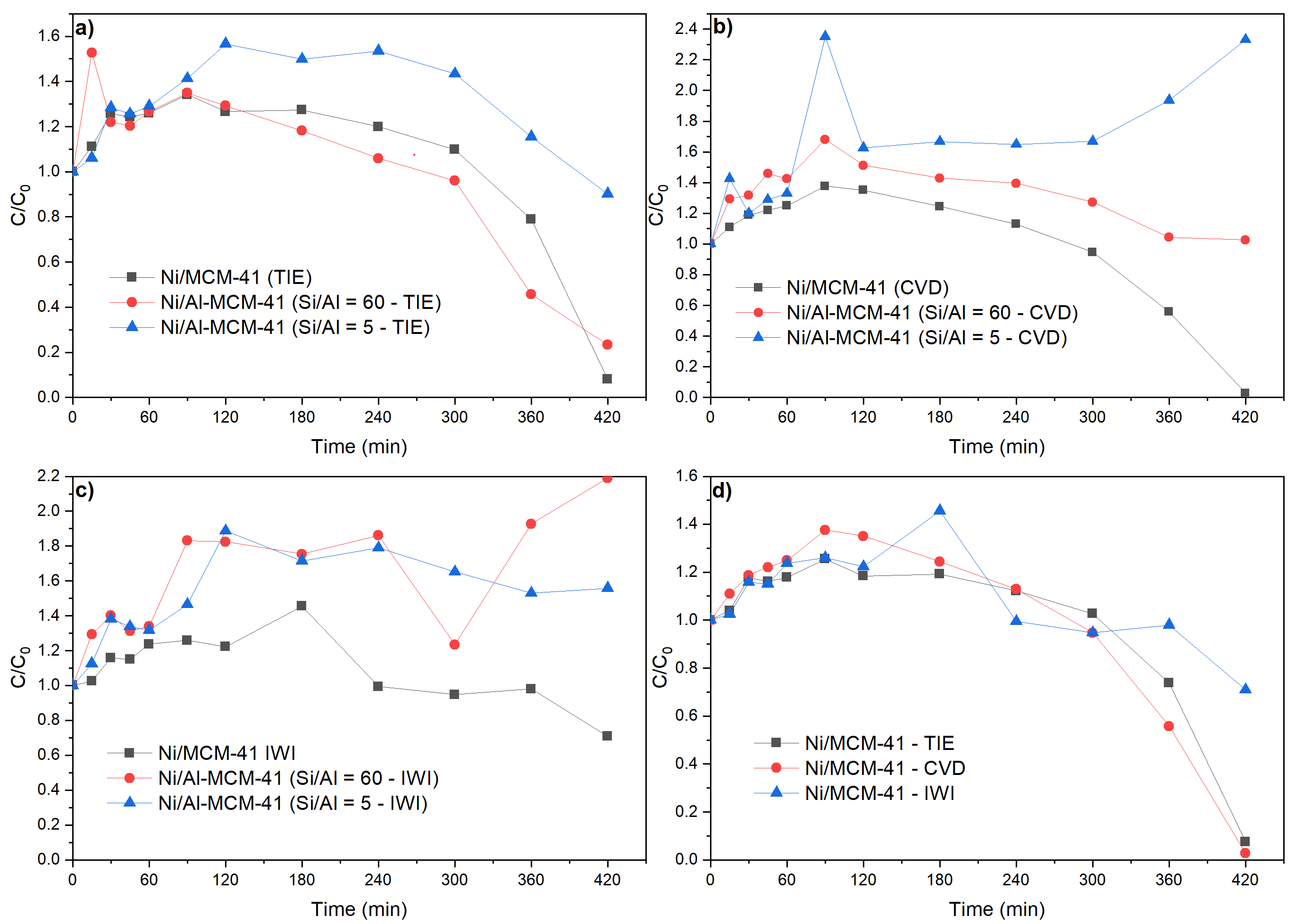
This study explores the synthesis and application of Ni-based photocatalysts supported on MCM-41 and Al-MCM-41 for phenol degradation. Three preparation methods were evaluated and compared: Chemical Vapor Deposition (CVD), Incipient Wet Impregnation (IWI), and Template Ion Exchange (TIE). The influence of the Si/Al ratio of 5 and 60 on phenol photodegradation was also examined. The results showed that the Ni/MCM-41 photocatalyst prepared by CVD achieved the highest degradation efficiency (97.28%), while the TIE method proved to be the most versatile overall. Notably, the TIE method was the only synthesis method capable of exhibiting photocatalytic activity in phenol degradation on all supports at different Si/Al ratios, unlike the materials prepared by CVD and IWI, which failed to degrade phenol in the presence of aluminum. These results indicate the TIE method as a novel synthesis method for the development of mesoporous photocatalysts with high photocatalytic activity in the degradation of phenol with different Si/Al ratios in the MCM-41 structure.
Graphical Abstract
Keywords
Data Availability Statement
Funding
Conflicts of Interest
AI Use Statement
Ethical Approval and Consent to Participate
References
- Mishra, S., & Sundaram, B. (2024). A review of the photocatalysis process used for wastewater treatment. Materials Today: Proceedings, 102, 393-409.
[CrossRef] [Google Scholar] - Bibi, A., Bibi, S., Abu-Dieyeh, M., & Al-Ghouti, M. A. (2023). Towards sustainable physiochemical and biological techniques for the remediation of phenol from wastewater: A review on current applications and removal mechanisms. Journal of Cleaner Production, 417, 137810.
[CrossRef] [Google Scholar] - Chong, M. N., Jin, B., Chow, C. W., & Saint, C. (2010). Recent developments in photocatalytic water treatment technology: a review. Water research, 44(10), 2997-3027.
[CrossRef] [Google Scholar] - Akbari, A., Sabouri, Z., Hosseini, H. A., Hashemzadeh, A., Khatami, M., & Darroudi, M. (2020). Effect of nickel oxide nanoparticles as a photocatalyst in dyes degradation and evaluation of effective parameters in their removal from aqueous environments. Inorganic Chemistry Communications, 115, 107867.
[CrossRef] [Google Scholar] - Belekbir, S., El Azzouzi, M., El Hamidi, A., Rodríguez-Lorenzo, L., Santaballa, J. A., & Canle, M. (2020). Improved photocatalyzed degradation of phenol, as a model pollutant, over metal-impregnated nanosized TiO2. Nanomaterials, 10(5), 996.
[CrossRef] [Google Scholar] - Sun, R., Wu, Y., Han, N., Chen, L., Chen, Z., & Zhao, H. (2025). Mesoporous Silica‐Based Photocatalytic Materials for Solar Energy Storage and Utilization. Carbon Energy, 7(10), e70054.
[CrossRef] [Google Scholar] - Singh, B., Na, J., Konarova, M., Wakihara, T., Yamauchi, Y., Salomon, C., & Gawande, M. B. (2020). Functional mesoporous silica nanomaterials for catalysis and environmental applications. Bulletin of the Chemical Society of Japan, 93(12), 1459-1496.
[CrossRef] [Google Scholar] - Reddy, G. R., Chennakesavulu, K., Lakshmipathiraj, P., Ravindran, B., Chang, S. W., Lee, S. M., ... & Nguyen, D. D. (2021). Removal of organic pollutants in water by the MCM-41 anchored with nickel (II) and copper (II) complexes. Environmental Technology & Innovation, 22, 101492.
[CrossRef] [Google Scholar] - Wu, Q., Hu, X., Yue, P. L., Zhao, X. S., & Lu, G. Q. (2001). Copper/MCM-41 as catalyst for the wet oxidation of phenol. Applied Catalysis B: Environmental, 32(3), 151-156.
[CrossRef] [Google Scholar] - Din, I. U., Nasir, Q., Garba, M. D., Alharthi, A. I., Alotaibi, M. A., & Usman, M. (2022). A review of preparation methods for heterogeneous catalysts. Mini-Reviews in Organic Chemistry, 19(1), 92-110.
[CrossRef] [Google Scholar] - Wegener, S. L., Marks, T. J., & Stair, P. C. (2012). Design strategies for the molecular level synthesis of supported catalysts. Accounts of chemical research, 45(2), 206-214.
[CrossRef] [Google Scholar] - Perea, L. A., Wolff, T., Veit, P., Hilfert, L., Edelmann, F. T., Hamel, C., & Seidel-Morgenstern, A. (2013). Alumino-mesostructured Ni catalysts for the direct conversion of ethene to propene. Journal of catalysis, 305, 154-168.
[CrossRef] [Google Scholar] - Yonemitsu, M., Tanaka, Y., & Iwamoto, M. (1997). Metal ion-planted MCM-41. 1. Planting of manganese (II) ion into MCM-41 by a newly developed template-ion exchange method. Chemistry of materials, 9(12), 2679-2681.
[CrossRef] [Google Scholar] - Al-Hamdi, A. M., Sillanpää, M., & Dutta, J. (2016). Intermediate formation during photodegradation of phenol using lanthanum doped tin dioxide nanoparticles. Research on Chemical Intermediates, 42(4), 3055-3069.
[CrossRef] [Google Scholar] - He, D., Zhang, H., & Yan, Y. (2017). Chemical vapor deposition of CuO on ZSM-5 membrane for catalytic wet peroxide oxidation of phenol in a fixed bed reactor. RSC advances, 7(75), 47435-47447.
[CrossRef] [Google Scholar] - Jia, R., Wang, P., Yang, X., Li, D., Qiao, J., Li, T., & Chen, J. (2025). Regulating the Si/Al ratio of g-C3N4/HBeta to improve adsorption and catalytic activity for enhancing photocatalytic pollutant degradation and H2 production. Journal of Molecular Structure, 1337, 142156.
[CrossRef] [Google Scholar]
Cite This Article
TY  - JOUR
AU  - Corona, Yulissa Aleli Esquivel
AU  - León, Laura Annette Romero De
AU  - Valdez, Elvia Valdez
AU  - Luna, Claudia Yolanda Valero
AU  - Frías, Alan Bañuelos
AU  - Perea, Leo Alvarado
PY  - 2026
DA  - 2026/05/28
TI  - Phenol Photodegradation over Ni/MCM-41: Effect of the Ni Incorporation Method
JO  - Journal of Chemical Engineering and Renewable Fuels
T2  - Journal of Chemical Engineering and Renewable Fuels
JF  - Journal of Chemical Engineering and Renewable Fuels
VL  - 2
IS  - 2
SP  - 65
EP  - 70
DO  - 10.62762/JCERF.2026.349345
UR  - https://www.icck.org/article/abs/JCERF.2026.349345
KW  - Ni/MCM-41
KW  - photodegradation of phenol
KW  - TIE
KW  - CVD
KW  - IWI
AB  - This study explores the synthesis and application of Ni-based photocatalysts supported on MCM-41 and Al-MCM-41 for phenol degradation. Three preparation methods were evaluated and compared: Chemical Vapor Deposition (CVD), Incipient Wet Impregnation (IWI), and Template Ion Exchange (TIE). The influence of the Si/Al ratio of 5 and 60 on phenol photodegradation was also examined. The results showed that the Ni/MCM-41 photocatalyst prepared by CVD achieved the highest degradation efficiency (97.28%), while the TIE method proved to be the most versatile overall. Notably, the TIE method was the only synthesis method capable of exhibiting photocatalytic activity in phenol degradation on all supports at different Si/Al ratios, unlike the materials prepared by CVD and IWI, which failed to degrade phenol in the presence of aluminum. These results indicate the TIE method as a novel synthesis method for the development of mesoporous photocatalysts with high photocatalytic activity in the degradation of phenol with different Si/Al ratios in the MCM-41 structure.
SN  - 3070-1058
PB  - Institute of Central Computation and Knowledge
LA  - English
ER  -
@article{Corona2026Phenol,
  author = {Yulissa Aleli Esquivel Corona and Laura Annette Romero De León and Elvia Valdez Valdez and Claudia Yolanda Valero Luna and Alan Bañuelos Frías and Leo Alvarado Perea},
  title = {Phenol Photodegradation over Ni/MCM-41: Effect of the Ni Incorporation Method},
  journal = {Journal of Chemical Engineering and Renewable Fuels},
  year = {2026},
  volume = {2},
  number = {2},
  pages = {65-70},
  doi = {10.62762/JCERF.2026.349345},
  url = {https://www.icck.org/article/abs/JCERF.2026.349345},
  abstract = {This study explores the synthesis and application of Ni-based photocatalysts supported on MCM-41 and Al-MCM-41 for phenol degradation. Three preparation methods were evaluated and compared: Chemical Vapor Deposition (CVD), Incipient Wet Impregnation (IWI), and Template Ion Exchange (TIE). The influence of the Si/Al ratio of 5 and 60 on phenol photodegradation was also examined. The results showed that the Ni/MCM-41 photocatalyst prepared by CVD achieved the highest degradation efficiency (97.28\%), while the TIE method proved to be the most versatile overall. Notably, the TIE method was the only synthesis method capable of exhibiting photocatalytic activity in phenol degradation on all supports at different Si/Al ratios, unlike the materials prepared by CVD and IWI, which failed to degrade phenol in the presence of aluminum. These results indicate the TIE method as a novel synthesis method for the development of mesoporous photocatalysts with high photocatalytic activity in the degradation of phenol with different Si/Al ratios in the MCM-41 structure.},
  keywords = {Ni/MCM-41, photodegradation of phenol, TIE, CVD, IWI},
  issn = {3070-1058},
  publisher = {Institute of Central Computation and Knowledge}
}
Article Metrics
Publisher's Note
ICCK stays neutral with regard to jurisdictional claims in published maps and institutional affiliations.
Rights and Permissions
 Copyright © 2026 by the Author(s). Published by Institute of Central Computation and Knowledge. This article is an open access article distributed under the terms and conditions of the Creative Commons Attribution (CC BY) license (https://creativecommons.org/licenses/by/4.0/), which permits use, sharing, adaptation, distribution and reproduction in any medium or format, as long as you give appropriate credit to the original author(s) and the source, provide a link to the Creative Commons licence, and indicate if changes were made.


Portico
