


-
CiteScore
-
Impact Factor
Volume 1, Issue 4, ICCK Journal of Image Analysis and Processing
Volume 1, Issue 4, 2025
Submit Manuscript Edit a Special Issue
Article QR Code
Article QR Code
Scan the QR code for reading
Popular articles
ICCK Journal of Image Analysis and Processing, Volume 1, Issue 4, 2025: 196-209

Open Access | Research Article | 18 December 2025
Interpretable Deep Learning for Diabetic Retinopathy Grading using Regression Activation Maps
1 School of Computer Science and Technology, Chongqing University of Posts and Telecommunications, Chongqing 400065, China
2 Chongqing Key Laboratory of Image Cognition, Chongqing University of Posts and Telecommunications, Chongqing 400065, China
3 Key Laboratory of Big Data Intelligent Computing, Chongqing University of Posts and Telecommunications, Chongqing 400065, China
4 Department of Information Engineering, University of Pisa, Pisa 56122, Italy
* Corresponding Author: Muzamil Khan, [email protected]
Received: 30 September 2025, Accepted: 08 December 2025, Published: 18 December 2025  
Abstract
The escalating global prevalence of diabetes renders effective screening for Diabetic Retinopathy (DR) indispensable to prevent irreversible vision loss. Although deep learning models, particularly Convolutional Neural Networks (CNNs), attain diagnostic accuracy comparable to that of human experts, their black-box nature erodes clinical trust. To harmonize accuracy with interpretability, this paper proposes a novel CNN architecture that reformulates DR grading as a regression task. By substituting traditional dense layers with a Global Average Pooling (GAP) layer, our approach substantially reduces model complexity and training time while enabling the generation of Regression Activation Maps (RAMs). These RAMs deliver visual explanations by precisely highlighting the pathological regions that underpin the model's predictions. Evaluated on the Kaggle Diabetic Retinopathy Detection dataset, our model—through the replacement of dense layers with Global Average Pooling—markedly lowers model complexity while delivering diagnostic performance on par with baseline models employing fully-connected layers. The resulting system provides a simpler, more precise, and transparent alternative for automated medical screening, directly associating predictions with clinically relevant features.

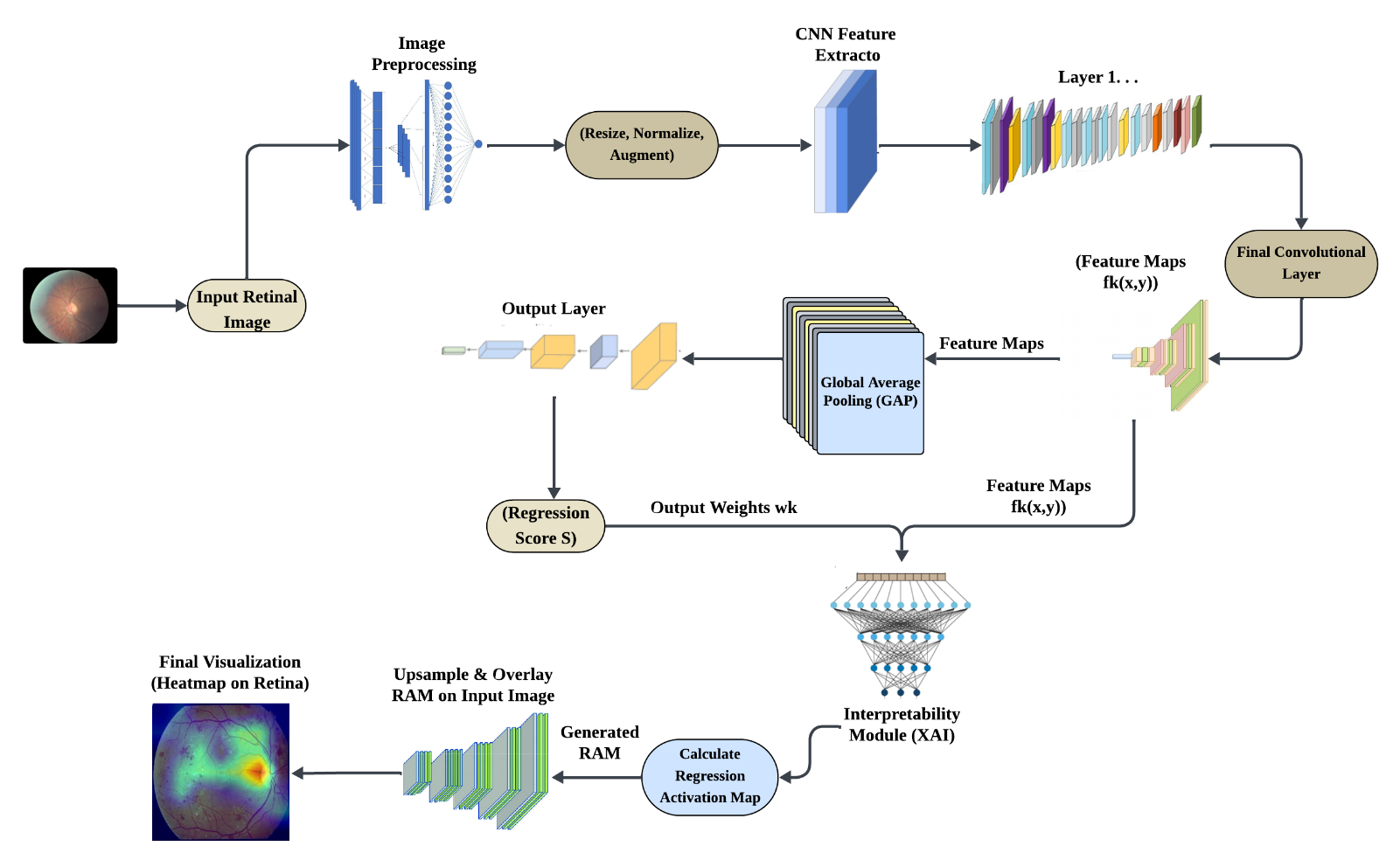
Graphical Abstract
Interpretable Deep Learning for Diabetic Retinopathy Grading using Regression Activation Maps

Keywords
diabetic retinopathy
deep learning
explainable AI
regression activation maps (RAM)
global average pooling

Data Availability Statement
Data will be made available on request.

Funding
This work was supported without any funding.

Conflicts of Interest
The authors declare no conflicts of interest.

Ethical Approval and Consent to Participate
Ethical approval and informed consent were not required for this study, as it exclusively utilized the publicly available Kaggle Diabetic Retinopathy Detection dataset, which has been previously de-identified and approved for research purposes.

References
  1. Kaggle. (2015). Diabetic retinopathy detection. Retrieved from \url{https://www.kaggle.com/c/diabetic-retinopathydetection
    [Google Scholar]
  2. Antony, M., & Brggemann, S. (2015). Kaggle diabetic retinopathy detection: team o\_O solution. Competition Report Github. Retrieved from \url{https://github. com/sveitser/kaggle_diabetic
    [Google Scholar]
  3. Bazzani, L., Bergamo, A., Anguelov, D., & Torresani, L. (2016, March). Self-taught object localization with deep networks. In 2016 IEEE winter conference on applications of computer vision (WACV) (pp. 1-9). IEEE.
    [CrossRef]   [Google Scholar]
  4. Bengio, Y. (2009). Learning deep architectures for AI. Foundations and trends® in Machine Learning, 2(1), 1-127. http://dx.doi.org/10.1561/2200000006
    [Google Scholar]
  5. Deng, L. (2014). A tutorial survey of architectures, algorithms, and applications for deep learning. APSIPA Transactions on Signal and Information Processing, 3, e2.
    [CrossRef]   [Google Scholar]
  6. Dosovitskiy, A., & Brox, T. (2016, June). Inverting Visual Representations with Convolutional Networks. In 2016 IEEE Conference on Computer Vision and Pattern Recognition (CVPR) (pp. 4829-4837). IEEE.
    [CrossRef]   [Google Scholar]
  7. Krizhevsky, A., Sutskever, I., & Hinton, G. E. (2012). Imagenet classification with deep convolutional neural networks. In Advances in Neural Information Processing Systems (pp. 1097–1105).
    [Google Scholar]
  8. LeCun, Y., Boser, B., Denker, J. S., Henderson, D., Howard, R. E., Hubbard, W., & Jackel, L. D. (1989). Backpropagation applied to handwritten zip code recognition. Neural Computation, 1(4), 541–551.
    [CrossRef]   [Google Scholar]
  9. LeCun, Y., Bottou, L., Orr, G. B., & Müller, K. R. (2002). Efficient backprop. In Neural networks: Tricks of the trade (pp. 9-50). Berlin, Heidelberg: Springer Berlin Heidelberg.
    [CrossRef]   [Google Scholar]
  10. Lim, G., Lee, M. L., Hsu, W., & Wong, T. Y. (2014, July). Transformed representations for convolutional neural networks in diabetic retinopathy screening. In AAAI workshop: modern artificial intelligence for health analytics (pp. 21-25).
    [Google Scholar]
  11. Mahendran, A., & Vedaldi, A. (2015, June). Understanding deep image representations by inverting them. In 2015 IEEE Conference on Computer Vision and Pattern Recognition (CVPR) (pp. 5188-5196). IEEE.
    [CrossRef]   [Google Scholar]
  12. Oquab, M., Bottou, L., Laptev, I., & Sivic, J. (2014, June). Learning and Transferring Mid-level Image Representations Using Convolutional Neural Networks. In 2014 IEEE Conference on Computer Vision and Pattern Recognition (pp. 1717-1724). IEEE.
    [CrossRef]   [Google Scholar]
  13. Pinz, A., Bernogger, S., Datlinger, P., & Kruger, A. (1998). Mapping the human retina. IEEE Transactions on medical imaging, 17(4), 606-619.
    [CrossRef]   [Google Scholar]
  14. Pratt, H., Coenen, F., Broadbent, D. M., Harding, S. P., & Zheng, Y. (2016). Convolutional neural networks for diabetic retinopathy. Procedia computer science, 90, 200-205.
    [CrossRef]   [Google Scholar]
  15. Silberman, N., Ahrlich, K., Fergus, R., & Subramanian, L. (2010, March). Case for Automated Detection of Diabetic Retinopathy. In AAAI Spring Symposium: Artificial Intelligence for Development.
    [Google Scholar]
  16. Sopharak, A., Uyyanonvara, B., & Barman, S. (2009). Automatic exudate detection from non-dilated diabetic retinopathy retinal images using fuzzy c-means clustering. sensors, 9(3), 2148-2161.
    [CrossRef]   [Google Scholar]
  17. Szegedy, C., Liu, W., Jia, Y., Sermanet, P., Reed, S., Anguelov, D., ... & Rabinovich, A. (2015, June). Going deeper with convolutions. In 2015 IEEE Conference on Computer Vision and Pattern Recognition (CVPR) (pp. 1-9). IEEE.
    [CrossRef]   [Google Scholar]
  18. Wang, S., Yin, Y., Cao, G., Wei, B., Zheng, Y., & Yang, G. (2015). Hierarchical retinal blood vessel segmentation based on feature and ensemble learning. Neurocomputing, 149, 708–717.
    [CrossRef]   [Google Scholar]
  19. Wang, Z., Yan, W., & Oates, T. (2017). Time series classification from scratch with deep neural networks: A strong baseline. In 2017 International Joint Conference on Neural Networks (IJCNN) (pp. 1578–1585).
    [CrossRef]   [Google Scholar]
  20. Wu, D., Zhang, M., Liu, J. C., & Bauman, W. (2006). On the adaptive detection of blood vessels in retinal images. IEEE Transactions on Biomedical Engineering, 53(2), 341-343.
    [CrossRef]   [Google Scholar]
  21. Yang, J. B., Nguyen, M. N., San, P. P., Li, X. L., & Krishnaswamy, S. (2015, July). Deep convolutional neural networks on multichannel time series for human activity recognition. In Proceedings of the 24th International Conference on Artificial Intelligence (pp. 3995-4001).
    [Google Scholar]
  22. Zeiler, M. D., & Fergus, R. (2014, September). Visualizing and understanding convolutional networks. In European conference on computer vision (pp. 818-833). Cham: Springer International Publishing.
    [CrossRef]   [Google Scholar]
  23. Zhou, B., Khosla, A., Lapedriza, A., Oliva, A., & Torralba, A. (2014). Object detectors emerge in deep scene cnns. arXiv preprint arXiv:1412.6856.
    [Google Scholar]
  24. Zhou, B., Khosla, A., Lapedriza, A., Oliva, A., & Torralba, A. (2016, June). Learning Deep Features for Discriminative Localization. In 2016 IEEE Conference on Computer Vision and Pattern Recognition (CVPR) (pp. 2921-2929). IEEE.
    [CrossRef]   [Google Scholar]
  25. Lin, M., Chen, Q., & Yan, S. (2013). Network in network. arXiv preprint arXiv:1312.4400.
    [Google Scholar]
  26. Howard, A. G., Zhu, M., Chen, B., Kalenichenko, D., Wang, W., Weyand, T., ... & Adam, H. (2017). Mobilenets: Efficient convolutional neural networks for mobile vision applications. arXiv preprint arXiv:1704.04861.
    [Google Scholar]
  27. Tjoa, E., & Guan, C. (2020). A survey on explainable artificial intelligence (XAI): Toward building trustable AI. IEEE Transactions on Neural Networks and Learning Systems, 32(11), 4793–4813.
    [CrossRef]   [Google Scholar]
  28. Selvaraju, R. R., Cogswell, M., Das, A., Vedantam, R., Parikh, D., & Batra, D. (2017, October). Grad-CAM: Visual Explanations from Deep Networks via Gradient-Based Localization. In 2017 IEEE International Conference on Computer Vision (ICCV) (pp. 618-626). IEEE.
    [CrossRef]   [Google Scholar]
  29. Ghassemi, M., Oakden-Rayner, L., & Beam, A. L. (2021). The false hope of current approaches to explainable artificial intelligence in health care. The lancet digital health, 3(11), e745-e750.
    [CrossRef]   [Google Scholar]
  30. Suryani, A. I., Chang, C. W., Feng, Y. F., Lin, T. K., Lin, C. W., Cheng, J. C., & Chang, C. Y. (2022). Lung tumor localization and visualization in chest X-ray images using deep fusion network and class activation mapping. IEEE Access, 10, 124448-124463.
    [CrossRef]   [Google Scholar]
  31. Suvalakshmi, S., & Vinoth Kumar, B. (2025, April). Diabetic Retinopathy Classification using Transformer Models: An Comprehensive Survey. In International Conference on Computer Vision and Robotics (pp. 58-72). Cham: Springer Nature Switzerland.
    [CrossRef]   [Google Scholar]
  32. Yuan, H., Kang, L., & Li, Y. (2025). Opening the black box of deep learning: Validating the statistical association between explainable artificial intelligence (XAI) and clinical domain knowledge in fundus image-based glaucoma diagnosis. arXiv preprint arXiv:2504.04549.
    [Google Scholar]
  33. Alonso-Caneiro, D., Kugelman, J., Tong, J., Kalloniatis, M., Chen, F. K., Read, S. A., & Collins, M. J. (2021, November). Use of uncertainty quantification as a surrogate for layer segmentation error in Stargardt disease retinal OCT images. In 2021 Digital Image Computing: Techniques and Applications (DICTA) (pp. 1-8). IEEE.
    [CrossRef]   [Google Scholar]

Cite This Article
APA Style
Khalid, M. I., Ahmad, I., Saleem, S., Hussain, A., Hussain, S. A., Waghan, A. A., & Khan, M. (2025). Interpretable Deep Learning for Diabetic Retinopathy Grading using Regression Activation Maps. ICCK Journal of Image Analysis and Processing, 1(4), 196–209. https://doi.org/10.62762/JIAP.2025.346328
Export Citation
RIS Format
Compatible with EndNote, Zotero, Mendeley, and other reference managers
RIS format data for reference managers
TY  - JOUR
AU  - Khalid, Muhammad Imran
AU  - Ahmad, Israr
AU  - Saleem, Sohaibe
AU  - Hussain, Altaf
AU  - Hussain, Syed Akif
AU  - Waghan, Atif Ali
AU  - Khan, Muzamil
PY  - 2025
DA  - 2025/12/18
TI  - Interpretable Deep Learning for Diabetic Retinopathy Grading using Regression Activation Maps
JO  - ICCK Journal of Image Analysis and Processing
T2  - ICCK Journal of Image Analysis and Processing
JF  - ICCK Journal of Image Analysis and Processing
VL  - 1
IS  - 4
SP  - 196
EP  - 209
DO  - 10.62762/JIAP.2025.346328
UR  - https://www.icck.org/article/abs/JIAP.2025.346328
KW  - diabetic retinopathy
KW  - deep learning
KW  - explainable AI
KW  - regression activation maps (RAM)
KW  - global average pooling
AB  - The escalating global prevalence of diabetes renders effective screening for Diabetic Retinopathy (DR) indispensable to prevent irreversible vision loss. Although deep learning models, particularly Convolutional Neural Networks (CNNs), attain diagnostic accuracy comparable to that of human experts, their black-box nature erodes clinical trust. To harmonize accuracy with interpretability, this paper proposes a novel CNN architecture that reformulates DR grading as a regression task. By substituting traditional dense layers with a Global Average Pooling (GAP) layer, our approach substantially reduces model complexity and training time while enabling the generation of Regression Activation Maps (RAMs). These RAMs deliver visual explanations by precisely highlighting the pathological regions that underpin the model's predictions. Evaluated on the Kaggle Diabetic Retinopathy Detection dataset, our model—through the replacement of dense layers with Global Average Pooling—markedly lowers model complexity while delivering diagnostic performance on par with baseline models employing fully-connected layers. The resulting system provides a simpler, more precise, and transparent alternative for automated medical screening, directly associating predictions with clinically relevant features.
SN  - 3068-6679
PB  - Institute of Central Computation and Knowledge
LA  - English
ER  - 
BibTeX Format
Compatible with LaTeX, BibTeX, and other reference managers
BibTeX format data for LaTeX and reference managers
@article{Khalid2025Interpreta,
  author = {Muhammad Imran Khalid and Israr Ahmad and Sohaibe Saleem and Altaf Hussain and Syed Akif Hussain and Atif Ali Waghan and Muzamil Khan},
  title = {Interpretable Deep Learning for Diabetic Retinopathy Grading using Regression Activation Maps},
  journal = {ICCK Journal of Image Analysis and Processing},
  year = {2025},
  volume = {1},
  number = {4},
  pages = {196-209},
  doi = {10.62762/JIAP.2025.346328},
  url = {https://www.icck.org/article/abs/JIAP.2025.346328},
  abstract = {The escalating global prevalence of diabetes renders effective screening for Diabetic Retinopathy (DR) indispensable to prevent irreversible vision loss. Although deep learning models, particularly Convolutional Neural Networks (CNNs), attain diagnostic accuracy comparable to that of human experts, their black-box nature erodes clinical trust. To harmonize accuracy with interpretability, this paper proposes a novel CNN architecture that reformulates DR grading as a regression task. By substituting traditional dense layers with a Global Average Pooling (GAP) layer, our approach substantially reduces model complexity and training time while enabling the generation of Regression Activation Maps (RAMs). These RAMs deliver visual explanations by precisely highlighting the pathological regions that underpin the model's predictions. Evaluated on the Kaggle Diabetic Retinopathy Detection dataset, our model—through the replacement of dense layers with Global Average Pooling—markedly lowers model complexity while delivering diagnostic performance on par with baseline models employing fully-connected layers. The resulting system provides a simpler, more precise, and transparent alternative for automated medical screening, directly associating predictions with clinically relevant features.},
  keywords = {diabetic retinopathy, deep learning, explainable AI, regression activation maps (RAM), global average pooling},
  issn = {3068-6679},
  publisher = {Institute of Central Computation and Knowledge}
}

Article Metrics
Citations:

Crossref

0

Scopus

0

Web of Science

0
Article Access Statistics:
Views: 39
PDF Downloads: 12

Publisher's Note
ICCK stays neutral with regard to jurisdictional claims in published maps and institutional affiliations.

Rights and Permissions
CC BY Copyright © 2025 by the Author(s). Published by Institute of Central Computation and Knowledge. This article is an open access article distributed under the terms and conditions of the Creative Commons Attribution (CC BY) license (https://creativecommons.org/licenses/by/4.0/), which permits use, sharing, adaptation, distribution and reproduction in any medium or format, as long as you give appropriate credit to the original author(s) and the source, provide a link to the Creative Commons licence, and indicate if changes were made.
ICCK Journal of Image Analysis and Processing

ICCK Journal of Image Analysis and Processing

ISSN: 3068-6679 (Online)

Email: [email protected]

Portico

Portico

All published articles are preserved here permanently:
https://www.portico.org/publishers/icck/