Volume 1, Issue 1, Journal of Reliable and Secure Computing
Volume 1, Issue 1, 2025
Submit Manuscript Edit a Special Issue
Article QR Code
Article QR Code
Scan the QR code for reading
Popular articles
Journal of Reliable and Secure Computing, Volume 1, Issue 1, 2025: 41-53

Open Access | Review Article | 20 December 2025
Virtual Tourism Cybersecurity: A Scientometric Analysis of Research Trends
1 Srinivasa Ramanujan Department of Mathematics, Central University of Himachal Pradesh, Dharamshala 176215, India
2 Department of Computer Engineering AI and Big Data, Marwadi University, Rajkot 360003, India
* Corresponding Author: Sunil Prajapat, [email protected]
ARK: ark:/57805/jrsc.2025.547593
Received: 23 October 2025, Accepted: 01 December 2025, Published: 20 December 2025  
Abstract
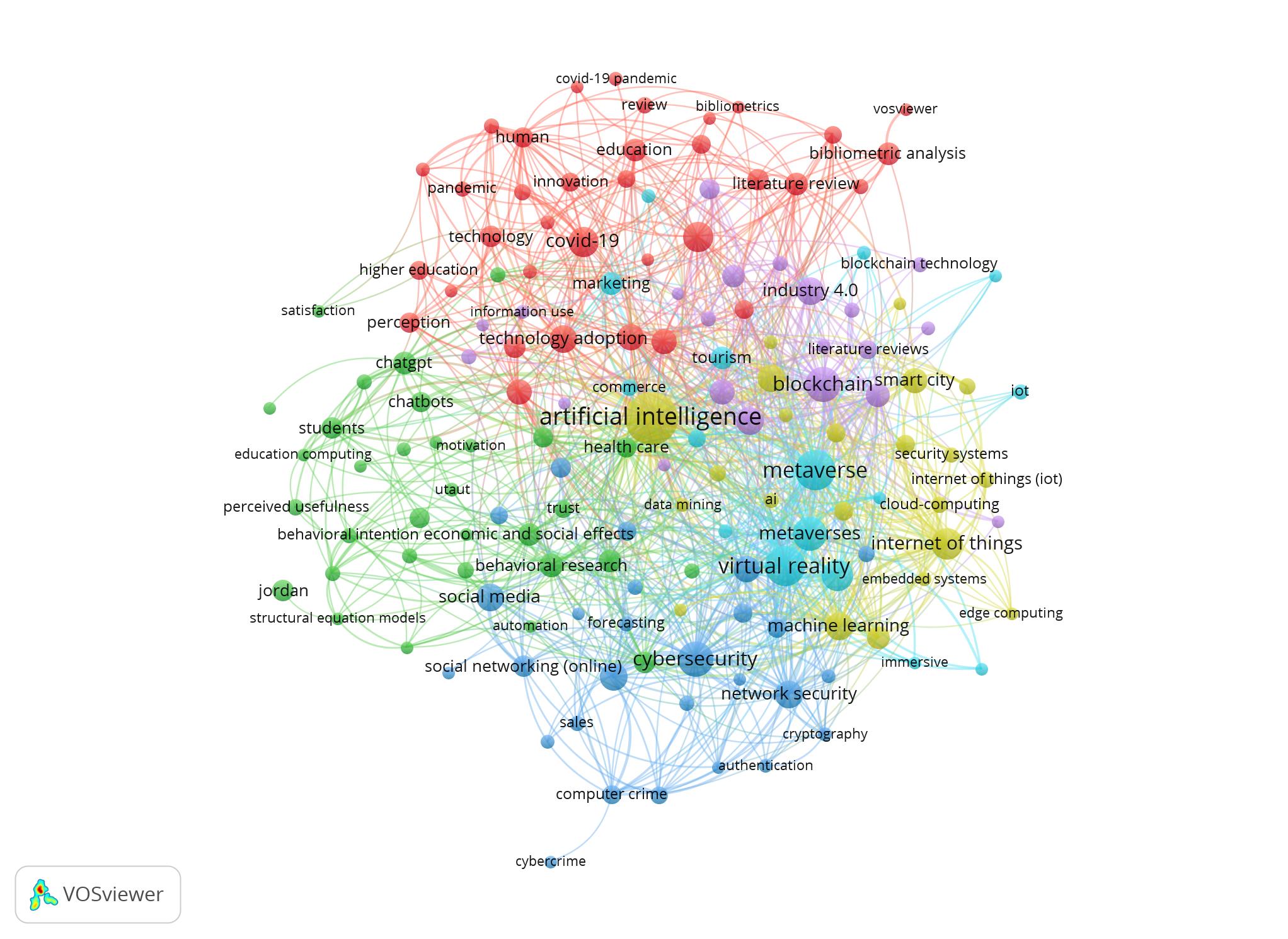
The rapid pace of technological developments in the digital age has transformed the tourism sector, spawning virtual tourism, an emerging platform through which tourists are able to visit their destination using augmented reality (AR) and virtual reality (VR) for interactive experiences. Such technological transformation creates significant cybersecurity challenges, such as data breaches, violations of users’ privacy, and vulnerabilities on platforms. Therefore, our work uses bibliometric approaches to examine the growing body of research on virtual tourism cybersecurity. A total of 1145 publications were retrieved using the specified query, which includes studies on the dangers of data theft, malware threats, shoddy authentication procedures, and improper usage of augmented and virtual reality technologies. Our investigation identifies leading cybersecurity academics, top publications, primary research clusters, and regional research bases. Cybersecurity research on virtual tourism helps academics create better security methods by highlighting areas of the subject that are explored less. Consequently, the scientific results of this study give decision-makers in the fields of virtual tourism development and web security the ability to create more reliable and effective systems for users.

Graphical Abstract
Virtual Tourism Cybersecurity: A Scientometric Analysis of Research Trends

Keywords
cybersecurity
virtual tourism
scientometric
scopus data
virtual reality

Data Availability Statement
Not applicable.

Funding
This work was supported without any funding.

Conflicts of Interest
The authors declare no conflicts of interest.

Ethical Approval and Consent to Participate
Not applicable.

References
  1. Balsalobre-Lorente, D., Driha, O. M., Shahbaz, M., & Sinha, A. (2020). The effects of tourism and globalization over environmental degradation in developed countries. Environmental Science and Pollution Research, 27(7), 7130-7144.
    [CrossRef]   [Google Scholar]
  2. Kapoor, V. (2024). Artificial Intelligence and Cyber Security in the Service Industry. In Artificial Intelligence for Smart Technology in the Hospitality and Tourism Industry (pp. 265-303). Apple Academic Press.
    [Google Scholar]
  3. Becken, S., Whittlesea, E., Loehr, J., & Scott, D. (2020). Tourism and climate change: Evaluating the extent of policy integration. Journal of sustainable tourism, 28(10), 1603-1624.
    [CrossRef]   [Google Scholar]
  4. Sharma, H., Srivastava, P. R., Jasimuddin, S. M., Zhang, Z. J., & Jebabli, I. (2024). Privacy concerns in tourism: a systematic literature review using machine learning approach and bibliometric analysis. Tourism Review, 79(5), 1105-1125.
    [CrossRef]   [Google Scholar]
  5. Florido-Benítez, L. (2025). The role of cybersecurity as a preventive measure in digital tourism and travel: a systematic literature review. Discover Computing, 28(1), 28.
    [CrossRef]   [Google Scholar]
  6. Masseno, M. D., & Santos, C. T. (2018). Assuring privacy and data protection within the framework of smart tourism destinations. MediaLaws-Rivista di Diritto dei Media,(2), 251-266.
    [Google Scholar]
  7. Pratisto, E. H., Thompson, N., & Potdar, V. (2022). Immersive technologies for tourism: a systematic review. Information Technology & Tourism, 24(2), 181-219.
    [CrossRef]   [Google Scholar]
  8. Anwar, M. S., Ullah, I., Ahmad, S., Choi, A., Ahmad, S., Wang, J., & Aurangzeb, K. (2023). Immersive learning and AR/VR-based education: cybersecurity measures and risk management. In Cybersecurity management in education technologies (pp. 1-22). CRC Press.
    [Google Scholar]
  9. Ampountolas, A., & Li, J. (2025). Blockchain and the metaverse in tourism: A conceptual framework for decentralized OTAs. Tourism Economics, 13548166251399010.
    [CrossRef]   [Google Scholar]
  10. Kovačić, M., Čičin-Šain, M., & Milojica, V. (2022). Cyber security and tourism: Bibliometric analysis. Journal of process management and new technologies, 10(3-4), 75-92.
    [CrossRef]   [Google Scholar]
  11. Saeed, S., Altamimi, S. A., Alkayyal, N. A., Alshehri, E., & Alabbad, D. A. (2023). Digital transformation and cybersecurity challenges for businesses resilience: Issues and recommendations. Sensors, 23(15), 6666.
    [CrossRef]   [Google Scholar]
  12. Sinha, N., Dhingra, S., Sehrawat, R., Jain, V., & Himanshu. (2025). Customers’ intention to use virtual reality in tourism: a comprehensive analysis of influencing factors. Tourism Review, 80(3), 742-766.
    [CrossRef]   [Google Scholar]
  13. Calvaresi, D., Leis, M., Dubovitskaya, A., Schegg, R., & Schumacher, M. (2019). Trust in tourism via blockchain technology: results from a systematic review. Information and communication technologies in tourism 2019, 304-317.
    [CrossRef]   [Google Scholar]
  14. Ramaseri-Chandra, A. N., & Pothana, P. (2024, October). Cybersecurity threats in Virtual Reality Environments: A Literature Review. In 2024 Cyber Awareness and Research Symposium (CARS) (pp. 1-7). IEEE.
    [CrossRef]   [Google Scholar]
  15. Alzahrani, N. M., & Alfouzan, F. A. (2022). Augmented reality (AR) and cyber-security for smart cities—A systematic literature review. Sensors, 22(7), 2792.
    [CrossRef]   [Google Scholar]
  16. Ghaderi, Z., Beal, L., & Houanti, L. (2024). Cybersecurity threats in tourism and hospitality: perspectives from tourists engaging with sharing economy services. Current Issues in Tourism, 1-16.
    [CrossRef]   [Google Scholar]
  17. Loan, F. A., Bisma, B., & Nahida, N. (2022). Global research productivity in cybersecurity: a scientometric study. Global Knowledge, Memory and Communication, 71(4/5), 342-354.
    [CrossRef]   [Google Scholar]
  18. Newman, M. E. (2001). The structure of scientific collaboration networks. Proceedings of the national academy of sciences, 98(2), 404-409.
    [CrossRef]   [Google Scholar]
  19. Glänzel, W. (2014). Analysis of co-authorship patterns at the individual level. Transinformação, 26(3), 229-238.
    [CrossRef]   [Google Scholar]
  20. Barrett, A. M., Crossley, M., & Dachi, H. A. (2011). International collaboration and research capacity building: Learning from the EdQual experience. Comparative Education, 47(1), 25-43.
    [CrossRef]   [Google Scholar]
  21. Wagner, C. S. (2006). International collaboration in science and technology: Promises and pitfalls. Science and technology policy for development, dialogues at the interface, 165-176.
    [Google Scholar]
  22. Yu, H., Zhang, J., Zhang, M., & Fan, F. (2022). Cross-national knowledge transfer, absorptive capacity, and total factor productivity: The intermediary effect test of international technology spillover. Technology Analysis & Strategic Management, 34(6), 625-640.
    [CrossRef]   [Google Scholar]
  23. Talukder, M. B., Kabir, F., Horaira, M. A., & Kumar, S. (2025). Challenges and Future Directions for the Use of AI and Security Intelligence in Tourism Industry. The AI Metaverse Revolution: Transforming Multi-business Scenarios (Volume 1), 165-178.
    [CrossRef]   [Google Scholar]
  24. Ghaderi, Z., Beal, L., & Houanti, L. (2024). Cybersecurity threats in tourism and hospitality: perspectives from tourists engaging with sharing economy services. Current Issues in Tourism, 1-16.
    [CrossRef]   [Google Scholar]
  25. Dutta, P., Choi, T. M., Somani, S., & Butala, R. (2020). Blockchain technology in supply chain operations: Applications, challenges and research opportunities. Transportation research part e: Logistics and transportation review, 142, 102067.
    [CrossRef]   [Google Scholar]
  26. Buhalis, D. (2020). Technology in tourism-from information communication technologies to eTourism and smart tourism towards ambient intelligence tourism: a perspective article. Tourism review, 75(1), 267-272.
    [CrossRef]   [Google Scholar]
  27. Sharma, S., Gautam, A., & Tyagi, R. (2024, August). Artificial Intelligence and Cyber Security Driven Social Innovations in Digital Adventure Tourism. In 2024 First International Conference on Pioneering Developments in Computer Science & Digital Technologies (IC2SDT) (pp. 1-6). IEEE.
    [CrossRef]   [Google Scholar]
  28. Bhattacharya, P., Saraswat, D., Dave, A., Acharya, M., Tanwar, S., Sharma, G., & Davidson, I. E. (2021). Coalition of 6G and blockchain in AR/VR space: Challenges and future directions. IEEE Access, 9, 168455-168484.
    [CrossRef]   [Google Scholar]
  29. Xu, D., Pearce, P. L., & Chen, T. (2021). Deconstructing tourist scams: A social-practice-theory perspective. Tourism Management, 82, 104186.
    [CrossRef]   [Google Scholar]
  30. Mêgnigbêto, E. (2015). Effect of international collaboration on knowledge flow within an innovation system: a Triple Helix approach. Triple Helix, 2(1), 1-21.
    [Google Scholar]
  31. Tan, C. N. L. (2016). Enhancing knowledge sharing and research collaboration among academics: the role of knowledge management. Higher education, 71(4), 525-556.
    [CrossRef]   [Google Scholar]
  32. Liu, J., Chaminade, C., & Asheim, B. (2015). The geography and structure of global innovation networks: A knowledge base perspective. In Global and Regional Dynamics in Knowledge Flows and Innovation (pp. 140-157). Routledge.
    [Google Scholar]
  33. Hinrichs, M. M., Seager, T. P., Tracy, S. J., & Hannah, M. A. (2017). Innovation in the Knowledge Age: implications for collaborative science. Environment Systems and Decisions, 37(2), 144-155.
    [CrossRef]   [Google Scholar]

Cite This Article
APA Style
Bhamasi, N., Thakur, G., Prajapat, S., & Kumar, P. (2025). Virtual Tourism Cybersecurity: A Scientometric Analysis of Research Trends. Journal of Reliable and Secure Computing, 1(1), 41–53. https://doi.org/10.62762/JRSC.2025.547593
Export Citation
RIS Format
Compatible with EndNote, Zotero, Mendeley, and other reference managers
RIS format data for reference managers
TY  - JOUR
AU  - Bhamasi, Naveen
AU  - Thakur, Garima
AU  - Prajapat, Sunil
AU  - Kumar, Pankaj
PY  - 2025
DA  - 2025/12/20
TI  - Virtual Tourism Cybersecurity: A Scientometric Analysis of Research Trends
JO  - Journal of Reliable and Secure Computing
T2  - Journal of Reliable and Secure Computing
JF  - Journal of Reliable and Secure Computing
VL  - 1
IS  - 1
SP  - 41
EP  - 53
DO  - 10.62762/JRSC.2025.547593
UR  - https://www.icck.org/article/abs/JRSC.2025.547593
KW  - cybersecurity
KW  - virtual tourism
KW  - scientometric
KW  - scopus data
KW  - virtual reality
AB  - The rapid pace of technological developments in the digital age has transformed the tourism sector, spawning virtual tourism, an emerging platform through which tourists are able to visit their destination using augmented reality (AR) and virtual reality (VR) for interactive experiences. Such technological transformation creates significant cybersecurity challenges, such as data breaches, violations of users’ privacy, and vulnerabilities on platforms. Therefore, our work uses bibliometric approaches to examine the growing body of research on virtual tourism cybersecurity. A total of 1145 publications were retrieved using the specified query, which includes studies on the dangers of data theft, malware threats, shoddy authentication procedures, and improper usage of augmented and virtual reality technologies. Our investigation identifies leading cybersecurity academics, top publications, primary research clusters, and regional research bases. Cybersecurity research on virtual tourism helps academics create better security methods by highlighting areas of the subject that are explored less. Consequently, the scientific results of this study give decision-makers in the fields of virtual tourism development and web security the ability to create more reliable and effective systems for users.
SN  - 3070-6424
PB  - Institute of Central Computation and Knowledge
LA  - English
ER  - 
BibTeX Format
Compatible with LaTeX, BibTeX, and other reference managers
BibTeX format data for LaTeX and reference managers
@article{Bhamasi2025Virtual,
  author = {Naveen Bhamasi and Garima Thakur and Sunil Prajapat and Pankaj Kumar},
  title = {Virtual Tourism Cybersecurity: A Scientometric Analysis of Research Trends},
  journal = {Journal of Reliable and Secure Computing},
  year = {2025},
  volume = {1},
  number = {1},
  pages = {41-53},
  doi = {10.62762/JRSC.2025.547593},
  url = {https://www.icck.org/article/abs/JRSC.2025.547593},
  abstract = {The rapid pace of technological developments in the digital age has transformed the tourism sector, spawning virtual tourism, an emerging platform through which tourists are able to visit their destination using augmented reality (AR) and virtual reality (VR) for interactive experiences. Such technological transformation creates significant cybersecurity challenges, such as data breaches, violations of users’ privacy, and vulnerabilities on platforms. Therefore, our work uses bibliometric approaches to examine the growing body of research on virtual tourism cybersecurity. A total of 1145 publications were retrieved using the specified query, which includes studies on the dangers of data theft, malware threats, shoddy authentication procedures, and improper usage of augmented and virtual reality technologies. Our investigation identifies leading cybersecurity academics, top publications, primary research clusters, and regional research bases. Cybersecurity research on virtual tourism helps academics create better security methods by highlighting areas of the subject that are explored less. Consequently, the scientific results of this study give decision-makers in the fields of virtual tourism development and web security the ability to create more reliable and effective systems for users.},
  keywords = {cybersecurity, virtual tourism, scientometric, scopus data, virtual reality},
  issn = {3070-6424},
  publisher = {Institute of Central Computation and Knowledge}
}

Article Metrics
Citations:

Crossref

0

Scopus

0

Web of Science

0
Article Access Statistics:
Views: 258
PDF Downloads: 93

Publisher's Note
ICCK stays neutral with regard to jurisdictional claims in published maps and institutional affiliations.

Rights and Permissions
CC BY Copyright © 2025 by the Author(s). Published by Institute of Central Computation and Knowledge. This article is an open access article distributed under the terms and conditions of the Creative Commons Attribution (CC BY) license (https://creativecommons.org/licenses/by/4.0/), which permits use, sharing, adaptation, distribution and reproduction in any medium or format, as long as you give appropriate credit to the original author(s) and the source, provide a link to the Creative Commons licence, and indicate if changes were made.
Journal of Reliable and Secure Computing

Journal of Reliable and Secure Computing

ISSN: 3070-6424 (Online)

Email: [email protected]

Portico

Portico

All published articles are preserved here permanently:
https://www.portico.org/publishers/icck/