


ICCK Journal of Software Engineering
ISSN: 3069-1834 (Online)
Email: [email protected]

 Submit Manuscript
Edit a Special Issue
Submit Manuscript
Edit a Special Issue


TY  - JOUR
AU  - Akhtar, Samia
AU  - Aftab, Shabib
PY  - 2026
DA  - 2026/02/08
TI  - Comparing Agile Transitions: A Study of XP, Scrum, and Hybrid Frameworks
JO  - ICCK Journal of Software Engineering
T2  - ICCK Journal of Software Engineering
JF  - ICCK Journal of Software Engineering
VL  - 2
IS  - 1
SP  - 30
EP  - 51
DO  - 10.62762/JSE.2025.428569
UR  - https://www.icck.org/article/abs/JSE.2025.428569
KW  - extreme programming
KW  - scrum
KW  - agile methodologies
KW  - comparative analysis
KW  - hybrid models
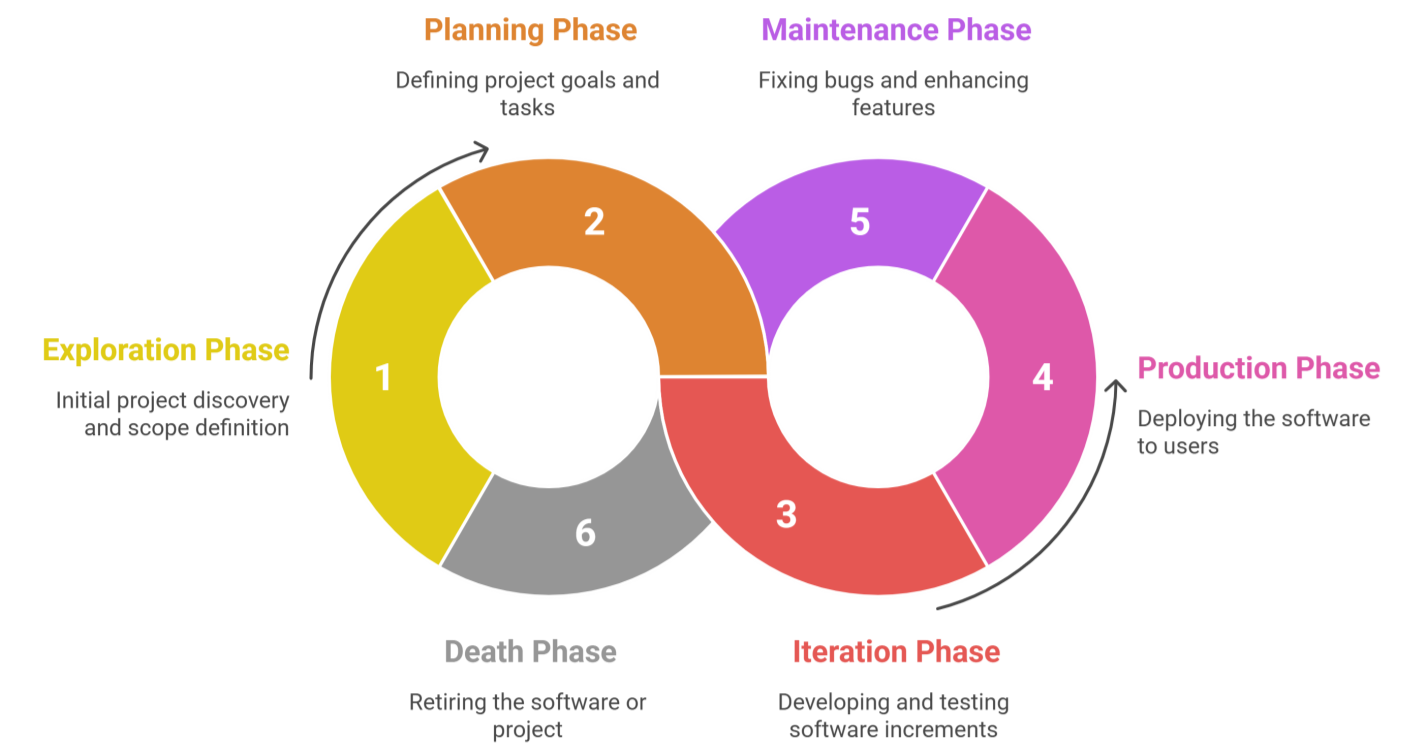
AB  - Agile has become a cornerstone of modern software development. Among its many frameworks, Extreme Programming (XP) and Scrum are the most widely recognized. XP emphasizes technical practices and engineering discipline while Scrum provides structured roles and iterative planning. Over time, many organizations have also adopted hybrid models that combine the strengths of both. Despite their popularity, teams often face challenges when deciding which approach to adopt. The choice between XP, Scrum or a hybrid is not always straightforward as each carries different strengths, limitations and suitability for specific contexts. This paper addresses this issue by presenting a comparative analysis of XP, Scrum and their hybrids. First, we revisit their phases and key practices along with their strengths, weaknesses and application. Then a detailed comparison is presented between XP, Scrum and their Hybrids. Building on this analysis, we have proposed a structured decision framework. This framework provides a clear criteria and step-by-step guidance to help practitioners select the most suitable approach for their projects. The framework is supported by subsections that explain evaluation criteria and conceptual use cases. In addition, published case studies are discussed to validate the framework and show how XP, Scrum, and hybrid methods are applied in practice. The paper also outlines future directions for agile practices including the role of AI, scaling strategies and distributed collaboration. Through this work, the paper offers both critical insights and practical tools for researchers and practitioners. It highlights not only how XP and Scrum compare but also how hybrid approaches can improve agile adoption in today’s dynamic development landscape.
SN  - 3069-1834
PB  - Institute of Central Computation and Knowledge
LA  - English
ER  -
@article{Akhtar2026Comparing,
  author = {Samia Akhtar and Shabib Aftab},
  title = {Comparing Agile Transitions: A Study of XP, Scrum, and Hybrid Frameworks},
  journal = {ICCK Journal of Software Engineering},
  year = {2026},
  volume = {2},
  number = {1},
  pages = {30-51},
  doi = {10.62762/JSE.2025.428569},
  url = {https://www.icck.org/article/abs/JSE.2025.428569},
  abstract = {Agile has become a cornerstone of modern software development. Among its many frameworks, Extreme Programming (XP) and Scrum are the most widely recognized. XP emphasizes technical practices and engineering discipline while Scrum provides structured roles and iterative planning. Over time, many organizations have also adopted hybrid models that combine the strengths of both. Despite their popularity, teams often face challenges when deciding which approach to adopt. The choice between XP, Scrum or a hybrid is not always straightforward as each carries different strengths, limitations and suitability for specific contexts. This paper addresses this issue by presenting a comparative analysis of XP, Scrum and their hybrids. First, we revisit their phases and key practices along with their strengths, weaknesses and application. Then a detailed comparison is presented between XP, Scrum and their Hybrids. Building on this analysis, we have proposed a structured decision framework. This framework provides a clear criteria and step-by-step guidance to help practitioners select the most suitable approach for their projects. The framework is supported by subsections that explain evaluation criteria and conceptual use cases. In addition, published case studies are discussed to validate the framework and show how XP, Scrum, and hybrid methods are applied in practice. The paper also outlines future directions for agile practices including the role of AI, scaling strategies and distributed collaboration. Through this work, the paper offers both critical insights and practical tools for researchers and practitioners. It highlights not only how XP and Scrum compare but also how hybrid approaches can improve agile adoption in today’s dynamic development landscape.},
  keywords = {extreme programming, scrum, agile methodologies, comparative analysis, hybrid models},
  issn = {3069-1834},
  publisher = {Institute of Central Computation and Knowledge}
}
 Copyright © 2026 by the Author(s). Published by Institute of Central Computation and Knowledge. This article is an open access article distributed under the terms and conditions of the Creative Commons Attribution (CC BY) license (https://creativecommons.org/licenses/by/4.0/), which permits use, sharing, adaptation, distribution and reproduction in any medium or format, as long as you give appropriate credit to the original author(s) and the source, provide a link to the Creative Commons licence, and indicate if changes were made.

Portico
All published articles are preserved here permanently:
https://www.portico.org/publishers/icck/