
Volume 2, Issue 1, ICCK Journal of Software Engineering
Volume 2, Issue 1, 2026
Submit Manuscript Edit a Special Issue
Article QR Code
Article QR Code
Scan the QR code for reading
Popular articles
ICCK Journal of Software Engineering, Volume 2, Issue 1, 2026: 1-10

Open Access | Review Article | 27 January 2026
Is AI Code Generation Undermining Developers’ Problem‑Solving Skills?
1 Department of Computer Science, COMSATS University Islamabad, Sahiwal 57000, Pakistan
2 Department of Computer Science, Global Institute, Lahore 54000, Pakistan
* Corresponding Author: Yasir Arif, [email protected]
ARK: ark:/57805/jse.2025.847963
Received: 02 August 2025, Accepted: 30 October 2025, Published: 27 January 2026  
Abstract
The rise of AI tools such as GitHub Copilot and ChatGPT has reshaped software development by providing substantial support for coding and debugging tasks. Although these tools enhance productivity and reduce routine workload, existing research has largely emphasized short-term efficiency gains, leaving their long-term cognitive and pedagogical effects insufficiently explored. This study investigates the cognitive trade-offs associated with sustained reliance on generative AI, with particular attention to students and junior developers. Recent empirical findings indicate that excessive dependence on AI assistance may weaken deep debugging skills, impede conceptual understanding, and challenge established educational practices in software engineering. To address these concerns, we synthesize empirical studies published since 2020 and draw on contemporary pedagogical theories to propose a structured framework for balanced AI integration. The proposed hybrid model shifts emphasis from full automation to a learning-oriented process that foregrounds exploration, human reasoning, and critical evaluation. It comprises three iterative phases—Detect (AI-assisted exploration), Engage (manual problem-solving and algorithmic reasoning), and Verify (AI-supported refinement)—designed to preserve core cognitive competencies while effectively leveraging automation. The study underscores the importance of aligning AI tool usage with pedagogical objectives, ensuring that system design promotes understanding rather than output generation alone. These findings have implications for curriculum design in computer science education and for industrial strategies aimed at sustaining developer expertise in increasingly automated environments.

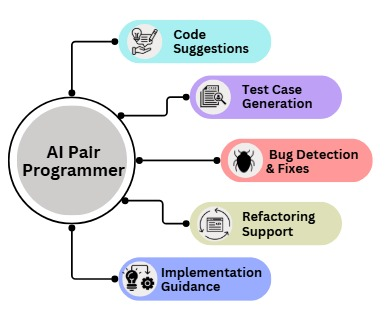
Graphical Abstract
Is AI Code Generation Undermining Developers’ Problem‑Solving Skills?

Keywords
AI code generation
developer cognition
gitHub copilot
code automation
programming pedagogy

Data Availability Statement
Not applicable.

Funding
This work was supported without any funding.

Conflicts of Interest
The authors declare no conflicts of interest.

AI Use Statement
The authors declare that no generative AI was used in the preparation of this manuscript.

Ethical Approval and Consent to Participate
Not applicable.

References
  1. Kalliamvakou, E. (n.d.). Research: quantifying GitHub Copilot’s impact on developer productivity and happiness. The GitHub Blog. Retrieved August 1, 2025, from https://github.blog/news-insights/research/research-quantifying-github-copilots-impact-on-developer-productivity-and-happiness/
    [Google Scholar]
  2. Peng, S., Kalliamvakou, E., Cihon, P., & Demirer, M. (2023). The impact of ai on developer productivity: Evidence from github copilot. arXiv preprint arXiv:2302.06590.
    [Google Scholar]
  3. Cambon, A., Hecht, B., Edelman, B., Ngwe, D., Jaffe, S., Heger, A., ... & Teevan, J. (2023). Early LLM-based tools for enterprise information workers likely provide meaningful boosts to productivity. Microsoft Research. MSR-TR-2023, 43.
    [Google Scholar]
  4. Song, F., Agarwal, A., & Wen, W. (2024). The impact of generative AI on collaborative open-source software development: Evidence from GitHub Copilot. arXiv preprint arXiv:2410.02091.
    [Google Scholar]
  5. Yilmaz, R., & Yilmaz, F. G. K. (2023). The effect of generative artificial intelligence (AI)-based tool use on students' computational thinking skills, programming self-efficacy and motivation. Computers and Education: Artificial Intelligence, 4, 100147.
    [CrossRef]   [Google Scholar]
  6. Ziegler, A., Kalliamvakou, E., Li, X. A., Rice, A., Rifkin, D., Simister, S., ... & Aftandilian, E. (2024). Measuring github copilot's impact on productivity. Communications of the ACM, 67(3), 54-63.
    [CrossRef]   [Google Scholar]
  7. Vaithilingam, P., Zhang, T., & Glassman, E. L. (2022, April). Expectation vs. experience: Evaluating the usability of code generation tools powered by large language models. In Chi conference on human factors in computing systems extended abstracts (pp. 1-7).
    [CrossRef]   [Google Scholar]
  8. Prather, J., Reeves, B. N., Denny, P., Becker, B. A., Leinonen, J., Luxton-Reilly, A., ... & Santos, E. A. (2023). “It’s weird that it knows what i want”: Usability and interactions with copilot for novice programmers. ACM transactions on computer-human interaction, 31(1), 1-31.
    [CrossRef]   [Google Scholar]
  9. Bakal, G., Dasdan, A., Katz, Y., Kaufman, M., & Levin, G. (2025). Experience with GitHub Copilot for Developer Productivity at Zoominfo. arXiv preprint arXiv:2501.13282.
    [Google Scholar]
  10. Kohen-Vacs, D., Usher, M., & Jansen, M. (2025). Integrating generative AI into programming education: Student perceptions and the challenge of correcting AI errors. International Journal of Artificial Intelligence in Education, 1-19.
    [CrossRef]   [Google Scholar]
  11. Ali, M., Mazhar, T., Arif, Y., Al-Otaibi, S., Ghadi, Y. Y., Shahzad, T., ... & Hamam, H. (2024). Software defect prediction using an intelligent ensemble-based model. IEEE Access, 12, 20376-20395.
    [CrossRef]   [Google Scholar]
  12. Ali, M., Mazhar, T., Shahzad, T., Ghadi, Y. Y., Mohsin, S. M., Akber, S. M. A., & Ali, M. (2023). Analysis of feature selection methods in software defect prediction models. IEEE Access, 11, 145954-145974.
    [CrossRef]   [Google Scholar]
  13. Jiang, E., Toh, E., Molina, A., Olson, K., Kayacik, C., Donsbach, A., ... & Terry, M. (2022, April). Discovering the syntax and strategies of natural language programming with generative language models. In Proceedings of the 2022 CHI Conference on Human Factors in Computing Systems (pp. 1-19).
    [CrossRef]   [Google Scholar]
  14. Alanazi, M., Soh, B., Samra, H., & Li, A. (2025). The Influence of Artificial Intelligence Tools on Learning Outcomes in Computer Programming: A Systematic Review and Meta-Analysis. Computers (2073-431X), 14(5).
    [CrossRef]   [Google Scholar]
  15. Bloom, B. S. (1956). Taxonomy of Edu-cational Objectives, Handbook 1: Cognitive Do-main.
    [Google Scholar]
  16. Fan, G., Liu, D., Zhang, R., & Pan, L. (2025). The impact of AI-assisted pair programming on student motivation, programming anxiety, collaborative learning, and programming performance: a comparative study with traditional pair programming and individual approaches. International Journal of STEM Education, 12(1), 16.
    [CrossRef]   [Google Scholar]
  17. Sun, D., Boudouaia, A., Zhu, C., & Li, Y. (2024). Would ChatGPT-facilitated programming mode impact college students’ programming behaviors, performances, and perceptions? An empirical study. International Journal of Educational Technology in Higher Education, 21(1), 14.
    [CrossRef]   [Google Scholar]
  18. Chugh, R., Turnbull, D., Kutty, S., Sabrina, F., Rashid, M. M., Morshed, A., ... & Subramani, S. (2025). Generative AI as a learning assistant in ICT education: student perspectives and educational implications. Education and Information Technologies, 1-36.
    [CrossRef]   [Google Scholar]
  19. Dickey, E., Bejarano, A., & Garg, C. (2023). Innovating computer programming pedagogy: The AI-lab framework for generative AI adoption. arXiv preprint arXiv:2308.12258.
    [Google Scholar]
  20. Damyanov, I., Tsankov, N., & Nedyalkov, I. (2024). Applications of Generative Artificial Intelligence in the Software Industry. TEM Journal, 13(4).
    [CrossRef]   [Google Scholar]
  21. Kazemitabaar, M., Chow, J., Ma, C. K. T., Ericson, B. J., Weintrop, D., & Grossman, T. (2023, April). Studying the effect of AI code generators on supporting novice learners in introductory programming. In Proceedings of the 2023 CHI conference on human factors in computing systems (pp. 1-23).
    [CrossRef]   [Google Scholar]
  22. Banh, L., Holldack, F., & Strobel, G. (2025). Copiloting the future: How generative AI transforms Software Engineering. Information and Software Technology, 183, 107751.
    [CrossRef]   [Google Scholar]
  23. Li, Z. S., Arony, N. N., Awon, A. M., Damian, D., & Xu, B. (2024). AI tool use and adoption in software development by individuals and organizations: a grounded theory study. arXiv preprint arXiv:2406.17325.
    [Google Scholar]

Cite This Article
APA Style
Nazir, M., & Arif, Y. (2026). Is AI Code Generation Undermining Developers’ Problem-Solving Skills?. ICCK Journal of Software Engineering, 2(1), 1–10. https://doi.org/10.62762/JSE.2025.847963
Export Citation
RIS Format
Compatible with EndNote, Zotero, Mendeley, and other reference managers
RIS format data for reference managers
TY  - JOUR
AU  - Nazir, Moomna
AU  - Arif, Yasir
PY  - 2026
DA  - 2026/01/27
TI  - Is AI Code Generation Undermining Developers’ Problem‑Solving Skills?
JO  - ICCK Journal of Software Engineering
T2  - ICCK Journal of Software Engineering
JF  - ICCK Journal of Software Engineering
VL  - 2
IS  - 1
SP  - 1
EP  - 10
DO  - 10.62762/JSE.2025.847963
UR  - https://www.icck.org/article/abs/JSE.2025.847963
KW  - AI code generation
KW  - developer cognition
KW  - gitHub copilot
KW  - code automation
KW  - programming pedagogy
AB  - The rise of AI tools such as GitHub Copilot and ChatGPT has reshaped software development by providing substantial support for coding and debugging tasks. Although these tools enhance productivity and reduce routine workload, existing research has largely emphasized short-term efficiency gains, leaving their long-term cognitive and pedagogical effects insufficiently explored. This study investigates the cognitive trade-offs associated with sustained reliance on generative AI, with particular attention to students and junior developers. Recent empirical findings indicate that excessive dependence on AI assistance may weaken deep debugging skills, impede conceptual understanding, and challenge established educational practices in software engineering. To address these concerns, we synthesize empirical studies published since 2020 and draw on contemporary pedagogical theories to propose a structured framework for balanced AI integration. The proposed hybrid model shifts emphasis from full automation to a learning-oriented process that foregrounds exploration, human reasoning, and critical evaluation. It comprises three iterative phases—Detect (AI-assisted exploration), Engage (manual problem-solving and algorithmic reasoning), and Verify (AI-supported refinement)—designed to preserve core cognitive competencies while effectively leveraging automation. The study underscores the importance of aligning AI tool usage with pedagogical objectives, ensuring that system design promotes understanding rather than output generation alone. These findings have implications for curriculum design in computer science education and for industrial strategies aimed at sustaining developer expertise in increasingly automated environments.
SN  - 3069-1834
PB  - Institute of Central Computation and Knowledge
LA  - English
ER  - 
BibTeX Format
Compatible with LaTeX, BibTeX, and other reference managers
BibTeX format data for LaTeX and reference managers
@article{Nazir2026Is,
  author = {Moomna Nazir and Yasir Arif},
  title = {Is AI Code Generation Undermining Developers’ Problem‑Solving Skills?},
  journal = {ICCK Journal of Software Engineering},
  year = {2026},
  volume = {2},
  number = {1},
  pages = {1-10},
  doi = {10.62762/JSE.2025.847963},
  url = {https://www.icck.org/article/abs/JSE.2025.847963},
  abstract = {The rise of AI tools such as GitHub Copilot and ChatGPT has reshaped software development by providing substantial support for coding and debugging tasks. Although these tools enhance productivity and reduce routine workload, existing research has largely emphasized short-term efficiency gains, leaving their long-term cognitive and pedagogical effects insufficiently explored. This study investigates the cognitive trade-offs associated with sustained reliance on generative AI, with particular attention to students and junior developers. Recent empirical findings indicate that excessive dependence on AI assistance may weaken deep debugging skills, impede conceptual understanding, and challenge established educational practices in software engineering. To address these concerns, we synthesize empirical studies published since 2020 and draw on contemporary pedagogical theories to propose a structured framework for balanced AI integration. The proposed hybrid model shifts emphasis from full automation to a learning-oriented process that foregrounds exploration, human reasoning, and critical evaluation. It comprises three iterative phases—Detect (AI-assisted exploration), Engage (manual problem-solving and algorithmic reasoning), and Verify (AI-supported refinement)—designed to preserve core cognitive competencies while effectively leveraging automation. The study underscores the importance of aligning AI tool usage with pedagogical objectives, ensuring that system design promotes understanding rather than output generation alone. These findings have implications for curriculum design in computer science education and for industrial strategies aimed at sustaining developer expertise in increasingly automated environments.},
  keywords = {AI code generation, developer cognition, gitHub copilot, code automation, programming pedagogy},
  issn = {3069-1834},
  publisher = {Institute of Central Computation and Knowledge}
}

Article Metrics
Citations:

Crossref

0

Scopus

0

Web of Science

0
Article Access Statistics:
Views: 78
PDF Downloads: 203

Publisher's Note
ICCK stays neutral with regard to jurisdictional claims in published maps and institutional affiliations.

Rights and Permissions
CC BY Copyright © 2026 by the Author(s). Published by Institute of Central Computation and Knowledge. This article is an open access article distributed under the terms and conditions of the Creative Commons Attribution (CC BY) license (https://creativecommons.org/licenses/by/4.0/), which permits use, sharing, adaptation, distribution and reproduction in any medium or format, as long as you give appropriate credit to the original author(s) and the source, provide a link to the Creative Commons licence, and indicate if changes were made.
ICCK Journal of Software Engineering

ICCK Journal of Software Engineering

ISSN: 3069-1834 (Online)

Email: [email protected]

Portico

Portico

All published articles are preserved here permanently:
https://www.portico.org/publishers/icck/