
Evolutionary Game Simulation Analysis of Government Supervision of Shadow Banking in China





Article Information
Abstract
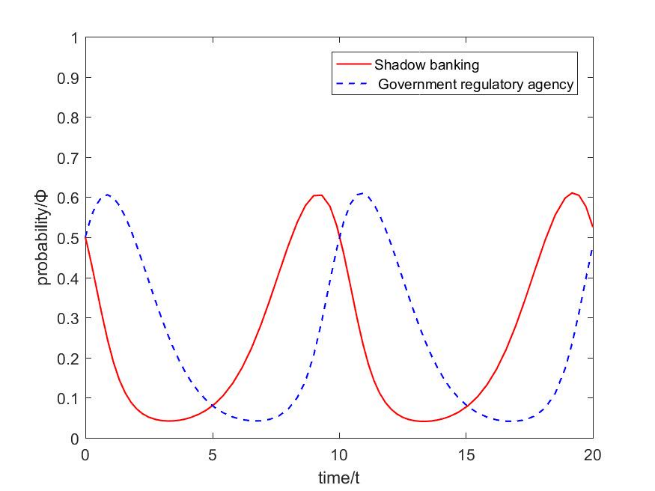
Both the shadow banking and the government regulatory agencies are boundedly rational, and they will constantly adjust their strategies according to the changes in the other party's strategy when making decisions. Therefore, it has become an effective way to explore the government regulatory issues of China's shadow banking with the application of evolutionary game theory. By constructing the evolutionary game model of shadow banking and government regulatory authorities, this paper analyzes the dynamic adjustment relationship between the strategy choice of shadow banking and government regulatory authorities, and concludes that the operating income and cost of shadow banking, the intensity of rewards and punishments and the supervision cost of government regulatory authorities are important factors affecting the decision-making of the two. It is necessary to improve the information disclosure system of shadow banking, strengthen the reward and punishment mechanism for shadow banking, innovate the ways and methods of government supervision of shadow banking, smooth and improve the channels and mechanisms for coordinating government supervision, and guide the compliance operation of shadow banking.
Graphical Abstract
Keywords
Data Availability Statement
Funding
Conflicts of Interest
Ethical Approval and Consent to Participate
References
- Mitchell, A. (1999). Out of the shadows. Journal of Marketing Management, 15(1-3), 25-42.
[CrossRef] [Google Scholar] - Tarnanidou, C. I. (2016). EU financial collateral arrangements and re-hypothecation in the shadow of ‘shadow banking’: To further regulate or not?. Journal of banking regulation, 17(3), 200-238.
[CrossRef] [Google Scholar] - Elliott, D., Kroeber, A., & Qiao, Y. (2015). Shadow banking in China: A primer. Economic Studies at Brookings, 3(2015), 1-7.
[Google Scholar] - Grillet-Aubert, L., Haquin, J. B., Jackson, C., Killeen, N., & Weistroffer, C. (2016). Assessing shadow banking–non-bank financial intermediation in Europe. ESRB: Occasional Paper Series, (2016/10).
[CrossRef] [Google Scholar] - Kodres, L. E. (2013). What is shadow banking. Finance and Development, 50(2), 42-43.
[Google Scholar] - Yang, L., van Wijnbergen, S., Qi, X., & Yi, Y. (2019). Chinese shadow banking, financial regulation and effectiveness of monetary policy. Pacific-Basin Finance Journal, 57, 101169.
[CrossRef] [Google Scholar] - Xu, M. (2023). The Coordination Between Macro-Prudential Supervision and Monetary Policy—From the Perspective of Financial Stability. Frontiers in Management Science, 2(4), 60-79.
[Google Scholar] - Thiemann, M., Birk, M., & Friedrich, J. (2018). Much ado about nothing? Macro-prudential ideas and the post-crisis regulation of shadow banking. KZfSS Kölner Zeitschrift für Soziologie und Sozialpsychologie, 70(Suppl 1), 259-286.
[CrossRef] [Google Scholar] - Cai, J., & Wang, A. (2022, December). Shadow Bank Scale and Financial Risk Prevention and Control Ability An Empirical Study Based on Principal Component Analysis. In 2022 International Conference on mathematical statistics and economic analysis (MSEA 2022) (pp. 107-114). Atlantis Press.
[CrossRef] [Google Scholar] - Zhang, J., & Xu, L. (2023). Local supervision of Chinese shadow banking. Journal of Banking Regulation, 24(3), 337-356.
[CrossRef] [Google Scholar] - Li, J., Hsu, S., & Qin, Y. (2014). Shadow banking in China: institutional risks. China Economic Review, 31, 119-129.
[CrossRef] [Google Scholar] - Schwarcz, S. L. (2011). Regulating Shadow Banking: Inaugural Address for the Inaugural Symposium of the Review of Banking & Financial Law. Rev. Banking & Fin. L., 31, 619.
[Google Scholar] - Pellegrini, C. B., Cincinelli, P., Meoli, M., & Urga, G. (2022). The role of shadow banking in systemic risk in the European financial system. Journal of Banking & Finance, 138, 106422.
[CrossRef] [Google Scholar] - Hachem, K. (2018). Shadow banking in China. Annual review of financial economics, 10(1), 287-308.
[CrossRef] [Google Scholar] - Friedman, D. (1991). Evolutionary games in economics. Econometrica: journal of the econometric society, 637-666.
[CrossRef] [Google Scholar] - Wan, X., Xiao, S., Li, Q., & Du, Y. (2021). Evolutionary policy of trading of blue carbon produced by marine ranching with media participation and government supervision. Marine Policy, 124, 104302.
[CrossRef] [Google Scholar]
Cite This Article
TY  - JOUR
AU  - Li, Ronghui
AU  - Yang, Jianren
AU  - Yan, Yixin
PY  - 2024
DA  - 2024/04/24
TI  - Evolutionary Game Simulation Analysis of Government Supervision of Shadow Banking in China
JO  - Journal of Social Systems and Policy Analysis
T2  - Journal of Social Systems and Policy Analysis
JF  - Journal of Social Systems and Policy Analysis
VL  - 1
IS  - 2
SP  - 32
EP  - 46
DO  - 10.62762/JSSPA.2024.775392
UR  - https://www.icck.org/article/abs/jsspa.2024.775392
KW  - Shadow banking
KW  - Government supervision
KW  - Evolutionary game
KW  - Simulation
AB  - Both the shadow banking and the government regulatory agencies are boundedly rational, and they will constantly adjust their strategies according to the changes in the other party's strategy when making decisions. Therefore, it has become an effective way to explore the government regulatory issues of China's shadow banking with the application of evolutionary game theory. By constructing the evolutionary game model of shadow banking and government regulatory authorities, this paper analyzes the dynamic adjustment relationship between the strategy choice of shadow banking and government regulatory authorities, and concludes that the operating income and cost of shadow banking, the intensity of rewards and punishments and the supervision cost of government regulatory authorities are important factors affecting the decision-making of the two. It is necessary to improve the information disclosure system of shadow banking, strengthen the reward and punishment mechanism for shadow banking, innovate the ways and methods of government supervision of shadow banking, smooth and improve the channels and mechanisms for coordinating government supervision, and guide the compliance operation of shadow banking.
SN  - 3068-5540
PB  - Institute of Central Computation and Knowledge
LA  - English
ER  -
@article{Li2024Evolutiona,
  author = {Ronghui Li and Jianren Yang and Yixin Yan},
  title = {Evolutionary Game Simulation Analysis of Government Supervision of Shadow Banking in China},
  journal = {Journal of Social Systems and Policy Analysis},
  year = {2024},
  volume = {1},
  number = {2},
  pages = {32-46},
  doi = {10.62762/JSSPA.2024.775392},
  url = {https://www.icck.org/article/abs/jsspa.2024.775392},
  abstract = {Both the shadow banking and the government regulatory agencies are boundedly rational, and they will constantly adjust their strategies according to the changes in the other party's strategy when making decisions. Therefore, it has become an effective way to explore the government regulatory issues of China's shadow banking with the application of evolutionary game theory. By constructing the evolutionary game model of shadow banking and government regulatory authorities, this paper analyzes the dynamic adjustment relationship between the strategy choice of shadow banking and government regulatory authorities, and concludes that the operating income and cost of shadow banking, the intensity of rewards and punishments and the supervision cost of government regulatory authorities are important factors affecting the decision-making of the two. It is necessary to improve the information disclosure system of shadow banking, strengthen the reward and punishment mechanism for shadow banking, innovate the ways and methods of government supervision of shadow banking, smooth and improve the channels and mechanisms for coordinating government supervision, and guide the compliance operation of shadow banking.},
  keywords = {Shadow banking, Government supervision, Evolutionary game, Simulation},
  issn = {3068-5540},
  publisher = {Institute of Central Computation and Knowledge}
}
Article Metrics
Publisher's Note
ICCK stays neutral with regard to jurisdictional claims in published maps and institutional affiliations.
Rights and Permissions
 Copyright © 2024 by the Author(s). Published by Institute of Central Computation and Knowledge. This article is an open access article distributed under the terms and conditions of the Creative Commons Attribution (CC BY) license (https://creativecommons.org/licenses/by/4.0/), which permits use, sharing, adaptation, distribution and reproduction in any medium or format, as long as you give appropriate credit to the original author(s) and the source, provide a link to the Creative Commons licence, and indicate if changes were made.


Portico
