


Journal of Social Systems and Policy Analysis
ISSN: 3068-5540 (Online)
Email: [email protected]

 Submit Manuscript
Edit a Special Issue
Submit Manuscript
Edit a Special Issue


TY  - JOUR
AU  - Yang, Yifan
AU  - Chen, Guohui
AU  - Fu, Ruoyu
PY  - 2026
DA  - 2026/03/07
TI  - Research on the Design of Macau Tourism Cultural and Creative Products under the Perspective of Narratology
JO  - Journal of Social Systems and Policy Analysis
T2  - Journal of Social Systems and Policy Analysis
JF  - Journal of Social Systems and Policy Analysis
VL  - 3
IS  - 2
SP  - 69
EP  - 82
DO  - 10.62762/JSSPA.2025.561440
UR  - https://www.icck.org/article/abs/JSSPA.2025.561440
KW  - narratology
KW  - cultural and creative products
KW  - narrative design
KW  - user experience
KW  - kano model
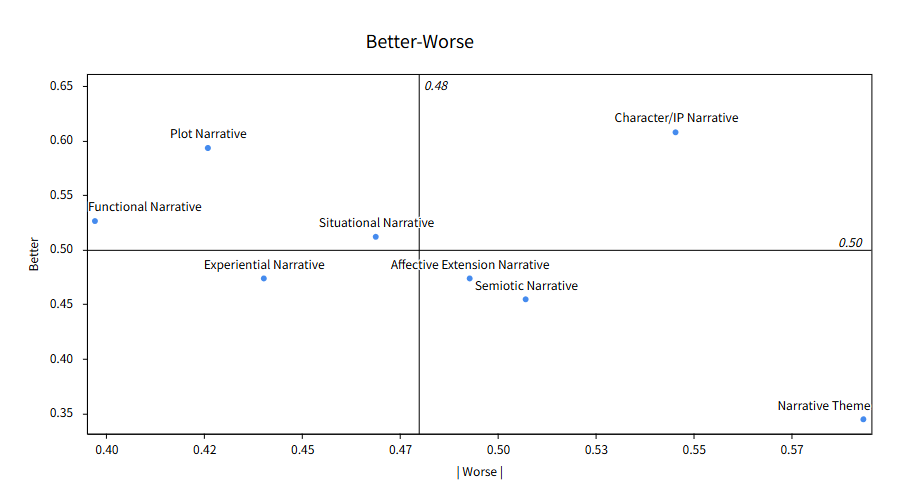
AB  - Macao, as a critical tourist destination at the junction of Chinese and Western civilisations, showcases the opportunity to feature its regional culture via culture-based tourism products, and tourism marketing presents further opportunities for cross-cultural connection. That said, there is significant thematic homogenisation, superficial and uninspired narratives, and a lack of user experience variation and engagement with the cultural products. This study employs the discipline of Narratology and analyses how narrative frameworks can be redesigned in cultural product development. This study proposes an eight constituent dimension framework: Narrative Theme, Plot Narrative, Character/IP Narrative, Situational Narrative, Symbolic Narrative, Functional Narrative, Experiential Narrative, and Emotional Extension Narrative. This study employs the Kano Model to conduct a narrative analysis, concluding the Narrative Theme is Must-be quality (M), Character/IP Narrative is high-sensitivity One-dimensional quality (O), Plot, Functional and Experiential Narratives are classified as the Detached quality (A). From this, the study develops a narrativised design approach prioritising cultural storytelling and experiential engagement. This work proposes and underscores the importance of narrative cohesiveness, the development of local IP, and the need for product stereotype breakdown with novel, immersive experience narratives. This work is the first to provide both perspective and praxis for Macao tourism cultural products.
SN  - 3068-5540
PB  - Institute of Central Computation and Knowledge
LA  - English
ER  -
@article{Yang2026Research,
  author = {Yifan Yang and Guohui Chen and Ruoyu Fu},
  title = {Research on the Design of Macau Tourism Cultural and Creative Products under the Perspective of Narratology},
  journal = {Journal of Social Systems and Policy Analysis},
  year = {2026},
  volume = {3},
  number = {2},
  pages = {69-82},
  doi = {10.62762/JSSPA.2025.561440},
  url = {https://www.icck.org/article/abs/JSSPA.2025.561440},
  abstract = {Macao, as a critical tourist destination at the junction of Chinese and Western civilisations, showcases the opportunity to feature its regional culture via culture-based tourism products, and tourism marketing presents further opportunities for cross-cultural connection. That said, there is significant thematic homogenisation, superficial and uninspired narratives, and a lack of user experience variation and engagement with the cultural products. This study employs the discipline of Narratology and analyses how narrative frameworks can be redesigned in cultural product development. This study proposes an eight constituent dimension framework: Narrative Theme, Plot Narrative, Character/IP Narrative, Situational Narrative, Symbolic Narrative, Functional Narrative, Experiential Narrative, and Emotional Extension Narrative. This study employs the Kano Model to conduct a narrative analysis, concluding the Narrative Theme is Must-be quality (M), Character/IP Narrative is high-sensitivity One-dimensional quality (O), Plot, Functional and Experiential Narratives are classified as the Detached quality (A). From this, the study develops a narrativised design approach prioritising cultural storytelling and experiential engagement. This work proposes and underscores the importance of narrative cohesiveness, the development of local IP, and the need for product stereotype breakdown with novel, immersive experience narratives. This work is the first to provide both perspective and praxis for Macao tourism cultural products.},
  keywords = {narratology, cultural and creative products, narrative design, user experience, kano model},
  issn = {3068-5540},
  publisher = {Institute of Central Computation and Knowledge}
}
 Copyright © 2026 by the Author(s). Published by Institute of Central Computation and Knowledge. This article is an open access article distributed under the terms and conditions of the Creative Commons Attribution (CC BY) license (https://creativecommons.org/licenses/by/4.0/), which permits use, sharing, adaptation, distribution and reproduction in any medium or format, as long as you give appropriate credit to the original author(s) and the source, provide a link to the Creative Commons licence, and indicate if changes were made.

Portico
All published articles are preserved here permanently:
https://www.portico.org/publishers/icck/