

Safety-Oriented Multi-Parameter Monitoring and Response Time Assessment of Battery Energy Storage Systems


Article Information
Abstract
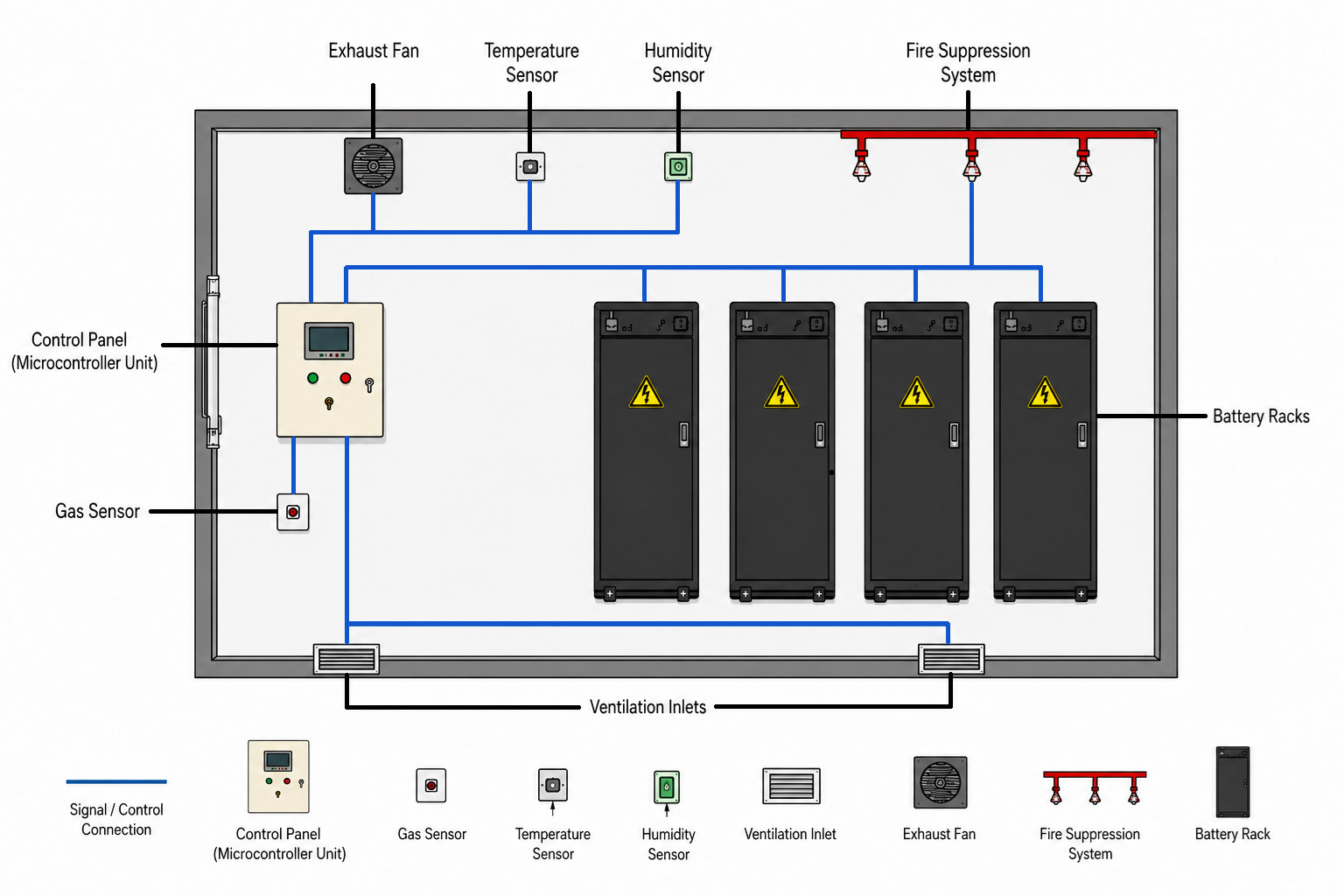
The rapid integration of battery energy storage systems (BESS) into modern power grids necessitates robust safety architectures to prevent catastrophic failures such as thermal runaway. Current diagnostic frameworks are often reliant on isolated, single-parameter thresholds and lack direct linkage to hardware-level execution. This work proposes a comprehensive, multi-parameter early warning and hierarchical protection methodology that bridges the gap between software-based fault detection and practical electromechanical response. The proposed algorithm calculates a dynamic, weighted safety score in real-time by structurally integrating internal battery management system (BMS) metrics, such as cell temperature and voltage deviation, with enclosure-level environmental indicators, particularly early gas emissions. To ensure ultra-low latency, the architecture utilizes discrete analog signal conditioning to bypass computational delays found in complex software models. The assessed score drives a hierarchical state machine branching to a preventive pre-alarm phase initiating HVAC support and load reduction, and a critical protection phase executing closed-loop electromechanical isolation. Transient state simulations performed via LTspice verify the deterministic performance of the system. These simulations demonstrate the system's ability to identify leading anomalies, secure critical response time, and guarantee absolute hardware isolation before critical thermal safety limits are exceeded.
Graphical Abstract
Keywords
Data Availability Statement
Funding
Conflicts of Interest
AI Use Statement
Ethical Approval and Consent to Participate
References
- Jaradat, T. E., & Khatib, T. (2025). A review of battery energy storage system for renewable energy penetration in electrical power system: environmental impact, sizing methods, market features, and policy frameworks. Future Batteries, 100106.
[CrossRef] [Google Scholar] - Sakib, S., Hossain, M. B., Zamee, M. A., Hossain, M. J., & Habib, M. A. (2025). Role of battery energy storage systems: A comprehensive review on renewable energy zones integration in weak transmission networks. Journal of Energy Storage, 128, 117223.
[CrossRef] [Google Scholar] - Nazaralizadeh, S., Banerjee, P., Srivastava, A. K., & Famouri, P. (2024). Battery energy storage systems: A review of energy management systems and health metrics. Energies, 17(5), 1250.
[CrossRef] [Google Scholar] - He, M., Chartouni, D., Landmann, D., & Colombi, S. (2024). Safety aspects of stationary battery energy storage systems. Batteries, 10(12), 418.
[CrossRef] [Google Scholar] - Lian, N., Ji, W., & Chen, J. (2025). Research on the Safety Risk Analysis Framework and Control System for Multi-Type New Energy Storage Technologies. Energies, 18(4), 798.
[CrossRef] [Google Scholar] - Yao, L., Yu, C., Xiao, Y., Cui, G., Fei, Z., & Qu, C. (2025). A comprehensive review of lithium-ion battery safety issues and fault diagnosis strategies throughout the entire lifecycle. Journal of Energy Storage, 136, 118447.
[CrossRef] [Google Scholar] - Liu, Z., Han, K., Zhang, Q., & Li, M. (2025). Thermal safety focus and early warning of lithium-ion batteries: A systematic review. Journal of Energy Storage, 115, 115944.
[CrossRef] [Google Scholar] - Kong, D., Lv, H., Ping, P., & Wang, G. (2023). A review of early warning methods of thermal runaway of lithium ion batteries. Journal of Energy Storage, 64, 107073.
[CrossRef] [Google Scholar] - Garttan, G., Alahakoon, S., Emami, K., & Jayasinghe, S. G. (2025). Battery energy storage systems: Energy market review, challenges, and opportunities in frequency control ancillary services. Energies, 18(15), 4174.
[CrossRef] [Google Scholar] - Coccato, S., Barhmi, K., Lampropoulos, I., Golroodbari, S., & van Sark, W. (2025). A review of battery energy storage optimization in the built environment. Batteries, 11(5), 179.
[CrossRef] [Google Scholar] - Pan, W. (2025). Research Progress on Risk Prevention and Control Technology for Lithium-Ion Battery Energy Storage Power Stations: A Review. Batteries, 11(8), 301.
[CrossRef] [Google Scholar] - Zhi, M., Liu, Q., Xu, Q., Pan, Z., Sun, Q., Su, B., ... & He, Y. (2024). Review of prevention and mitigation technologies for thermal runaway in lithium-ion batteries. Aerospace Traffic and Safety, 1(1), 55-72.
[CrossRef] [Google Scholar] - Zhao, J., Feng, X., Tran, M. K., Fowler, M., Ouyang, M., & Burke, A. F. (2024). Battery safety: Fault diagnosis from laboratory to real world. Journal of Power Sources, 598, 234111.
[CrossRef] [Google Scholar] - Yu, Q., Wang, C., Li, J., Xiong, R., & Pecht, M. (2023). Challenges and outlook for lithium-ion battery fault diagnosis methods from the laboratory to real world applications. ETransportation, 17, 100254.
[CrossRef] [Google Scholar] - Xu, Y., Ge, X., Guo, R., & Shen, W. (2025). Recent advances in model-based fault diagnosis for lithium-ion batteries: A comprehensive review. Renewable and Sustainable Energy Reviews, 207, 114922.
[CrossRef] [Google Scholar] - Rao, K. D., Lakshmi Pujitha, N. N., Rao Ranga, M., Manaswi, C., Dawn, S., Ustun, T. S., & Kalam, A. (2025). Fault mitigation and diagnosis for lithium-ion batteries: a review. Frontiers in Energy Research, 13, 1529608.
[CrossRef] [Google Scholar] - Qu, X., Zhao, J., Pang, H., Fowler, M., & Burke, A. F. (2026). Challenges and prospects in real-world battery status prediction within Industry 4.0. Green Energy and Intelligent Transportation, 5(2), 100298.
[CrossRef] [Google Scholar] - Gu, X., Shang, Y., Li, J., Zhu, Y., Tao, X., Geng, H., ... & Zhang, C. (2025). Early warning of thermal runaway based on state of safety for lithium-ion batteries. Communications Engineering, 4(1), 106.
[CrossRef] [Google Scholar] - Shahid, S., & Agelin-Chaab, M. (2022). A review of thermal runaway prevention and mitigation strategies for lithium-ion batteries. Energy Conversion and Management: X, 16, 100310.
[CrossRef] [Google Scholar] - Li, K., Huang, Z., Wu, W., Cao, Y. C., Zhang, Y., & Han, X. (2026). Quantifying early warning feasibility for battery safety failures: A dimensionless analysis of multi-signal dynamics. Energy, 140623.
[CrossRef] [Google Scholar] - Xiong, R., Sun, X., Meng, X., Shen, W., & Sun, F. (2024). Advancing fault diagnosis in next-generation smart battery with multidimensional sensors. Applied Energy, 364, 123202.
[CrossRef] [Google Scholar] - Abdolrasol, M. G., Ayob, A., Lipu, M. H., Ansari, S., Kiong, T. S., Saad, M. H. M., ... & Kalam, A. (2024). Advanced data-driven fault diagnosis in lithium-ion battery management systems for electric vehicles: Progress, challenges, and future perspectives. ETransportation, 22, 100374.
[CrossRef] [Google Scholar] - Hu, X., Li, X., Shen, Z., Wang, Y., Yang, J., & Li, J. (2025). Early safety warning method for lithium-ion batteries under mechanical abuse conditions based on online electrochemical parameter identification. Electrochimica Acta, 147361.
[CrossRef] [Google Scholar] - Zhang, F., Zheng, X., Xing, Z., & Wu, M. (2024). Fault diagnosis method for lithium-ion power battery incorporating multidimensional fault features. Energies, 17(7), 1568.
[CrossRef] [Google Scholar] - Duan, S., Zuo, Q., Li, J., Zhao, Z., & Liu, H. (2024). Multi-fault diagnosis of lithium battery packs based on comprehensive analysis of locally weighted Manhattan distance and voltage ratio. Journal of Energy Storage, 101, 113947.
[CrossRef] [Google Scholar] - Zhao, Y., Deng, J., Liu, P., Zhang, L., Cui, D., Wang, Q., ... & Wang, Z. (2025). Enhancing battery durable operation: Multi-fault diagnosis and safety evaluation in series-connected lithium-ion battery systems. Applied Energy, 377, 124632.
[CrossRef] [Google Scholar] - Song, Y., Jiang, X., Lyu, N., Lu, H., Zhang, D., & Li, H. (2025). Early warning of lithium-ion battery thermal runaway based on gas sensors. eTransportation, 26, 100502.
[CrossRef] [Google Scholar] - Tao, Z., Zhou, H., Cao, Y., Huang, X., Wang, W., & Zhang, H. (2025). A review of thermal runaway gases and detection methods for lithium-ion batteries. Thermal Science and Engineering Progress, 104427.
[CrossRef] [Google Scholar] - Pu, Z., Yang, M., Jiao, M., Zhao, D., Huo, Y., & Wang, Z. (2024). Thermal runaway warning of lithium battery based on electronic nose and machine learning algorithms. Batteries, 10(11), 390.
[CrossRef] [Google Scholar] - Liu, H., Wang, Y., Li, X., Li, Y., & Shang, Y. (2025). Early warning of thermal runaway for lithium-ion batteries based on multimodal reconstruction fusion of acoustic signals. Journal of Energy Storage, 137, 118497.
[CrossRef] [Google Scholar] - Yan, N., Gu, M., Wang, Q., Liu, H., & Li, X. (2026). A hierarchical warning control method for battery modules based on multi-parameter fusion. Energy Conversion and Management, 349, 120945.
[CrossRef] [Google Scholar] - Iurilli, P., Brivio, C., & Merlo, M. (2019). SoC management strategies in battery energy storage system providing primary control reserve. Sustainable Energy, Grids and Networks, 19, 100230.
[CrossRef] [Google Scholar] - Khan, N., Ooi, C. A., Alturki, A., Amir, M., & Alharbi, T. (2024). A critical review of battery cell balancing techniques, optimal design, converter topologies, and performance evaluation for optimizing storage system in electric vehicles. Energy Reports, 11, 4999-5032.
[CrossRef] [Google Scholar] - Ma, S., Jiang, M., Tao, P., Song, C., Wu, J., Wang, J., ... & Shang, W. (2018). Temperature effect and thermal impact in lithium-ion batteries: A review. Progress in Natural Science: Materials International, 28(6), 653-666.
[CrossRef] [Google Scholar] - Cai, T., Tran, V., Stefanopoulou, A. G., & Siegel, J. B. (2021). Modeling li-ion battery first venting events before thermal runaway. IFAC-PapersOnLine, 54(20), 528-533.
[CrossRef] [Google Scholar] - Wu, X., Cui, Z., Zhou, G., Wen, T., Hu, F., Du, J., & Ouyang, M. (2021). Comprehensive early warning strategies based on consistency deviation of thermal–electrical characteristics for energy storage grid. Iscience, 24(9), 103058.
[CrossRef] [Google Scholar]
Cite This Article
TY  - JOUR
AU  - Yıldız, Tarık İsa
AU  - Andriukaitis, Darius
AU  - Aliyev, Raul
PY  - 2026
DA  - 2026/06/16
TI  - Safety-Oriented Multi-Parameter Monitoring and Response Time Assessment of Battery Energy Storage Systems
JO  - ICCK Transactions on Electric Power Networks and Systems
T2  - ICCK Transactions on Electric Power Networks and Systems
JF  - ICCK Transactions on Electric Power Networks and Systems
VL  - 2
IS  - 2
SP  - 89
EP  - 106
DO  - 10.62762/TEPNS.2026.458291
UR  - https://www.icck.org/article/abs/TEPNS.2026.458291
KW  - battery safety
KW  - early warning
KW  - multi-parameter fusion
KW  - thermal runaway
AB  - The rapid integration of battery energy storage systems (BESS) into modern power grids necessitates robust safety architectures to prevent catastrophic failures such as thermal runaway. Current diagnostic frameworks are often reliant on isolated, single-parameter thresholds and lack direct linkage to hardware-level execution. This work proposes a comprehensive, multi-parameter early warning and hierarchical protection methodology that bridges the gap between software-based fault detection and practical electromechanical response. The proposed algorithm calculates a dynamic, weighted safety score in real-time by structurally integrating internal battery management system (BMS) metrics, such as cell temperature and voltage deviation, with enclosure-level environmental indicators, particularly early gas emissions. To ensure ultra-low latency, the architecture utilizes discrete analog signal conditioning to bypass computational delays found in complex software models. The assessed score drives a hierarchical state machine branching to a preventive pre-alarm phase initiating HVAC support and load reduction, and a critical protection phase executing closed-loop electromechanical isolation. Transient state simulations performed via LTspice verify the deterministic performance of the system. These simulations demonstrate the system's ability to identify leading anomalies, secure critical response time, and guarantee absolute hardware isolation before critical thermal safety limits are exceeded.
SN  - 3070-2607
PB  - Institute of Central Computation and Knowledge
LA  - English
ER  -
@article{Yldz2026SafetyOrie,
  author = {Tarık İsa Yıldız and Darius Andriukaitis and Raul Aliyev},
  title = {Safety-Oriented Multi-Parameter Monitoring and Response Time Assessment of Battery Energy Storage Systems},
  journal = {ICCK Transactions on Electric Power Networks and Systems},
  year = {2026},
  volume = {2},
  number = {2},
  pages = {89-106},
  doi = {10.62762/TEPNS.2026.458291},
  url = {https://www.icck.org/article/abs/TEPNS.2026.458291},
  abstract = {The rapid integration of battery energy storage systems (BESS) into modern power grids necessitates robust safety architectures to prevent catastrophic failures such as thermal runaway. Current diagnostic frameworks are often reliant on isolated, single-parameter thresholds and lack direct linkage to hardware-level execution. This work proposes a comprehensive, multi-parameter early warning and hierarchical protection methodology that bridges the gap between software-based fault detection and practical electromechanical response. The proposed algorithm calculates a dynamic, weighted safety score in real-time by structurally integrating internal battery management system (BMS) metrics, such as cell temperature and voltage deviation, with enclosure-level environmental indicators, particularly early gas emissions. To ensure ultra-low latency, the architecture utilizes discrete analog signal conditioning to bypass computational delays found in complex software models. The assessed score drives a hierarchical state machine branching to a preventive pre-alarm phase initiating HVAC support and load reduction, and a critical protection phase executing closed-loop electromechanical isolation. Transient state simulations performed via LTspice verify the deterministic performance of the system. These simulations demonstrate the system's ability to identify leading anomalies, secure critical response time, and guarantee absolute hardware isolation before critical thermal safety limits are exceeded.},
  keywords = {battery safety, early warning, multi-parameter fusion, thermal runaway},
  issn = {3070-2607},
  publisher = {Institute of Central Computation and Knowledge}
}
Article Metrics
Publisher's Note
ICCK stays neutral with regard to jurisdictional claims in published maps and institutional affiliations.
Rights and Permissions


Portico
