-
CiteScore
-
Impact Factor
Volume 3, Issue 1, ICCK Transactions on Emerging Topics in Artificial Intelligence
Volume 3, Issue 1, 2026
Submit Manuscript Edit a Special Issue
Article QR Code
Article QR Code
Scan the QR code for reading
Popular articles
ICCK Transactions on Emerging Topics in Artificial Intelligence, Volume 3, Issue 1, 2026: 9-19

Open Access | Research Article | 25 November 2025
Fast and Robust Copy-Move Forgery Detection Using BRIEF, FAST, and SIFT Feature Matching
1 Faculty of Electrical Engineering, Wrocław University of Science and Technology, 50-370 Wrocław, Poland
2 School of Mechanical and Electrical Engineering, Quanzhou University of Information Engineering, Quanzhou 362000, China
3 Department of Mathematics, Faculty of Science, Chiang Mai University, Chiang Mai 50200, Thailand
4 Department of Electrical Engineering and Information Technology, Otto-von-Guericke University Magdeburg, 39106 Magdeburg, Germany
5 IT4Innovations, VSB – Technical University of Ostrava, 708 00 Ostrava, Czech Republic
6 Faculty of Electrical Engineering, Saint Petersburg Electrotechnical University "LETI", 197376, Saint Petersburg, Russia
7 Electrical and Electronic Engineering Department, Beaconhouse International College, Islamabad 44000, Pakistan
* Corresponding Author: Bilal Mushtaq, [email protected]
Received: 11 July 2025, Accepted: 02 October 2025, Published: 25 November 2025  
Abstract
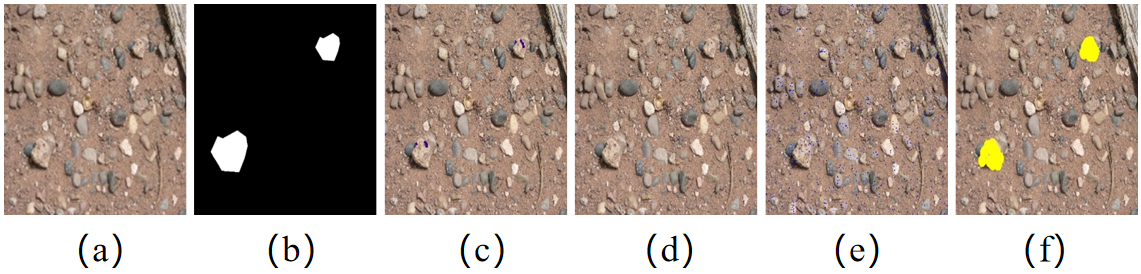
This paper presents a novel hybrid copy–move forgery detection method that combines the efficiency of FAST-BRIEF (for rapid keypoint detection and binary descriptors) with the robustness of SIFT (for scale- and rotation-invariant feature matching). The proposed framework employs g2NN matching for accurate feature correspondence, followed by morphological processing and LSC-SSIM superpixel segmentation for precise localization of tampered regions. The method is evaluated on 30 diverse test images from benchmark datasets comprising over 700 images, achieving a 95% F-measure with an average CPU time of 6.02 seconds. It demonstrates strong resilience to geometric transformations (rotation, scaling), photometric adjustments (contrast, brightness), additive noise, and multiple forgeries. The proposed methodology offers a 5–30% improvement in accuracy and computational speed. This approach addresses emerging challenges in deepfake detection and satellite imagery authentication, where localized manipulations threaten media integrity.

Graphical Abstract
Fast and Robust Copy-Move Forgery Detection Using BRIEF, FAST, and SIFT Feature Matching

Keywords
hybrid FAST-BRIEF-SIFT
g2NN matching
LSC-SSIM segmentation
copy-move forgery detection
deepfake localization
satellite image authentication
real-time forensics
f-measure optimization

Data Availability Statement
Data will be made available on request.

Funding
This work was supported without any funding.

Conflicts of Interest
The authors declare no conflicts of interest.

Ethical Approval and Consent to Participate
Not applicable.

References
  1. Rosten, E., & Drummond, T. (2006, May). Machine learning for high-speed corner detection. In European conference on computer vision (pp. 430-443). Berlin, Heidelberg: Springer Berlin Heidelberg.
    [CrossRef]   [Google Scholar]
  2. Lowe, D. G. (2004). Distinctive image features from scale-invariant keypoints. International journal of computer vision, 60(2), 91-110.
    [CrossRef]   [Google Scholar]
  3. Calonder, M., Lepetit, V., Strecha, C., & Fua, P. (2010, September). Brief: Binary robust independent elementary features. In European conference on computer vision (pp. 778-792). Berlin, Heidelberg: Springer Berlin Heidelberg.
    [CrossRef]   [Google Scholar]
  4. Li, Z., & Chen, J. (2015, June). Superpixel segmentation using Linear Spectral Clustering. In 2015 IEEE Conference on Computer Vision and Pattern Recognition (CVPR) (pp. 1356-1363). IEEE.
    [CrossRef]   [Google Scholar]
  5. Wang, W., Dong, J., & Tan, T. (2009, August). A survey of passive image tampering detection. In International workshop on digital watermarking (pp. 308-322). Berlin, Heidelberg: Springer Berlin Heidelberg.
    [CrossRef]   [Google Scholar]
  6. Elaskily, M., Aslan, H., Dessouky, M., Abd El-Samie, F., Faragallah, O., & Elshakankiry, O. (2019). Enhanced Fiilltterr-based SIFT Apprroach fforr Copy-Move Forrgerry Dettecttiion. Menoufia Journal of Electronic Engineering Research, 28(1), 159-182.
    [Google Scholar]
  7. Pun, C. M., Yuan, X. C., & Bi, X. L. (2015). Image forgery detection using adaptive oversegmentation and feature point matching. IEEE transactions on information forensics and security, 10(8), 1705-1716.
    [CrossRef]   [Google Scholar]
  8. Ryu, S. J., Lee, M. J., & Lee, H. K. (2010, June). Detection of copy-rotate-move forgery using Zernike moments. In International workshop on information hiding (pp. 51-65). Berlin, Heidelberg: Springer Berlin Heidelberg.
    [CrossRef]   [Google Scholar]
  9. Cao, Y., Gao, T., Fan, L., & Yang, Q. (2012). A robust detection algorithm for copy-move forgery in digital images. Forensic science international, 214(1-3), 33-43.
    [CrossRef]   [Google Scholar]
  10. Popescu, A. C., & Farid, H. (2005). Exposing digital forgeries by detecting traces of resampling. IEEE Transactions on Signal Processing, 53(2), 758–767.
    [CrossRef]   [Google Scholar]
  11. Huang, H., Guo, W., & Zhang, Y. (2008, December). Detection of copy-move forgery in digital images using SIFT algorithm. In 2008 IEEE Pacific-Asia Workshop on Computational Intelligence and Industrial Application (Vol. 2, pp. 272-276). IEEE.
    [CrossRef]   [Google Scholar]
  12. Abd Warif, N. B., Wahab, A. W. A., Idris, M. Y. I., Ramli, R., Salleh, R., Shamshirband, S., & Choo, K. K. R. (2016). Copy-move forgery detection: survey, challenges and future directions. Journal of Network and Computer Applications, 75, 259-278.
    [CrossRef]   [Google Scholar]
  13. Amerini, I., Ballan, L., Caldelli, R., Del Bimbo, A., & Serra, G. (2011). A sift-based forensic method for copy–move attack detection and transformation recovery. IEEE transactions on information forensics and security, 6(3), 1099-1110.
    [CrossRef]   [Google Scholar]
  14. Christlein, V., Riess, C., Jordan, J., Riess, C., & Angelopoulou, E. (2012). An evaluation of popular copy-move forgery detection approaches. IEEE Transactions on information forensics and security, 7(6), 1841-1854.
    [CrossRef]   [Google Scholar]
  15. Zhong, J., Gan, Y., Young, J., Huang, L., & Lin, P. (2017). A new block-based method for copy move forgery detection under image geometric transforms. Multimedia Tools and Applications, 76(13), 14887-14903.
    [CrossRef]   [Google Scholar]
  16. Zhong, J., Gan, Y., & Xie, S. (2016). Radon odd radial harmonic Fourier moments in detecting cloned forgery image. Chaos, Solitons & Fractals, 89, 115-129.
    [CrossRef]   [Google Scholar]
  17. Wang, J., Liu, G., Zhang, Z., Dai, Y., & Wang, Z. (2009). Fast and robust forensics for image region-duplication forgery. Acta Automatica Sinica, 35(12), 1488-1495.
    [Google Scholar]
  18. Kang, X., & Wei, S. (2008, December). Identifying tampered regions using singular value decomposition in digital image forensics. In 2008 International conference on computer science and software engineering (Vol. 3, pp. 926-930). IEEE.
    [CrossRef]   [Google Scholar]
  19. Bashar, M., Noda, K., Ohnishi, N., & Mori, K. (2010). Exploring duplicated regions in natural images. IEEE Transactions on Image Processing, 19(3), 773–788.
    [CrossRef]   [Google Scholar]
  20. Luo, W., Huang, J., & Qiu, G. (2006). Robust detection of region-duplication forgery in digital image. In 18th International Conference on Pattern Recognition (Vol. 4, pp. 746–749). IEEE.
    [CrossRef]   [Google Scholar]
  21. Bravo-Solorio, S., & Nandi, A. K. (2011). Exposing duplicated regions affected by reflection, rotation and scaling. In 2011 IEEE International Conference on Acoustics, Speech and Signal Processing (pp. 1880–1883). IEEE.
    [CrossRef]   [Google Scholar]
  22. Lin, H. J., Wang, C. W., & Kao, Y. T. (2009). Fast copy-move forgery detection. WSEAS Transactions on Signal Processing, 5(5), 188-197.
    [Google Scholar]
  23. Mahdian, B., & Saic, S. (2007). Detection of copy–move forgery using a method based on blur moment invariants. Forensic Science International, 171(2-3), 180–189.
    [CrossRef]   [Google Scholar]
  24. Bayram, S., Sencar, H. T., & Memon, N. (2009, April). An efficient and robust method for detecting copy-move forgery. In 2009 IEEE International Conference on Acoustics, Speech and Signal Processing (pp. 1053-1056). IEEE.
    [CrossRef]   [Google Scholar]
  25. Dixit, R., & Naskar, R. (2016, February). DyWT based copy-move forgery detection with improved detection accuracy. In 2016 3rd International Conference on Signal Processing and Integrated Networks (SPIN) (pp. 133-138). IEEE.
    [CrossRef]   [Google Scholar]
  26. Wang, Z., Bovik, A. C., Sheikh, H. R., & Simoncelli, E. P. (2004). Image quality assessment: from error visibility to structural similarity. IEEE transactions on image processing, 13(4), 600-612.
    [CrossRef]   [Google Scholar]
  27. Jabbar, M. U., Waqar, A., Awais, M., Mushtaq, Z., Abbass, M. J., Rehman, M. A., ... & Jan, A. Z. (2022, November). High dimensional Bio medical images denoising using wavelet transform and modified bilateral filter. In 2022 14th International Conference on Mathematics, Actuarial Science, Computer Science and Statistics (MACS) (pp. 1-5). IEEE.
    [CrossRef]   [Google Scholar]
  28. Agarwal, R., & Verma, O. P. (2020). An efficient copy move forgery detection using deep learning feature extraction and matching algorithm. Multimedia Tools and Applications, 79(11), 7355-7376.
    [CrossRef]   [Google Scholar]
  29. Bi, X., Pun, C. M., & Yuan, X. C. (2018). Multi-scale feature extraction and adaptive matching for copy-move forgery detection. Multimedia Tools and Applications, 77(1), 363-385.
    [CrossRef]   [Google Scholar]

Cite This Article
APA Style
Abbass, M. J., Waqar, A., Seemab, N., Khan, A. S., Riaz, M. B., Abbas, S., & Mushtaq, B. (2025). Fast and Robust Copy-Move Forgery Detection Using BRIEF, FAST, and SIFT Feature Matching. ICCK Transactions on Emerging Topics in Artificial Intelligence, 3(1), 9–19. https://doi.org/10.62762/TETAI.2025.152706
Export Citation
RIS Format
Compatible with EndNote, Zotero, Mendeley, and other reference managers
RIS format data for reference managers
TY  - JOUR
AU  - Abbass, Muhammad Jamshed
AU  - Waqar, Ali
AU  - Seemab, Natasha
AU  - Khan, Abdul Saboor
AU  - Riaz, Muhammad Bilal
AU  - Abbas, Sharjeel
AU  - Mushtaq, Bilal
PY  - 2025
DA  - 2025/11/25
TI  - Fast and Robust Copy-Move Forgery Detection Using BRIEF, FAST, and SIFT Feature Matching
JO  - ICCK Transactions on Emerging Topics in Artificial Intelligence
T2  - ICCK Transactions on Emerging Topics in Artificial Intelligence
JF  - ICCK Transactions on Emerging Topics in Artificial Intelligence
VL  - 3
IS  - 1
SP  - 9
EP  - 19
DO  - 10.62762/TETAI.2025.152706
UR  - https://www.icck.org/article/abs/TETAI.2025.152706
KW  - hybrid FAST-BRIEF-SIFT
KW  - g2NN matching
KW  - LSC-SSIM segmentation
KW  - copy-move forgery detection
KW  - deepfake localization
KW  - satellite image authentication
KW  - real-time forensics
KW  - f-measure optimization
AB  - This paper presents a novel hybrid copy–move forgery detection method that combines the efficiency of FAST-BRIEF (for rapid keypoint detection and binary descriptors) with the robustness of SIFT (for scale- and rotation-invariant feature matching). The proposed framework employs g2NN matching for accurate feature correspondence, followed by morphological processing and LSC-SSIM superpixel segmentation for precise localization of tampered regions. The method is evaluated on 30 diverse test images from benchmark datasets comprising over 700 images, achieving a 95% F-measure with an average CPU time of 6.02 seconds. It demonstrates strong resilience to geometric transformations (rotation, scaling), photometric adjustments (contrast, brightness), additive noise, and multiple forgeries. The proposed methodology offers a 5–30% improvement in accuracy and computational speed. This approach addresses emerging challenges in deepfake detection and satellite imagery authentication, where localized manipulations threaten media integrity.
SN  - 3068-6652
PB  - Institute of Central Computation and Knowledge
LA  - English
ER  - 
BibTeX Format
Compatible with LaTeX, BibTeX, and other reference managers
BibTeX format data for LaTeX and reference managers
@article{Abbass2025Fast,
  author = {Muhammad Jamshed Abbass and Ali Waqar and Natasha Seemab and Abdul Saboor Khan and Muhammad Bilal Riaz and Sharjeel Abbas and Bilal Mushtaq},
  title = {Fast and Robust Copy-Move Forgery Detection Using BRIEF, FAST, and SIFT Feature Matching},
  journal = {ICCK Transactions on Emerging Topics in Artificial Intelligence},
  year = {2025},
  volume = {3},
  number = {1},
  pages = {9-19},
  doi = {10.62762/TETAI.2025.152706},
  url = {https://www.icck.org/article/abs/TETAI.2025.152706},
  abstract = {This paper presents a novel hybrid copy–move forgery detection method that combines the efficiency of FAST-BRIEF (for rapid keypoint detection and binary descriptors) with the robustness of SIFT (for scale- and rotation-invariant feature matching). The proposed framework employs g2NN matching for accurate feature correspondence, followed by morphological processing and LSC-SSIM superpixel segmentation for precise localization of tampered regions. The method is evaluated on 30 diverse test images from benchmark datasets comprising over 700 images, achieving a 95\% F-measure with an average CPU time of 6.02 seconds. It demonstrates strong resilience to geometric transformations (rotation, scaling), photometric adjustments (contrast, brightness), additive noise, and multiple forgeries. The proposed methodology offers a 5–30\% improvement in accuracy and computational speed. This approach addresses emerging challenges in deepfake detection and satellite imagery authentication, where localized manipulations threaten media integrity.},
  keywords = {hybrid FAST-BRIEF-SIFT, g2NN matching, LSC-SSIM segmentation, copy-move forgery detection, deepfake localization, satellite image authentication, real-time forensics, f-measure optimization},
  issn = {3068-6652},
  publisher = {Institute of Central Computation and Knowledge}
}

Article Metrics
Citations:

Crossref

0

Scopus

0

Web of Science

0
Article Access Statistics:
Views: 308
PDF Downloads: 97

Publisher's Note
ICCK stays neutral with regard to jurisdictional claims in published maps and institutional affiliations.

Rights and Permissions
CC BY Copyright © 2025 by the Author(s). Published by Institute of Central Computation and Knowledge. This article is an open access article distributed under the terms and conditions of the Creative Commons Attribution (CC BY) license (https://creativecommons.org/licenses/by/4.0/), which permits use, sharing, adaptation, distribution and reproduction in any medium or format, as long as you give appropriate credit to the original author(s) and the source, provide a link to the Creative Commons licence, and indicate if changes were made.
ICCK Transactions on Emerging Topics in Artificial Intelligence

ICCK Transactions on Emerging Topics in Artificial Intelligence

ISSN: 3068-6652 (Online)

Email: [email protected]

Portico

Portico

All published articles are preserved here permanently:
https://www.portico.org/publishers/icck/