

Volume 3, Issue 1, ICCK Transactions on Emerging Topics in Artificial Intelligence
Volume 3, Issue 1, 2026
Submit Manuscript Edit a Special Issue
Article QR Code
Article QR Code
Scan the QR code for reading
Popular articles
ICCK Transactions on Emerging Topics in Artificial Intelligence, Volume 3, Issue 1, 2026: 20-32

Open Access | Research Article | 02 January 2026
Enhancing Social Media Bot Detection with Cross-Feature Gating and Residual Learning
1 Department of Computer Science, University of Wah, Wah Cantt 47040, Pakistan
2 Department of Computer Science, FAST—National University of Computer and Emerging Sciences, Chiniot-Faisalabad Campus, Chiniot 35400, Pakistan
* Corresponding Author: Hassan Ahmed, [email protected]
ARK: ark:/57805/tetai.2025.791029
Received: 22 July 2025, Accepted: 23 November 2025, Published: 02 January 2026  
Abstract
The growing presence of malicious bot accounts on social media poses a threat to the authenticity of online communities, as they amplify misinformation, spread spam, and manipulate engagement. Reliable detection of these accounts is therefore essential to protect the integrity of platforms such as Instagram. This study introduces a deep learning–based detection framework built on the CrossGatedTabular (CGT) architecture, designed to learn complex patterns in user activity. To strengthen evaluation, two publicly available datasets of Instagram accounts were merged into a comprehensive benchmark representing diverse user behaviors. Natural language processing (NLP) was applied to refine textual content and metadata, enhancing the quality of feature representation. For classification, a CrossGatedTabular neural architecture is employed, which integrates cross-feature interactions, gated multilayer perceptron (MLP) layers, and regularization mechanisms to effectively capture complex patterns within the dataset. Experimental results demonstrate that the proposed approach achieves 0.9340 accuracy along with high precision, recall, and F1-scores, consistently outperforming baseline classifiers. These findings highlight the effectiveness of deep neural architectures in malicious account detection and provide a scalable solution for enhancing the trustworthiness of social media platforms.

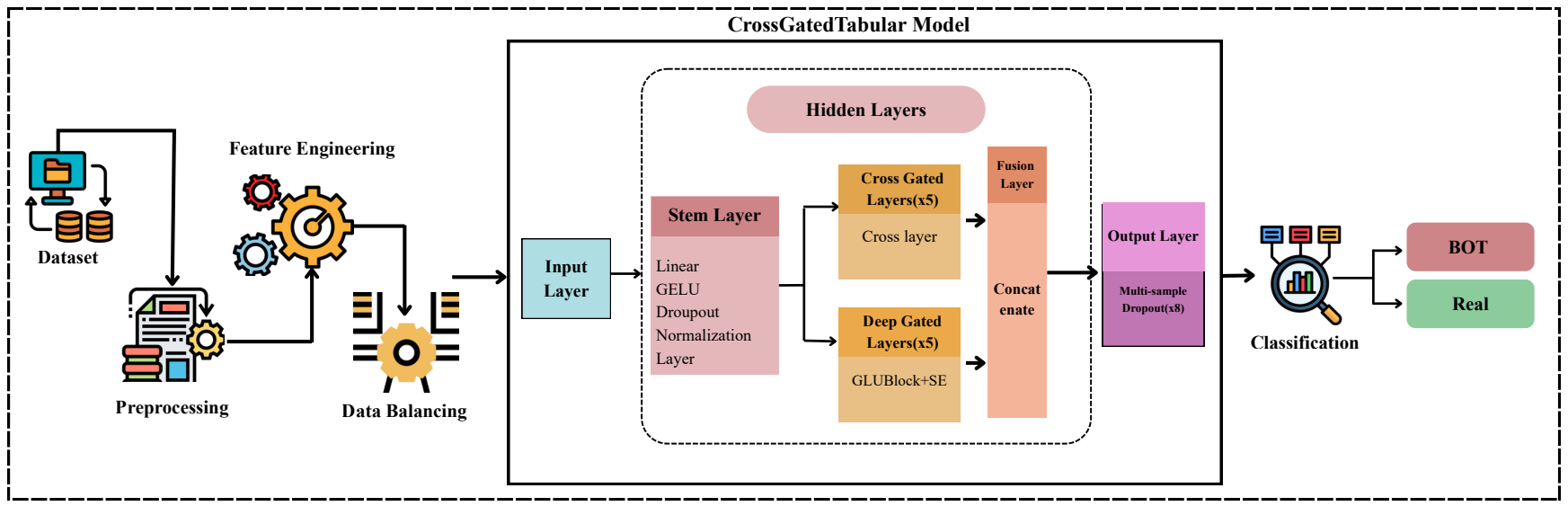
Graphical Abstract
Enhancing Social Media Bot Detection with Cross-Feature Gating and Residual Learning

Keywords
malicious bot detection
social media security
NLP
CrossGatedTabularV4
Instagram account classification

Data Availability Statement
Data will be made available on request.

Funding
This work was supported without any funding.

Conflicts of Interest
The authors declare no conflicts of interest.

Ethical Approval and Consent to Participate
Not applicable.

References
  1. Subrahmanian, V. S., Azaria, A., Durst, S., Kagan, V., Galstyan, A., Lerman, K., ... & Menczer, F. (2016). The DARPA Twitter bot challenge. Computer, 49(6), 38-46.
    [CrossRef]   [Google Scholar]
  2. Abulaish, M., & Fazil, M. (2020). Socialbots: Impacts, threat-dimensions, and defense challenges. IEEE Technology and Society Magazine, 39(3), 52–61.
    [CrossRef]   [Google Scholar]
  3. Shao, C., Ciampaglia, G. L., Varol, O., Yang, K. C., Flammini, A., & Menczer, F. (2018). The spread of low-credibility content by social bots. Nature communications, 9(1), 4787.
    [CrossRef]   [Google Scholar]
  4. Davis, C. A., Varol, O., Ferrara, E., Flammini, A., & Menczer, F. (2016, April). Botornot: A system to evaluate social bots. In Proceedings of the 25th international conference companion on world wide web (pp. 273-274).
    [CrossRef]   [Google Scholar]
  5. Cresci, S., Di Pietro, R., Petrocchi, M., Spognardi, A., & Tesconi, M. (2017, April). The paradigm-shift of social spambots: Evidence, theories, and tools for the arms race. In Proceedings of the 26th international conference on world wide web companion (pp. 963-972).
    [CrossRef]   [Google Scholar]
  6. Arin, E., & Kutlu, M. (2023). Deep learning based social bot detection on twitter. IEEE Transactions on Information Forensics and Security, 18, 1763-1772.
    [CrossRef]   [Google Scholar]
  7. Sayyadiharikandeh, M., Varol, O., Yang, K. C., Flammini, A., & Menczer, F. (2020, October). Detection of novel social bots by ensembles of specialized classifiers. In Proceedings of the 29th ACM international conference on information & knowledge management (pp. 2725-2732).
    [CrossRef]   [Google Scholar]
  8. Vaswani, A., Shazeer, N., Parmar, N., Uszkoreit, J., Jones, L., Gomez, A.~N., \ldots & Polosukhin, I. (2017). Attention is all you need. Advances in Neural Information Processing Systems, 30.
    [Google Scholar]
  9. Wu, Z., Pan, S., Chen, F., Long, G., Zhang, C., & Yu, P. S. (2020). A comprehensive survey on graph neural networks. IEEE transactions on neural networks and learning systems, 32(1), 4-24.
    [CrossRef]   [Google Scholar]
  10. Kudugunta, S., & Ferrara, E. (2018). Deep neural networks for bot detection. Information Sciences, 467, 312-322.
    [CrossRef]   [Google Scholar]
  11. Ellaky, Z., Benabbou, F., Matrane, Y., & Qaqa, S. (2024). A hybrid deep learning architecture for social media bots detection based on BiGRU-LSTM and GloVe word embedding. IEEE Access.
    [CrossRef]   [Google Scholar]
  12. Terumalasetti, S., & Reeja, S.~R. (2024). Enhancing social media user’s trust: A comprehensive framework for detecting malicious profiles using multi-dimensional analytics. IEEE Access.
    [CrossRef]   [Google Scholar]
  13. Sallah, A., Agoujil, S., Wani, M. A., Hammad, M., Maleh, Y., & Abd El-Latif, A. A. (2024). Fine-tuned understanding: Enhancing social bot detection with transformer-based classification. IEEE Access, 12, 118250-118269.
    [CrossRef]   [Google Scholar]
  14. Zeng, K., Li, Z., & Wang, X. (2025). Emoji-Driven Sentiment Analysis for Social Bot Detection with Relational Graph Convolutional Networks. Sensors, 25(13), 4179.
    [CrossRef]   [Google Scholar]
  15. Swathi, P., Karmakar, M., Banshal, S. K., & Moni, R. (2024, November). Malicious Social Bot Detection: RL-RNN Based Hybrid Approach. In 2024 3rd Edition of IEEE Delhi Section Flagship Conference (DELCON) (pp. 1-5). IEEE.
    [CrossRef]   [Google Scholar]
  16. Mohammadi, H., & Hosseini, S. (2025). Mobile botnet attacks detection using supervised learning algorithms. Security and Privacy, 8(2), e494.
    [CrossRef]   [Google Scholar]
  17. Arranz-Escudero, O., Quijano-Sanchez, L., & Liberatore, F. (2025). Enhancing misinformation countermeasures: a multimodal approach to twitter bot detection. Social Network Analysis and Mining, 15(1), 26.
    [CrossRef]   [Google Scholar]
  18. Guyan, Q., Liu, Y., Liu, J., & Zhang, P. (2025). PEGNN: Peripheral-Enhanced graph neural network for social bot detection. Expert Systems with Applications, 278, 127294.
    [CrossRef]   [Google Scholar]
  19. Zhou, M., Zhang, D., Wang, Y., Geng, Y., Dong, Y., & Tang, J. (2025). Lgb: Language model and graph neural network-driven social bot detection. IEEE Transactions on Knowledge and Data Engineering.
    [CrossRef]   [Google Scholar]
  20. Ghosh, D., Boettcher, W., Johnston, R., & Lahiri, S. (2025). Bot Identification in Social Media. arXiv preprint arXiv:2503.23629.
    [Google Scholar]
  21. Lopez-Joya, S., Diaz-Garcia, J.~A., Ruiz, M.~D., & Martin-Bautista, M.~J. (2024). Exploring social bots: a feature-based approach to improve bot detection in social networks. arXiv preprint arXiv:2411.06626.
    [Google Scholar]
  22. Wei, F., & Nguyen, U.~T. (2019). Twitter bot detection using bidirectional long short-term memory neural networks and word embeddings. In 2019 First IEEE International Conference on Trust, Privacy and Security in Intelligent Systems and Applications (TPS-ISA) (pp. 101–109). IEEE.
    [CrossRef]   [Google Scholar]
  23. Mounika, K., & Reddy, N. R. (2025). An Integrated Machine Learning Framework for Spammer and Fake User Detection in Online Social Networks. Fringe Multi-Engineering Proceedings (FMEP, ISSN: 3107-6149), 1(3), 12-25.
    [CrossRef]   [Google Scholar]
  24. Thavasimani, K., & Srinath, N.~K. (2022). Optimal hyper-parameter tuning using custom genetic algorithm on deep learning to detect Twitter bots. Journal of Engineering Science and Technology, 17(2), 1532–1549.
    [Google Scholar]
  25. Deshmukh, A., Moh, M., & Moh, T. S. (2024, December). Bot Detection in Social Media Using GraphSage and BERT. In 2024 IEEE/WIC International Conference on Web Intelligence and Intelligent Agent Technology (WI-IAT) (pp. 804-811). IEEE.
    [CrossRef]   [Google Scholar]
  26. Ellaky, Z., Benabbou, F., Ouahabi, S., & Sael, N. (2021). Word embedding for social bot detection systems. In 2021 Fifth International Conference On Intelligent Computing in Data Sciences (ICDS) (pp. 1–8). IEEE.
    [CrossRef]   [Google Scholar]
  27. Javed, D., Jhanjhi, N. Z., Khan, N. A., Ray, S. K., Al-Dhaqm, A., & Kebande, V. R. (2025). Identification of Spambots and Fake Followers on Social Network via Interpretable AI-Based Machine Learning. IEEE Access.
    [CrossRef]   [Google Scholar]
  28. Di Paolo, E., De Gaspari, F., & Spognardi, A. (2025). BotHash: Efficient and Training-Free Bot Detection Through Approximate Nearest Neighbor. arXiv preprint arXiv:2506.20503.
    [Google Scholar]
  29. Duman, A., & Mengutaycı, Ü. (2025). Transformer Based Approach for Instagram Fake Profile Detection. In Proceedings of the 5th International Conference on Contemporary Academic Research (ICCAR) (pp. 109-113). Konya, Turkey. https://www.researchgate.net/profile/Uemmueguelsuem-Mengutayci/publication/393325036
    [Google Scholar]
  30. Chelas, S., Routis, G., & Roussaki, I. (2024). Detection of fake instagram accounts via machine learning techniques. Computers, 13(11), 296.
    [CrossRef]   [Google Scholar]
  31. Ellaky, Z., Benabbou, F., Bouaine, C., & Matrane, Y. (2024, October). Enhanced Multi-model Approach for Social Media Bots Recognition Systems Using Imbalanced Dataset. In The Proceedings of the International Conference on Smart City Applications (pp. 256-266). Cham: Springer Nature Switzerland.
    [CrossRef]   [Google Scholar]
  32. Akyon, F. C., & Kalfaoglu, M. E. (2019, October). Instagram fake and automated account detection. In 2019 Innovations in intelligent systems and applications conference (ASYU) (pp. 1-7). IEEE.
    [CrossRef]   [Google Scholar]
  33. Bakhshandeh, B. (2019). Instagram fake spammer genuine accounts. Kaggle. Retrieved from https://www.kaggle.com/datasets/free4ever1/instagram-fake-spammer-genuine-accounts (accessed on 01 January 2026).
    [Google Scholar]
  34. Al-Amin, M., Deb, P., Rintu, I.~J., Islam, M.~M., Das, D.~C., & Khan, S.~A. (2024). Genuine or Spammer? Enhanced Fake Profile Detection using Feature Synthesis. In 2024 27th International Conference on Computer and Information Technology (ICCIT) (pp. 3499–3504). IEEE.
    [CrossRef]   [Google Scholar]
  35. Gunawan, H., Budhi, G. S., & Gunadi, K. (2025). Machine Learning-Based Fake Account Detection System: Instagram Case Study (Doctoral dissertation, Petra Christian University).
    [Google Scholar]
  36. Goyal, B., Gill, N.~S., & Gulia, P. (2024). Securing social spaces: machine learning techniques for fake profile detection on instagram. Social Network Analysis and Mining, 14(1), 231.
    [CrossRef]   [Google Scholar]
  37. Arunprakaash, R. R., & Nathiya, R. (2024, August). Leveraging Machine Learning algorithms for Fake Profile Detection on Instagram. In 2024 7th International Conference on Circuit Power and Computing Technologies (ICCPCT) (Vol. 1, pp. 869-876). IEEE.
    [CrossRef]   [Google Scholar]

Cite This Article
APA Style
Khan, A., Fatima, A., Jamil, R., Ahmed, H., & Saba, A. (2026). Enhancing Social Media Bot Detection with Cross-Feature Gating and Residual Learning. ICCK Transactions on Emerging Topics in Artificial Intelligence, 3(1), 20–32. https://doi.org/10.62762/TETAI.2025.791029
Export Citation
RIS Format
Compatible with EndNote, Zotero, Mendeley, and other reference managers
RIS format data for reference managers
TY  - JOUR
AU  - Khan, Abdullah
AU  - Fatima, Arooj
AU  - Jamil, Ridda
AU  - Ahmed, Hassan
AU  - Saba, Aini
PY  - 2026
DA  - 2026/01/02
TI  - Enhancing Social Media Bot Detection with Cross-Feature Gating and Residual Learning
JO  - ICCK Transactions on Emerging Topics in Artificial Intelligence
T2  - ICCK Transactions on Emerging Topics in Artificial Intelligence
JF  - ICCK Transactions on Emerging Topics in Artificial Intelligence
VL  - 3
IS  - 1
SP  - 20
EP  - 32
DO  - 10.62762/TETAI.2025.791029
UR  - https://www.icck.org/article/abs/TETAI.2025.791029
KW  - malicious bot detection
KW  - social media security
KW  - NLP
KW  - CrossGatedTabularV4
KW  - Instagram account classification
AB  - The growing presence of malicious bot accounts on social media poses a threat to the authenticity of online communities, as they amplify misinformation, spread spam, and manipulate engagement. Reliable detection of these accounts is therefore essential to protect the integrity of platforms such as Instagram. This study introduces a deep learning–based detection framework built on the CrossGatedTabular (CGT) architecture, designed to learn complex patterns in user activity. To strengthen evaluation, two publicly available datasets of Instagram accounts were merged into a comprehensive benchmark representing diverse user behaviors. Natural language processing (NLP) was applied to refine textual content and metadata, enhancing the quality of feature representation. For classification, a CrossGatedTabular neural architecture is employed, which integrates cross-feature interactions, gated multilayer perceptron (MLP) layers, and regularization mechanisms to effectively capture complex patterns within the dataset. Experimental results demonstrate that the proposed approach achieves 0.9340 accuracy along with high precision, recall, and F1-scores, consistently outperforming baseline classifiers. These findings highlight the effectiveness of deep neural architectures in malicious account detection and provide a scalable solution for enhancing the trustworthiness of social media platforms.
SN  - 3068-6652
PB  - Institute of Central Computation and Knowledge
LA  - English
ER  - 
BibTeX Format
Compatible with LaTeX, BibTeX, and other reference managers
BibTeX format data for LaTeX and reference managers
@article{Khan2026Enhancing,
  author = {Abdullah Khan and Arooj Fatima and Ridda Jamil and Hassan Ahmed and Aini Saba},
  title = {Enhancing Social Media Bot Detection with Cross-Feature Gating and Residual Learning},
  journal = {ICCK Transactions on Emerging Topics in Artificial Intelligence},
  year = {2026},
  volume = {3},
  number = {1},
  pages = {20-32},
  doi = {10.62762/TETAI.2025.791029},
  url = {https://www.icck.org/article/abs/TETAI.2025.791029},
  abstract = {The growing presence of malicious bot accounts on social media poses a threat to the authenticity of online communities, as they amplify misinformation, spread spam, and manipulate engagement. Reliable detection of these accounts is therefore essential to protect the integrity of platforms such as Instagram. This study introduces a deep learning–based detection framework built on the CrossGatedTabular (CGT) architecture, designed to learn complex patterns in user activity. To strengthen evaluation, two publicly available datasets of Instagram accounts were merged into a comprehensive benchmark representing diverse user behaviors. Natural language processing (NLP) was applied to refine textual content and metadata, enhancing the quality of feature representation. For classification, a CrossGatedTabular neural architecture is employed, which integrates cross-feature interactions, gated multilayer perceptron (MLP) layers, and regularization mechanisms to effectively capture complex patterns within the dataset. Experimental results demonstrate that the proposed approach achieves 0.9340 accuracy along with high precision, recall, and F1-scores, consistently outperforming baseline classifiers. These findings highlight the effectiveness of deep neural architectures in malicious account detection and provide a scalable solution for enhancing the trustworthiness of social media platforms.},
  keywords = {malicious bot detection, social media security, NLP, CrossGatedTabularV4, Instagram account classification},
  issn = {3068-6652},
  publisher = {Institute of Central Computation and Knowledge}
}

Article Metrics
Citations:

Crossref

0

Scopus

0

Web of Science

0
Article Access Statistics:
Views: 467
PDF Downloads: 220

Publisher's Note
ICCK stays neutral with regard to jurisdictional claims in published maps and institutional affiliations.

Rights and Permissions
CC BY Copyright © 2026 by the Author(s). Published by Institute of Central Computation and Knowledge. This article is an open access article distributed under the terms and conditions of the Creative Commons Attribution (CC BY) license (https://creativecommons.org/licenses/by/4.0/), which permits use, sharing, adaptation, distribution and reproduction in any medium or format, as long as you give appropriate credit to the original author(s) and the source, provide a link to the Creative Commons licence, and indicate if changes were made.
ICCK Transactions on Emerging Topics in Artificial Intelligence

ICCK Transactions on Emerging Topics in Artificial Intelligence

ISSN: 3068-6652 (Online)

Email: [email protected]

Portico

Portico

All published articles are preserved here permanently:
https://www.portico.org/publishers/icck/