On-line Configuration Identification and Control of Modular Reconfigurable Flight Array








Article Information
Abstract
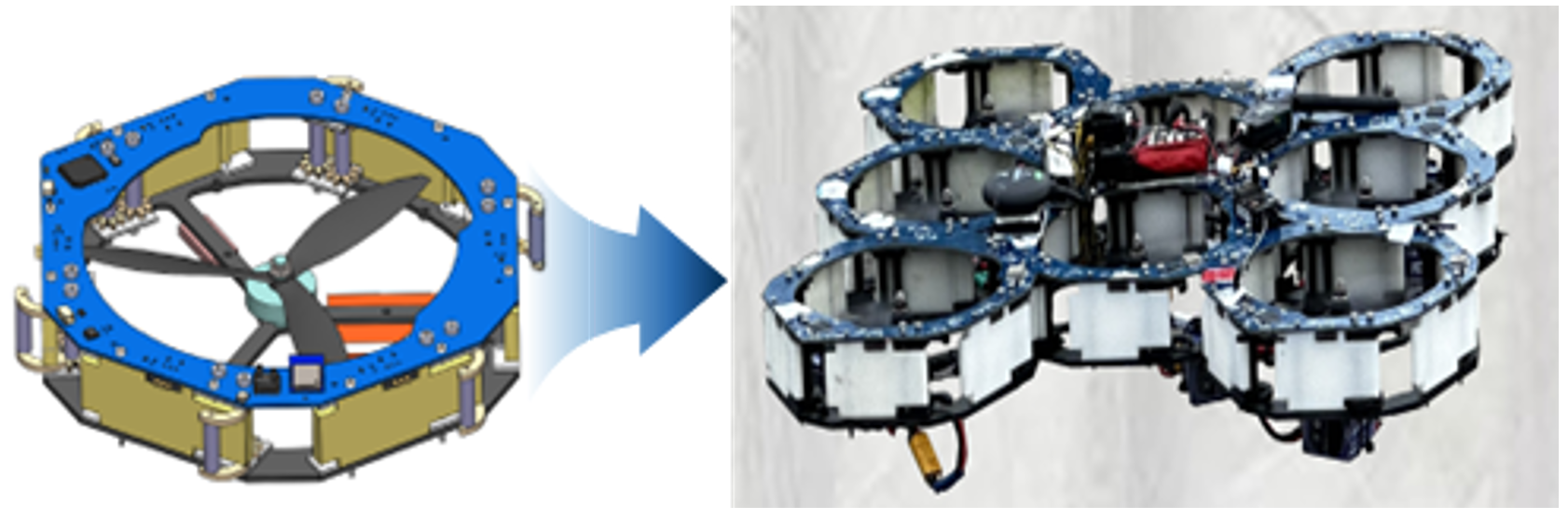
With the increasing complexity of the working environment and the diversification of mission requirements of UAVs, traditional UAVs have a fixed structure and single function. It is difficult to be applied in occasions with complex environments and changing load demands. The modular reconfigurable flight array (MRFA) is composed of no less than four isomorphic unit modules that are freely spliced together. By adding or removing flight unit modules and adjusting the arrangement of flight unit modules, the configuration of the MRFA can be changed, so that it can adapt to complex environments and then complete different flight missions. In the process of MRFA research and development, online configuration identification has become one of important problem to be solved. In this paper, a configuration recognition algorithm is designed based on the breadth-first searching method to identify the online structure of MRFA firstly. Then, the dynamic model of the aircraft is carried out according to the obtained configuration information. At the same time, the mathematical model and configuration information of the MRFA are combined to establish an optimization control allocation mechanism to allocate suitable rotational speed for multiple rotors. Finally, several examples are carried out to show that the proposed technology can recognize the configuration with 100% recognition rate and average online recognition time 569.4ms. Then a cascade PID controller is designed to realize the flight control of the irregular MRFA with faster tracking performance of no more than 40 seconds.
Graphical Abstract
Keywords
Data Availability Statement
Funding
Conflicts of Interest
Ethical Approval and Consent to Participate
References
- Roussel, E., Gassmann, V., & Laroche, E. (2016, June). Modelling and identification of a coaxial birotor UAV from scarce flight data. In 2016 European Control Conference (ECC) (pp. 2158-2164). IEEE.
[CrossRef] [Google Scholar] - Park, S., Lee, J., Ahn, J., Kim, M., Her, J., Yang, G. H., & Lee, D. (2018). Odar: Aerial manipulation platform enabling omnidirectional wrench generation. IEEE/ASME Transactions on mechatronics, 23(4), 1907-1918.
[CrossRef] [Google Scholar] - Zhou, X., Wen, X., Wang, Z., Gao, Y., Li, H., Wang, Q., ... & Gao, F. (2022). Swarm of micro flying robots in the wild. Science Robotics, 7(66), eabm5954.
[CrossRef] [Google Scholar] - Mu, B., & Chirarattananon, P. (2019). Universal flying objects: Modular multirotor system for flight of rigid objects. IEEE Transactions on Robotics, 36(2), 458-471.
[CrossRef] [Google Scholar] - Gabrich, B., Saldana, D., Kumar, V., & Yim, M. (2018, May). A flying gripper based on cuboid modular robots. In 2018 IEEE International Conference on Robotics and Automation (ICRA) (pp. 7024-7030). IEEE.
[CrossRef] [Google Scholar] - Li, G., Gabrich, B., Saldana, D., Das, J., Kumar, V., & Yim, M. (2019, May). ModQuad-Vi: A vision-based self-assembling modular quadrotor. In 2019 International Conference on Robotics and Automation (ICRA) (pp. 346-352). IEEE.
[CrossRef] [Google Scholar] - Oung, R., & D’Andrea, R. (2011). The distributed flight array. Mechatronics, 21(6), 908-917.
[CrossRef] [Google Scholar] - Carlson, S. J., Arora, P., & Papachristos, C. (2022, May). A multi-vtol modular aspect ratio reconfigurable aerial robot. In 2022 International conference on robotics and automation (ICRA) (pp. 8-15). IEEE.
[CrossRef] [Google Scholar] - Zhao, N., Luo, Y., Wang, G., & Shen, Y. (2022). A deployable articulated mechanism enabled in-flight morphing aerial gripper. Mechanism and Machine Theory, 167, 104518.
[CrossRef] [Google Scholar] - Ryll, M., Bicego, D., & Franchi, A. (2016, October). Modeling and control of FAST-Hex: A fully-actuated by synchronized-tilting hexarotor. In 2016 IEEE/RSJ International Conference on Intelligent Robots and Systems (IROS) (pp. 1689-1694). IEEE.
[CrossRef] [Google Scholar] - Ryll, M., Bicego, D., Giurato, M., Lovera, M., & Franchi, A. (2021). Fast-hex—a morphing hexarotor: design, mechanical implementation, control and experimental validation. IEEE/ASME transactions on mechatronics, 27(3), 1244-1255.
[CrossRef] [Google Scholar] - Lau, H. Y. K., Ko, A. W. Y., & Lau, T. L. (2008). The design of a representation and analysis method for modular self-reconfigurable robots. Robotics and Computer-Integrated Manufacturing, 24(2), 258-269.
[CrossRef] [Google Scholar] - Yang, J., Yang, C., Zhang, X., & Na, J. (2024). Fixed-time sliding mode control with varying exponent coefficient for modular reconfigurable flight arrays. IEEE/CAA Journal of Automatica Sinica, 11(2), 514-528.
[CrossRef] [Google Scholar] - Yu, H., Yu, J., Bi, S., & Zong, G. (2005). Configuration synthesis of reconfigurable robot based on graph theory. Journal of Mechanical Engineering, 41(8), 79-83. https://qikan.cmes.org/jxgcxb/EN/PDF/21546
[Google Scholar] - Ma, D., Xia, Y., Shen, G., Jiang, H., & Hao, C. (2020). Practical fixed-time disturbance rejection control for quadrotor attitude tracking. IEEE Transactions on Industrial Electronics, 68(8), 7274-7283.
[CrossRef] [Google Scholar] - Mahony, R., Kumar, V., & Corke, P. (2012). Multirotor aerial vehicles: Modeling, estimation, and control of quadrotor. IEEE robotics & automation magazine, 19(3), 20-32.
[CrossRef] [Google Scholar] - Bao, N., Ran, X., Wu, Z., Xue, Y., & Wang, K. (2017, December). Research on attitude controller of quadcopter based on cascade PID control algorithm. In 2017 IEEE 2nd Information Technology, Networking, Electronic and Automation Control Conference (ITNEC) (pp. 1493-1497). IEEE.
[CrossRef] [Google Scholar] - Li, J., & Li, Y. (2011, August). Dynamic analysis and PID control for a quadrotor. In 2011 IEEE International Conference on Mechatronics and Automation (pp. 573-578). IEEE.
[CrossRef] [Google Scholar] - Xu, L. X., Wang, Y. L., Wang, X., & Peng, C. (2023). Distributed active disturbance rejection formation tracking control for quadrotor UAVs. IEEE Transactions on Cybernetics, 54(8), 4678-4689.
[CrossRef] [Google Scholar] - Lee, T., Leok, M., & McClamroch, N. H. (2010, December). Geometric tracking control of a quadrotor UAV on SE (3). In 49th IEEE conference on decision and control (CDC) (pp. 5420-5425). IEEE.
[CrossRef] [Google Scholar]
Cited By (10)
-
Feng Ding, Yongsong Xiao, Ling Xu, Zhiming Fang. Hierarchical Stochastic Gradient and Hierarchical Multi‐Innovation Stochastic Gradient Identification for Multivariable ARX Models.
International Journal of Adaptive Control and Signal Processing, 2026 , 40 (1).
[CrossRef] -
Orestis Kaparounakis, Yunqi Zhang, Phillip Stanley-Marbell. Approximating Analytically-Intractable Likelihood Densities With Deterministic Arithmetic for Optimal Particle Filtering.
IEEE Signal Processing Letters, 2026 , 33 .
[CrossRef] -
Tianyun Li, Chunxi Yang, Xiufeng Zhang, Hongwei Sun, Zexiang Zhang. .
2026 IEEE 15th Data Driven Control and Learning Systems (DDCLS), 2026 .
[CrossRef] -
Yuan Liu, Lianpeng Zhang, Ruichen Wang, Litong Lyu, Jie Feng, Guangtao Ma. Adaptive integral sliding mode control for attitude tracking of 6-DOF electro-hydraulic shaking tables.
Journal of Measurements in Engineering, 2026 , 14 (2).
[CrossRef] -
Weichen Zhou, Chunxi Yang, Xiufeng Zhang, Hongwei Sun, Yu Shi. .
2026 IEEE 20th International Conference on Control and Automation (ICCA), 2026 .
[CrossRef] -
Qian Zhang, Ximei Liu. Auxiliary Model Maximum Likelihood Moving‐Data‐Window Generalized Extended Gradient‐Based Iterative Algorithm for Multivariable Autoregressive Output‐Error Autoregressive Moving‐Average Systems.
Optimal Control Applications and Methods, 2025 , 46 (5).
[CrossRef] -
Xinghong Yang, Lizhen Shao. Green and efficient path planning framework based on multi-granularity view fusion for amphibious unmanned aerial vehicles.
Engineering Applications of Artificial Intelligence, 2025 , 151 .
[CrossRef] -
Mateus de Sousa, Rafael M. Duarte, Moises Nuñez, Juan M. M. Villanueva. Development of a Data Collection and Data Transmission System Using Drones and IoT Sensors.
Journal of Advances in Information Technology, 2025 , 16 (11).
[CrossRef] -
Jianquan Zhang, Fangting Huang, Shuqing Zhu, Xiao Xiao. A Resource Allocation Strategy in Internet of Vehicles Based on Multi-Task Federated Learning and Incentive Mechanism.
IEEE Transactions on Intelligent Transportation Systems, 2025 , 26 (10).
[CrossRef] -
Lei Yang, Shaobo Li, Liya Yu, Caichao Zhu, Congbao Wang. Multi-source data fusion-based knowledge transfer for unmanned aerial vehicle flight data anomaly detection and recovery.
Scientific Reports, 2025 , 15 (1).
[CrossRef]
Cite This Article
TY  - JOUR
AU  - Ren, Bin
AU  - Liu, Jianhui
AU  - Zhang, Simin
AU  - Yang, Chunxi
AU  - Na, Jing
PY  - 2024
DA  - 2024/09/29
TI  - On-line Configuration Identification and Control of Modular Reconfigurable Flight Array
JO  - ICCK Transactions on Intelligent Systematics
T2  - ICCK Transactions on Intelligent Systematics
JF  - ICCK Transactions on Intelligent Systematics
VL  - 1
IS  - 2
SP  - 91
EP  - 101
DO  - 10.62762/TIS.2024.681878
UR  - https://www.icck.org/article/abs/tis.2024.681878
KW  - modular reconfigurable flight array
KW  - breadth-first search
KW  - configuration recognition
KW  - dynamic modeling
KW  - control allocation
AB  - With the increasing complexity of the working environment and the diversification of mission requirements of UAVs, traditional UAVs have a fixed structure and single function. It is difficult to be applied in occasions with complex environments and changing load demands. The modular reconfigurable flight array (MRFA) is composed of no less than four isomorphic unit modules that are freely spliced together. By adding or removing flight unit modules and adjusting the arrangement of flight unit modules, the configuration of the MRFA can be changed, so that it can adapt to complex environments and then complete different flight missions. In the process of MRFA research and development, online configuration identification has become one of important problem to be solved. In this paper, a configuration recognition algorithm is designed based on the breadth-first searching method to identify the online structure of MRFA firstly. Then, the dynamic model of the aircraft is carried out according to the obtained configuration information. At the same time, the mathematical model and configuration information of the MRFA are combined to establish an optimization control allocation mechanism to allocate suitable rotational speed for multiple rotors. Finally, several examples are carried out to show that the proposed technology can recognize the configuration with 100% recognition rate and average online recognition time 569.4ms. Then a cascade PID controller is designed to realize the flight control of the irregular MRFA with faster tracking performance of no more than 40 seconds.
SN  - 3068-5079
PB  - Institute of Central Computation and Knowledge
LA  - English
ER  -
@article{Ren2024Online,
  author = {Bin Ren and Jianhui Liu and Simin Zhang and Chunxi Yang and Jing Na},
  title = {On-line Configuration Identification and Control of Modular Reconfigurable Flight Array},
  journal = {ICCK Transactions on Intelligent Systematics},
  year = {2024},
  volume = {1},
  number = {2},
  pages = {91-101},
  doi = {10.62762/TIS.2024.681878},
  url = {https://www.icck.org/article/abs/tis.2024.681878},
  abstract = {With the increasing complexity of the working environment and the diversification of mission requirements of UAVs, traditional UAVs have a fixed structure and single function. It is difficult to be applied in occasions with complex environments and changing load demands. The modular reconfigurable flight array (MRFA) is composed of no less than four isomorphic unit modules that are freely spliced together. By adding or removing flight unit modules and adjusting the arrangement of flight unit modules, the configuration of the MRFA can be changed, so that it can adapt to complex environments and then complete different flight missions. In the process of MRFA research and development, online configuration identification has become one of important problem to be solved. In this paper, a configuration recognition algorithm is designed based on the breadth-first searching method to identify the online structure of MRFA firstly. Then, the dynamic model of the aircraft is carried out according to the obtained configuration information. At the same time, the mathematical model and configuration information of the MRFA are combined to establish an optimization control allocation mechanism to allocate suitable rotational speed for multiple rotors. Finally, several examples are carried out to show that the proposed technology can recognize the configuration with 100\% recognition rate and average online recognition time 569.4ms. Then a cascade PID controller is designed to realize the flight control of the irregular MRFA with faster tracking performance of no more than 40 seconds.},
  keywords = {modular reconfigurable flight array, breadth-first search, configuration recognition, dynamic modeling, control allocation},
  issn = {3068-5079},
  publisher = {Institute of Central Computation and Knowledge}
}
Publisher's Note
ICCK stays neutral with regard to jurisdictional claims in published maps and institutional affiliations.
Rights and Permissions


Portico