Long-term Traffic Flow Prediction Using Stochastic Configuration Networks for Smart Cities



Article Information
Abstract
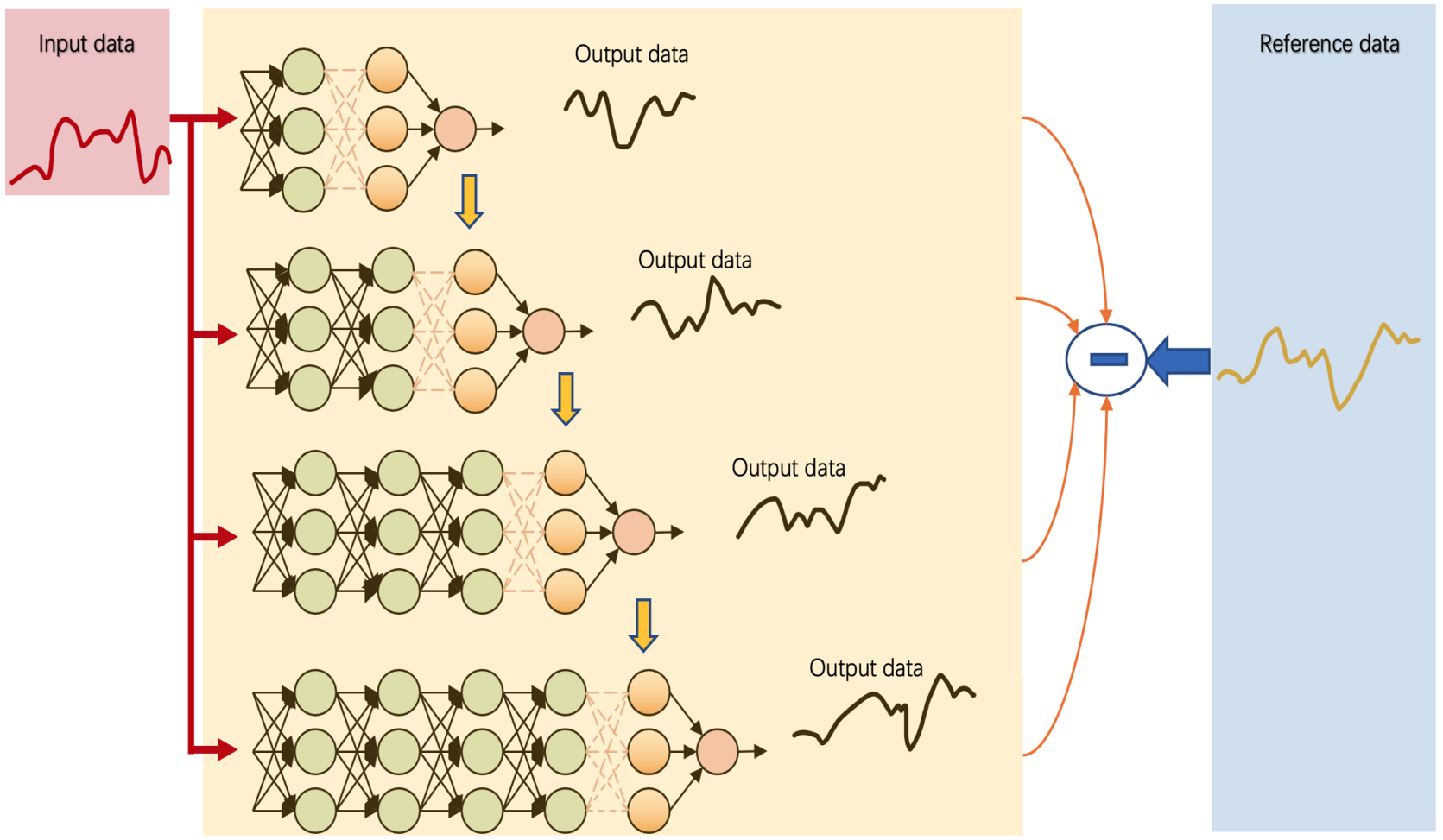
Accurate predictions of traffic flow are very meaningful to city managers. With such information, traffic systems can better coordinate traffic signals and reduce congestion. By understanding traffic patterns, navigation systems can provide real-time routing suggestions that avoid traffic jams, save time, and reduce fuel consumption. However, traffic flow will be interfered with by multiple factors such as collection time and place. In this paper, stochastic configuration networks (SCNs) are proposed to predict the traffic flow. The network is trained through stepwise construction, and the network parameters are effectively optimized based on the approximation theorem and convergence analysis optimization mechanism. The proposed network automatically adjusts its structure according to the complexity of traffic flow to better adapt to the complex non-linearity of traffic flow. It is observed that the proposed model achieves better prediction performance overall and greater flexibility in the length of the prediction period compared to the benchmarks using the Guangzhou urban traffic flow dataset. It is worth noting that SCNs consistently outperform other models across different prediction intervals. They yield RMSE improvements of up to 10.73\% for 10-minute predictions, 5.02\% for 30-minute predictions, and 11.21\% for 60-minute predictions compared to the least effective models. The R-value also exhibits steady enhancement, increasing by up to 0.0075, 0.0002, and 0.0204 for 10-minute, 30-minute, and 60-minute predictions, respectively. These notable advancements, combined with the model's computational efficiency, especially in short-term predictions, underscore the effectiveness and practicality of SCNs in traffic flow prediction tasks.
Graphical Abstract
Keywords
Data Availability Statement
Funding
Conflicts of Interest
Ethical Approval and Consent to Participate
References
- Ma, C., Zhao, Y., Dai, G., Xu, X., & Wong, S. C. (2022). A novel STFSA-CNN-GRU hybrid model for short-term traffic speed prediction. IEEE Transactions on Intelligent Transportation Systems, 24(4), 3728-3737.
[CrossRef] [Google Scholar] - Li, Y., Chai, S., Ma, Z., & Wang, G. (2021). A hybrid deep learning framework for long-term traffic flow prediction. Ieee Access, 9, 11264-11271.
[CrossRef] [Google Scholar] - Bogaerts, T., Masegosa, A. D., Angarita-Zapata, J. S., Onieva, E., & Hellinckx, P. (2020). A graph CNN-LSTM neural network for short and long-term traffic forecasting based on trajectory data. Transportation Research Part C: Emerging Technologies, 112, 62-77.
[CrossRef] [Google Scholar] - Li, Y., Yu, R., Shahabi, C., & Liu, Y. (2017). Diffusion convolutional recurrent neural network: Data-driven traffic forecasting. arXiv preprint arXiv:1707.01926.
[Google Scholar] - Chen, Z. Y., Xiao, F., Wang, X. K., Deng, M. H., Wang, J. Q., & Li, J. B. (2022). Stochastic configuration network based on improved whale optimization algorithm for nonstationary time series prediction. Journal of Forecasting, 41(7), 1458-1482.
[CrossRef] [Google Scholar] - Tian, Y., & Pan, L. (2015, December). Predicting short-term traffic flow by long short-term memory recurrent neural network. In 2015 IEEE international conference on smart city/SocialCom/SustainCom (SmartCity) (pp. 153-158). IEEE.
[CrossRef] [Google Scholar] - Yin, X., Wu, G., Wei, J., Shen, Y., Qi, H., & Yin, B. (2021). Deep learning on traffic prediction: Methods, analysis, and future directions. IEEE Transactions on Intelligent Transportation Systems, 23(6), 4927-4943.
[CrossRef] [Google Scholar] - Hochreiter, S., & Schmidhuber, J. (1997). Long short-term memory. Neural computation, 9(8), 1735-1780.
[CrossRef] [Google Scholar] - Sun, H., Liu, H. X., Xiao, H., He, R. R., & Ran, B. (2003). Use of local linear regression model for short-term traffic forecasting. Transportation Research Record, 1836(1), 143-150.
[CrossRef] [Google Scholar] - Yang, B., Sun, S., Li, J., Lin, X., & Tian, Y. (2019). Traffic flow prediction using LSTM with feature enhancement. Neurocomputing, 332, 320-327.
[CrossRef] [Google Scholar] - Meng, X., Fu, H., Peng, L., Liu, G., Yu, Y., Wang, Z., & Chen, E. (2020). D-LSTM: Short-term road traffic speed prediction model based on GPS positioning data. IEEE Transactions on Intelligent Transportation Systems, 23(3), 2021-2030.
[CrossRef] [Google Scholar] - Chen, C., Liu, Z., Wan, S., Luan, J., & Pei, Q. (2020). Traffic flow prediction based on deep learning in internet of vehicles. IEEE transactions on intelligent transportation systems, 22(6), 3776-3789.
[CrossRef] [Google Scholar] - Connor, J. T., Martin, R. D., & Atlas, L. E. (1994). Recurrent neural networks and robust time series prediction. IEEE transactions on neural networks, 5(2), 240-254.
[CrossRef] [Google Scholar] - Jaitly, N., Le, Q. V., Vinyals, O., Sutskever, I., Sussillo, D., & Bengio, S. (2016). An online sequence-to-sequence model using partial conditioning. Advances in neural information processing systems, 29.
[Google Scholar] - Cao, S., Wu, L., Wu, J., Wu, D., & Li, Q. (2022). A spatio-temporal sequence-to-sequence network for traffic flow prediction. Information Sciences, 610, 185-203.
[CrossRef] [Google Scholar] - Niu, Z., Zhong, G., & Yu, H. (2021). A review on the attention mechanism of deep learning. Neurocomputing, 452, 48-62.
[CrossRef] [Google Scholar] - Li, Z., Xu, H., Gao, X., Wang, Z., & Xu, W. (2024). Fusion attention mechanism bidirectional LSTM for short-term traffic flow prediction. Journal of Intelligent Transportation Systems, 28(4), 511-524.
[CrossRef] [Google Scholar] - Qiu, Z., Zhu, T., Jin, Y., Sun, L., & Du, B. (2023). A graph attention fusion network for event-driven traffic speed prediction. Information Sciences, 622, 405-423.
[CrossRef] [Google Scholar] - Kong, J., Fan, X., Jin, X., Lin, S., & Zuo, M. (2023). A variational Bayesian inference-based en-decoder framework for traffic flow prediction. IEEE Transactions on Intelligent Transportation Systems, 25(3), 2966-2975.
[CrossRef] [Google Scholar] - Du, S., Li, T., Yang, Y., & Horng, S. J. (2020). Multivariate time series forecasting via attention-based encoder–decoder framework. Neurocomputing, 388, 269-279.
[CrossRef] [Google Scholar] - Reza, S., Ferreira, M. C., Machado, J. J., & Tavares, J. M. R. (2022). A multi-head attention-based transformer model for traffic flow forecasting with a comparative analysis to recurrent neural networks. Expert Systems with Applications, 202, 117275.
[CrossRef] [Google Scholar] - Huang, C., Li, M., & Wang, D. (2021). Stochastic configuration network ensembles with selective base models. Neural Networks, 137, 106-118.
[CrossRef] [Google Scholar] - Wang, D., & Li, M. (2017). Stochastic configuration networks: Fundamentals and algorithms. IEEE transactions on cybernetics, 47(10), 3466-3479.
[CrossRef] [Google Scholar] - Chen, X., Chen, Y., and He, Z.(2021). Urban Traffic Speed Dataset of Guangzhou, China. Zenodo.
[CrossRef] [Google Scholar] - Zhang, W., Li, X., Li, A., Huang, X., Wang, T., & Gao, H. (2023, December). Sgru: A high-performance structured gated recurrent unit for traffic flow prediction. In 2023 IEEE 29th International Conference on Parallel and Distributed Systems (ICPADS) (pp. 467-473). IEEE.
[CrossRef] [Google Scholar]
Cited By (41)
-
Jianwei Ning. Smart City Traffic Flow Prediction and Signal Dynamic Optimization Algorithm Based on Deep Learning.
Procedia Computer Science, 2026 , 279 .
[CrossRef] -
Xiangxu Wang, Jinzhou Cao, Tianhong Zhao, Bowen Zhang, Guanzhou Chen, Zhenhui Li, Haolin Chen, Wei Tu, Qingquan Li. ST-Camba: A decoupled-free spatiotemporal graph fusion state space model with linear complexity for efficient traffic forecasting.
Information Fusion, 2026 , 126 .
[CrossRef] -
M. Tanveer, Mohammad Tabish, Anuradha Kumari, Ashwani Kumar Malik, Weiping Ding. Support Vector Clustering Uncovered: Insights, Challenges, and Future Outlook.
IEEE/CAA Journal of Automatica Sinica, 2026 , 13 (4).
[CrossRef] -
Delin Liu. Bridge stability prediction using Bayesian-optimized ConvLSTM.
Engineering Research Express, 2026 , 8 (21).
[CrossRef] -
Kaveesha Hewage, Boyu Li, Ting Guo, Alexis Stenfors, Peter Mere, Fang Chen. Learning unified market interdependencies via networked attention for stock price forecasting.
Engineering Applications of Artificial Intelligence, 2026 , 176 .
[CrossRef] -
Sangjin Park, Hyeonhak Kim, Richard Murray. International Stock Forecasting Using Ensemble Deep Graph Models and Complex Network Analysis.
International Journal of Intelligent Systems, 2026 , 2026 (1).
[CrossRef] -
Xinning Yu, Xiao Wang, Delanyo Kwame Bensah Kulevome, Haifeng Wang, Salah-Ud-Din Khokhar, Na Li. Multi-Scale temporal modeling via STL decomposition and dual-Transformer for resource prediction.
Future Generation Computer Systems, 2026 , 178 .
[CrossRef] -
Hao Huang, Jee-Hyong Lee, Yanling Ge, Seok-Beom Roh, Xue Zhao. Adaptive spatial–temporal graph attention network for real-time traffic forecasting.
Engineering Applications of Artificial Intelligence, 2026 , 163 .
[CrossRef] -
Jiaqi Gao, Yaru He, Daoqi Han, Yueming Lu, Yaojun Qiao. Spectrum-Aided Traffic Decomposition and Deep Learning Method for Network Traffic Prediction in Internet of Things.
IEEE Transactions on Industrial Informatics, 2026 , 22 (2).
[CrossRef] -
Jin Xue-Bo, Zhang Zhi-Zhao, Kong Jian-Lei, Bai Yu-Ting, Su Ting-Li. .
Proceedings of the 17th International Conference on Modelling, Identification and Control (ICMIC2025), 2026 , 1495 .
[CrossRef] -
Jie Hu, Min Wu, Witold Pedrycz. Burn-Through Point Dynamic Modeling Based on Temporal Cascade Broad Echo State Learning System in Sintering Process.
IEEE Transactions on Industrial Electronics, 2026 , 73 (5).
[CrossRef] -
Zhe Zhang, Niaona Zhang. A parallel preceding vehicle speed prediction method combining deep belief networks and gated recurrent units.
Journal of Control and Decision, 2026 , 13 (4).
[CrossRef] -
Yu-Kai Huang, Chih-Hung Chen, Yun-Cheng Tsai, Shun-Shii Lin. Stock Market Forecasting in Taiwan: A Radius Neighbors Regressor Approach.
Big Data and Cognitive Computing, 2026 , 10 (4).
[CrossRef] -
Chaolong Jia, Haodong Lv, Zheyi Kang, Fu Jiang, Zhengjun Zhou, Rong Wang, Yunpeng Xiao. Long-term traffic flow forecasting model based on windowed attention mechanism.
Applied Soft Computing, 2026 , 203 .
[CrossRef] -
Yating Yu, Hongyue Guo, Peng Jia, Lidong Wang, Witold Pedrycz. Trend granulation-based time series long-term prediction under privacy protection.
Applied Soft Computing, 2026 , 203 .
[CrossRef] -
Yuxin Jia, Nan Guo, |Tiewei Shang, Wenlu Li, Yueyang Sun, Junfei Qiao. A Bayesian‐Optimized GRU Network With WMD‐EFAST Self‐Organizing Mechanism for Multimodal Atmospheric Pollutant Prediction.
International Journal of Adaptive Control and Signal Processing, 2026 , 40 (11).
[CrossRef] -
Xianshuang Yao, Huiyu Wang. Serial-Parallel Fractional-Integer-Order Echo State Network for Time Series Prediction.
IEEE Transactions on Knowledge and Data Engineering, 2026 , 38 (1).
[CrossRef] -
Mst Suraiya Farzana, Liuxiao Feng, Peiyin Chen, Md Owahedur Rahman, Muhammad Bilal Yaseen, Sadashiv Chaturvedi. Hierarchical transformer-based adaptive cross-modal gait recognition for lower-limb exoskeletons: Advancing real-time intent detection and predictive assistance.
Biomedical Signal Processing and Control, 2026 , 125 .
[CrossRef] -
Yanji Jiang, Hongwei Zhou, Hao Dong, Haiyang Zhang, Zhongbin Luo. LaCoCast: Traffic Flow Forecasting with Lag-Aware Cross-Sensor Corroboration.
Symmetry, 2026 , 18 (11).
[CrossRef] -
Yangyan Zeng, Shen Yu, Gaoyi Deng, Yi Yang, Wei Liang, Xu Zhang, M. Jamal Deen, Xiaokang Zhou. Generative Spatio-Temporal Graph Network for Long-Range Urban Mobility Prediction.
IEEE Transactions on Consumer Electronics, 2026 , 72 (3).
[CrossRef]
Cite This Article
TY  - JOUR
AU  - Lin, Yuqi
PY  - 2024
DA  - 2024/09/27
TI  - Long-term Traffic Flow Prediction Using Stochastic Configuration Networks for Smart Cities
JO  - ICCK Transactions on Intelligent Systematics
T2  - ICCK Transactions on Intelligent Systematics
JF  - ICCK Transactions on Intelligent Systematics
VL  - 1
IS  - 2
SP  - 79
EP  - 90
DO  - 10.62762/TIS.2024.952592
UR  - https://www.icck.org/article/abs/tis.2024.952592
KW  - traffic flow prediction
KW  - time-series data prediction
KW  - stochastic configuration network(SCNs)
KW  - deep learning
AB  - Accurate predictions of traffic flow are very meaningful to city managers. With such information, traffic systems can better coordinate traffic signals and reduce congestion. By understanding traffic patterns, navigation systems can provide real-time routing suggestions that avoid traffic jams, save time, and reduce fuel consumption. However, traffic flow will be interfered with by multiple factors such as collection time and place. In this paper, stochastic configuration networks (SCNs) are proposed to predict the traffic flow. The network is trained through stepwise construction, and the network parameters are effectively optimized based on the approximation theorem and convergence analysis optimization mechanism. The proposed network automatically adjusts its structure according to the complexity of traffic flow to better adapt to the complex non-linearity of traffic flow. It is observed that the proposed model achieves better prediction performance overall and greater flexibility in the length of the prediction period compared to the benchmarks using the Guangzhou urban traffic flow dataset. It is worth noting that SCNs consistently outperform other models across different prediction intervals. They yield RMSE improvements of up to 10.73\% for 10-minute predictions, 5.02\% for 30-minute predictions, and 11.21\% for 60-minute predictions compared to the least effective models. The R-value also exhibits steady enhancement, increasing by up to 0.0075, 0.0002, and 0.0204 for 10-minute, 30-minute, and 60-minute predictions, respectively. These notable advancements, combined with the model's computational efficiency, especially in short-term predictions, underscore the effectiveness and practicality of SCNs in traffic flow prediction tasks.
SN  - 3068-5079
PB  - Institute of Central Computation and Knowledge
LA  - English
ER  -
@article{Lin2024Longterm,
  author = {Yuqi Lin},
  title = {Long-term Traffic Flow Prediction Using Stochastic Configuration Networks for Smart Cities},
  journal = {ICCK Transactions on Intelligent Systematics},
  year = {2024},
  volume = {1},
  number = {2},
  pages = {79-90},
  doi = {10.62762/TIS.2024.952592},
  url = {https://www.icck.org/article/abs/tis.2024.952592},
  abstract = {Accurate predictions of traffic flow are very meaningful to city managers. With such information, traffic systems can better coordinate traffic signals and reduce congestion. By understanding traffic patterns, navigation systems can provide real-time routing suggestions that avoid traffic jams, save time, and reduce fuel consumption. However, traffic flow will be interfered with by multiple factors such as collection time and place. In this paper, stochastic configuration networks (SCNs) are proposed to predict the traffic flow. The network is trained through stepwise construction, and the network parameters are effectively optimized based on the approximation theorem and convergence analysis optimization mechanism. The proposed network automatically adjusts its structure according to the complexity of traffic flow to better adapt to the complex non-linearity of traffic flow. It is observed that the proposed model achieves better prediction performance overall and greater flexibility in the length of the prediction period compared to the benchmarks using the Guangzhou urban traffic flow dataset. It is worth noting that SCNs consistently outperform other models across different prediction intervals. They yield RMSE improvements of up to 10.73\\% for 10-minute predictions, 5.02\\% for 30-minute predictions, and 11.21\\% for 60-minute predictions compared to the least effective models. The R-value also exhibits steady enhancement, increasing by up to 0.0075, 0.0002, and 0.0204 for 10-minute, 30-minute, and 60-minute predictions, respectively. These notable advancements, combined with the model's computational efficiency, especially in short-term predictions, underscore the effectiveness and practicality of SCNs in traffic flow prediction tasks.},
  keywords = {traffic flow prediction, time-series data prediction, stochastic configuration network(SCNs), deep learning},
  issn = {3068-5079},
  publisher = {Institute of Central Computation and Knowledge}
}
Publisher's Note
ICCK stays neutral with regard to jurisdictional claims in published maps and institutional affiliations.
Rights and Permissions


Portico