-
CiteScore
-
Impact Factor
Volume 3, Issue 1, ICCK Transactions on Intelligent Systematics
Volume 3, Issue 1, 2026
Submit Manuscript Edit a Special Issue
Academic Editor
Xue-Bo Jin
Xue-Bo Jin
Beijing Technology and Business University, China
Article QR Code
Article QR Code
Scan the QR code for reading
Popular articles
ICCK Transactions on Intelligent Systematics, Volume 3, Issue 1, 2026: 1-10

Free to Read | Research Article | 26 November 2025
Dual Attention-Driven Optimized YOLOV5 Framework for Accurate Fall Detection in Visual Monitoring Systems
1 Departamento de Sistemas Informaticos, Universidad Politécnica de Madrid, Madrid 28031, Spain
2 Yoobee Colleges of Creative Innovation, Auckland 1010, New Zealand
3 Department of IT, Saudi Media Systems, Riyadh 11482, Saudi Arabia
4 Department of Computer Science, Govt Degree College Lalqilla Maidan Dir Lower, Pakistan
* Corresponding Author: Bilal Ahmad, [email protected]
Received: 01 September 2025, Accepted: 29 September 2025, Published: 26 November 2025  
Abstract
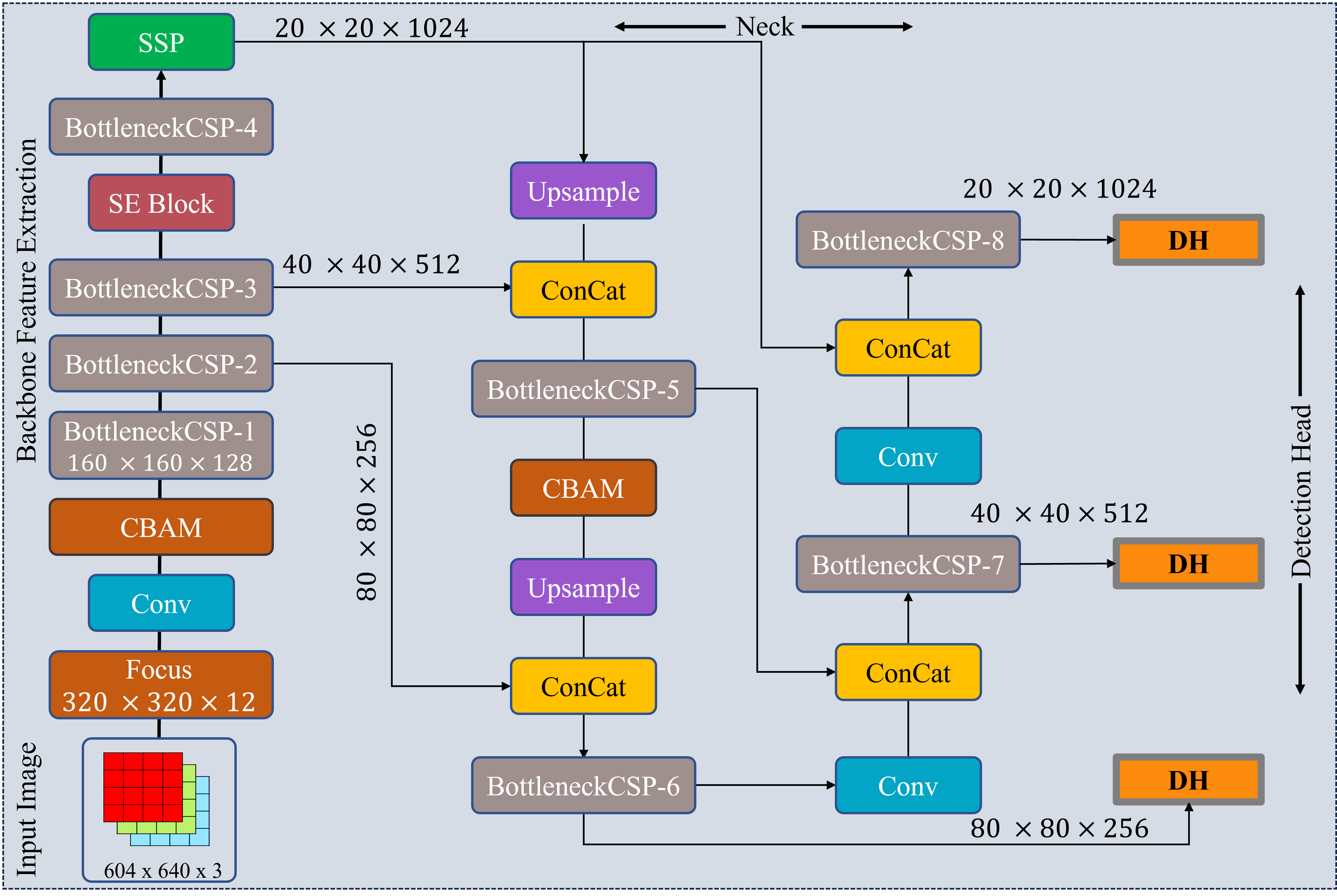
Fall detection (FD) systems are an important part of healthcare monitoring, especially for elderly populations, where quick intervention can prevent serious injuries. This paper introduces an optimized YOLOV5-based framework that combines dual attention mechanisms for improved FD in real-time edge deployment situations. The proposed design integrates the Convolutional Block Attention Module (CBAM) and Squeeze-and-Excitation (SE) blocks within the YOLOv5 backbone, along with an improved Focus module that uses slice-based feature extraction. These enhancements allow the model to effectively capture both spatial and channel-wise dependencies, which are essential for distinguishing fall events from normal human activities. Ablation studies confirm the individual contribution of each component, with more notable improvements observed on the challenging DiverseFALL10500 dataset, which features diverse environmental conditions. The framework maintains computational efficiency suitable for edge deployment while offering robust detection performance across different camera angles, lighting conditions, and complex backgrounds. A thorough evaluation on the CAUCAFall and DiverseFALL10500 benchmark datasets shows superior performance compared to existing YOLO variants.

Graphical Abstract
Dual Attention-Driven Optimized YOLOV5 Framework for Accurate Fall Detection in Visual Monitoring Systems

Keywords
fall detection
optimized YOLOv5
attention mechanism
healthcare monitoring
image analysis

Data Availability Statement
Data will be made available on request.

Funding
This work was supported without any funding.

Conflicts of Interest
Taimur Ali Khan is an employee of Department of IT, Saudi Media Systems, Riyadh 11482, Saudi Arabia. The authors declare no conflicts of interest.

Ethical Approval and Consent to Participate
Not applicable.

References
  1. Facts about falls. (2024, June 10). Older Adult Fall Prevention. Retrieved from https://www.cdc.gov/falls/data-research/facts-stats/index.html
    [Google Scholar]
  2. Ren, L., & Peng, Y. (2019). Research of Fall Detection and Fall Prevention Technologies: A Systematic Review. IEEE Access, 7, 77702-77722.
    [CrossRef]   [Google Scholar]
  3. Ma, L., Liu, M., Wang, N., Wang, L., Yang, Y., & Wang, H. (2020). Room-level fall detection based on ultra-wideband (UWB) monostatic radar and convolutional long short-term memory (LSTM). Sensors, 20(4), 1105.
    [CrossRef]   [Google Scholar]
  4. Wang, K., Zhan, G., & Chen, W. (2019). A new approach for IoT-based fall detection system using commodity mmWave sensors. In Proceedings of the 2019 7th International Conference on Information Technology: IoT and Smart City (pp. 197-201).
    [CrossRef]   [Google Scholar]
  5. Sheng-lan, Z., Yi-fan, Y., Li-fu, G., & Diao, W. (2019, November). Research and design of a fall detection system based on multi-axis sensor. In Proceedings of the 4th International Conference on Intelligent Information Processing (pp. 303-309).
    [CrossRef]   [Google Scholar]
  6. Er, P. V., & Tan, K. K. (2020). Wearable solution for robust fall detection. In Assistive Technology for the Elderly (pp. 81-105). Academic Press.
    [CrossRef]   [Google Scholar]
  7. Alam, E., Sufian, A., Dutta, P., & Leo, M. (2022). Vision-based human fall detection systems using deep learning: A review. Computers in biology and medicine, 146, 105626.
    [CrossRef]   [Google Scholar]
  8. Raza, A., Yousaf, M. H., & Velastin, S. A. (2022). Human fall detection using YOLO: a real-time and AI-on-the-edge perspective. In 2022 12th International Conference on Pattern Recognition Systems (ICPRS) (pp. 1-6). IEEE.
    [CrossRef]   [Google Scholar]
  9. Qi, P., Chiaro, D., & Piccialli, F. (2023). FL-FD: Federated learning-based fall detection with multimodal data fusion. Information Fusion, 99, 101890.
    [CrossRef]   [Google Scholar]
  10. Galvão, Y. M., Ferreira, J., Albuquerque, V. A., Barros, P., & Fernandes, B. J. (2021). A multimodal approach using deep learning for fall detection. Expert Systems with Applications, 168, 114226.
    [CrossRef]   [Google Scholar]
  11. Khan, H., Usman, M. T., & Koo, J. (2025). Bilateral feature fusion with hexagonal attention for robust saliency detection under uncertain environments. Information Fusion, 121, 103165.
    [CrossRef]   [Google Scholar]
  12. Rassekh, E., & Snidaro, L. (2025). Survey on data fusion approaches for fall-detection. Information Fusion, 114, 102696.
    [CrossRef]   [Google Scholar]
  13. Lin, B. S., Yu, T., Peng, C. W., Lin, C. H., Hsu, H. K., Lee, I. J., & Zhang, Z. (2022). Fall detection system with artificial intelligence-based edge computing. IEEE Access, 10, 4328-4339.
    [CrossRef]   [Google Scholar]
  14. Lv, H., Yan, H., Liu, K., Zhou, Z., & Jing, J. (2022). Yolov5-ac: Attention mechanism-based lightweight yolov5 for track pedestrian detection. Sensors, 22(15), 5903.
    [CrossRef]   [Google Scholar]
  15. Gholami, R., Jahromi, H. D., & Sedaghat, S. (2025). Design and Implementation of a Near Real-Time Human Detection Robot Using YOLO Framework and IoT Technologies. IEEE Access.
    [CrossRef]   [Google Scholar]
  16. Chin, W. H., Tay, N. N. W., Kubota, N., & Loo, C. K. (2020, July). A lightweight neural-net with assistive mobile robot for human fall detection system. In 2020 International Joint Conference on Neural Networks (IJCNN) (pp. 1-6). IEEE.
    [CrossRef]   [Google Scholar]
  17. Redmon, J., & Farhadi, A. (2017). YOLO9000: better, faster, stronger. In Proceedings of the IEEE conference on computer vision and pattern recognition (pp. 7263-7271).
    [CrossRef]   [Google Scholar]
  18. Zhang, X., Xie, Q., Sun, W., & Wang, T. (2025). Fall detection method based on spatio-temporal coordinate attention for high-resolution networks. Complex & Intelligent Systems, 11(1), 1.
    [CrossRef]   [Google Scholar]
  19. Chen, Y., Li, W., Wang, L., Hu, J., & Ye, M. (2020). Vision-based fall event detection in complex background using attention guided bi-directional LSTM. IEEE Access, 8, 161337-161348.
    [CrossRef]   [Google Scholar]
  20. Zhao, D., Song, T., Gao, J., Li, D., & Niu, Y. (2024). Yolo-fall: A novel convolutional neural network model for fall detection in open spaces. IEEE Access, 12, 26137-26149.
    [CrossRef]   [Google Scholar]
  21. Islam, M. M., Tayan, O., Islam, M. R., Islam, M. S., Nooruddin, S., Kabir, M. N., & Islam, M. R. (2020). Deep learning based systems developed for fall detection: a review. IEEE Access, 8, 166117-166137.
    [CrossRef]   [Google Scholar]
  22. Wu, P., Li, H., Zeng, N., & Li, F. (2022). FMD-Yolo: An efficient face mask detection method for COVID-19 prevention and control in public. Image and vision computing, 117, 104341.
    [CrossRef]   [Google Scholar]
  23. Tong, K., & Wu, Y. (2022). Deep learning-based detection from the perspective of small or tiny objects: A survey. Image and Vision Computing, 123, 104471.
    [CrossRef]   [Google Scholar]
  24. Chen, T., Ding, Z., & Li, B. (2022). Elderly Fall Detection Based on Improved YOLOv5s Network. IEEE Access, 10, 91273-91282.
    [CrossRef]   [Google Scholar]
  25. Woo, S., Park, J., Lee, J. Y., & Kweon, I. S. (2018, September). CBAM: Convolutional Block Attention Module. In European Conference on Computer Vision (pp. 3-19). Cham: Springer International Publishing.
    [CrossRef]   [Google Scholar]
  26. Usman, M. T., Khan, H., Singh, S. K., Lee, M. Y., & Koo, J. (2024). Efficient deepfake detection via layer-frozen assisted dual attention network for consumer imaging devices. IEEE Transactions on Consumer Electronics.
    [CrossRef]   [Google Scholar]
  27. Yar, H., Khan, Z. A., Ullah, F. U. M., Ullah, W., & Baik, S. W. (2023). A modified YOLOv5 architecture for efficient fire detection in smart cities. Expert Systems with Applications, 231, 120465.
    [CrossRef]   [Google Scholar]
  28. Khan, H., Ullah, I., Shabaz, M., Omer, M. F., Usman, M. T., Guellil, M. S., & Koo, J. (2024). Visionary vigilance: Optimized YOLOV8 for fallen person detection with large-scale benchmark dataset. Image and Vision Computing, 149, 105195.
    [CrossRef]   [Google Scholar]
  29. Khan, H., Huy, B. Q., Abidin, Z. U., Yoo, J., Lee, M., Seo, K. W., ... & Suhr, J. K. (2023). A modified yolov4 network with medium-scale challenging benchmark for efficient animal detection. Proceedings of the Korean Institute of Next Generation Computing, 183-186.
    [Google Scholar]
  30. Guerrero, J. C. E., España, E. M., Añasco, M. M., & Lopera, J. E. P. (2022). Dataset for human fall recognition in an uncontrolled environment. Data in brief, 45, 108610.
    [CrossRef]   [Google Scholar]

Cite This Article
APA Style
Ahmad, M. J., Khan, A., Khan, T. A., & Ahmad, B. (2025). Dual Attention-Driven Optimized YOLOV5 Framework for Accurate Fall Detection in Visual Monitoring Systems. ICCK Transactions on Intelligent Systematics, 3(1), 1–10. https://doi.org/10.62762/TIS.2025.559776
Export Citation
RIS Format
Compatible with EndNote, Zotero, Mendeley, and other reference managers
RIS format data for reference managers
TY  - JOUR
AU  - Ahmad, Muhammad Jamal
AU  - Khan, Arshad
AU  - Khan, Taimur Ali
AU  - Ahmad, Bilal
PY  - 2025
DA  - 2025/11/26
TI  - Dual Attention-Driven Optimized YOLOV5 Framework for Accurate Fall Detection in Visual Monitoring Systems
JO  - ICCK Transactions on Intelligent Systematics
T2  - ICCK Transactions on Intelligent Systematics
JF  - ICCK Transactions on Intelligent Systematics
VL  - 3
IS  - 1
SP  - 1
EP  - 10
DO  - 10.62762/TIS.2025.559776
UR  - https://www.icck.org/article/abs/TIS.2025.559776
KW  - fall detection
KW  - optimized YOLOv5
KW  - attention mechanism
KW  - healthcare monitoring
KW  - image analysis
AB  - Fall detection (FD) systems are an important part of healthcare monitoring, especially for elderly populations, where quick intervention can prevent serious injuries. This paper introduces an optimized YOLOV5-based framework that combines dual attention mechanisms for improved FD in real-time edge deployment situations. The proposed design integrates the Convolutional Block Attention Module (CBAM) and Squeeze-and-Excitation (SE) blocks within the YOLOv5 backbone, along with an improved Focus module that uses slice-based feature extraction. These enhancements allow the model to effectively capture both spatial and channel-wise dependencies, which are essential for distinguishing fall events from normal human activities. Ablation studies confirm the individual contribution of each component, with more notable improvements observed on the challenging DiverseFALL10500 dataset, which features diverse environmental conditions. The framework maintains computational efficiency suitable for edge deployment while offering robust detection performance across different camera angles, lighting conditions, and complex backgrounds. A thorough evaluation on the CAUCAFall and DiverseFALL10500 benchmark datasets shows superior performance compared to existing YOLO variants.
SN  - 3068-5079
PB  - Institute of Central Computation and Knowledge
LA  - English
ER  - 
BibTeX Format
Compatible with LaTeX, BibTeX, and other reference managers
BibTeX format data for LaTeX and reference managers
@article{Ahmad2025Dual,
  author = {Muhammad Jamal Ahmad and Arshad Khan and Taimur Ali Khan and Bilal Ahmad},
  title = {Dual Attention-Driven Optimized YOLOV5 Framework for Accurate Fall Detection in Visual Monitoring Systems},
  journal = {ICCK Transactions on Intelligent Systematics},
  year = {2025},
  volume = {3},
  number = {1},
  pages = {1-10},
  doi = {10.62762/TIS.2025.559776},
  url = {https://www.icck.org/article/abs/TIS.2025.559776},
  abstract = {Fall detection (FD) systems are an important part of healthcare monitoring, especially for elderly populations, where quick intervention can prevent serious injuries. This paper introduces an optimized YOLOV5-based framework that combines dual attention mechanisms for improved FD in real-time edge deployment situations. The proposed design integrates the Convolutional Block Attention Module (CBAM) and Squeeze-and-Excitation (SE) blocks within the YOLOv5 backbone, along with an improved Focus module that uses slice-based feature extraction. These enhancements allow the model to effectively capture both spatial and channel-wise dependencies, which are essential for distinguishing fall events from normal human activities. Ablation studies confirm the individual contribution of each component, with more notable improvements observed on the challenging DiverseFALL10500 dataset, which features diverse environmental conditions. The framework maintains computational efficiency suitable for edge deployment while offering robust detection performance across different camera angles, lighting conditions, and complex backgrounds. A thorough evaluation on the CAUCAFall and DiverseFALL10500 benchmark datasets shows superior performance compared to existing YOLO variants.},
  keywords = {fall detection, optimized YOLOv5, attention mechanism, healthcare monitoring, image analysis},
  issn = {3068-5079},
  publisher = {Institute of Central Computation and Knowledge}
}

Article Metrics
Citations:

Crossref

0

Scopus

0

Web of Science

0
Article Access Statistics:
Views: 200
PDF Downloads: 67

Publisher's Note
ICCK stays neutral with regard to jurisdictional claims in published maps and institutional affiliations.

Rights and Permissions
Institute of Central Computation and Knowledge (ICCK) or its licensor (e.g. a society or other partner) holds exclusive rights to this article under a publishing agreement with the author(s) or other rightsholder(s); author self-archiving of the accepted manuscript version of this article is solely governed by the terms of such publishing agreement and applicable law.
ICCK Transactions on Intelligent Systematics

ICCK Transactions on Intelligent Systematics

ISSN: 3068-5079 (Online) | ISSN: 3069-003X (Print)

Email: [email protected]

Portico

Portico

All published articles are preserved here permanently:
https://www.portico.org/publishers/icck/