Advancing Robotic Automation with Custom Sequential Deep CNN-Based Indoor Scene Recognition
Article Information
Abstract
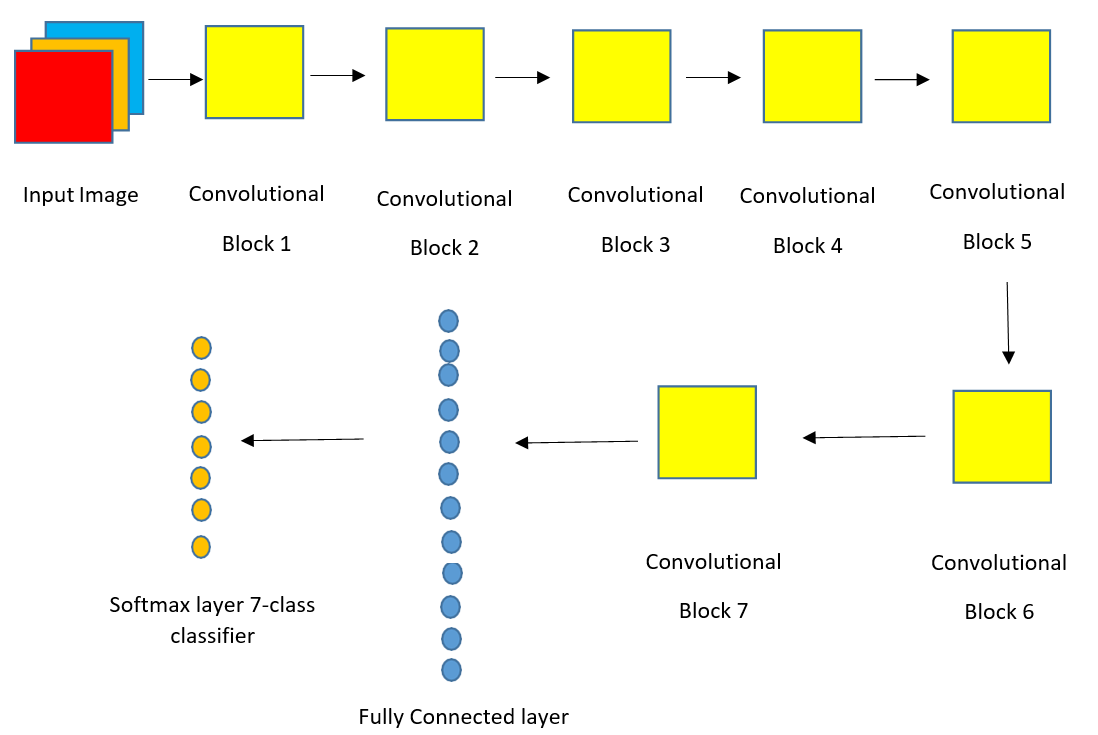
Indoor scene recognition poses considerable hurdles, especially in cluttered and visually analogous settings. Although several current recognition systems perform well in outside settings, there is a distinct necessity for enhanced precision in inside scene detection, particularly for robotics and automation applications. This research presents a revolutionary deep Convolutional Neural Network (CNN) model tailored with bespoke parameters to improve indoor image comprehension. Our proprietary dataset consists of seven unique interior scene types, and our deep CNN model is trained to attain excellent accuracy in classification tasks. The model exhibited exceptional performance, achieving a training accuracy of 99%, a testing accuracy of 89.73%, a precision of 90.11%, a recall of 89.73%, and an F1-score of 89.79%. These findings underscore the efficacy of our methodology in tackling the intricacies of indoor scene recognition. This research substantially advances the domain of robotics and automation by establishing a more resilient and dependable framework for autonomous navigation and scene comprehension in GPS-denied settings, facilitating the development of more efficient and intelligent robotic systems.
Graphical Abstract
Keywords
Data Availability Statement
Funding
Conflicts of Interest
Ethical Approval and Consent to Participate
References
- Macrorie, R., Marvin, S., & While, A. (2021). Robotics and automation in the city: a research agenda. Urban Geography, 42(2), 197-217.
[CrossRef] [Google Scholar] - Kolpashchikov, D., Gerget, O., & Meshcheryakov, R. (2022). Robotics in healthcare. Handbook of Artificial Intelligence in Healthcare: Vol 2: Practicalities and Prospects, 281-306.
[CrossRef] [Google Scholar] - Afif, M., Ayachi, R., Said, Y., & Atri, M. (2022). An evaluation of EfficientDet for object detection used for indoor robots assistance navigation. Journal of Real-Time Image Processing, 19(3), 651-661.
[CrossRef] [Google Scholar] - Heikel, E., & Espinosa-Leal, L. (2022). Indoor scene recognition via object detection and TF-IDF. Journal of Imaging, 8(8), 209.
[CrossRef] [Google Scholar] - Glavan, A., & Talavera, E. (2022). InstaIndoor and multi-modal deep learning for indoor scene recognition. Neural Computing and Applications, 34(9), 6861-6877.
[CrossRef] [Google Scholar] - Espinace, P., Kollar, T., Roy, N., & Soto, A. (2013). Indoor scene recognition by a mobile robot through adaptive object detection. Robotics and Autonomous Systems, 61(9), 932-947.
[CrossRef] [Google Scholar] - Khan, S. H., Hayat, M., Bennamoun, M., Togneri, R., & Sohel, F. A. (2016). A discriminative representation of convolutional features for indoor scene recognition. IEEE Transactions on Image Processing, 25(7), 3372-3383.
[CrossRef] [Google Scholar] - Khan, S. D., & Othman, K. M. (2024). Indoor Scene Classification through Dual-Stream Deep Learning: A Framework for Improved Scene Understanding in Robotics. Computers, 13(5), 121.
[CrossRef] [Google Scholar] - Li, X. (2024, April). Intelligent Inspection Robot Scene Recognition under Convolutional Neural Network. In 2024 IEEE 13th International Conference on Communication Systems and Network Technologies (CSNT) (pp. 519-524). IEEE.
[CrossRef] [Google Scholar] - Santos, D., Lopez-Lopez, E., Pardo, X. M., Iglesias, R., Barro, S., & Fdez-Vidal, X. R. (2019). Robust and fast scene recognition in robotics through the automatic identification of meaningful images. Sensors, 19(18), 4024.
[CrossRef] [Google Scholar] - Jia, Y., Ramalingam, B., Mohan, R. E., Yang, Z., Zeng, Z., & Veerajagadheswar, P. (2023). Deep-learning-based context-aware multi-level information fusion systems for indoor mobile robots safe navigation. sensors, 23(4), 2337.
[CrossRef] [Google Scholar] - Sharma, V., Nagpal, N., Shandilya, A., Dureja, A., & Dureja, A. (2022, December). A Practical Approach to detect Indoor and Outdoor Scene Recognition. In Proceedings of the 4th International Conference on Information Management & Machine Intelligence (pp. 1-10).
[CrossRef] [Google Scholar] - Zhu, Y., Luo, H., Zhao, F., & Chen, R. (2020). Indoor/outdoor switching detection using multisensor DenseNet and LSTM. IEEE Internet of Things Journal, 8(3), 1544-1556.
[CrossRef] [Google Scholar] - Kuriakose, B., Shrestha, R., & Sandnes, F. E. (2021, October). SceneRecog: a deep learning scene recognition model for assisting blind and visually impaired navigate using smartphones. In 2021 IEEE International Conference on Systems, Man, and Cybernetics (SMC) (pp. 2464-2470). IEEE.
[CrossRef] [Google Scholar] - Alqobali, R., Alshmrani, M., Alnasser, R., Rashidi, A., Alhmiedat, T., & Alia, O. M. D. (2023). A survey on robot semantic navigation systems for indoor environments. Applied Sciences, 14(1), 89.
[CrossRef] [Google Scholar] - Wijayathunga, L., Rassau, A., & Chai, D. (2023). Challenges and solutions for autonomous ground robot scene understanding and navigation in unstructured outdoor environments: A review. Applied Sciences, 13(17), 9877.
[CrossRef] [Google Scholar] - Daou, A., Pothin, J. B., Honeine, P., & Bensrhair, A. (2023). Indoor scene recognition mechanism based on direction-driven convolutional neural networks. Sensors, 23(12), 5672.
[CrossRef] [Google Scholar] - Kumar, N., Singh, H., Varshney, M. T., Malik, M. V., & Kumar, V. (2022). Indoor and Outdoor Scene Recognition. Grenze International Journal of Engineering & Technology (GIJET), 8(2). https://www.academia.edu/download/98777831/18_924_930.pdf
[Google Scholar] - Seichter, D., Köhler, M., Lewandowski, B., Wengefeld, T., & Gross, H. M. (2021, May). Efficient rgb-d semantic segmentation for indoor scene analysis. In 2021 IEEE international conference on robotics and automation (ICRA) (pp. 13525-13531). IEEE.
[CrossRef] [Google Scholar] - Liu, S., & Tian, G. (2019). An indoor scene classification method for service robot Based on CNN feature. Journal of Robotics, 2019(1), 8591035.
[CrossRef] [Google Scholar] - Rafique, A. A., Gochoo, M., Jalal, A., & Kim, K. (2023). Maximum entropy scaled super pixels segmentation for multi-object detection and scene recognition via deep belief network. Multimedia Tools and Applications, 82(9), 13401-13430.
[CrossRef] [Google Scholar] - Zhao, X., & Cheah, C. C. (2023). BIM-based indoor mobile robot initialization for construction automation using object detection. Automation in Construction, 146, 104647.
[CrossRef] [Google Scholar] - Wang, H., & Li, M. (2024). A new era of indoor scene reconstruction: A survey. IEEE Access, 12, 110160-110192.
[CrossRef] [Google Scholar] - Choe, S., Seong, H., & Kim, E. (2021). Indoor place category recognition for a cleaning robot by fusing a probabilistic approach and deep learning. IEEE Transactions on Cybernetics, 52(8), 7265-7276.
[CrossRef] [Google Scholar] - Yang, J., Zou, H., Zhou, Y., & Xie, L. (2021). Robust adversarial discriminative domain adaptation for real-world cross-domain visual recognition. Neurocomputing, 433, 28-36.
[CrossRef] [Google Scholar] - Gupta, S., Arbelaez, P., & Malik, J. (2013). Perceptual organization and recognition of indoor scenes from RGB-D images. In Proceedings of the IEEE conference on computer vision and pattern recognition (pp. 564-571).
[Google Scholar] - Zhou, Z., Li, L., Fürsterling, A., Durocher, H. J., Mouridsen, J., & Zhang, X. (2022). Learning-based object detection and localization for a mobile robot manipulator in SME production. Robotics and Computer-Integrated Manufacturing, 73, 102229.
[CrossRef] [Google Scholar] - Samani, E. U., Yang, X., & Banerjee, A. G. (2021). Visual object recognition in indoor environments using topologically persistent features. IEEE Robotics and Automation Letters, 6(4), 7509-7516.
[CrossRef] [Google Scholar] - Silvera-Tawil, D. (2024). Robotics in Healthcare: A Survey. SN Computer Science, 5(1), 189.
[CrossRef] [Google Scholar] - Liu, M., Chen, M., Wu, Z., Zhong, B., & Deng, W. (2024). Implementation of Intelligent Indoor Service Robot Based on ROS and Deep Learning. Machines, 12(4), 256.
[CrossRef] [Google Scholar] - Strader, J., Hughes, N., Chen, W., Speranzon, A., & Carlone, L. (2024). Indoor and outdoor 3d scene graph generation via language-enabled spatial ontologies. IEEE Robotics and Automation Letters, 9(6), 4886-4893.
[CrossRef] [Google Scholar] - Liu, Z., Wang, J., Li, J., Liu, P., & Ren, K. (2023). A novel multiple targets detection method for service robots in the indoor complex scenes. Intelligent Service Robotics, 16(4), 453-469.
[CrossRef] [Google Scholar] - Han, X., Li, S., Wang, X., & Zhou, W. (2021). Semantic mapping for mobile robots in indoor scenes: A survey. Information, 12(2), 92.
[CrossRef] [Google Scholar] - Feng, J., Sun, J., & Yao, Y. (2023, April). Design of Intelligent Service Robot for Military Recuperation. In 2023 IEEE International Conference on Control, Electronics and Computer Technology (ICCECT) (pp. 131-137). IEEE.
[CrossRef] [Google Scholar] - Jiang, L., Nie, W., Zhu, J., Gao, X., & Lei, B. (2022). Lightweight object detection network model suitable for indoor mobile robots. Journal of Mechanical Science and Technology, 36(2), 907-920.
[CrossRef] [Google Scholar] - Chang, C. Y., Chang, S. E., Hsiao, P. Y., & Fu, L. C. (2020, November). EPSNet: Efficient Panoptic Segmentation Network with Cross-layer Attention Fusion. In Asian Conference on Computer Vision (pp. 689-705).
[CrossRef] [Google Scholar] - Wang, L., Li, R., Sun, J., Liu, X., Zhao, L., Seah, H. S., ... & Tandianus, B. (2019). Multi-view fusion-based 3D object detection for robot indoor scene perception. Sensors, 19(19), 4092.
[CrossRef] [Google Scholar] - Masone, C., & Caputo, B. (2021). A survey on deep visual place recognition. IEEE Access, 9, 19516-19547.
[CrossRef] [Google Scholar] - Hanni, A., Chickerur, S., & Bidari, I. (2017, December). Deep learning framework for scene based indoor location recognition. In 2017 international conference on technological advancements in power and energy (TAP energy) (pp. 1-8). IEEE.
[CrossRef] [Google Scholar] - Afif, M., Ayachi, R., Said, Y., & Atri, M. (2023). An indoor scene recognition system based on deep learning evolutionary algorithms. Soft Computing, 27(21), 15581-15594.
[CrossRef] [Google Scholar] - Labinghisa, B. A., & Lee, D. M. (2022). Indoor localization system using deep learning based scene recognition. Multimedia Tools and Applications, 81(20), 28405-28429.
[CrossRef] [Google Scholar] - Ismail, A. S., Seifelnasr, M. M., & Guo, H. (2018, April). Understanding indoor scene: Spatial layout estimation, scene classification, and object detection. In Proceedings of the 3rd International Conference on Multimedia Systems and Signal Processing (pp. 64-70).
[CrossRef] [Google Scholar] - Sitaula, C., Xiang, Y., Zhang, Y., Lu, X., & Aryal, S. (2019). Indoor image representation by high-level semantic features. IEEE Access, 7, 84967-84979.
[CrossRef] [Google Scholar] - Susan, S., & Tuteja, M. (2024). Feature Engineering Versus Deep Learning for Scene Recognition: A Brief Survey. International Journal of Image and Graphics, 2550054.
[CrossRef] [Google Scholar] - Guo, J., Chen, H., Liu, B., & Xu, F. (2023). A system and method for person identification and positioning incorporating object edge detection and scale-invariant feature transformation. Measurement, 223, 113759.
[CrossRef] [Google Scholar] - Afif, M., Ayachi, R., Said, Y., & Atri, M. (2020). Deep learning based application for indoor scene recognition. Neural Processing Letters, 51, 2827-2837.
[CrossRef] [Google Scholar] - Surendran, R., Chihi, I., Anitha, J., & Hemanth, D. J. (2023). Indoor Scene Recognition: An Attention-Based Approach Using Feature Selection-Based Transfer Learning and Deep Liquid State Machine. Algorithms, 16(9), 430.
[CrossRef] [Google Scholar] - Singh, A., Pandey, P., Puig, D., Nandi, G. C., & Abdel-Nasser, M. (2022). Reliable Scene Recognition Approach for Mobile Robots with Limited Resources Based on Deep Learning and Neuro-Fuzzy Inference. Traitement du Signal, 39(4), 1255.
[CrossRef] [Google Scholar] - Quattoni, A., & Torralba, A. (2009, June). Recognizing indoor scenes. In 2009 IEEE conference on computer vision and pattern recognition (pp. 413-420). IEEE.
[CrossRef] [Google Scholar] - Bose, D., Hebbar, R., Somandepalli, K., Zhang, H., Cui, Y., Cole-McLaughlin, K., ... & Narayanan, S. (2023). Movieclip: Visual scene recognition in movies. In Proceedings of the IEEE/CVF Winter Conference on Applications of Computer Vision (pp. 2083-2092).
[Google Scholar] - Velikov, K. (2023). Enhancing Semantic Segmentation for Indoor Environments: Integrating Depth Information into Neural Networks (Bachelor's thesis, University of Twente). https://essay.utwente.nl/fileshare/file/96088/Velikov_BA_EEMCS.pdf
[Google Scholar] - Piekenbrinck, J., Hermans, A., Vaskevicius, N., Linder, T., & Leibe, B. (2024). RGB-D Cube R-CNN: 3D Object Detection with Selective Modality Dropout. In Proceedings of the IEEE/CVF Conference on Computer Vision and Pattern Recognition (pp. 1997-2006).
[Google Scholar] - Naidu, G., Zuva, T., & Sibanda, E. M. (2023, April). A review of evaluation metrics in machine learning algorithms. In Computer Science On-line Conference (pp. 15-25). Cham: Springer International Publishing.
[CrossRef] [Google Scholar] - Ahmed, M. W., & Jalal, A. (2024, November). Indoor Scene Classification Using RGB-D Data: A Vision Transformer and Conditional Random Field Approach. In 2024 5th International Conference on Innovative Computing (ICIC) (pp. 1-6). IEEE.
[CrossRef] [Google Scholar] - Miao, B., Zhou, L., Mian, A. S., Lam, T. L., & Xu, Y. (2021, September). Object-to-scene: Learning to transfer object knowledge to indoor scene recognition. In 2021 IEEE/RSJ International Conference on Intelligent Robots and Systems (IROS) (pp. 2069-2075). IEEE.
[CrossRef] [Google Scholar] - Zhou, B., Lapedriza, A., Khosla, A., Oliva, A., & Torralba, A. (2017). Places: A 10 million image database for scene recognition. IEEE transactions on pattern analysis and machine intelligence, 40(6), 1452-1464.
[CrossRef] [Google Scholar] - Ni, J., Shen, K., Chen, Y., & Yang, S. X. (2023). An improved ssd-like deep network-based object detection method for indoor scenes. IEEE Transactions on Instrumentation and Measurement, 72, 1-15.
[CrossRef] [Google Scholar] - Xie, L., Lee, F., Liu, L., Kotani, K., & Chen, Q. (2020). Scene recognition: A comprehensive survey. Pattern Recognition, 102, 107205.
[CrossRef] [Google Scholar] - Anbarasu, B., & Anitha, G. (2018). Indoor scene recognition for micro aerial vehicles navigation using enhanced-GIST descriptors. Defence Science Journal, 68(2), 129.
[CrossRef] [Google Scholar] - Yue, H., Lehtola, V., Wu, H., Vosselman, G., Li, J., & Liu, C. (2024). Recognition of Indoor Scenes using 3D Scene Graphs. IEEE Transactions on Geoscience and Remote Sensing.
[CrossRef] [Google Scholar] - Song, X., Jiang, S., & Herranz, L. (2017). Multi-scale multi-feature context modeling for scene recognition in the semantic manifold. IEEE Transactions on Image Processing, 26(6), 2721-2735.
[CrossRef] [Google Scholar] - Ha, I., Kim, H., Park, S., & Kim, H. (2018). Image retrieval using BIM and features from pretrained VGG network for indoor localization. Building and Environment, 140, 23-31.
[CrossRef] [Google Scholar] - Nascimento, G., Laranjeira, C., Braz, V., Lacerda, A., & Nascimento, E. R. (2017, November). A robust indoor scene recognition method based on sparse representation. In Iberoamerican Congress on Pattern Recognition (pp. 408-415). Cham: Springer International Publishing.
[CrossRef] [Google Scholar]
Cited By (21)
-
Jia Liu, Long Wu, Chunxi Yang, Xiufeng Zhang, Hongwei Sun. .
Advances in Bio-inspired System and Robotics, 2027 .
[CrossRef] -
Praveen Kulkarni, Naina Kalyanshetti, A Sachin, Aryan Penukonda, M Naveen, Pramod Gurunath Chitrapur. .
2026 International Conference on Smart Electronic Devices and Intelligent Systems (ICSEDIS), 2026 .
[CrossRef] -
Prateek Agrawal, Dharmendra Pathak, Vishu Madaan, Pawan Kumar Verma, Wou Onn Choo. Spatiotemporal deep learning for real-time video-based deepfake detection using 3DCNN, 3DResNet, TCN, and VAE.
Scientific Reports, 2026 , 16 (1).
[CrossRef] -
Nagalakshmi Vallabhaneni, Prabhavathy Panneer. Hybrid vision–IMU deep learning framework with graph convolutional networks and attention for personalized yoga posture identification.
Scientific Reports, 2026 , 16 (1).
[CrossRef] -
Fahad Ata, Kubilay Ayturan, Fırat Hardalaç, Uğurhan Kutbay. Optimized deep learning architectures for high precision eye blink detection on consumer grade hardware.
Discover Artificial Intelligence, 2026 , 6 (1).
[CrossRef] -
Dheeraj Kumar, Piyush Kumar Singh, Prabhat Ranjan. Hybrid attention mechanism for deepfake faces detection.
Signal, Image and Video Processing, 2026 , 20 (5).
[CrossRef] -
Gunjan Pareek, Rajiv Singh, Swati Nigam. Multimodal activity recognition using separable convolutional long short-term memory.
International Journal of Data Science and Analytics, 2026 , 22 (1).
[CrossRef] -
Imad Tbaileh, Huthaifa I. Ashqar. Evaluating domain generalization of product image quality assessment models using AI-generated images.
Multimedia Systems, 2026 , 32 (7).
[CrossRef] -
Saklain Abdullah, Riad Hossain, Mahfuzulhoq Chowdhury. Quantifying modality imbalance and visual jailbreak robustness in LLaVA via projected gradient descent.
Discover Applied Sciences, 2026 , 8 (7).
[CrossRef] -
Kalaimathi Bathirappan, Jayanthy Soundararajan. A channel and spatial attentions mechanisms with CNN for enhanced license plate detection.
Scientific Reports, 2026 , 16 (1).
[CrossRef] -
Othmane Sebban, Ahmed Azough, Mohamed Lamrini. Lightweight real-time image captioning for mobile systems: an optimized multimodal framework and benchmarking study.
Journal of Real-Time Image Processing, 2026 , 23 (5).
[CrossRef] -
Shatakshi Saxena, Angel, Manju Khurana, Shailendra Tiwari, Harish Kumar Shakya. Low-light driver drowsiness detection for real-time safety assistance using dual attention mechanisms in deep learning model.
Scientific Reports, 2026 , 16 (1).
[CrossRef] -
Maher Alrahhal, Fatimah Alqahtani, Rohaya Latip, Mohammad AlShabi, Walaa M. Abd-Elhafiez. Deepfake face detection using hybrid bag-of-visual-words and multi-CNN feature fusion.
Scientific Reports, 2026 , 16 (1).
[CrossRef] -
Jiale Wang, Yue Mei, Ming Xia, Chuang Shi. RDG-Three-Branch Network With GAF-Based 1-D-to-2-D Image Transformation for Pedestrian Scene Recognition.
IEEE Sensors Journal, 2026 , 26 (11).
[CrossRef] -
Irfan Ali, Zarqa Bano, Lyu Guanghua, Ghulam E Mustafa Abro, Syed Hadi Hussain Shah. Robust Trajectory Tracking Control in Two Stages of a Robot Manipulator in Quasi Linearization Form.
Arabian Journal for Science and Engineering, 2025 , 50 (22).
[CrossRef] -
Marwa Ben Jabra, Omar Cheikhrouhou, Anouar BenAmor. Leveraging temporal attention and bidirectional modeling for robust deepfake video detection.
Signal, Image and Video Processing, 2025 , 19 (16).
[CrossRef] -
Abdullah M. Alashjaee, Asma A. Alhashmi, Abdulbasit A. Darem. A smart assistive system for visually challenged people through efficient object detection using deep learning with tunicate swarm algorithm.
Scientific Reports, 2025 , 15 (1).
[CrossRef] -
Abdulatif Ahmed Ali Aboluhom, Ismet Kandilli. Real-time facial recognition via multitask learning on raspberry Pi.
Scientific Reports, 2025 , 15 (1).
[CrossRef] -
Anoop Dev, Sachin Singh, Ashmeet Kaur, Neha, Satish Upadhyay, J. Refonaa. AI-ASSISTED RESTORATION OF FOLK MURALS.
ShodhKosh: Journal of Visual and Performing Arts, 2025 , 6 (1s).
[CrossRef] -
Ahmed Sameh, Mohamed Fanni, Maher Rashad. Advances in intelligent industrial manipulators for smart manufacturing and standardized automation technologies.
Discover Robotics, 2025 , 1 (1).
[CrossRef]
Cite This Article
TY - JOUR AU - Dahri, Fida Hussain AU - Abro, Ghulam E Mustafa AU - Dahri, Nisar Ahmed AU - Laghari, Asif Ali AU - Ali, Zain Anwar PY - 2024 DA - 2024/12/27 TI - Advancing Robotic Automation with Custom Sequential Deep CNN-Based Indoor Scene Recognition JO - ICCK Transactions on Intelligent Systematics T2 - ICCK Transactions on Intelligent Systematics JF - ICCK Transactions on Intelligent Systematics VL - 2 IS - 1 SP - 14 EP - 26 DO - 10.62762/TIS.2025.613103 UR - https://www.icck.org/article/abs/TIS.2025.613103 KW - indoor scene recognition KW - deep convolutional neural network (CNN) KW - robotics and automation autonomous navigation and GPS-Denied environments AB - Indoor scene recognition poses considerable hurdles, especially in cluttered and visually analogous settings. Although several current recognition systems perform well in outside settings, there is a distinct necessity for enhanced precision in inside scene detection, particularly for robotics and automation applications. This research presents a revolutionary deep Convolutional Neural Network (CNN) model tailored with bespoke parameters to improve indoor image comprehension. Our proprietary dataset consists of seven unique interior scene types, and our deep CNN model is trained to attain excellent accuracy in classification tasks. The model exhibited exceptional performance, achieving a training accuracy of 99%, a testing accuracy of 89.73%, a precision of 90.11%, a recall of 89.73%, and an F1-score of 89.79%. These findings underscore the efficacy of our methodology in tackling the intricacies of indoor scene recognition. This research substantially advances the domain of robotics and automation by establishing a more resilient and dependable framework for autonomous navigation and scene comprehension in GPS-denied settings, facilitating the development of more efficient and intelligent robotic systems. SN - 3068-5079 PB - Institute of Central Computation and Knowledge LA - English ER -
@article{Dahri2024Advancing,
author = {Fida Hussain Dahri and Ghulam E Mustafa Abro and Nisar Ahmed Dahri and Asif Ali Laghari and Zain Anwar Ali},
title = {Advancing Robotic Automation with Custom Sequential Deep CNN-Based Indoor Scene Recognition},
journal = {ICCK Transactions on Intelligent Systematics},
year = {2024},
volume = {2},
number = {1},
pages = {14-26},
doi = {10.62762/TIS.2025.613103},
url = {https://www.icck.org/article/abs/TIS.2025.613103},
abstract = {Indoor scene recognition poses considerable hurdles, especially in cluttered and visually analogous settings. Although several current recognition systems perform well in outside settings, there is a distinct necessity for enhanced precision in inside scene detection, particularly for robotics and automation applications. This research presents a revolutionary deep Convolutional Neural Network (CNN) model tailored with bespoke parameters to improve indoor image comprehension. Our proprietary dataset consists of seven unique interior scene types, and our deep CNN model is trained to attain excellent accuracy in classification tasks. The model exhibited exceptional performance, achieving a training accuracy of 99\%, a testing accuracy of 89.73\%, a precision of 90.11\%, a recall of 89.73\%, and an F1-score of 89.79\%. These findings underscore the efficacy of our methodology in tackling the intricacies of indoor scene recognition. This research substantially advances the domain of robotics and automation by establishing a more resilient and dependable framework for autonomous navigation and scene comprehension in GPS-denied settings, facilitating the development of more efficient and intelligent robotic systems.},
keywords = {indoor scene recognition, deep convolutional neural network (CNN), robotics and automation autonomous navigation and GPS-Denied environments},
issn = {3068-5079},
publisher = {Institute of Central Computation and Knowledge}
}
Publisher's Note
ICCK stays neutral with regard to jurisdictional claims in published maps and institutional affiliations.
Rights and Permissions
Portico