

Extracting Agricultural Experts' Experiential Knowledge from Non-Standardized Text with Quantity and Operation Scope Constraints


Article Information
Abstract
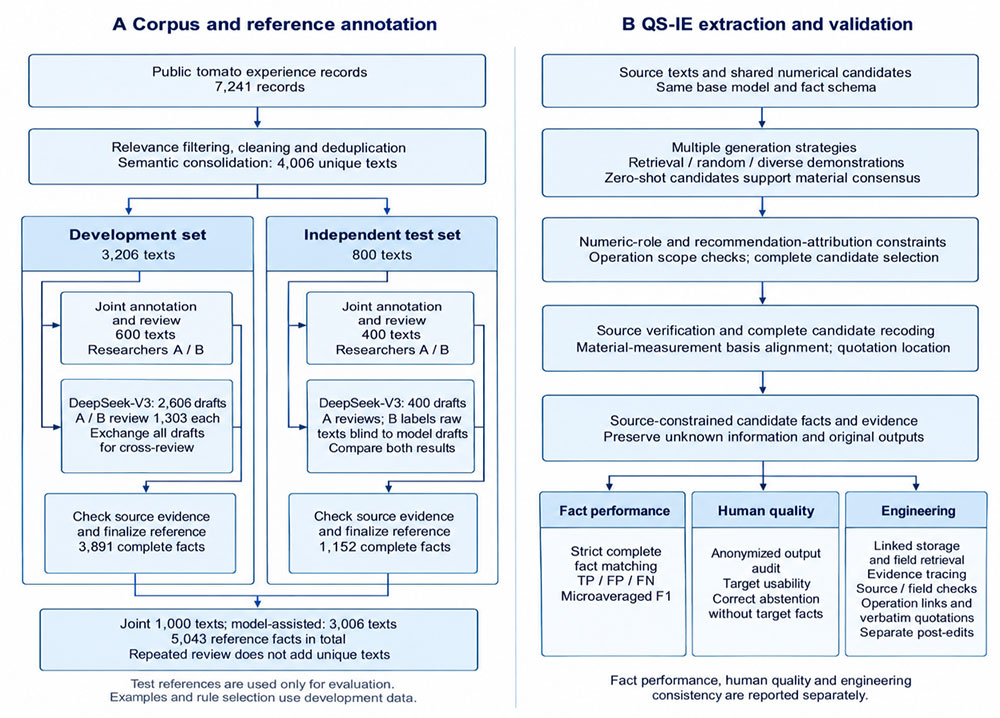
Expert advice on crop management is often written informally, and in such text a number can easily be assigned the wrong role or attached to the wrong operation, material, or measurement basis. We propose QS-IE, a knowledge extraction method constrained by quantity and operation scope. Its unit of extraction is a complete quantitative fact. Given a shared set of numeric candidates and a single base model, QS-IE selects complete candidates from several prompting strategies, verifies them against the source text, and applies scope constraints, so that every extracted quantity stays linked to its source evidence. We built a corpus of 4006 texts on tomato cultivation. Two researchers with agronomy backgrounds jointly annotated and reviewed 1000 of them; the other 3006 were annotated with large language model assistance and then reviewed by hand. The corpus was split into 3206 development texts and 800 independent test texts. On the 1152 reference facts of the test set, QS-IE reached a precision of 84.02%, a recall of 86.72%, and a micro-averaged F1 of 85.35%, which is 3.91 percentage points higher than the strongest baseline, a multi-strategy in-context learning ensemble. Removing the operation scope constraints lowered test F1 by 8.24 percentage points. In a sampled human audit of the test set, 82.00% of the outputs for texts containing target facts were judged usable, and all six engineering checks on storage and evidence traceability were passed. The results indicate that explicit association constraints make quantitative facts extracted from tomato cultivation texts more complete and easier to review, which supports the structured, traceable storage of experiential knowledge that experts express in non-standardized text.
Graphical Abstract
Keywords
Data Availability Statement
Funding
Conflicts of Interest
AI Use Statement
Ethical Approval and Consent to Participate
References
- Rafea, A., El-Dessouki, A., Hassan, H., & Mohamed, S. (1993). Development and implementation of a knowledge acquisition methodology for crop management expert systems. Computers and electronics in agriculture, 8(2), 129-146.
[CrossRef] [Google Scholar] - Girard, N., & Hubert, B. (1999). Modelling expert knowledge with knowledge-based systems to design decision aids: The example of a knowledge-based model on grazing management. Agricultural Systems, 59(2), 123-144.
[CrossRef] [Google Scholar] - Cornelissen, A. M. G., van den Berg, J., Koops, W. J., & Kaymak, U. (2003). Elicitation of expert knowledge for fuzzy evaluation of agricultural production systems. Agriculture, ecosystems & environment, 95(1), 1-18.
[CrossRef] [Google Scholar] - Robledo, J., Sulá, A. I. P., Jaworski, L. G., Mouafo-Tchinda, R. A., Andersen Onofre, K. F., Thomas-Sharma, S., & Garrett, K. A. (2025). Expert knowledge elicitation: Accessing the big data in experts’ brains. Phytopathology®, 115(10), 1245-1259.
[CrossRef] [Google Scholar] - Semeon, G., & Garfield, M. J. (2019). Framework for externalization of tacit knowledge in participatory agricultural research in Ethiopia: The case of Farmers Research Group (FRG). In Proceedings of the 52nd Hawaii International Conference on System Sciences (pp. 5339-5347). https://aisel.aisnet.org/hicss-52/ks/culture_ks/4/
[Google Scholar] - Koenderink, N. J., Top, J. L., & van Vliet, L. J. (2005, August). Expert-based ontology construction: A case-study in horticulture. In 16th International Workshop on Database and Expert Systems Applications (DEXA'05) (pp. 383-387). IEEE.
[CrossRef] [Google Scholar] - Ngo, Q. H., Kechadi, T., & Le-Khac, N. A. (2022). Knowledge representation in digital agriculture: A step towards standardised model. Computers and Electronics in Agriculture, 199, 107127.
[CrossRef] [Google Scholar] - Jonquet, C., Toulet, A., Arnaud, E., Aubin, S., Yeumo, E. D., Emonet, V., ... & Larmande, P. (2018). AgroPortal: A vocabulary and ontology repository for agronomy. Computers and Electronics in Agriculture, 144, 126-143.
[CrossRef] [Google Scholar] - Nismi Mol, E. A., & Santosh Kumar, M. B. (2023). Review on knowledge extraction from text and scope in agriculture domain. Artificial intelligence review, 56(5), 4403-4445.
[CrossRef] [Google Scholar] - Wu, H., Xie, N., Fan, J., Wang, X., Liu, H., Zheng, H., ... & Lv, Q. (2026). Autonomous construction of crop pest and disease knowledge graphs at scale via LLM-driven expert modeling. Computers and Electronics in Agriculture, 250, 111970.
[CrossRef] [Google Scholar] - Guo, W., & Zhao, C. (2026). Wheat agronomic knowledge extraction and spatio-temporal knowledge graph construction. Applied Sciences, 16(10), 4776.
[CrossRef] [Google Scholar] - Wang, Y., Zhao, K., Li, H., Wang, R., & Chen, W. (2026). A condition-aware retrieval-augmented decision support framework for tomato cultivation management. Frontiers in Plant Science, 17, 1802748.
[CrossRef] [Google Scholar] - Gu, W., Wang, X., Wang, Z., Gao, Y., Zhang, X., Zheng, J., & Liu, K. (2026). PlantExpert: A knowledge graph-augmented large language model for agricultural question answering. Smart Agricultural Technology, 15, 102467.
[CrossRef] [Google Scholar] - Wu, H., Xie, N., Wang, X., Fan, J., Li, Y., & Meng, Z. (2025). Crop GraphRAG: pest and disease knowledge base Q&A system for sustainable crop protection. Frontiers in Plant Science, 16, 1696872.
[CrossRef] [Google Scholar] - Lu, Y., Liu, Q., Dai, D., Xiao, X., Lin, H., Han, X., ... & Wu, H. (2022, May). Unified structure generation for universal information extraction. In Proceedings of the 60th annual meeting of the association for computational linguistics (volume 1: Long papers) (pp. 5755-5772).
[CrossRef] [Google Scholar] - Wadden, D., Wennberg, U., Luan, Y., & Hajishirzi, H. (2019, November). Entity, relation, and event extraction with contextualized span representations. In Proceedings of the 2019 conference on empirical methods in natural language processing and the 9th international joint conference on natural language processing (EMNLP-IJCNLP) (pp. 5784-5789).
[CrossRef] [Google Scholar] - Kaushik, N., & Chatterjee, N. (2018). Automatic relationship extraction from agricultural text for ontology construction. Information processing in agriculture, 5(1), 60-73.
[CrossRef] [Google Scholar] - Dagdelen, J., Dunn, A., Lee, S., Walker, N., Rosen, A. S., Ceder, G., ... & Jain, A. (2024). Structured information extraction from scientific text with large language models. Nature communications, 15(1), 1418.
[CrossRef] [Google Scholar] - Polak, M. P., & Morgan, D. (2024). Extracting accurate materials data from research papers with conversational language models and prompt engineering. Nature Communications, 15(1), 1569.
[CrossRef] [Google Scholar] - Mysore, S., Jensen, Z., Kim, E., Huang, K., Chang, H. S., Strubell, E., ... & Olivetti, E. (2019, August). The materials science procedural text corpus: Annotating materials synthesis procedures with shallow semantic structures. In Proceedings of the 13th linguistic annotation workshop (pp. 56-64).
[CrossRef] [Google Scholar] - Du, W., Liao, W., Liang, H., & Lei, W. (2024, August). PAGED: A benchmark for procedural graphs extraction from documents. In Proceedings of the 62nd Annual Meeting of the Association for Computational Linguistics (Volume 1: Long Papers) (pp. 10829-10846).
[CrossRef] [Google Scholar] - Ying, W., Liu, Y., Zhao, X., Cheng, W., Chen, Z., Yu, W., Fu, Y., & Chen, H. (2026). Multi-agent procedural graph extraction with structural and logical refinement. In Findings of the Association for Computational Linguistics: EACL 2026 (pp. 3021-3034).
[CrossRef] [Google Scholar] - Liu, J., Shen, D., Zhang, Y., Dolan, W. B., Carin, L., & Chen, W. (2022, May). What makes good in-context examples for GPT-3?. In Proceedings of Deep Learning Inside Out (DeeLIO 2022): The 3rd workshop on knowledge extraction and integration for deep learning architectures (pp. 100-114).
[CrossRef] [Google Scholar] - Liu, A., Feng, B., Xue, B., Wang, B., Wu, B., Lu, C., ... & Piao, Y. (2024). Deepseek-v3 technical report. arXiv preprint arXiv:2412.19437.
[CrossRef] [Google Scholar] - Court, C. J., & Cole, J. M. (2018). Auto-generated materials database of Curie and Néel temperatures via semi-supervised relationship extraction. Scientific data, 5(1), 180111.
[CrossRef] [Google Scholar] - Lewis, P., Perez, E., Piktus, A., Petroni, F., Karpukhin, V., Goyal, N., ... & Kiela, D. (2020). Retrieval-augmented generation for knowledge-intensive nlp tasks. Advances in neural information processing systems, 33, 9459-9474. https://papers.neurips.cc/paper/2020/hash/6b493230205f780e1bc26945df7481e5-Abstract.html
[Google Scholar] - Brown, T., Mann, B., Ryder, N., Subbiah, M., Kaplan, J. D., Dhariwal, P., ... & Amodei, D. (2020). Language models are few-shot learners. Advances in neural information processing systems, 33, 1877-1901. https://proceedings.neurips.cc/paper_files/paper/2020/hash/1457c0d6bfcb4967418bfb8ac142f64a-Abstract.html
[Google Scholar] - Hui, B., Yang, J., Cui, Z., Yang, J., Liu, D., Zhang, L., ... & Lin, J. (2024). Qwen2.5-coder technical report. arXiv preprint arXiv:2409.12186.
[CrossRef] [Google Scholar] - Sokolova, M., & Lapalme, G. (2009). A systematic analysis of performance measures for classification tasks. Information processing & management, 45(4), 427-437.
[CrossRef] [Google Scholar] - Buneman, P., Khanna, S., & Wang-Chiew, T. (2001, January). Why and where: A characterization of data provenance. In International conference on database theory (pp. 316-330). Berlin, Heidelberg: Springer Berlin Heidelberg.
[CrossRef] [Google Scholar] - Artstein, R., & Poesio, M. (2008). Inter-coder agreement for computational linguistics. Computational linguistics, 34(4), 555-596.
[CrossRef] [Google Scholar] - Arora, S., Narayan, A., Chen, M. F., Orr, L., Guha, N., Bhatia, K., ... & Ré, C. (2022). Ask me anything: A simple strategy for prompting language models. arXiv preprint arXiv:2210.02441.
[CrossRef] [Google Scholar] - Ballot, R., Loyce, C., Jeuffroy, M.-H., Ronceux, A., Gombert, J., Lesur-Dumoulin, C., & Guichard, L. (2018). First cropping system model based on expert-knowledge parameterization. Agronomy for Sustainable Development, 38, 33.
[CrossRef] [Google Scholar] - Buche, P., Cuq, B., Fortin, J., & Sipieter, C. (2019). Expertise-based decision support for managing food quality in agri-food companies. Computers and Electronics in Agriculture, 163, 104843.
[CrossRef] [Google Scholar]
Cite This Article
TY  - JOUR
AU  - Liu, Shigang
AU  - Wu, Huarui
AU  - Huang, Jialong
PY  - 2026
DA  - 2026/10/26
TI  - Extracting Agricultural Experts' Experiential Knowledge from Non-Standardized Text with Quantity and Operation Scope Constraints
JO  - ICCK Transactions on Intelligent Systematics
T2  - ICCK Transactions on Intelligent Systematics
JF  - ICCK Transactions on Intelligent Systematics
VL  - 3
IS  - 4
SP  - 229
EP  - 244
DO  - 10.62762/TIS.2026.540629
UR  - https://www.icck.org/article/abs/TIS.2026.540629
KW  - agricultural expert knowledge
KW  - non-standardized advice
KW  - knowledge extraction
KW  - numeric roles
KW  - operation scope
KW  - evidence traceability
AB  - Expert advice on crop management is often written informally, and in such text a number can easily be assigned the wrong role or attached to the wrong operation, material, or measurement basis. We propose QS-IE, a knowledge extraction method constrained by quantity and operation scope. Its unit of extraction is a complete quantitative fact. Given a shared set of numeric candidates and a single base model, QS-IE selects complete candidates from several prompting strategies, verifies them against the source text, and applies scope constraints, so that every extracted quantity stays linked to its source evidence. We built a corpus of 4006 texts on tomato cultivation. Two researchers with agronomy backgrounds jointly annotated and reviewed 1000 of them; the other 3006 were annotated with large language model assistance and then reviewed by hand. The corpus was split into 3206 development texts and 800 independent test texts. On the 1152 reference facts of the test set, QS-IE reached a precision of 84.02%, a recall of 86.72%, and a micro-averaged F1 of 85.35%, which is 3.91 percentage points higher than the strongest baseline, a multi-strategy in-context learning ensemble. Removing the operation scope constraints lowered test F1 by 8.24 percentage points. In a sampled human audit of the test set, 82.00% of the outputs for texts containing target facts were judged usable, and all six engineering checks on storage and evidence traceability were passed. The results indicate that explicit association constraints make quantitative facts extracted from tomato cultivation texts more complete and easier to review, which supports the structured, traceable storage of experiential knowledge that experts express in non-standardized text.
SN  - 3068-5079
PB  - Institute of Central Computation and Knowledge
LA  - English
ER  -
@article{Liu2026Extracting,
  author = {Shigang Liu and Huarui Wu and Jialong Huang},
  title = {Extracting Agricultural Experts' Experiential Knowledge from Non-Standardized Text with Quantity and Operation Scope Constraints},
  journal = {ICCK Transactions on Intelligent Systematics},
  year = {2026},
  volume = {3},
  number = {4},
  pages = {229-244},
  doi = {10.62762/TIS.2026.540629},
  url = {https://www.icck.org/article/abs/TIS.2026.540629},
  abstract = {Expert advice on crop management is often written informally, and in such text a number can easily be assigned the wrong role or attached to the wrong operation, material, or measurement basis. We propose QS-IE, a knowledge extraction method constrained by quantity and operation scope. Its unit of extraction is a complete quantitative fact. Given a shared set of numeric candidates and a single base model, QS-IE selects complete candidates from several prompting strategies, verifies them against the source text, and applies scope constraints, so that every extracted quantity stays linked to its source evidence. We built a corpus of 4006 texts on tomato cultivation. Two researchers with agronomy backgrounds jointly annotated and reviewed 1000 of them; the other 3006 were annotated with large language model assistance and then reviewed by hand. The corpus was split into 3206 development texts and 800 independent test texts. On the 1152 reference facts of the test set, QS-IE reached a precision of 84.02\%, a recall of 86.72\%, and a micro-averaged F1 of 85.35\%, which is 3.91 percentage points higher than the strongest baseline, a multi-strategy in-context learning ensemble. Removing the operation scope constraints lowered test F1 by 8.24 percentage points. In a sampled human audit of the test set, 82.00\% of the outputs for texts containing target facts were judged usable, and all six engineering checks on storage and evidence traceability were passed. The results indicate that explicit association constraints make quantitative facts extracted from tomato cultivation texts more complete and easier to review, which supports the structured, traceable storage of experiential knowledge that experts express in non-standardized text.},
  keywords = {agricultural expert knowledge, non-standardized advice, knowledge extraction, numeric roles, operation scope, evidence traceability},
  issn = {3068-5079},
  publisher = {Institute of Central Computation and Knowledge}
}
Article Metrics
Publisher's Note
ICCK stays neutral with regard to jurisdictional claims in published maps and institutional affiliations.
Rights and Permissions
 Copyright © 2026 by the Author(s). Published by Institute of Central Computation and Knowledge. This article is an open access article distributed under the terms and conditions of the Creative Commons Attribution (CC BY) license (https://creativecommons.org/licenses/by/4.0/), which permits use, sharing, adaptation, distribution and reproduction in any medium or format, as long as you give appropriate credit to the original author(s) and the source, provide a link to the Creative Commons licence, and indicate if changes were made.


Portico

