Volume 2, Issue 1, ICCK Transactions on Information Security and Cryptography
Volume 2, Issue 1, 2026
Submit Manuscript Edit a Special Issue
Article QR Code
Article QR Code
Scan the QR code for reading
Popular articles
ICCK Transactions on Information Security and Cryptography, Volume 2, Issue 1, 2026: 29-42

Free to Read | Research Article | 09 February 2026
Constellation Warping-Based QAM Signal Watermarking for Secure and Reliable Wireless Communications
1 The Egyptian Technical Research and Development Centre, Cairo 11618, Egypt
2 Faculty of Computers and Information System, Egyptian Chinese University, Cairo 11765, Egypt
3 School of Computer Science and Electronic Engineering, University of Essex, Colchester, United Kingdom
4 Faculty of Informatics and Computer Science, German International University, Cairo, Egypt
* Corresponding Authors: Syed T. Shah, [email protected] ; Mahmoud A. Shawky, [email protected]
ARK: ark:/57805/tisc.2025.407888
Received: 28 October 2025, Accepted: 21 December 2025, Published: 09 February 2026  
Abstract
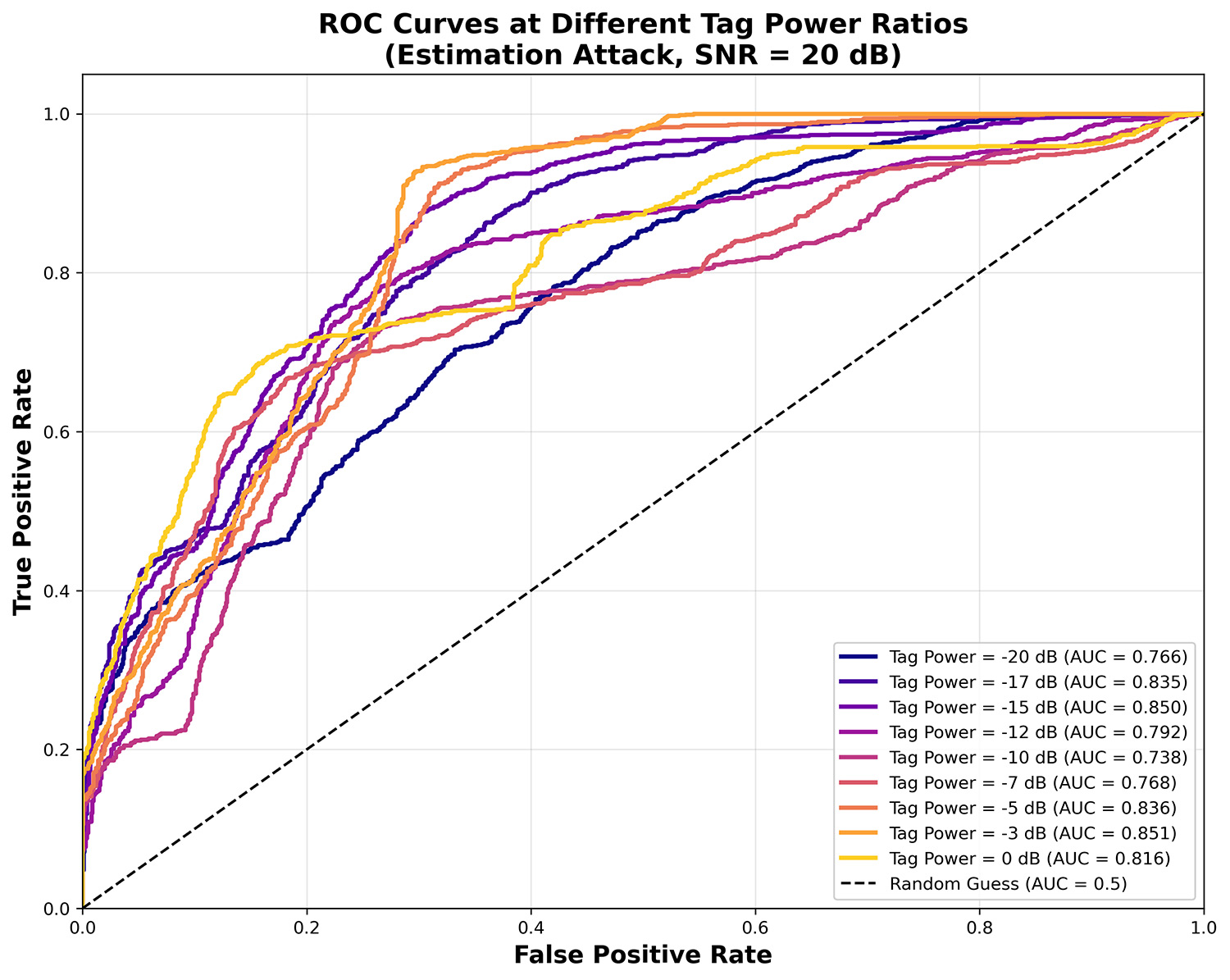
This paper investigates the performance of constellation warping techniques in QAM signals as a novel approach for physical layer authentication. We introduce a dynamic watermarking method that embeds subtle warping patterns into QAM constellations, enabling receivers to authenticate legitimate transmissions while detecting spoofing attacks. Our time-varying watermarking scheme employs secure key-based pattern generation to resist replay and estimation attacks. Extensive simulations analyze the system's resilience against various attack types (replay, blind spoofing, and estimation-based) across different signal-to-noise ratios. Results demonstrate that the proposed approach achieves high detection rates ($>90%$ at moderate SNRs) with minimal false alarms and negligible impact on communication performance. We further identify optimal warping strengths and authentication thresholds that maximize security while minimizing symbol error rate degradation. The findings establish constellation warping as an effective physical layer security technique for wireless communications systems that face sophisticated spoofing threats.

Graphical Abstract
Constellation Warping-Based QAM Signal Watermarking for Secure and Reliable Wireless Communications

Keywords
anti-spoofing
authentication
constellation warping
physical layer security
QAM
watermarking
wireless security

Data Availability Statement
Data will be made available on request.

Funding
This work was supported without any funding.

Conflicts of Interest
Amgad A. Salama is affiliated with the The Egyptian Technical Research and Development Centre, Cairo 11618, Egypt. The authors declare that this affiliation had no influence on the study design, data collection, analysis, interpretation, or the decision to publish, and that no other competing interests exist.

AI Use Statement
The authors declare that no generative AI was used in the preparation of this manuscript.

Ethical Approval and Consent to Participate
Not applicable.

References
  1. Bai, L., Zhu, L., Liu, J., Choi, J., & Zhang, W. (2020). Physical layer authentication in wireless communication networks: A survey. Journal of Communications and Information Networks, 5(3), 237-264.
    [CrossRef]   [Google Scholar]
  2. Khan, S. Z., Mohsin, M., & Iqbal, W. (2021). On GPS spoofing of aerial platforms: a review of threats, challenges, methodologies, and future research directions. PeerJ Computer Science, 7, e507.
    [CrossRef]   [Google Scholar]
  3. Shafique, A., Mehmood, A., & Elhadef, M. (2021). Detecting signal spoofing attack in uavs using machine learning models. IEEE Access, 9, 93803-93815.
    [CrossRef]   [Google Scholar]
  4. Wang, X., Hao, P., & Hanzo, L. (2016). Physical-layer authentication for wireless security enhancement: Current challenges and future developments. IEEE Communications Magazine, 54(6), 152-158.
    [CrossRef]   [Google Scholar]
  5. Illi, E., Qaraqe, M., Althunibat, S., Alhasanat, A., Alsafasfeh, M., De Ree, M., ... & Al-Kuwari, S. (2023). Physical layer security for authentication, confidentiality, and malicious node detection: A paradigm shift in securing IoT networks. IEEE Communications Surveys & Tutorials, 26(1), 347-388.
    [CrossRef]   [Google Scholar]
  6. Zhang, J., Rajendran, S., Sun, Z., Woods, R., & Hanzo, L. (2019). Physical layer security for the Internet of Things: Authentication and key generation. IEEE Wireless Communications, 26(5), 92-98.
    [CrossRef]   [Google Scholar]
  7. Mitev, M., Chorti, A., Belmega, E. V., & Poor, H. V. (2021). Protecting physical layer secret key generation from active attacks. Entropy, 23(8), 960.
    [CrossRef]   [Google Scholar]
  8. Eberz, S., Strohmeier, M., Wilhelm, M., & Martinovic, I. (2012, September). A practical man-in-the-middle attack on signal-based key generation protocols. In European symposium on research in computer security (pp. 235-252). Berlin, Heidelberg: Springer Berlin Heidelberg.
    [CrossRef]   [Google Scholar]
  9. Shawky, M. A., Shah, S. T., Abbasi, Q. H., Hussein, M., Imran, M. A., Hasan, S. F., Ansari, S., & Taha, A. (2023). RIS-enabled secret key generation for secured vehicular communication in the presence of denial-of-service attacks. Sensors, 23(8), 4104.
    [CrossRef]   [Google Scholar]
  10. Zhang, P., Taleb, T., Jiang, X., & Wu, B. (2019). Physical layer authentication for massive MIMO systems with hardware impairments. IEEE Transactions on Wireless Communications, 19(3), 1563–1576.
    [CrossRef]   [Google Scholar]
  11. Tahir, M., & Siddiqi, M. U. (2014). A Hybrid Scheme for Wireless Physical Layer Security Based on Encryption and Channel Pre-compensation. IETE Journal of Research, 60(4), 267-275.
    [CrossRef]   [Google Scholar]
  12. Shawky, M. A., Shah, S. T., Abdrabou, M., Usman, M., Abbasi, Q. H., Flynn, D., Imran, M. A., Ansari, S., & Taha, A. (2024). How secure are our roads? An in-depth review of authentication in vehicular communications. Vehicular Communications, 47, 100784.
    [CrossRef]   [Google Scholar]
  13. Xiang, Y., Natgunanathan, I., Rong, Y., & Guo, S. (2015). Spread spectrum-based high embedding capacity watermarking method for audio signals. IEEE/ACM transactions on audio, speech, and language processing, 23(12), 2228-2237.
    [CrossRef]   [Google Scholar]
  14. Mekhfioui, M., El Bazi, N., Laayati, O., Satif, A., Bouchouirbat, M., Kissi, C., ... & Chebak, A. (2025). Optimized digital watermarking for robust information security in embedded systems. Information, 16(4), 322.
    [CrossRef]   [Google Scholar]
  15. Chen, B., & Wornell, G. W. (1999, April). Dither modulation: a new approach to digital watermarking and information embedding. In Security and Watermarking of Multimedia Contents (Vol. 3657, pp. 342-353). SPIE.
    [CrossRef]   [Google Scholar]
  16. Wu, Y., Khisti, A., Xiao, C., Caire, G., Wong, K. K., & Gao, X. (2018). A survey of physical layer security techniques for 5G wireless networks and challenges ahead. IEEE Journal on selected areas in communications, 36(4), 679-695.
    [CrossRef]   [Google Scholar]
  17. Zhang, P., Shen, Y., Jiang, X., & Wu, B. (2020). Physical layer authentication jointly utilizing channel and phase noise in MIMO systems. IEEE Transactions on Communications, 68(4), 2446-2458.
    [CrossRef]   [Google Scholar]
  18. Restuccia, F., D'Oro, S., Al-Shawabka, A., Belgiovine, M., Angioloni, L., Ioannidis, S., ... & Melodia, T. (2019, July). DeepRadioID: Real-time channel-resilient optimization of deep learning-based radio fingerprinting algorithms. In Proceedings of the twentieth ACM international symposium on mobile ad hoc networking and computing (pp. 51-60).
    [CrossRef]   [Google Scholar]
  19. Hagras, E. A. A., Aldosary, S., Khaled, H., & Hassan, T. M. (2023). Physical layer authenticated image encryption for IoT network based on biometric chaotic signature for MPFrFT OFDM system. Sensors, 23(18), 7843.
    [CrossRef]   [Google Scholar]
  20. Xu, D., & Ren, P. (2020). Concatenated graph coding on bandwidth part for secure pilot authentication in grant-free URLLC. IEEE Open Journal of the Computer Society, 1, 193–208.
    [CrossRef]   [Google Scholar]
  21. Pham, T. V., & Ishihara, S. (2025). Practical Design of Probabilistic Constellation Shaping for Enhancing Performance of Physical Layer Security in Visible Light Communications. IEEE Transactions on Communications.
    [CrossRef]   [Google Scholar]

Cite This Article
APA Style
Salama, A. A., Abdellatif, A. G., Safwat, S., Shah, S. T., & Shawky, M. A. (2026). Constellation Warping-Based QAM Signal Watermarking for Secure and Reliable Wireless Communications. ICCK Transactions on Information Security and Cryptography, 2(1), 29–41. https://doi.org/10.62762/TISC.2025.407888
Export Citation
RIS Format
Compatible with EndNote, Zotero, Mendeley, and other reference managers
RIS format data for reference managers
TY  - JOUR
AU  - Salama, Amgad A.
AU  - Abdellatif, Ahmed Gamal
AU  - Safwat, Soha
AU  - Shah, Syed T.
AU  - Shawky, Mahmoud A.
PY  - 2026
DA  - 2026/02/09
TI  - Constellation Warping-Based QAM Signal Watermarking for Secure and Reliable Wireless Communications
JO  - ICCK Transactions on Information Security and Cryptography
T2  - ICCK Transactions on Information Security and Cryptography
JF  - ICCK Transactions on Information Security and Cryptography
VL  - 2
IS  - 1
SP  - 29
EP  - 42
DO  - 10.62762/TISC.2025.407888
UR  - https://www.icck.org/article/abs/TISC.2025.407888
KW  - anti-spoofing
KW  - authentication
KW  - constellation warping
KW  - physical layer security
KW  - QAM
KW  - watermarking
KW  - wireless security
AB  - This paper investigates the performance of constellation warping techniques in QAM signals as a novel approach for physical layer authentication. We introduce a dynamic watermarking method that embeds subtle warping patterns into QAM constellations, enabling receivers to authenticate legitimate transmissions while detecting spoofing attacks. Our time-varying watermarking scheme employs secure key-based pattern generation to resist replay and estimation attacks. Extensive simulations analyze the system's resilience against various attack types (replay, blind spoofing, and estimation-based) across different signal-to-noise ratios. Results demonstrate that the proposed approach achieves high detection rates ($>90%$ at moderate SNRs) with minimal false alarms and negligible impact on communication performance. We further identify optimal warping strengths and authentication thresholds that maximize security while minimizing symbol error rate degradation. The findings establish constellation warping as an effective physical layer security technique for wireless communications systems that face sophisticated spoofing threats.
SN  - 3070-2429
PB  - Institute of Central Computation and Knowledge
LA  - English
ER  - 
BibTeX Format
Compatible with LaTeX, BibTeX, and other reference managers
BibTeX format data for LaTeX and reference managers
@article{Salama2026Constellat,
  author = {Amgad A. Salama and Ahmed Gamal Abdellatif and Soha Safwat and Syed T. Shah and Mahmoud A. Shawky},
  title = {Constellation Warping-Based QAM Signal Watermarking for Secure and Reliable Wireless Communications},
  journal = {ICCK Transactions on Information Security and Cryptography},
  year = {2026},
  volume = {2},
  number = {1},
  pages = {29-42},
  doi = {10.62762/TISC.2025.407888},
  url = {https://www.icck.org/article/abs/TISC.2025.407888},
  abstract = {This paper investigates the performance of constellation warping techniques in QAM signals as a novel approach for physical layer authentication. We introduce a dynamic watermarking method that embeds subtle warping patterns into QAM constellations, enabling receivers to authenticate legitimate transmissions while detecting spoofing attacks. Our time-varying watermarking scheme employs secure key-based pattern generation to resist replay and estimation attacks. Extensive simulations analyze the system's resilience against various attack types (replay, blind spoofing, and estimation-based) across different signal-to-noise ratios. Results demonstrate that the proposed approach achieves high detection rates (\$>90\%\$ at moderate SNRs) with minimal false alarms and negligible impact on communication performance. We further identify optimal warping strengths and authentication thresholds that maximize security while minimizing symbol error rate degradation. The findings establish constellation warping as an effective physical layer security technique for wireless communications systems that face sophisticated spoofing threats.},
  keywords = {anti-spoofing, authentication, constellation warping, physical layer security, QAM, watermarking, wireless security},
  issn = {3070-2429},
  publisher = {Institute of Central Computation and Knowledge}
}

Article Metrics
Citations:

Crossref

0

Scopus

0

Web of Science

0
Article Access Statistics:
Views: 44
PDF Downloads: 8

Publisher's Note
ICCK stays neutral with regard to jurisdictional claims in published maps and institutional affiliations.

Rights and Permissions
Institute of Central Computation and Knowledge (ICCK) or its licensor (e.g. a society or other partner) holds exclusive rights to this article under a publishing agreement with the author(s) or other rightsholder(s); author self-archiving of the accepted manuscript version of this article is solely governed by the terms of such publishing agreement and applicable law.
ICCK Transactions on Information Security and Cryptography

ICCK Transactions on Information Security and Cryptography

ISSN: 3070-2429 (Online)

Email: [email protected]

Portico

Portico

All published articles are preserved here permanently:
https://www.portico.org/publishers/icck/