

Effects of Adversarial Training of Word Embeddings on Chinese Agricultural Pest and Disease Named Entity Recognition with BERT-CRF



Article Information
Abstract
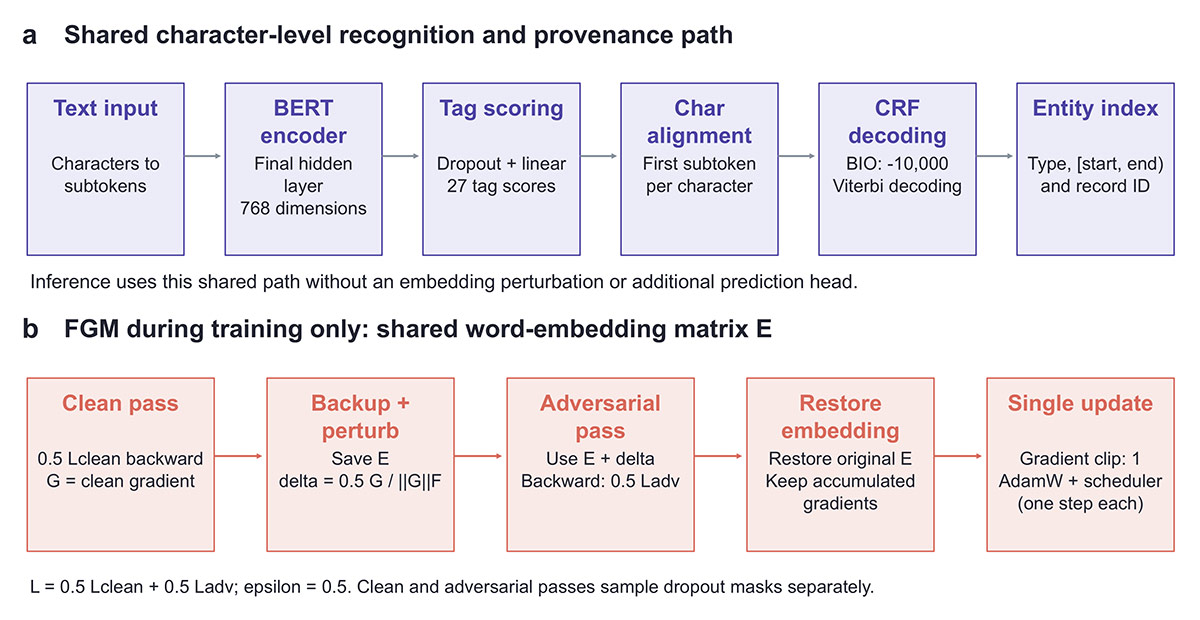
Entity boundaries, confusable entity types and surface forms absent from the training data all make it harder to extract structured information from agricultural pest and disease texts. We examined whether single-step adversarial training of word embeddings with the fast gradient method (FGM) improves entity recognition when the BERT-CRF inference architecture is left unchanged. On the official 13-type AgCNER corpus, with exact matching of character span and entity type, we compared a feature-based CRF, BiLSTM-CRF, BERT-CRF and BERT-CRF+FGM, training each neural model with three fixed random seeds. BERT-CRF+FGM reached mean test precision, recall and F1 of 94.37%, 95.10% and 94.73%. Its F1 was 0.28 percentage points higher than that of the matched BERT-CRF baseline, and the paired difference was positive for every seed. F1 on unseen surface forms rose from 74.87% to 76.41%, and the overall gain remained 0.27 percentage points after test texts duplicated in other splits were removed. Mean F1 increased for 11 of the 13 types but fell for Company and Organization. FGM did not change the parameter count. The seed-42 model produced 20,670 indexed entity occurrences that can be checked against the released records and character spans. The official test set had been used in an earlier baseline study and test results informed model adoption, so these findings are exploratory; independently sourced data are needed to assess how far they generalize.
Graphical Abstract
Keywords
Data Availability Statement
Funding
Conflicts of Interest
AI Use Statement
Ethical Approval and Consent to Participate
References
- Li, J., Sun, A., Han, J., & Li, C. (2020). A survey on deep learning for named entity recognition. IEEE transactions on knowledge and data engineering, 34(1), 50-70.
[CrossRef] [Google Scholar] - Nadeau, D., & Sekine, S. (2007). A survey of named entity recognition and classification. Lingvisticae Investigationes, 30(1), 3-26.
[CrossRef] [Google Scholar] - Yao, X., Hao, X., Liu, R., Li, L., & Guo, X. (2024). AgCNER, the first large-scale Chinese named entity recognition dataset for agricultural diseases and pests. Scientific Data, 11(1), 769.
[CrossRef] [Google Scholar] - Lafferty, J., McCallum, A., & Pereira, F. C. N. (2001). Conditional random fields: Probabilistic models for segmenting and labeling sequence data. In Proceedings of the 18th International Conference on Machine Learning (pp. 282-289). Morgan Kaufmann. https://repository.upenn.edu/cis_papers/159
[Google Scholar] - Huang, Z., Xu, W., & Yu, K. (2015). Bidirectional LSTM-CRF models for sequence tagging. arXiv preprint arXiv:1508.01991. https://arxiv.org/abs/1508.01991
[Google Scholar] - Lample, G., Ballesteros, M., Subramanian, S., Kawakami, K., & Dyer, C. (2016). Neural architectures for named entity recognition. In Proceedings of the 2016 Conference of the North American Chapter of the Association for Computational Linguistics: Human Language Technologies (pp. 260-270).
[CrossRef] [Google Scholar] - Guo, X., Hao, X., Tang, Z., Diao, L., Bai, Z., Lu, S., & Li, L. (2021). Ace-adp: adversarial contextual embeddings based named entity recognition for agricultural diseases and pests. Agriculture, 11(10), 912.
[CrossRef] [Google Scholar] - Vaswani, A., Shazeer, N., Parmar, N., Uszkoreit, J., Jones, L., Gomez, A. N., ... & Polosukhin, I. (2017). Attention is all you need. In Advances in Neural Information Processing Systems 30 (pp. 5998-6008).
[Google Scholar] - Devlin, J., Chang, M. W., Lee, K., & Toutanova, K. (2019, June). Bert: Pre-training of deep bidirectional transformers for language understanding. In Proceedings of the 2019 conference of the North American chapter of the association for computational linguistics: human language technologies, volume 1 (long and short papers) (pp. 4171-4186).
[CrossRef] [Google Scholar] - Cui, Y., Che, W., Liu, T., Qin, B., Wang, S., & Hu, G. (2020, November). Revisiting pre-trained models for Chinese natural language processing. In Findings of the Association for Computational Linguistics: EMNLP 2020 (pp. 657-668).
[CrossRef] [Google Scholar] - Zhang, Y., & Yang, J. (2018). Chinese NER using lattice LSTM. In Proceedings of the 56th Annual Meeting of the Association for Computational Linguistics (Volume 1: Long Papers) (pp. 1554-1564).
[CrossRef] [Google Scholar] - Li, X., Yan, H., Qiu, X., & Huang, X. J. (2020, July). FLAT: Chinese NER using flat-lattice transformer. In Proceedings of the 58th annual meeting of the association for computational linguistics (pp. 6836-6842).
[CrossRef] [Google Scholar] - Wu, S., Song, X., & Feng, Z. (2021, August). MECT: Multi-metadata embedding based cross-transformer for Chinese named entity recognition. In Proceedings of the 59th Annual Meeting of the Association for Computational Linguistics and the 11th International Joint Conference on Natural Language Processing (Volume 1: Long Papers) (pp. 1529-1539).
[CrossRef] [Google Scholar] - Guo, X., Zhou, H., Su, J., Hao, X., Tang, Z., Diao, L., & Li, L. (2020). Chinese agricultural diseases and pests named entity recognition with multi-scale local context features and self-attention mechanism. Computers and electronics in agriculture, 179, 105830.
[CrossRef] [Google Scholar] - Tang, W., Wen, X., & Hu, Z. (2024). Named entity recognition for crop diseases and pests based on gated fusion unit and Manhattan attention. Agriculture, 14(9), 1565.
[CrossRef] [Google Scholar] - Goodfellow, I. J., Shlens, J., & Szegedy, C. (2014). Explaining and harnessing adversarial examples. arXiv preprint arXiv:1412.6572.
[CrossRef] [Google Scholar] - Miyato, T., Dai, A. M., & Goodfellow, I. (2016). Adversarial training methods for semi-supervised text classification. arXiv preprint arXiv:1605.07725. https://arxiv.org/abs/1605.07725
[Google Scholar] - Zhu, C., Cheng, Y., Gan, Z., Sun, S., Goldstein, T., & Liu, J. (2019). Freelb: Enhanced adversarial training for natural language understanding. arXiv preprint arXiv:1909.11764.
[CrossRef] [Google Scholar] - Jiang, H., He, P., Chen, W., Liu, X., Gao, J., & Zhao, T. (2020). SMART: Robust and efficient fine-tuning for pre-trained natural language models through principled regularized optimization. In Proceedings of the 58th Annual Meeting of the Association for Computational Linguistics (pp. 2177-2190).
[CrossRef] [Google Scholar] - Ghaddar, A., Langlais, P., Rashid, A., & Rezagholizadeh, M. (2021). Context-aware adversarial training for name regularity bias in named entity recognition. Transactions of the Association for Computational Linguistics, 9, 586-604.
[CrossRef] [Google Scholar] - Reimers, N., & Gurevych, I. (2017). Reporting score distributions makes a difference: Performance study of LSTM-networks for sequence tagging. In Proceedings of the 2017 Conference on Empirical Methods in Natural Language Processing (pp. 338-348).
[CrossRef] [Google Scholar] - Dodge, J., Gururangan, S., Card, D., Schwartz, R., & Smith, N. A. (2019). Show your work: Improved reporting of experimental results. In Proceedings of the 2019 Conference on Empirical Methods in Natural Language Processing and the 9th International Joint Conference on Natural Language Processing (EMNLP-IJCNLP) (pp. 2185-2194).
[CrossRef] [Google Scholar] - Augenstein, I., Derczynski, L., & Bontcheva, K. (2017). Generalisation in named entity recognition: A quantitative analysis. Computer Speech & Language, 44, 61-83.
[CrossRef] [Google Scholar] - Liang, J., Li, D., Lin, Y., Wu, S., & Huang, Z. (2023). Named entity recognition of Chinese crop diseases and pests based on RoBERTa-wwm with adversarial training. Agronomy, 13(3), 941.
[CrossRef] [Google Scholar] - Loshchilov, I., & Hutter, F. (2017). Decoupled weight decay regularization. arXiv preprint arXiv:1711.05101.
[CrossRef] [Google Scholar] - Treviso, M., Lee, J. U., Ji, T., Van Aken, B., Cao, Q., Ciosici, M. R., ... & Schwartz, R. (2023). Efficient methods for natural language processing: A survey. Transactions of the Association for Computational Linguistics, 11, 826-860.
[CrossRef] [Google Scholar]
Cite This Article
TY  - JOUR
AU  - Cheng, Bo
AU  - Gao, Ziming
AU  - An, Biao
AU  - Wang, Yuansheng
PY  - 2026
DA  - 2026/10/24
TI  - Effects of Adversarial Training of Word Embeddings on Chinese Agricultural Pest and Disease Named Entity Recognition with BERT-CRF
JO  - ICCK Transactions on Machine Intelligence
T2  - ICCK Transactions on Machine Intelligence
JF  - ICCK Transactions on Machine Intelligence
VL  - 3
IS  - 1
SP  - 1
EP  - 18
DO  - 10.62762/TMI.2026.748742
UR  - https://www.icck.org/article/abs/TMI.2026.748742
KW  - Agricultural pests and diseases
KW  - named entity recognition
KW  - BERT-CRF
KW  - fast gradient method
KW  - unseen surface forms
KW  - entity occurrence index
AB  - Entity boundaries, confusable entity types and surface forms absent from the training data all make it harder to extract structured information from agricultural pest and disease texts. We examined whether single-step adversarial training of word embeddings with the fast gradient method (FGM) improves entity recognition when the BERT-CRF inference architecture is left unchanged. On the official 13-type AgCNER corpus, with exact matching of character span and entity type, we compared a feature-based CRF, BiLSTM-CRF, BERT-CRF and BERT-CRF+FGM, training each neural model with three fixed random seeds. BERT-CRF+FGM reached mean test precision, recall and F1 of 94.37%, 95.10% and 94.73%. Its F1 was 0.28 percentage points higher than that of the matched BERT-CRF baseline, and the paired difference was positive for every seed. F1 on unseen surface forms rose from 74.87% to 76.41%, and the overall gain remained 0.27 percentage points after test texts duplicated in other splits were removed. Mean F1 increased for 11 of the 13 types but fell for Company and Organization. FGM did not change the parameter count. The seed-42 model produced 20,670 indexed entity occurrences that can be checked against the released records and character spans. The official test set had been used in an earlier baseline study and test results informed model adoption, so these findings are exploratory; independently sourced data are needed to assess how far they generalize.
SN  - 3068-7403
PB  - Institute of Central Computation and Knowledge
LA  - English
ER  -
@article{Cheng2026Effects,
  author = {Bo Cheng and Ziming Gao and Biao An and Yuansheng Wang},
  title = {Effects of Adversarial Training of Word Embeddings on Chinese Agricultural Pest and Disease Named Entity Recognition with BERT-CRF},
  journal = {ICCK Transactions on Machine Intelligence},
  year = {2026},
  volume = {3},
  number = {1},
  pages = {1-18},
  doi = {10.62762/TMI.2026.748742},
  url = {https://www.icck.org/article/abs/TMI.2026.748742},
  abstract = {Entity boundaries, confusable entity types and surface forms absent from the training data all make it harder to extract structured information from agricultural pest and disease texts. We examined whether single-step adversarial training of word embeddings with the fast gradient method (FGM) improves entity recognition when the BERT-CRF inference architecture is left unchanged. On the official 13-type AgCNER corpus, with exact matching of character span and entity type, we compared a feature-based CRF, BiLSTM-CRF, BERT-CRF and BERT-CRF+FGM, training each neural model with three fixed random seeds. BERT-CRF+FGM reached mean test precision, recall and F1 of 94.37\%, 95.10\% and 94.73\%. Its F1 was 0.28 percentage points higher than that of the matched BERT-CRF baseline, and the paired difference was positive for every seed. F1 on unseen surface forms rose from 74.87\% to 76.41\%, and the overall gain remained 0.27 percentage points after test texts duplicated in other splits were removed. Mean F1 increased for 11 of the 13 types but fell for Company and Organization. FGM did not change the parameter count. The seed-42 model produced 20,670 indexed entity occurrences that can be checked against the released records and character spans. The official test set had been used in an earlier baseline study and test results informed model adoption, so these findings are exploratory; independently sourced data are needed to assess how far they generalize.},
  keywords = {Agricultural pests and diseases, named entity recognition, BERT-CRF, fast gradient method, unseen surface forms, entity occurrence index},
  issn = {3068-7403},
  publisher = {Institute of Central Computation and Knowledge}
}
Article Metrics
Publisher's Note
ICCK stays neutral with regard to jurisdictional claims in published maps and institutional affiliations.
Rights and Permissions
 Copyright © 2026 by the Author(s). Published by Institute of Central Computation and Knowledge. This article is an open access article distributed under the terms and conditions of the Creative Commons Attribution (CC BY) license (https://creativecommons.org/licenses/by/4.0/), which permits use, sharing, adaptation, distribution and reproduction in any medium or format, as long as you give appropriate credit to the original author(s) and the source, provide a link to the Creative Commons licence, and indicate if changes were made.


Portico
