
LAE-GSDetect: A Lightweight Fusion Framework for Robust Small-Face Detection in Low-Light Conditions




Article Information
Abstract
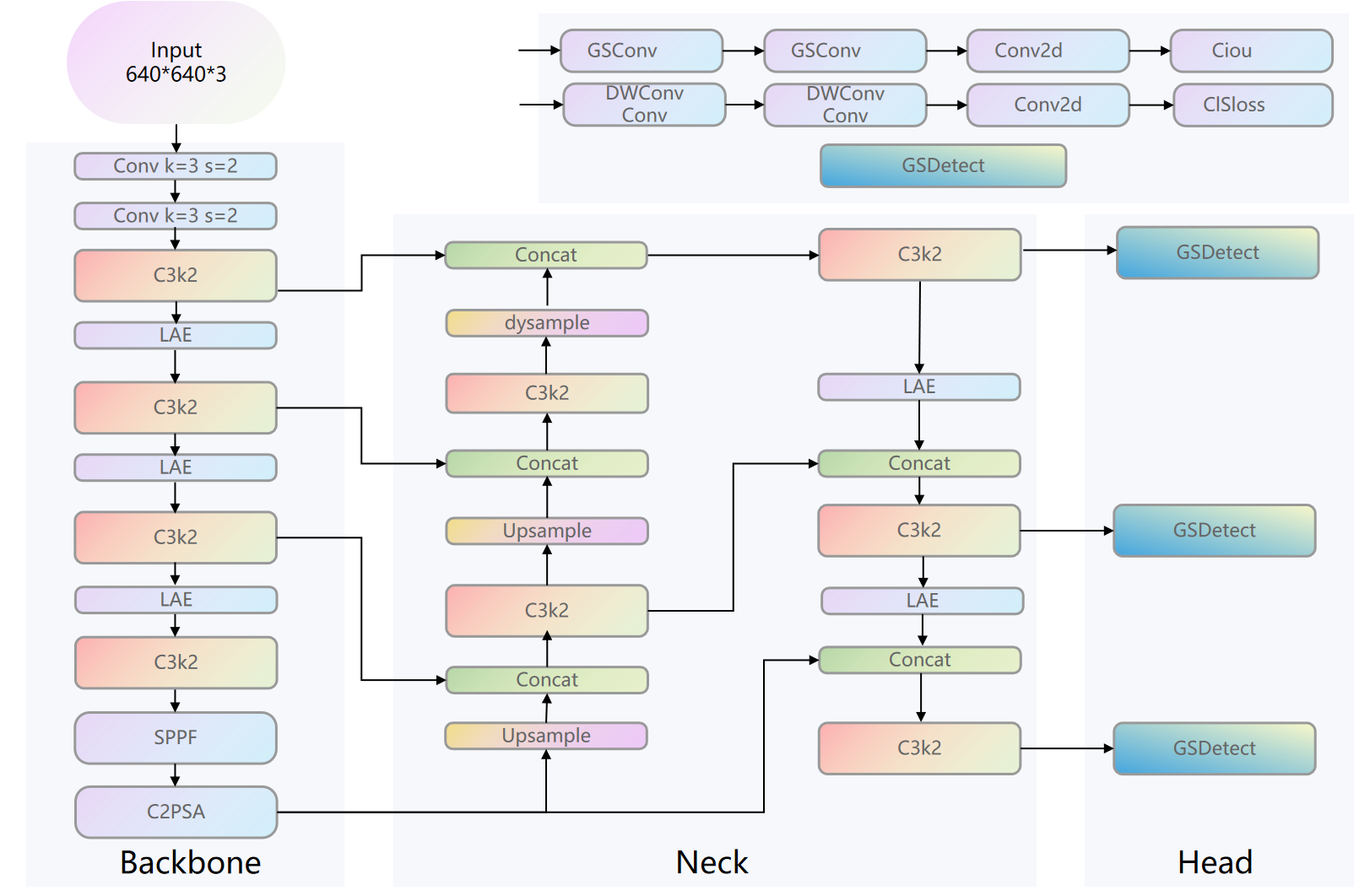
In response to the challenges of insufficient accuracy in face detection and missed small targets under low-light conditions, this paper proposes a detection scheme that combines image preprocessing and detection model optimization. Firstly, Zero-DCE low-light enhancement is introduced to adaptively restore image details and contrast, providing high-quality inputs for subsequent detection. Secondly, YOLOv11n is enhanced through the following improvements: a P2 small-target detection layer is added while the P5 layer is removed, addressing the original model's deficiency in detecting small targets and streamlining the computational process to balance model complexity and efficiency; the P2 upsampling is replaced with DySample dynamic upsampling, which adaptively adjusts the sampling strategy based on features to improve the accuracy of feature fusion; a lightweight adaptive extraction module (LAE) is incorporated to reduce the number of parameters and computational costs; finally, the detection head is replaced with GSDetect to maintain accuracy while reducing computational overhead. Experimental results show that the improved model reaches an mAP50 of 58.7%, which is an improvement of 10.2 percentage points compared with the original model. Although the computational complexity increases to 7.5 GFLOPs, the parameter count is reduced by 45%, offering a more optimal solution for face detection in low-light environments.
Graphical Abstract
Keywords
Data Availability Statement
Funding
Conflicts of Interest
Ethical Approval and Consent to Participate
References
- Wang, W., Wang, X., Yang, W., & Liu, J. (2022). Unsupervised face detection in the dark. IEEE Transactions on Pattern Analysis and Machine Intelligence, 45(1), 1250-1266.
[CrossRef] [Google Scholar] - Cho, S. W., Baek, N. R., Kim, M. C., Koo, J. H., Kim, J. H., & Park, K. R. (2018). Face detection in nighttime images using visible-light camera sensors with two-step faster region-based convolutional neural network. Sensors, 18(9), 2995.
[CrossRef] [Google Scholar] - Jiang, B., Jiang, H., Zhang, H., Zhang, Q., Li, Z., & Huang, L. (2024). 4AC-YOLOv5: an improved algorithm for small target face detection. EURASIP Journal on Image and Video Processing, 2024(1), 10.
[CrossRef] [Google Scholar] - Zhu, C., Tao, R., Luu, K., & Savvides, M. (2018, June). Seeing Small Faces from Robust Anchor's Perspective. In 2018 IEEE/CVF Conference on Computer Vision and Pattern Recognition (pp. 5127-5136). IEEE.
[CrossRef] [Google Scholar] - Cai, Y., Bian, H., Lin, J., Wang, H., Timofte, R., & Zhang, Y. (2023, October). Retinexformer: One-stage Retinex-based Transformer for Low-light Image Enhancement. In 2023 IEEE/CVF International Conference on Computer Vision (ICCV) (pp. 12470-12479). IEEE.
[CrossRef] [Google Scholar] - Jiang, Y., Gong, X., Liu, D., Cheng, Y., Fang, C., Shen, X., ... & Wang, Z. (2021). Enlightengan: Deep light enhancement without paired supervision. IEEE transactions on image processing, 30, 2340-2349.
[CrossRef] [Google Scholar] - Guo, C., Li, C., Guo, J., Loy, C. C., Hou, J., Kwong, S., & Cong, R. (2020, June). Zero-Reference Deep Curve Estimation for Low-Light Image Enhancement. In 2020 IEEE/CVF Conference on Computer Vision and Pattern Recognition (CVPR) (pp. 1777-1786). IEEE.
[CrossRef] [Google Scholar] - Khanam, R., & Hussain, M. (2024). Yolov11: An overview of the key architectural enhancements. arXiv preprint arXiv:2410.17725.
[CrossRef] [Google Scholar] - Yang, W., Yuan, Y., Ren, W., Liu, J., Scheirer, W. J., Wang, Z., ... & Qin, L. (2020). Advancing image understanding in poor visibility environments: A collective benchmark study. IEEE Transactions on Image Processing, 29, 5737-5752.
[CrossRef] [Google Scholar] - Fu, X., Zeng, D., Huang, Y., Liao, Y., Ding, X., & Paisley, J. W. (2016). A fusion-based enhancing method for weakly illuminated images. Signal Processing, 129, 82–96.
[CrossRef] [Google Scholar] - Ma, L., Ma, T., Liu, R., Fan, X., & Luo, Z. (2022, June). Toward Fast, Flexible, and Robust Low-Light Image Enhancement. In 2022 IEEE/CVF Conference on Computer Vision and Pattern Recognition (CVPR) (pp. 5627-5636). IEEE.
[CrossRef] [Google Scholar] - Zhao, Z. Q., Zheng, P., Xu, S. T., & Wu, X. (2019). Object detection with deep learning: A review. IEEE transactions on neural networks and learning systems, 30(11), 3212-3232.
[CrossRef] [Google Scholar] - Shovo, S. U. A., Abir, M. G. R., Kabir, M. M., & Mridha, M. F. (2024). Advancing low‐light object detection with you only look once models: An empirical study and performance evaluation. Cognitive Computation and Systems, 6(4), 119-134.
[CrossRef] [Google Scholar] - Redmon, J., Divvala, S., Girshick, R., & Farhadi, A. (2016, June). You Only Look Once: Unified, Real-Time Object Detection. In 2016 IEEE Conference on Computer Vision and Pattern Recognition (CVPR) (pp. 779-788). IEEE.
[CrossRef] [Google Scholar] - Li, J., Wang, Y., Wang, C., Tai, Y., Qian, J., Yang, J., ... & Huang, F. (2019, June). DSFD: Dual Shot Face Detector. In 2019 IEEE/CVF Conference on Computer Vision and Pattern Recognition (CVPR) (pp. 5055-5064). IEEE.
[CrossRef] [Google Scholar] - Tang, X., Du, D. K., He, Z., & Liu, J. (2018, September). PyramidBox: A Context-Assisted Single Shot Face Detector. In European Conference on Computer Vision (pp. 812-828).
[CrossRef] [Google Scholar] - Deng, J., Guo, J., Ververas, E., Kotsia, I., & Zafeiriou, S. (2020, June). RetinaFace: Single-Shot Multi-Level Face Localisation in the Wild. In 2020 IEEE/CVF Conference on Computer Vision and Pattern Recognition (CVPR) (pp. 5202-5211). IEEE.
[CrossRef] [Google Scholar] - Wang, W., Yang, W., & Liu, J. (2021, June). HLA-Face: Joint High-Low Adaptation for Low Light Face Detection. In 2021 IEEE/CVF Conference on Computer Vision and Pattern Recognition (CVPR) (pp. 16190-16199). IEEE.
[CrossRef] [Google Scholar] - Yu, J., Hao, X., & He, P. (2021, October). Single-stage Face Detection under Extremely Low-light Conditions. In 2021 IEEE/CVF International Conference on Computer Vision Workshops (ICCVW) (pp. 3516-3525). IEEE.
[CrossRef] [Google Scholar] - Liu, W., Lu, H., Fu, H., & Cao, Z. (2023, October). Learning to Upsample by Learning to Sample. In 2023 IEEE/CVF International Conference on Computer Vision (ICCV) (pp. 6004-6014). IEEE.
[CrossRef] [Google Scholar] - Yu, Z., Guan, Q., Yang, J., Yang, Z., Zhou, Q., Chen, Y., & Chen, F. (2024, December). Lsm-yolo: A compact and effective roi detector for medical detection. In International Conference on Neural Information Processing (pp. 30-44). Singapore: Springer Nature Singapore.
[CrossRef] [Google Scholar] - Li, H., Li, J., Wei, H., Liu, Z., Zhan, Z., & Ren, Q. (2024). Slim-neck by GSConv: A lightweight-design for real-time detector architectures. Journal of Real-Time Image Processing, 21(3), 62.
[CrossRef] [Google Scholar] - Wang, C. Y., Yeh, I. H., & Mark Liao, H. Y. (2024, September). Yolov9: Learning what you want to learn using programmable gradient information. In European conference on computer vision (pp. 1-21). Cham: Springer Nature Switzerland.
[CrossRef] [Google Scholar] - Wang, A., Chen, H., Liu, L., Chen, K., Lin, Z., & Han, J. (2024). Yolov10: Real-time end-to-end object detection. Advances in Neural Information Processing Systems, 37, 107984-108011.
[Google Scholar] - Zhao, Y., Lv, W., Xu, S., Wei, J., Wang, G., Dang, Q., ... & Chen, J. (2024, June). DETRs Beat YOLOs on Real-time Object Detection. In 2024 IEEE/CVF Conference on Computer Vision and Pattern Recognition (CVPR) (pp. 16965-16974). IEEE.
[CrossRef] [Google Scholar] - Yang, S., Luo, P., Loy, C. C., & Tang, X. (2016, June). WIDER FACE: A face detection benchmark. In 2016 IEEE/CVF Conference on Computer Vision and Pattern Recognition (CVPR) (pp. 5525-5533). IEEE.
[CrossRef] [Google Scholar]
Cited By (4)
-
Mohammadali Vaezi, Victor Klamert, Mugdim Bublin. Deep Learning for Process Monitoring and Defect Detection of Laser-Based Powder Bed Fusion of Polymers.
Polymers, 2026 , 18 (5).
[CrossRef] -
Leiquan Wang, Guixiang Lou, Xin Li, Xueqing Yang, Chunlei Wu, Zhongwei Li. Integrating global and local features for multisource remote sensing image classification with 2D Selective Scan Fusion.
International Journal of Remote Sensing, 2026 , 47 (13).
[CrossRef] -
Guangya Li, Xiaoliang Li, Zhilin Meng. Defect Repair of Murals Guided by Fusion Structural and Textural Feature.
IET Image Processing, 2026 , 20 (1).
[CrossRef] -
Pengyu Chen, Zi-Han Cao, Liang-Jian Deng, Jun Liu, Jianing Sun, Tieyong Zeng. TOPan: Token-wise orthogonal projection with mean flows for fast pansharpening.
Information Fusion, 2026 , 135 .
[CrossRef]
Cite This Article
TY  - JOUR
AU  - Chang, Bo
AU  - Tang, Lichao
AU  - Hu, Chen
AU  - Zhu, Mengxiao
AU  - Dou, Huijie
AU  - Ali, Kharudin Bin
PY  - 2025
DA  - 2025/12/18
TI  - LAE-GSDetect: A Lightweight Fusion Framework for Robust Small-Face Detection in Low-Light Conditions
JO  - ICCK Transactions on Sensing, Communication, and Control
T2  - ICCK Transactions on Sensing, Communication, and Control
JF  - ICCK Transactions on Sensing, Communication, and Control
VL  - 2
IS  - 4
SP  - 250
EP  - 262
DO  - 10.62762/TSCC.2025.972040
UR  - https://www.icck.org/article/abs/tscc.2025.972040
KW  - low-light
KW  - face detection
KW  - image enhancement
KW  - lightweight
KW  - deep learning
AB  - In response to the challenges of insufficient accuracy in face detection and missed small targets under low-light conditions, this paper proposes a detection scheme that combines image preprocessing and detection model optimization. Firstly, Zero-DCE low-light enhancement is introduced to adaptively restore image details and contrast, providing high-quality inputs for subsequent detection. Secondly, YOLOv11n is enhanced through the following improvements: a P2 small-target detection layer is added while the P5 layer is removed, addressing the original model's deficiency in detecting small targets and streamlining the computational process to balance model complexity and efficiency; the P2 upsampling is replaced with DySample dynamic upsampling, which adaptively adjusts the sampling strategy based on features to improve the accuracy of feature fusion; a lightweight adaptive extraction module (LAE) is incorporated to reduce the number of parameters and computational costs; finally, the detection head is replaced with GSDetect to maintain accuracy while reducing computational overhead. Experimental results show that the improved model reaches an mAP50 of 58.7%, which is an improvement of 10.2 percentage points compared with the original model. Although the computational complexity increases to 7.5 GFLOPs, the parameter count is reduced by 45%, offering a more optimal solution for face detection in low-light environments.
SN  - 3068-9287
PB  - Institute of Central Computation and Knowledge
LA  - English
ER  -
@article{Chang2025LAEGSDetec,
  author = {Bo Chang and Lichao Tang and Chen Hu and Mengxiao Zhu and Huijie Dou and Kharudin Bin Ali},
  title = {LAE-GSDetect: A Lightweight Fusion Framework for Robust Small-Face Detection in Low-Light Conditions},
  journal = {ICCK Transactions on Sensing, Communication, and Control},
  year = {2025},
  volume = {2},
  number = {4},
  pages = {250-262},
  doi = {10.62762/TSCC.2025.972040},
  url = {https://www.icck.org/article/abs/tscc.2025.972040},
  abstract = {In response to the challenges of insufficient accuracy in face detection and missed small targets under low-light conditions, this paper proposes a detection scheme that combines image preprocessing and detection model optimization. Firstly, Zero-DCE low-light enhancement is introduced to adaptively restore image details and contrast, providing high-quality inputs for subsequent detection. Secondly, YOLOv11n is enhanced through the following improvements: a P2 small-target detection layer is added while the P5 layer is removed, addressing the original model's deficiency in detecting small targets and streamlining the computational process to balance model complexity and efficiency; the P2 upsampling is replaced with DySample dynamic upsampling, which adaptively adjusts the sampling strategy based on features to improve the accuracy of feature fusion; a lightweight adaptive extraction module (LAE) is incorporated to reduce the number of parameters and computational costs; finally, the detection head is replaced with GSDetect to maintain accuracy while reducing computational overhead. Experimental results show that the improved model reaches an mAP50 of 58.7\%, which is an improvement of 10.2 percentage points compared with the original model. Although the computational complexity increases to 7.5 GFLOPs, the parameter count is reduced by 45\%, offering a more optimal solution for face detection in low-light environments.},
  keywords = {low-light, face detection, image enhancement, lightweight, deep learning},
  issn = {3068-9287},
  publisher = {Institute of Central Computation and Knowledge}
}
Publisher's Note
ICCK stays neutral with regard to jurisdictional claims in published maps and institutional affiliations.
Rights and Permissions


Portico
