

Volume 2, Issue 1, ICCK Transactions on Systems Safety and Reliability
Volume 2, Issue 1, 2026
Submit Manuscript Edit a Special Issue
Article QR Code
Article QR Code
Scan the QR code for reading
Popular articles
ICCK Transactions on Systems Safety and Reliability, Volume 2, Issue 1, 2026: 3-10

Free to Read | Research Article | 29 January 2026
Reliability of Coupled Subway and Bus Networks under Uncertainty
1 School of Economics & Management, Beijing Forestry University, Beijing 100083, China
2 School of Economics & Management, Beijing University of Technology, Beijing 100124, China
3 School of Management Science and Engineering, Central University of Finance and Economics, Beijing 100081, China
* Corresponding Author: Di Wu, [email protected]
ARK: ark:/57805/tssr.2025.612115
Received: 27 October 2025, Accepted: 05 November 2025, Published: 29 January 2026  
Abstract
In urban public transport networks, subway and bus systems complement each other and together form a coupled system that serves passenger travel. However, a disturbance in either subsystem can propagate through coupling nodes across the entire network, thereby reducing overall operational efficiency. Most existing studies focus only on the reliability of a single mode, and few have analyzed the overall reliability of the system while considering the coupling relationship between the two. To address this gap, this paper proposes a probabilistic evaluation model to assess the reliability of the subway and bus coupling system. System reliability is defined as the probability that the network can meet all passenger demand given uncertain demand and limited road and rail capacity. The model accounts for passengers’ travel behavior of “prioritizing the subway” and, by sequentially computing the load on each road section, the subway’s share, and the remaining bus load, determines whether the system is reliable under a given demand combination. This provides an effective quantitative tool for the planning and optimization of integrated urban transportation systems.

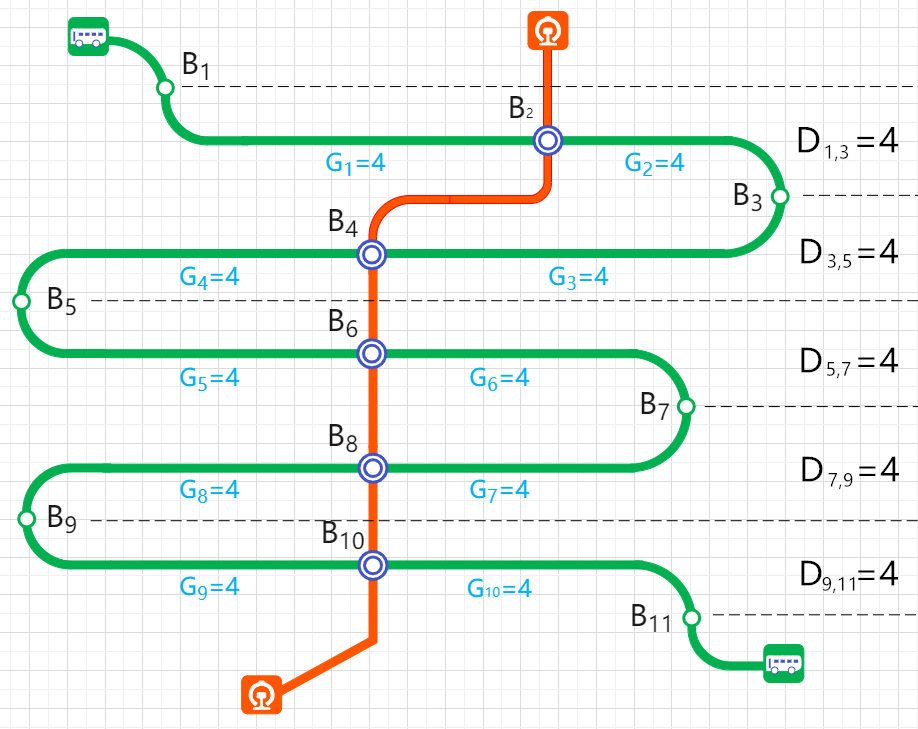
Graphical Abstract
Reliability of Coupled Subway and Bus Networks under Uncertainty

Keywords
reliability
coupled subway and bus system
demand uncertainty
capacity constraints
subway priority behavior

Data Availability Statement
Data will be made available on request.

Funding
This work was supported without any funding.

Conflicts of Interest
The authors declare no conflicts of interest.

AI Use Statement
The authors declare that no generative AI was used in the preparation of this manuscript.

Ethical Approval and Consent to Participate
Not applicable.

References
  1. Ahmed, S., & Dey, K. (2020). Resilience modeling concepts in transportation systems: a comprehensive review based on mode, and modeling techniques. Journal of Infrastructure Preservation and Resilience, 1(1), 8.
    [CrossRef]   [Google Scholar]
  2. Chen, A., Yang, H., Lo, H. K., & Tang, W. H. (2002). Capacity reliability of a road network: an assessment methodology and numerical results. Transportation Research Part B: Methodological, 36(3), 225-252.
    [CrossRef]   [Google Scholar]
  3. Bešinović, N. (2020). Resilience in railway transport systems: a literature review and research agenda. Transport Reviews, 40(4), 457–478.
    [CrossRef]   [Google Scholar]
  4. Ceder, A. (2016). Public transit planning and operation: Modeling, practice and behavior. CRC Press.
    [CrossRef]   [Google Scholar]
  5. Chen, C., Wang, S., Zhang, J., & Gu, X. (2023). Modeling the vulnerability and resilience of interdependent transportation networks under multiple disruptions. Journal of Infrastructure Systems, 29(1), 04022043.
    [CrossRef]   [Google Scholar]
  6. Du, Y., Wang, H., Gao, Q., Pan, N., Zhao, C., & Liu, C. (2022). Resilience concepts in integrated urban transport: a comprehensive review on multi-mode framework. Smart and resilient transportation, 4(2), 105-133.
    [CrossRef]   [Google Scholar]
  7. Guo, X., Du, Q., Li, Y., Zong, X., & Bai, L. (2025). Cascading failure and recovery propagation of metro-bus double-layer network under time-varying passengers. Transportation Research Part D: Transport and Environment, 139, 104571.
    [CrossRef]   [Google Scholar]
  8. Hosseini, A., & Pishvaee, M. S. (2022). Capacity reliability under uncertainty in transportation networks: An optimization framework and stability assessment methodology. Fuzzy Optimization and Decision Making, 21(3), 479–512.
    [CrossRef]   [Google Scholar]
  9. Hu, Z., Yang, J., Chang, S., & Zhang, Y. (2025). Robustness analysis of bus-rail multilayer network based on dynamic passenger flow. Reliability Engineering & System Safety, 264, 111403.
    [CrossRef]   [Google Scholar]
  10. Bell, M. G., & Iida, Y. (1997). Transportation network analysis. John Wiley & Sons.
    [CrossRef]   [Google Scholar]
  11. Li, J. Y., Teng, J., & Wang, H. (2025). Measuring robustness in uncertain topologies: a study of on-demand bus networks. Transportmetrica A: Transport Science, 21(3), 2317783.
    [CrossRef]   [Google Scholar]
  12. Liu, B., Liu, X., Yang, Y., Chen, X., & Ma, X. (2023). Resilience assessment framework toward interdependent bus–rail transit network: Structure, critical components, and coupling mechanism. Communications in Transportation Research, 3, 100098.
    [CrossRef]   [Google Scholar]
  13. Liu, Y., Yang, T., & Su, J. (2025). Optimal bus bridging service for urban rail transit disruptions with stochastic passenger demand. PLoS One, 20(10), e0333686.
    [CrossRef]   [Google Scholar]
  14. Shen, Y., Yang, H., Ren, G., & Ran, B. (2024). Model cascading overload failure and dynamic vulnerability analysis of facility network of metro station. Reliability Engineering & System Safety, 242, 109711.
    [CrossRef]   [Google Scholar]
  15. Sun, Y. (2020). Fuzzy approaches and simulation-based reliability modeling to solve a road–rail intermodal routing problem with soft delivery time windows when demand and capacity are uncertain. International Journal of Fuzzy Systems, 22(7), 2119–2148.
    [CrossRef]   [Google Scholar]
  16. Wang, N., Wu, M., & Yuen, K. F. (2023). A novel method to assess urban multimodal transportation system resilience considering passenger demand and infrastructure supply. Reliability Engineering & System Safety, 238, 109478.
    [CrossRef]   [Google Scholar]
  17. Wen, X., Si, B., Wei, Y., & Cui, H. (2025). Resilience assessment of urban rail transit systems: A literature review. Public Transport, 1–25.
    [CrossRef]   [Google Scholar]
  18. Lam, W. H., Gao, Z. Y., Chan, K. S., & Yang, H. (1999). A stochastic user equilibrium assignment model for congested transit networks. Transportation Research Part B: Methodological, 33(5), 351-368.
    [CrossRef]   [Google Scholar]
  19. Xing, J., Yin, X., Zhang, J., & Chen, J. (2023). Resilience modeling and improvement of metro systems considering statistical behaviors of passenger mobility. International Journal of Disaster Risk Reduction, 96, 103975.
    [CrossRef]   [Google Scholar]
  20. Yuan, Y., Li, S., Liu, S. Q., D’Ariano, A., & Yang, L. (2025). Dynamic bus bridging strategy in response to metro disruptions integrated with routing, timetabling and vehicle dispatching. Omega, 134, 103287.
    [CrossRef]   [Google Scholar]
  21. Zhang, J., Ren, G., & Song, J. (2023). Resilience-based optimization model for emergency bus bridging and dispatching in response to metro operational disruptions. PLoS One, 18(3), e0277577.
    [CrossRef]   [Google Scholar]
  22. Zhang, L., Xu, M., & Wang, S. (2023). Quantifying bus route service disruptions under interdependent cascading failures of a multimodal public transit system based on an improved coupled map lattice model. Reliability Engineering & System Safety, 235, 109250.
    [CrossRef]   [Google Scholar]
  23. Zhang, S., Lo, H. K., Ng, K. F., & Chen, G. (2021). Metro system disruption management and substitute bus service: a systematic review and future directions. Transport Reviews, 41(2), 230–251.
    [CrossRef]   [Google Scholar]
  24. Maltinti, F., Melis, D., & Annunziata, F. (2012). Road network vulnerability: A review of the literature. ICSDC 2011: Integrating Sustainability Practices in the Construction Industry, 677-685.
    [CrossRef]   [Google Scholar]

Cite This Article
APA Style
Gao, K., Yu, R., Zhang, S., & Wu, D. (2026). Reliability of Coupled Subway and Bus Networks under Uncertainty. ICCK Transactions on Systems Safety and Reliability, 2(1), 3–10. https://doi.org/10.62762/TSSR.2025.612115
Export Citation
RIS Format
Compatible with EndNote, Zotero, Mendeley, and other reference managers
RIS format data for reference managers
TY  - JOUR
AU  - Gao, Kaiye
AU  - Yu, Rongquan
AU  - Zhang, Sicheng
AU  - Wu, Di
PY  - 2026
DA  - 2026/01/29
TI  - Reliability of Coupled Subway and Bus Networks under Uncertainty
JO  - ICCK Transactions on Systems Safety and Reliability
T2  - ICCK Transactions on Systems Safety and Reliability
JF  - ICCK Transactions on Systems Safety and Reliability
VL  - 2
IS  - 1
SP  - 3
EP  - 10
DO  - 10.62762/TSSR.2025.612115
UR  - https://www.icck.org/article/abs/TSSR.2025.612115
KW  - reliability
KW  - coupled subway and bus system
KW  - demand uncertainty
KW  - capacity constraints
KW  - subway priority behavior
AB  - In urban public transport networks, subway and bus systems complement each other and together form a coupled system that serves passenger travel. However, a disturbance in either subsystem can propagate through coupling nodes across the entire network, thereby reducing overall operational efficiency. Most existing studies focus only on the reliability of a single mode, and few have analyzed the overall reliability of the system while considering the coupling relationship between the two. To address this gap, this paper proposes a probabilistic evaluation model to assess the reliability of the subway and bus coupling system. System reliability is defined as the probability that the network can meet all passenger demand given uncertain demand and limited road and rail capacity. The model accounts for passengers’ travel behavior of “prioritizing the subway” and, by sequentially computing the load on each road section, the subway’s share, and the remaining bus load, determines whether the system is reliable under a given demand combination. This provides an effective quantitative tool for the planning and optimization of integrated urban transportation systems.
SN  - 3069-1087
PB  - Institute of Central Computation and Knowledge
LA  - English
ER  - 
BibTeX Format
Compatible with LaTeX, BibTeX, and other reference managers
BibTeX format data for LaTeX and reference managers
@article{Gao2026Reliabilit,
  author = {Kaiye Gao and Rongquan Yu and Sicheng Zhang and Di Wu},
  title = {Reliability of Coupled Subway and Bus Networks under Uncertainty},
  journal = {ICCK Transactions on Systems Safety and Reliability},
  year = {2026},
  volume = {2},
  number = {1},
  pages = {3-10},
  doi = {10.62762/TSSR.2025.612115},
  url = {https://www.icck.org/article/abs/TSSR.2025.612115},
  abstract = {In urban public transport networks, subway and bus systems complement each other and together form a coupled system that serves passenger travel. However, a disturbance in either subsystem can propagate through coupling nodes across the entire network, thereby reducing overall operational efficiency. Most existing studies focus only on the reliability of a single mode, and few have analyzed the overall reliability of the system while considering the coupling relationship between the two. To address this gap, this paper proposes a probabilistic evaluation model to assess the reliability of the subway and bus coupling system. System reliability is defined as the probability that the network can meet all passenger demand given uncertain demand and limited road and rail capacity. The model accounts for passengers’ travel behavior of “prioritizing the subway” and, by sequentially computing the load on each road section, the subway’s share, and the remaining bus load, determines whether the system is reliable under a given demand combination. This provides an effective quantitative tool for the planning and optimization of integrated urban transportation systems.},
  keywords = {reliability, coupled subway and bus system, demand uncertainty, capacity constraints, subway priority behavior},
  issn = {3069-1087},
  publisher = {Institute of Central Computation and Knowledge}
}

Article Metrics
Citations:

Crossref

0

Scopus

0

Web of Science

0
Article Access Statistics:
Views: 25
PDF Downloads: 10

Publisher's Note
ICCK stays neutral with regard to jurisdictional claims in published maps and institutional affiliations.

Rights and Permissions
Institute of Central Computation and Knowledge (ICCK) or its licensor (e.g. a society or other partner) holds exclusive rights to this article under a publishing agreement with the author(s) or other rightsholder(s); author self-archiving of the accepted manuscript version of this article is solely governed by the terms of such publishing agreement and applicable law.
ICCK Transactions on Systems Safety and Reliability

ICCK Transactions on Systems Safety and Reliability

ISSN: 3069-1087 (Online)

Email: [email protected]

Portico

Portico

All published articles are preserved here permanently:
https://www.portico.org/publishers/icck/