

Clinical Text Analytics: Techniques, Deep Learning Models, and the Future of Medical Text Analytics


Article Information
Abstract
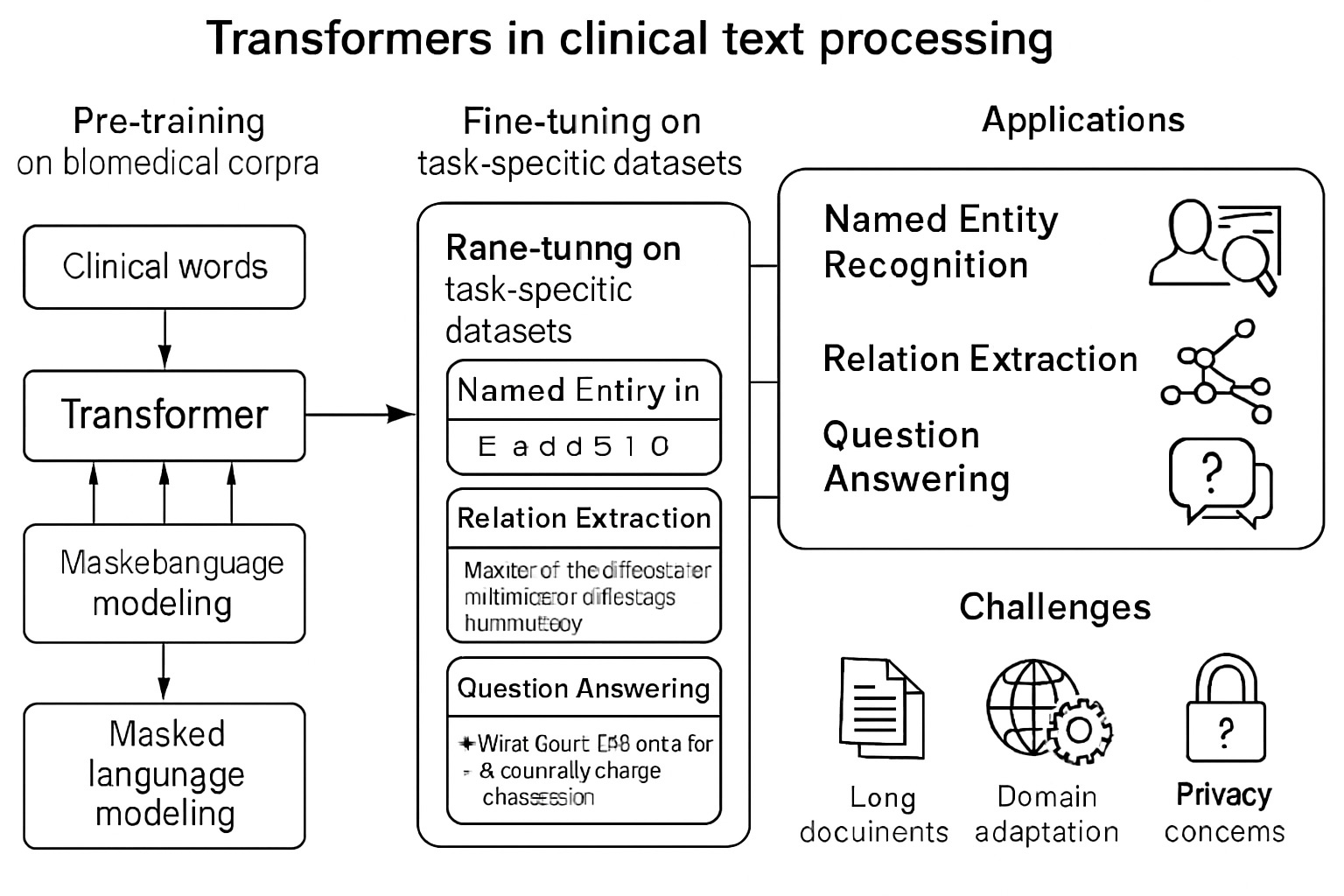
The healthcare sector has both opportunities and challenges as a result of the rapid expansion of unstructured clinical text data in electronic health records (EHRs). Physician notes, reports from radiologists, and summaries of discharge are examples of narrative medical documents from which relevant and actionable information can be extracted using clinical text analytics driven by Natural Language Processing (NLP). Named entity recognition, conceptual normalization, relation extraction, and temporal reasoning are just a few of the core methods and approaches in clinical natural language processing that are thoroughly covered in this paper. It covers cutting-edge deep learning models like BioBERT and ClinicalBERT as well as practical uses like clinical decision assistance, patient group identification, and adverse event detection. The paper also highlights future prospects including federated learning and multimodal integration, while addressing important issues in data privacy, annotation scarcity, and model interpretability. Clinical NLP has the potential to greatly improve patient care, biomedical research, and the effectiveness of the health system by converting free-text narratives into structured knowledge.
Graphical Abstract
Keywords
Data Availability Statement
Funding
Conflicts of Interest
Ethical Approval and Consent to Participate
References
- Chen, Y., Zhang, C., Bai, R., Sun, T., Ding, W., & Wang, R. (2025). A review of medical text analysis: Theory and practice. Information Fusion, 103024.
[CrossRef] [Google Scholar] - Li, I., Pan, J., Goldwasser, J., Verma, N., Wong, W. P., Nuzumlalı, M. Y., ... & Radev, D. (2022). Neural natural language processing for unstructured data in electronic health records: a review. Computer Science Review, 46, 100511.
[CrossRef] [Google Scholar] - Wu, S., Roberts, K., Datta, S., Du, J., Ji, Z., Si, Y., Soni, S., Wang, Q., Wei, Q., Xiang, Y., Zhao, B., & Xu, H. (2020). Deep learning in clinical natural language processing: a methodical review. Journal of the American Medical Informatics Association, 27(3), 457–470.
[CrossRef] [Google Scholar] - Li, Y., Tao, W., Li, Z., Sun, Z., Li, F., Fenton, S., ... & Tao, C. (2024). Artificial intelligence-powered pharmacovigilance: A review of machine and deep learning in clinical text-based adverse drug event detection for benchmark datasets. Journal of Biomedical Informatics, 152, 104621.
[CrossRef] [Google Scholar] - Elvas, L. B., Almeida, A., & Ferreira, J. C. (2025). Natural language processing in medical text processing: A scoping literature review. International Journal of Medical Informatics, 106049.
[CrossRef] [Google Scholar] - Mustafa, A., Naseem, U., & Azghadi, M. R. (2025). Large language models vs human for classifying clinical documents. International Journal of Medical Informatics, 195.
[CrossRef] [Google Scholar] - Koga, S., & Du, W. (2025). From text to image: challenges in integrating vision into ChatGPT for medical image interpretation. Neural Regeneration Research, 20(2), 487–488.
[CrossRef] [Google Scholar] - Guleria, P. (2025). NLP-based clinical text classification and sentiment analyses of complex medical transcripts using transformer model and machine learning classifiers. Neural Computing and Applications, 37(1), 341-366.
[CrossRef] [Google Scholar] - Jerfy, A., Selden, O., & Balkrishnan, R. (2024). The growing impact of natural language processing in healthcare and public health. INQUIRY: The Journal of Health Care Organization, Provision, and Financing, 61, 00469580241290095.
[CrossRef] [Google Scholar] - Karmalkar, P., Gurulingappa, H., Muhith, J., Singhal, S., Megaro, G., & Buchholz, F. (2021, February). Improving Consumer Experience for Medical Information Using Text Analytics. In 2021 International Symposium on Electrical, Electronics and Information Engineering (pp. 471-476).
[CrossRef] [Google Scholar] - Hossain, M. R., Mahabub, S., Masum, A. A., & Jahan, I. (2024). Natural Language Processing (NLP) in Analyzing Electronic Health Records for Better Decision Making. Journal of Computer Science and Technology Studies, 6(5), 216–228.
[CrossRef] [Google Scholar] - Yuan, J. (2024). Efficient Techniques for Processing Medical Texts in Legal Documents Using Transformer Architecture. In 2024 4th International Conference on Artificial Intelligence, Robotics, and Communication (ICAIRC) (pp. 990–993). IEEE.
[CrossRef] [Google Scholar] - Upadhyaya, N., Joshi, H., & Agrawal, C. (2025). Examining NLP for Smarter, Data-Driven Healthcare Solutions. In Intelligent Systems and IoT Applications in Clinical Health (pp. 393-420). IGI Global.
[CrossRef] [Google Scholar] - Kalankesh, L. R., & Monaghesh, E. (2024). Utilization of EHRs for clinical trials: a systematic review. BMC medical research methodology, 24(1), 70.
[CrossRef] [Google Scholar] - De Micco, F., Di Palma, G., Ferorelli, D., De Benedictis, A., Tomassini, L., Tambone, V., ... & Scendoni, R. (2025). Artificial intelligence in healthcare: transforming patient safety with intelligent systems—A systematic review. Frontiers in Medicine, 11, 1522554.
[CrossRef] [Google Scholar] - Kurki, S., Halla-Aho, V., Haussmann, M., Lähdesmäki, H., Leinonen, J. V., & Koskinen, M. (2024). A comparative study of clinical trial and real-world data in patients with diabetic kidney disease. Scientific reports, 14(1), 1731.
[CrossRef] [Google Scholar] - Ryan, D. K., Maclean, R. H., Balston, A., Scourfield, A., Shah, A. D., & Ross, J. (2023). Artificial intelligence and machine learning for clinical pharmacology. British Journal of Clinical Pharmacology, 90(3), 629–639.
[CrossRef] [Google Scholar] - Akhlaghi, H., Freeman, S., Vari, C., McKenna, B., Braitberg, G., Karro, J., & Tahayori, B. (2023). Machine learning in clinical practice: Evaluation of an artificial intelligence tool after implementation. Emergency Medicine Australasia, 36(1), 118–124.
[CrossRef] [Google Scholar] - Vaswani, A., Shazeer, N., Parmar, N., Uszkoreit, J., Jones, L., Gomez, A. N., Kaiser, Ł., & Polosukhin, I. (2017). Attention is all you need. Advances in Neural Information Processing Systems, 30, 5998–6008.
[Google Scholar] - Rasmy, L., Xiang, Y., Xie, Z., Tao, C., & Zhi, D. (2021). Med-BERT: pretrained contextualized embeddings on large-scale structured electronic health records for disease prediction. NPJ digital medicine, 4(1), 86.
[CrossRef] [Google Scholar] - Liu, X., Liu, H., Yang, G., Jiang, Z., Cui, S., Zhang, Z., ... & Wang, G. (2025). A generalist medical language model for disease diagnosis assistance. Nature medicine, 31(3), 932-942.
[CrossRef] [Google Scholar] - I2b2: Informatics for integrating biology & the bedside. (n.d.). i2b2: Informatics for Integrating Biology & the Bedside. Retrieved from https://www.i2b2.org/NLP/DataSets/
[Google Scholar] - MIMIC-IV. (n.d.). PhysioNet. Retrieved from https://physionet.org/content/mimiciv/3.1/
[Google Scholar] - PhysioNet databases. (n.d.). PhysioNet. Retrieved from https://physionet.org/about/database/
[Google Scholar] - Styler, W. F., Bethard, S., Finan, S., Palmer, M., Pradhan, S., de Groen, P. C., Erickson, B., Miller, T., Lin, C., Savova, G., & Pustejovsky, J. (2014). Temporal Annotation in the Clinical Domain. Transactions of the Association for Computational Linguistics, 2, 143–154.
[CrossRef] [Google Scholar] - Stubbs, A., Filannino, M., & Uzuner, Ö. (2017). De-identification of psychiatric intake records: Overview of 2016 CEGS N-GRID shared tasks Track 1. Journal of Biomedical Informatics, 75, S4–S18.
[CrossRef] [Google Scholar] - Medical text. (n.d.). Kaggle: Your Machine Learning and Data Science Community. Retrieved from https://www.kaggle.com/datasets/chaitanyakck/medical-text
[Google Scholar]
Cited By (4)
-
İlknur Dönmez, Faruk Bulut. Multidimensional Diversity In Video Recommender Systems: A Holistic Framework of Literature Gaps and Future Directions.
Intelligent Systems with Applications, 2026 .
[CrossRef] -
Shubhani Aggarwal, Arzoo Miglani, Norah Saleh Alghamdi, Gaurav Dhiman. Resilient and decentralized demand-side management in smart grids using blockchain.
Scientific Reports, 2026 , 16 (1).
[CrossRef] -
Beihua Yang, Peng Song, Yunpeng Zeng. COALN-MvC: A continuous optimized anchor learning network for multi-view clustering.
Knowledge-Based Systems, 2026 , 345 .
[CrossRef] -
Gaurav Dhiman, Kiran Deep Singh, Prabh Deep Singh, Norah Saleh Alghamdi, Ghadah Shukri Albakri. A novel approach to reliable and flexible distributed computing with virtualization in smart healthcare applications.
Scientific Reports, 2026 , 16 (1).
[CrossRef]
Cite This Article
TY  - JOUR
AU  - Kumar, Atul
PY  - 2025
DA  - 2025/11/14
TI  - Clinical Text Analytics: Techniques, Deep Learning Models, and the Future of Medical Text Analytics
JO  - ICCK Transactions on Machine Intelligence
T2  - ICCK Transactions on Machine Intelligence
JF  - ICCK Transactions on Machine Intelligence
VL  - 1
IS  - 3
SP  - 148
EP  - 165
DO  - 10.62762/TMI.2025.451731
UR  - https://www.icck.org/article/abs/TMI.2025.451731
KW  - clinical text
KW  - NLP
KW  - electronic health records (EHRs)
KW  - named entity recognition (NER)
AB  - The healthcare sector has both opportunities and challenges as a result of the rapid expansion of unstructured clinical text data in electronic health records (EHRs). Physician notes, reports from radiologists, and summaries of discharge are examples of narrative medical documents from which relevant and actionable information can be extracted using clinical text analytics driven by Natural Language Processing (NLP). Named entity recognition, conceptual normalization, relation extraction, and temporal reasoning are just a few of the core methods and approaches in clinical natural language processing that are thoroughly covered in this paper. It covers cutting-edge deep learning models like BioBERT and ClinicalBERT as well as practical uses like clinical decision assistance, patient group identification, and adverse event detection. The paper also highlights future prospects including federated learning and multimodal integration, while addressing important issues in data privacy, annotation scarcity, and model interpretability. Clinical NLP has the potential to greatly improve patient care, biomedical research, and the effectiveness of the health system by converting free-text narratives into structured knowledge.
SN  - 3068-7403
PB  - Institute of Central Computation and Knowledge
LA  - English
ER  -
@article{Kumar2025Clinical,
  author = {Atul Kumar},
  title = {Clinical Text Analytics: Techniques, Deep Learning Models, and the Future of Medical Text Analytics},
  journal = {ICCK Transactions on Machine Intelligence},
  year = {2025},
  volume = {1},
  number = {3},
  pages = {148-165},
  doi = {10.62762/TMI.2025.451731},
  url = {https://www.icck.org/article/abs/TMI.2025.451731},
  abstract = {The healthcare sector has both opportunities and challenges as a result of the rapid expansion of unstructured clinical text data in electronic health records (EHRs). Physician notes, reports from radiologists, and summaries of discharge are examples of narrative medical documents from which relevant and actionable information can be extracted using clinical text analytics driven by Natural Language Processing (NLP). Named entity recognition, conceptual normalization, relation extraction, and temporal reasoning are just a few of the core methods and approaches in clinical natural language processing that are thoroughly covered in this paper. It covers cutting-edge deep learning models like BioBERT and ClinicalBERT as well as practical uses like clinical decision assistance, patient group identification, and adverse event detection. The paper also highlights future prospects including federated learning and multimodal integration, while addressing important issues in data privacy, annotation scarcity, and model interpretability. Clinical NLP has the potential to greatly improve patient care, biomedical research, and the effectiveness of the health system by converting free-text narratives into structured knowledge.},
  keywords = {clinical text, NLP, electronic health records (EHRs), named entity recognition (NER)},
  issn = {3068-7403},
  publisher = {Institute of Central Computation and Knowledge}
}
Publisher's Note
ICCK stays neutral with regard to jurisdictional claims in published maps and institutional affiliations.
Rights and Permissions


Portico
