
MaizeEviReason for Auditable Evidence Applicability and Conservative Release in Maize Disease Decision Support





Article Information
Abstract
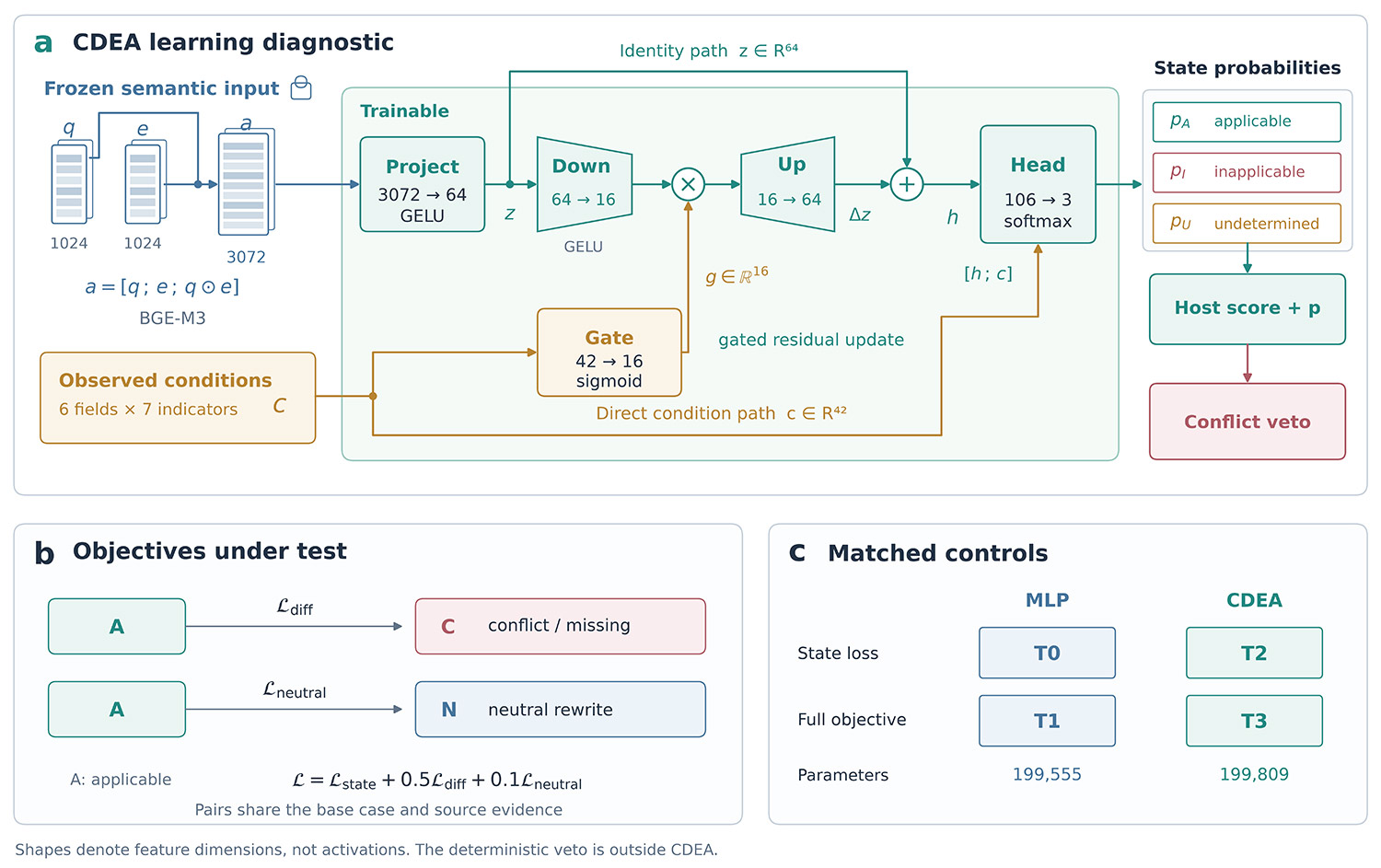
Agricultural evidence can be topically relevant yet conflict with the conditions of a query, or lack the information needed to support an action. We present MaizeEviReason, an auditable interface that keeps source conditions, distinguishes applicable, inapplicable and undetermined states, and separates applicability assessment from deterministic release checks. The core evaluation measures how much information is lost when conditions are projected onto fixed fields and what coverage is given up when supplied contracts are enforced. Matched learning experiments evaluate applicability prediction, and a public-pipeline diagnostic examines whether the interface is activated. On 49 constructed assignments from five documents, a six-field projection wrongly accepted 13 conflicting or unresolved assignments and reached an accuracy of 0.7347, against 0.8367 for direct interpretation of the text contract. The complete rule agrees perfectly with its reference, as expected, because those labels were derived from the same contracts. On 120 constructed release records, deterministic gating reduced observed symbolic violations from 7 to 0, while coverage fell from 55.83% to 50.00%. The prespecified source-family comparison of decision accuracy was not significant (Holm-adjusted $p = 0.75$), and the eight-record source-bound test covered only one family. On ten permanently held-out documents, the condition-differential evidence adapter (CDEA) obtained a macro-F1 of 0.4949 with the state loss and 0.2518 with its full objective. In the public evaluation the condition interface was never activated, so its effect under usable condition inputs remains untested. Taken together, these descriptive diagnostics locate information loss in the evaluated condition representation and mark the operating scope of applicability assessment and output checking; they are not evidence of general decision-support effectiveness.
Graphical Abstract
Keywords
Data Availability Statement
Funding
Conflicts of Interest
AI Use Statement
Ethical Approval and Consent to Participate
References
- Liakos, K. G., Busato, P., Moshou, D., Pearson, S., & Bochtis, D. (2018). Machine learning in agriculture: A review. Sensors, 18(8), 2674.
[CrossRef] [Google Scholar] - Kamilaris, A., & Prenafeta-Boldú, F. X. (2018). Deep learning in agriculture: A survey. Computers and electronics in agriculture, 147, 70-90.
[CrossRef] [Google Scholar] - Rose, D. C., Sutherland, W. J., Parker, C., Lobley, M., Winter, M., Morris, C., ... & Dicks, L. V. (2016). Decision support tools for agriculture: Towards effective design and delivery. Agricultural systems, 149, 165-174.
[CrossRef] [Google Scholar] - Lewis, P., Perez, E., Piktus, A., Petroni, F., Karpukhin, V., Goyal, N., ... & Kiela, D. (2020). Retrieval-augmented generation for knowledge-intensive nlp tasks. Advances in neural information processing systems, 33, 9459-9474.
[Google Scholar] - Karpukhin, V., Oguz, B., Min, S., Lewis, P., Wu, L., Edunov, S., ... & Yih, W. T. (2020, November). Dense passage retrieval for open-domain question answering. In Proceedings of the 2020 conference on empirical methods in natural language processing (EMNLP) (pp. 6769-6781).
[CrossRef] [Google Scholar] - Chen, J., Xiao, S., Zhang, P., Luo, K., Lian, D., & Liu, Z. (2024). M3-Embedding: Multi-linguality, multi-functionality, multi-granularity text embeddings through self-knowledge distillation. In Findings of the Association for Computational Linguistics: ACL 2024 (pp. 2318-2335).
[CrossRef] [Google Scholar] - Wu, H., Xie, N., Wang, X., Fan, J., Li, Y., & Meng, Z. (2025). Crop GraphRAG: pest and disease knowledge base Q&A system for sustainable crop protection. Frontiers in Plant Science, 16, 1696872.
[CrossRef] [Google Scholar] - Liu, Y., Xie, Y., Wu, X., & Wang, Q. (2026). CornCare: A knowledge-graph-enhanced multimodal diagnostic reporting system for corn diseases. Agriculture, 16(10), 1109.
[CrossRef] [Google Scholar] - Wang, Y., Zhao, K., Li, H., Wang, R., & Chen, W. (2026). A condition-aware retrieval-augmented decision support framework for tomato cultivation management. Frontiers in Plant Science, 17, 1802748.
[CrossRef] [Google Scholar] - Liu, L., Li, S., Qi, J., Yuan, Z., & Yang, P. (2026). TARAG: A time-aware retrieval-augmented generation framework for supporting precision crop pest and disease management through large language models. Computers and Electronics in Agriculture, 248, 111786.
[CrossRef] [Google Scholar] - Chan, Y. C., Fan, Y. C., Li, H. C., & Yang, M. D. (2026). SMART: Structured multimodal agricultural retrieval-augmented transformer for plant disease diagnosis. Computers and Electronics in Agriculture, 250, 111882.
[CrossRef] [Google Scholar] - Asai, A., Wu, Z., Wang, Y., Sil, A., & Hajishirzi, H. (2024, May). Self-rag: Learning to retrieve, generate, and critique through self-reflection. In International conference on learning representations (Vol. 2024, pp. 9112-9141).
[Google Scholar] - Yan, S. Q., Gu, J. C., Zhu, Y., & Ling, Z. H. (2024). Corrective retrieval augmented generation. arXiv preprint arXiv:2401.15884.
[CrossRef] [Google Scholar] - Gao, T., Yen, H., Yu, J., & Chen, D. (2023). Enabling large language models to generate text with citations. In Proceedings of the 2023 Conference on Empirical Methods in Natural Language Processing (pp. 6465-6488).
[CrossRef] [Google Scholar] - Niu, C., Wu, Y., Zhu, J., Xu, S., Shum, K., Zhong, R., ... & Zhang, T. (2024, August). Ragtruth: A hallucination corpus for developing trustworthy retrieval-augmented language models. In Proceedings of the 62nd Annual Meeting of the Association for Computational Linguistics (Volume 1: Long Papers) (pp. 10862-10878).
[CrossRef] [Google Scholar] - Gebru, T., Morgenstern, J., Vecchione, B., Vaughan, J. W., Wallach, H., Iii, H. D., & Crawford, K. (2021). Datasheets for datasets. Communications of the ACM, 64(12), 86-92. https://dx.doi.org/10.1145/3458723
[Google Scholar] - Wang, Y., Xian, G., & Zhao, R. (2025). Image-Text Multi-Modal Dataset of Corn Leaf Diseases based on Manual Annotation and Contrast Generation Model. Journal of Agricultural Big Data, 7(3), 371.
[CrossRef] [Google Scholar] - CHEN, L., SHI, B., & YUAN, Y. IDADP-Corn Disease Image Description Dataset. China Scientific Data, 10(4), 1-10.
[CrossRef] [Google Scholar] - Gauba, A., Pi, I., Man, Y., Pang, Z., Adve, V., & Wang, Y. X. (2026). Agmmu: A comprehensive agricultural multimodal understanding benchmark. Advances in Neural Information Processing Systems, 38.
[Google Scholar] - Thorne, J., Vlachos, A., Christodoulopoulos, C., & Mittal, A. (2018, June). FEVER: a large-scale dataset for fact extraction and VERification. In Proceedings of the 2018 Conference of the North American Chapter of the Association for Computational Linguistics: Human Language Technologies, Volume 1 (Long Papers) (pp. 809-819).
[CrossRef] [Google Scholar] - Hüllermeier, E., & Waegeman, W. (2021). Aleatoric and epistemic uncertainty in machine learning: An introduction to concepts and methods. Machine learning, 110(3), 457-506.
[CrossRef] [Google Scholar] - Geifman, Y., & El-Yaniv, R. (2019). SelectiveNet: A deep neural network with an integrated reject option. In Proceedings of the 36th International Conference on Machine Learning (PMLR 97, pp. 2151-2159). https://proceedings.mlr.press/v97/geifman19a.html
[Google Scholar] - Ribeiro, M. T., Wu, T., Guestrin, C., & Singh, S. (2020). Beyond accuracy: Behavioral testing of NLP models with CheckList. In Proceedings of the 58th Annual Meeting of the Association for Computational Linguistics (pp. 4902-4912).
[CrossRef] [Google Scholar] - Sainz, O., Campos, J., García-Ferrero, I., Etxaniz, J., de Lacalle, O. L., & Agirre, E. (2023, December). NLP evaluation in trouble: On the need to measure LLM data contamination for each benchmark. In Findings of the Association for Computational Linguistics: EMNLP 2023 (pp. 10776-10787).
[CrossRef] [Google Scholar] - Holm, S. (1979). A simple sequentially rejective multiple test procedure. Scandinavian Journal of Statistics, 6(2), 65-70. https://www.jstor.org/stable/4615733
[Google Scholar]
Cite This Article
TY  - JOUR
AU  - Zhang, Ning
AU  - Wu, Huarui
AU  - Zhu, Huaji
AU  - Miao, Yisheng
PY  - 2026
DA  - 2026/11/08
TI  - MaizeEviReason for Auditable Evidence Applicability and Conservative Release in Maize Disease Decision Support
JO  - Digital Intelligence in Agriculture
T2  - Digital Intelligence in Agriculture
JF  - Digital Intelligence in Agriculture
VL  - 2
IS  - 4
SP  - 191
EP  - 202
DO  - 10.62762/DIA.2026.954088
UR  - https://www.icck.org/article/abs/dia.2026.954088
KW  - maize disease
KW  - evidence applicability
KW  - condition representation
KW  - conservative release
KW  - retrieval-augmented generation
KW  - source-separated evaluation
AB  - Agricultural evidence can be topically relevant yet conflict with the conditions of a query, or lack the information needed to support an action. We present MaizeEviReason, an auditable interface that keeps source conditions, distinguishes applicable, inapplicable and undetermined states, and separates applicability assessment from deterministic release checks. The core evaluation measures how much information is lost when conditions are projected onto fixed fields and what coverage is given up when supplied contracts are enforced. Matched learning experiments evaluate applicability prediction, and a public-pipeline diagnostic examines whether the interface is activated. On 49 constructed assignments from five documents, a six-field projection wrongly accepted 13 conflicting or unresolved assignments and reached an accuracy of 0.7347, against 0.8367 for direct interpretation of the text contract. The complete rule agrees perfectly with its reference, as expected, because those labels were derived from the same contracts. On 120 constructed release records, deterministic gating reduced observed symbolic violations from 7 to 0, while coverage fell from 55.83% to 50.00%. The prespecified source-family comparison of decision accuracy was not significant (Holm-adjusted $p = 0.75$), and the eight-record source-bound test covered only one family. On ten permanently held-out documents, the condition-differential evidence adapter (CDEA) obtained a macro-F1 of 0.4949 with the state loss and 0.2518 with its full objective. In the public evaluation the condition interface was never activated, so its effect under usable condition inputs remains untested. Taken together, these descriptive diagnostics locate information loss in the evaluated condition representation and mark the operating scope of applicability assessment and output checking; they are not evidence of general decision-support effectiveness.
SN  - 3069-3187
PB  - Institute of Central Computation and Knowledge
LA  - English
ER  -
@article{Zhang2026MaizeEviRe,
  author = {Ning Zhang and Huarui Wu and Huaji Zhu and Yisheng Miao},
  title = {MaizeEviReason for Auditable Evidence Applicability and Conservative Release in Maize Disease Decision Support},
  journal = {Digital Intelligence in Agriculture},
  year = {2026},
  volume = {2},
  number = {4},
  pages = {191-202},
  doi = {10.62762/DIA.2026.954088},
  url = {https://www.icck.org/article/abs/dia.2026.954088},
  abstract = {Agricultural evidence can be topically relevant yet conflict with the conditions of a query, or lack the information needed to support an action. We present MaizeEviReason, an auditable interface that keeps source conditions, distinguishes applicable, inapplicable and undetermined states, and separates applicability assessment from deterministic release checks. The core evaluation measures how much information is lost when conditions are projected onto fixed fields and what coverage is given up when supplied contracts are enforced. Matched learning experiments evaluate applicability prediction, and a public-pipeline diagnostic examines whether the interface is activated. On 49 constructed assignments from five documents, a six-field projection wrongly accepted 13 conflicting or unresolved assignments and reached an accuracy of 0.7347, against 0.8367 for direct interpretation of the text contract. The complete rule agrees perfectly with its reference, as expected, because those labels were derived from the same contracts. On 120 constructed release records, deterministic gating reduced observed symbolic violations from 7 to 0, while coverage fell from 55.83\% to 50.00\%. The prespecified source-family comparison of decision accuracy was not significant (Holm-adjusted \$p = 0.75\$), and the eight-record source-bound test covered only one family. On ten permanently held-out documents, the condition-differential evidence adapter (CDEA) obtained a macro-F1 of 0.4949 with the state loss and 0.2518 with its full objective. In the public evaluation the condition interface was never activated, so its effect under usable condition inputs remains untested. Taken together, these descriptive diagnostics locate information loss in the evaluated condition representation and mark the operating scope of applicability assessment and output checking; they are not evidence of general decision-support effectiveness.},
  keywords = {maize disease, evidence applicability, condition representation, conservative release, retrieval-augmented generation, source-separated evaluation},
  issn = {3069-3187},
  publisher = {Institute of Central Computation and Knowledge}
}
Article Metrics
Publisher's Note
ICCK stays neutral with regard to jurisdictional claims in published maps and institutional affiliations.
Rights and Permissions
 Copyright © 2026 by the Author(s). Published by Institute of Central Computation and Knowledge. This article is an open access article distributed under the terms and conditions of the Creative Commons Attribution (CC BY) license (https://creativecommons.org/licenses/by/4.0/), which permits use, sharing, adaptation, distribution and reproduction in any medium or format, as long as you give appropriate credit to the original author(s) and the source, provide a link to the Creative Commons licence, and indicate if changes were made.