

On the Structural Limitations of Neural Networks for Modeling Nonlinear CO$_2$ Adsorption Equilibria



Article Information
Abstract
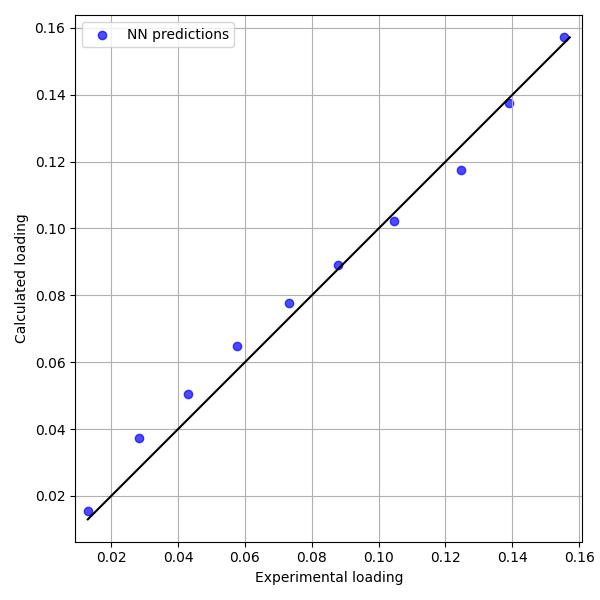
Machine learning has emerged as a flexible alternative for modeling adsorption equilibrium. However, its limitations in highly nonlinear systems remain unclear. In this work, a feedforward neural network was evaluated using experimental adsorption data for CO$_2$ and N$_2$ on zeolite 13X taken from the literature. While the model accurately reproduces N$_2$ adsorption behavior, it exhibits systematic deviations for CO$_2$, particularly at higher loadings. Training diagnostics reveal a persistent validation loss plateau, indicating a limitation in the model's ability to further reduce prediction error. These results suggest that the discrepancy is not due to data quality or overfitting, but rather to a structural mismatch between the neural network representation and the strongly nonlinear, saturating nature of CO$_2$ adsorption. The findings highlight the need for hybrid approaches that incorporate physical structure, such as models based on the Langmuir isotherm.
Graphical Abstract
Keywords
Data Availability Statement
Funding
Conflicts of Interest
AI Use Statement
Ethical Approval and Consent to Participate
References
- Aleksandrzak, T., Zabielska, K., & Gabruś, E. (2024). Modeling and experimental studies of carbon dioxide separation on zeolite fixed bed by cyclic pressure swing adsorption. Polish Journal of Chemical Technology, 26(1), 8-15. http://dx.doi.org/10.2478/pjct-2024-0002
[Google Scholar] - Dvořák, M., Skopec, P., Vodička, M., Hrdlička, J., Pilař, L., & Farionová, K. (2026). Experimental and Modeling Analysis of CO2 Adsorption from Flue Gas from a Fluidized Bed Biomass Boiler. Processes, 14(2), 222.
[CrossRef] [Google Scholar] - Yu, X., Liu, B., Shen, Y., & Zhang, D. (2022). Design and experiment of high-productivity two-stage vacuum pressure swing adsorption process for carbon capturing from dry flue gas. Chinese Journal of Chemical Engineering, 43, 378–391.
[CrossRef] [Google Scholar] - Zhan, G., Duan, Y., Chang, F., Shi, S., Zeng, S., Bai, Y., Bai, L., Li, Z., & Zhang, X. (2026). Dynamic simulation and assessment of decarbonization from confined space with pressure and temperature swing adsorption. Separation and Purification Technology, 380, 135209.
[CrossRef] [Google Scholar]
Cite This Article
TY  - JOUR
AU  - Calderon, Cristian J.
AU  - Tinoco, Esteban B. Hernández
PY  - 2026
DA  - 2026/08/12
TI  - On the Structural Limitations of Neural Networks for Modeling Nonlinear CO$_2$ Adsorption Equilibria
JO  - Journal of Chemical Engineering and Renewable Fuels
T2  - Journal of Chemical Engineering and Renewable Fuels
JF  - Journal of Chemical Engineering and Renewable Fuels
VL  - 2
IS  - 3
SP  - 78
EP  - 81
DO  - 10.62762/JCERF.2026.725231
UR  - https://www.icck.org/article/abs/JCERF.2026.725231
KW  - chemical engineering
KW  - neural networks
KW  - adsorption
KW  - carbon capture
AB  - Machine learning has emerged as a flexible alternative for modeling adsorption equilibrium. However, its limitations in highly nonlinear systems remain unclear. In this work, a feedforward neural network was evaluated using experimental adsorption data for CO$_2$ and N$_2$ on zeolite 13X taken from the literature. While the model accurately reproduces N$_2$ adsorption behavior, it exhibits systematic deviations for CO$_2$, particularly at higher loadings. Training diagnostics reveal a persistent validation loss plateau, indicating a limitation in the model's ability to further reduce prediction error. These results suggest that the discrepancy is not due to data quality or overfitting, but rather to a structural mismatch between the neural network representation and the strongly nonlinear, saturating nature of CO$_2$ adsorption. The findings highlight the need for hybrid approaches that incorporate physical structure, such as models based on the Langmuir isotherm.
SN  - 3070-1058
PB  - Institute of Central Computation and Knowledge
LA  - English
ER  -
@article{Calderon2026On,
  author = {Cristian J. Calderon and Esteban B. Hernández Tinoco},
  title = {On the Structural Limitations of Neural Networks for Modeling Nonlinear CO\$\_2\$ Adsorption Equilibria},
  journal = {Journal of Chemical Engineering and Renewable Fuels},
  year = {2026},
  volume = {2},
  number = {3},
  pages = {78-81},
  doi = {10.62762/JCERF.2026.725231},
  url = {https://www.icck.org/article/abs/JCERF.2026.725231},
  abstract = {Machine learning has emerged as a flexible alternative for modeling adsorption equilibrium. However, its limitations in highly nonlinear systems remain unclear. In this work, a feedforward neural network was evaluated using experimental adsorption data for CO\$\_2\$ and N\$\_2\$ on zeolite 13X taken from the literature. While the model accurately reproduces N\$\_2\$ adsorption behavior, it exhibits systematic deviations for CO\$\_2\$, particularly at higher loadings. Training diagnostics reveal a persistent validation loss plateau, indicating a limitation in the model's ability to further reduce prediction error. These results suggest that the discrepancy is not due to data quality or overfitting, but rather to a structural mismatch between the neural network representation and the strongly nonlinear, saturating nature of CO\$\_2\$ adsorption. The findings highlight the need for hybrid approaches that incorporate physical structure, such as models based on the Langmuir isotherm.},
  keywords = {chemical engineering, neural networks, adsorption, carbon capture},
  issn = {3070-1058},
  publisher = {Institute of Central Computation and Knowledge}
}
Article Metrics
Publisher's Note
ICCK stays neutral with regard to jurisdictional claims in published maps and institutional affiliations.
Rights and Permissions
 Copyright © 2026 by the Author(s). Published by Institute of Central Computation and Knowledge. This article is an open access article distributed under the terms and conditions of the Creative Commons Attribution (CC BY) license (https://creativecommons.org/licenses/by/4.0/), which permits use, sharing, adaptation, distribution and reproduction in any medium or format, as long as you give appropriate credit to the original author(s) and the source, provide a link to the Creative Commons licence, and indicate if changes were made.


Portico
