

Sustainable Aviation Fuel 2.0: Carbon- and Contrail-Intensity Managed Refineries for Climate-Smart Aviation



Article Information
Abstract
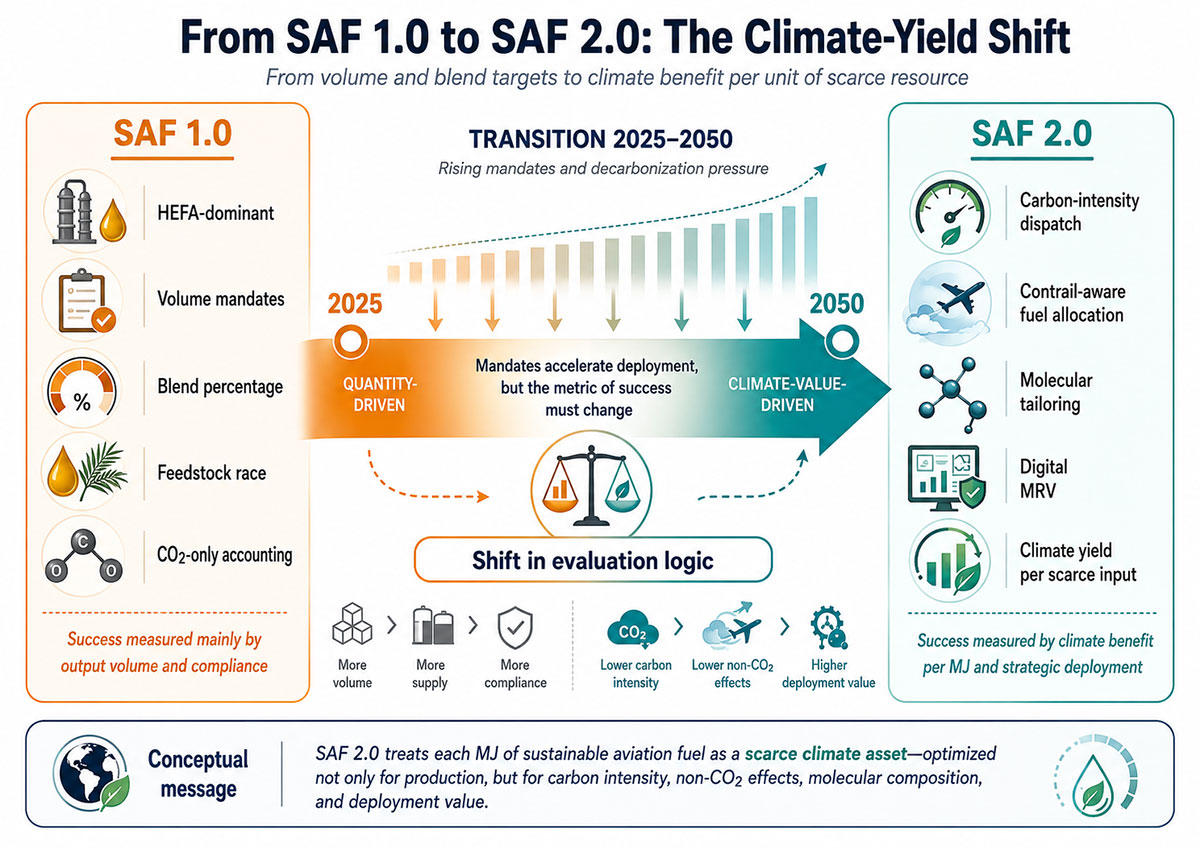
Sustainable aviation fuel (SAF) is entering the mandate era while still representing a sub-percent share of global aviation fuel. This Perspective argues that the next bottleneck is not only production capacity, but climate allocation: which carbon sources, hydrogen, renewable electrons and molecular structures should become jet fuel, and where that fuel should be deployed to deliver the greatest avoided climate impact. SAF 2.0 is proposed as a carbon- and contrail-intensity managed refinery–airport architecture that links certified HEFA, Fischer–Tropsch, alcohol-to-jet, power-to-liquid/e-SAF and co-processing modules with molecular finishing, digital monitoring, reporting and verification, and targeted fuel dispatch. In this framework, hydrogen content, sulfur, naphthalene, aromatics and cycloparaffins are treated as design variables affecting soot, non-volatile particulate emissions and contrail-forming potential, rather than as secondary specification details. A Climate Yield Factor is introduced as a screening metric to compare pathways and deployment options by avoided climate impact per unit of scarce carbon, hydrogen, electricity, feedstock and cost. The Perspective closes with an R&D agenda for refinery–airport demonstration hubs able to accelerate SAF scale-up while avoiding first-generation feedstock bottlenecks and volume-only compliance logic.
Graphical Abstract
Keywords
Data Availability Statement
Funding
Conflicts of Interest
AI Use Statement
Ethical Approval and Consent to Participate
References
- Bergero, C., Gosnell, G., Gielen, D., Kang, S., Bazilian, M., & Davis, S. J. (2023). Pathways to net-zero emissions from aviation. Nature Sustainability, 6 (4), 404-414.
[CrossRef] [Google Scholar] - Braun, M., Grimme, W., & Oesingmann, K. (2024). Pathway to net zero: Reviewing sustainable aviation fuels, environmental impacts and pricing. Journal of Air Transport Management, 117 , 102580.
[CrossRef] [Google Scholar] - International Air Transport Association. (2026). Sustainable aviation fuels (SAF): Fact sheet . IATA. Retrieved June 3, 2026, from https://www.iata.org/en/iata-repository/pressroom/fact-sheets/fact-sheet-sustainable-aviation-fuels/
[Google Scholar] - Martulli, A., Brandt, K., Allroggen, F., & Malina, R. (2025). The potential scale-up of sustainable aviation fuels production capacity to meet global and EU policy targets. Nature Communications, 16 (1), 1-12.
[CrossRef] [Google Scholar] - European Commission. (n.d.). ReFuelEU aviation . Directorate-General for Mobility and Transport. Retrieved June 3, 2026, from https://transport.ec.europa.eu/transport-modes/air/environment/refueleu-aviation_en
[Google Scholar] - UK Department for Transport. (2025, October 16). Sustainable Aviation Fuel (SAF) Mandate . GOV.UK. Retrieved June 3, 2026, from https://www.gov.uk/government/collections/sustainable-aviation-fuel-saf-mandate
[Google Scholar] - Teoh, R., Schumann, U., Voigt, C., Schripp, T., Shapiro, M., Engberg, Z., ... & Stettler, M. E. (2022). Targeted use of sustainable aviation fuel to maximize climate benefits. Environmental science & technology, 56 (23), 17246-17255.
[CrossRef] [Google Scholar] - International Civil Aviation Organization. (2023). SAF conversion processes . ICAO. Retrieved June 3, 2026, from https://www.icao.int/SAF/saf-conversion-processes
[Google Scholar] - Pearlson, M., Wollersheim, C., & Hileman, J. (2013). A techno‐economic review of hydroprocessed renewable esters and fatty acids for jet fuel production. Biofuels, Bioproducts and Biorefining, 7 (1), 89-96.
[CrossRef] [Google Scholar] - Tao, L., Milbrandt, A., Zhang, Y., & Wang, W. C. (2017). Techno-economic and resource analysis of hydroprocessed renewable jet fuel. Biotechnology for biofuels, 10 (1), 261.
[CrossRef] [Google Scholar] - de Klerk, A., Chauhan, G., Halmenschlager, C., Link, F., Montoya Sánchez, N., Gartley, B., ... & Lehoux, R. (2024). Sustainable aviation fuel: Pathways to fully formulated synthetic jet fuel via Fischer–Tropsch synthesis. Energy Science & Engineering, 12 (2), 394-409.
[CrossRef] [Google Scholar] - Eswaran, S., Subramaniam, S., Geleynse, S., Brandt, K., Wolcott, M., & Zhang, X. (2021). Techno-economic analysis of catalytic hydrothermolysis pathway for jet fuel production. Renewable and Sustainable Energy Reviews, 151 , 111516.
[CrossRef] [Google Scholar] - Geleynse, S., Brandt, K., Garcia‐Perez, M., Wolcott, M., & Zhang, X. (2018). The alcohol‐to‐jet conversion pathway for drop‐in biofuels: techno‐economic evaluation. ChemSusChem, 11 (21), 3728-3741.
[CrossRef] [Google Scholar] - Landera, A., Bambha, R. P., Hao, N., Desai, S. P., Moore, C. M., Sutton, A. D., & George, A. (2022). Building structure-property relationships of cycloalkanes in support of their use in sustainable aviation fuels. Frontiers in energy research, 9 , 771697.
[CrossRef] [Google Scholar] - Lindfors, C., Elliott, D. C., Prins, W., Oasmaa, A., & Lehtonen, J. (2023). Co-processing of Biocrudes in Oil Refineries. Energy and Fuels, 37 (2), 799-804.
[CrossRef] [Google Scholar] - Rojas-Michaga, M. F., Michailos, S., Cardozo, E., Akram, M., Hughes, K. J., Ingham, D., & Pourkashanian, M. (2023). Sustainable aviation fuel (SAF) production through power-to-liquid (PtL): A combined techno-economic and life cycle assessment. Energy Conversion and Management, 292 , 117427.
[CrossRef] [Google Scholar] - Brem, B. T., Durdina, L., Siegerist, F., Beyerle, P., Bruderer, K., Rindlisbacher, T., ... & Wang, J. (2015). Effects of fuel aromatic content on nonvolatile particulate emissions of an in-production aircraft gas turbine. Environmental science & technology, 49 (22), 13149-13157.
[CrossRef] [Google Scholar] - Schripp, T., Anderson, B. E., Bauder, U., Rauch, B., Corbin, J. C., Smallwood, G. J., ... & LeClercq, P. (2022). Aircraft engine particulate matter emissions from sustainable aviation fuels: Results from ground-based measurements during the NASA/DLR campaign ECLIF2/ND-MAX. Fuel, 325 , 124764.
[CrossRef] [Google Scholar] - Voigt, C., Kleine, J., Sauer, D., Moore, R. H., Bräuer, T., Le Clercq, P., ... & Anderson, B. E. (2021). Cleaner burning aviation fuels can reduce contrail cloudiness. Communications Earth & Environment, 2 (1), 114.
[CrossRef] [Google Scholar] - Märkl, R. S., Voigt, C., Sauer, D., Dischl, R. K., Kaufmann, S., Harlaß, T., ... & Le Clercq, P. (2024). Powering aircraft with 100\% sustainable aviation fuel reduces ice crystals in contrails. Atmospheric Chemistry and Physics, 24 (6), 3813-3837.
[CrossRef] [Google Scholar] - Dischl, R., Märkl, R., Sauer, D., Voigt, C., Harlaß, T., Scheibe, M., ... & Le Clercq, P. (2025). Fuel sulfur content can modulate contrail ice crystal numbers. Communications Earth & Environment, 6 (1), 902.
[CrossRef] [Google Scholar] - Quante, G., Enderle, B., Laybourn, P., Holm, P. W., Andersen, L. W., Voigt, C., & Kaltschmitt, M. (2025). Segregated supply of sustainable aviation fuel to reduce contrail energy forcing–demonstration and potentials. Journal of the Air Transport Research Society, 4 , 100049.
[CrossRef] [Google Scholar] - Tanzil, A. H., Brandt, K., Zhang, X., Wolcott, M., Stockle, C., & Garcia-Perez, M. (2021). Production of sustainable aviation fuels in petroleum refineries: evaluation of new bio-refinery concepts. Frontiers in Energy Research, 9 , 735661.
[CrossRef] [Google Scholar] - Prussi, M., Lee, U., Wang, M., Malina, R., Valin, H., Taheripour, F., ... & Hileman, J. I. (2021). CORSIA: The first internationally adopted approach to calculate life-cycle GHG emissions for aviation fuels. Renewable and Sustainable Energy Reviews, 150 , 111398.
[CrossRef] [Google Scholar] - Seber, G., Escobar, N., Valin, H., & Malina, R. (2022). Uncertainty in life cycle greenhouse gas emissions of sustainable aviation fuels from vegetable oils. Renewable and Sustainable Energy Reviews, 170 , 112945.
[CrossRef] [Google Scholar] - Faulhaber, C., Borland, C., Boehm, R., & Heyne, J. (2023). Measurements of nitrile rubber absorption of hydrocarbons: trends for sustainable aviation fuel compatibility. Energy & Fuels, 37 (13), 9207-9219.
[CrossRef] [Google Scholar] - Feldhausen, J., Bell, D. C., Yang, Z., Faulhaber, C., Boehm, R., & Heyne, J. (2022). Synthetic aromatic kerosene property prediction improvements with isomer specific characterization via GCxGC and vacuum ultraviolet spectroscopy. Fuel, 326 , 125002.
[CrossRef] [Google Scholar] - Heyne, J., Rauch, B., Le Clercq, P., & Colket, M. (2021). Sustainable aviation fuel prescreening tools and procedures. Fuel, 290 , 120004.
[CrossRef] [Google Scholar] - Ueckerdt, F., Bauer, C., Dirnaichner, A., Everall, J., Sacchi, R., & Luderer, G. (2021). Potential and risks of hydrogen-based e-fuels in climate change mitigation. Nature Climate Change, 11 (5), 384-393.
[CrossRef] [Google Scholar] - International Air Transport Association. (2025). IATA releases SAF accounting and reporting methodology . Retrieved June 3, 2026, from https://www.iata.org/contentassets/d13875e9ed784f75bac90f000760e998/iata-sustainable-aviation-fuel-saf-accounting--reporting-methodology.pdf
[Google Scholar] - International Air Transport Association. (2025). SAF Registry goes live . IATA. Retrieved June 3, 2026, from https://www.iata.org/en/pressroom/2025-releases/2025-04-03-01/
[Google Scholar] - Tanzil, A. H., Brandt, K., Wolcott, M., Zhang, X., & Garcia-Perez, M. (2021). Strategic assessment of sustainable aviation fuel production technologies: Yield improvement and cost reduction opportunities. Biomass and Bioenergy, 145 , 105942.
[CrossRef] [Google Scholar] - Tao, L., Markham, J. N., Haq, Z., & Biddy, M. J. (2017). Techno-economic analysis for upgrading the biomass-derived ethanol-to-jet blendstocks. Green Chemistry, 19 (4), 1082-1101.
[CrossRef] [Google Scholar] - Elwalily, A., Verkama, E., Mantei, F., Kaliyeva, A., Pounder, A., Sauer, J., & Nestler, F. (2025). Sustainable aviation fuel production via the methanol pathway: a technical review. Sustainable Energy & Fuels, 9 (19), 5151-5180.
[CrossRef] [Google Scholar] - Chen, X., Orton, K. A., Mukarakate, C., Gaston, K., Fioroni, G. M., McCormick, R. L., ... & Iisa, K. (2024). Cycloalkane-rich sustainable aviation fuel production via hydrotreating lignocellulosic biomass-derived catalytic fast pyrolysis oils. Sustainable Energy & Fuels, 8 (23), 5504-5513.
[CrossRef] [Google Scholar] - Paltsev, S., Gurgel, A., Morris, J., & Chen, H. (2024). Sustainable Decarbonization of Aviation in Latin America . Available at: https://cs3.mit.edu/publication/118414
[Google Scholar]
Cite This Article
TY  - JOUR
AU  - Morales‑Leal, Francisco
PY  - 2026
DA  - 2026/08/18
TI  - Sustainable Aviation Fuel 2.0: Carbon- and Contrail-Intensity Managed Refineries for Climate-Smart Aviation
JO  - Journal of Chemical Engineering and Renewable Fuels
T2  - Journal of Chemical Engineering and Renewable Fuels
JF  - Journal of Chemical Engineering and Renewable Fuels
VL  - 2
IS  - 3
SP  - 82
EP  - 90
DO  - 10.62762/JCERF.2026.855881
UR  - https://www.icck.org/article/abs/JCERF.2026.855881
KW  - sustainable aviation fuel (SAF)
KW  - carbon intensity
KW  - refinery integration
KW  - e-SAF
KW  - molecular design
KW  - hydrogen management
KW  - aviation decarbonization
AB  - Sustainable aviation fuel (SAF) is entering the mandate era while still representing a sub-percent share of global aviation fuel. This Perspective argues that the next bottleneck is not only production capacity, but climate allocation: which carbon sources, hydrogen, renewable electrons and molecular structures should become jet fuel, and where that fuel should be deployed to deliver the greatest avoided climate impact. SAF 2.0 is proposed as a carbon- and contrail-intensity managed refinery–airport architecture that links certified HEFA, Fischer–Tropsch, alcohol-to-jet, power-to-liquid/e-SAF and co-processing modules with molecular finishing, digital monitoring, reporting and verification, and targeted fuel dispatch. In this framework, hydrogen content, sulfur, naphthalene, aromatics and cycloparaffins are treated as design variables affecting soot, non-volatile particulate emissions and contrail-forming potential, rather than as secondary specification details. A Climate Yield Factor is introduced as a screening metric to compare pathways and deployment options by avoided climate impact per unit of scarce carbon, hydrogen, electricity, feedstock and cost. The Perspective closes with an R&D agenda for refinery–airport demonstration hubs able to accelerate SAF scale-up while avoiding first-generation feedstock bottlenecks and volume-only compliance logic.
SN  - 3070-1058
PB  - Institute of Central Computation and Knowledge
LA  - English
ER  -
@article{MoralesLeal2026Sustainabl,
  author = {Francisco Morales‑Leal},
  title = {Sustainable Aviation Fuel 2.0: Carbon- and Contrail-Intensity Managed Refineries for Climate-Smart Aviation},
  journal = {Journal of Chemical Engineering and Renewable Fuels},
  year = {2026},
  volume = {2},
  number = {3},
  pages = {82-90},
  doi = {10.62762/JCERF.2026.855881},
  url = {https://www.icck.org/article/abs/JCERF.2026.855881},
  abstract = {Sustainable aviation fuel (SAF) is entering the mandate era while still representing a sub-percent share of global aviation fuel. This Perspective argues that the next bottleneck is not only production capacity, but climate allocation: which carbon sources, hydrogen, renewable electrons and molecular structures should become jet fuel, and where that fuel should be deployed to deliver the greatest avoided climate impact. SAF 2.0 is proposed as a carbon- and contrail-intensity managed refinery–airport architecture that links certified HEFA, Fischer–Tropsch, alcohol-to-jet, power-to-liquid/e-SAF and co-processing modules with molecular finishing, digital monitoring, reporting and verification, and targeted fuel dispatch. In this framework, hydrogen content, sulfur, naphthalene, aromatics and cycloparaffins are treated as design variables affecting soot, non-volatile particulate emissions and contrail-forming potential, rather than as secondary specification details. A Climate Yield Factor is introduced as a screening metric to compare pathways and deployment options by avoided climate impact per unit of scarce carbon, hydrogen, electricity, feedstock and cost. The Perspective closes with an R\&D agenda for refinery–airport demonstration hubs able to accelerate SAF scale-up while avoiding first-generation feedstock bottlenecks and volume-only compliance logic.},
  keywords = {sustainable aviation fuel (SAF), carbon intensity, refinery integration, e-SAF, molecular design, hydrogen management, aviation decarbonization},
  issn = {3070-1058},
  publisher = {Institute of Central Computation and Knowledge}
}
Article Metrics
Publisher's Note
ICCK stays neutral with regard to jurisdictional claims in published maps and institutional affiliations.
Rights and Permissions
 Copyright © 2026 by the Author(s). Published by Institute of Central Computation and Knowledge. This article is an open access article distributed under the terms and conditions of the Creative Commons Attribution (CC BY) license (https://creativecommons.org/licenses/by/4.0/), which permits use, sharing, adaptation, distribution and reproduction in any medium or format, as long as you give appropriate credit to the original author(s) and the source, provide a link to the Creative Commons licence, and indicate if changes were made.


Portico
