

Short-Term Impact of China's Reverse Repo Operations on the Overnight Shibor: Evidence from the Money Market


Article Information
Abstract
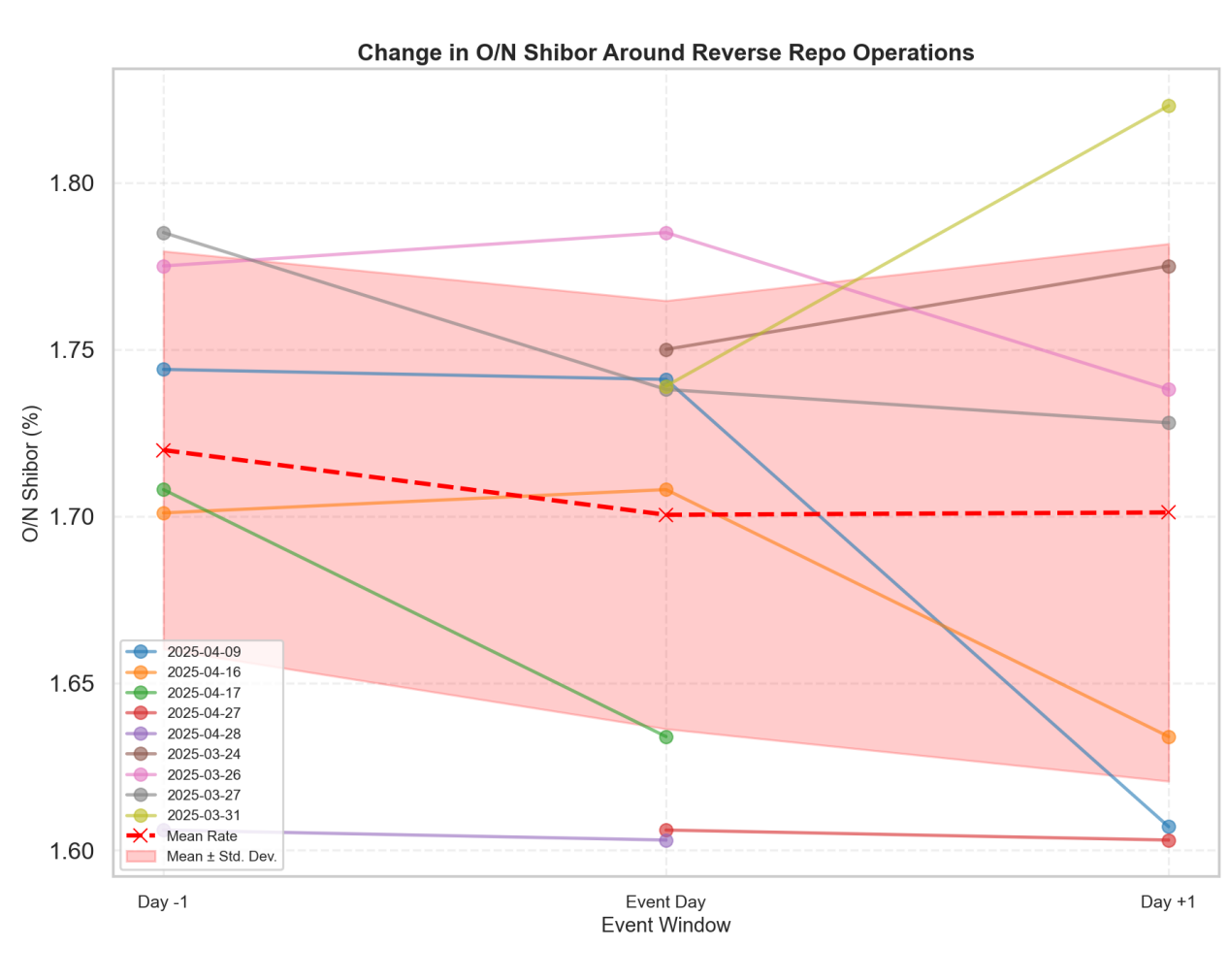
Based on daily data from China's money market between March and April 2025, this study investigates the short-term effects of the People's Bank of China's (PBC) reverse repo operations on the overnight interbank rate (O/N Shibor). Using Ordinary Least Squares (OLS) regression and an event-study approach, the analysis explores both the quantity-based and price-based transmission mechanisms of monetary policy. Empirical results indicate that an increase in the reverse repo amount significantly reduces the overnight rate at the 5% level, confirming the liquidity-supply channel of quantitative policy and demonstrating that liquidity injections effectively ease short-term funding costs. The reverse repo rate exerts a positive but statistically insignificant influence, suggesting that while its price signal aligns with theoretical expectations, its short-term transmission remains limited. The one-week Shibor has a strong and significant positive impact on the overnight rate, highlighting the dominant role of market expectations. Overall, the findings suggest a three-stage transmission chain-liquidity adjustment, market expectations, and rate response-where reverse repo operations mainly function as a liquidity-relief mechanism shaped by expectation dynamics rather than a direct policy shock.
Graphical Abstract
Keywords
Data Availability Statement
Funding
Conflicts of Interest
AI Use Statement
Ethical Approval and Consent to Participate
References
- Fernald, J. G., Spiegel, M. M., & Swanson, E. T. (2014). Monetary policy effectiveness in China: Evidence from a FAVAR model. Journal of International Money and Finance, 49, 83-103.
[CrossRef] [Google Scholar] - Guo, T., Wang, Y., & Zhang, W. (2023). Standing lending facility in interbank market: Evidence from China. Plos one, 18(5), e0284470.
[CrossRef] [Google Scholar] - Base, M.\,B. (2022). Reverse repurchase rate on selected monetary policy indicators: A vector autoregression. International Journal of Academe and Industry Research, 3(4), 83--106.
[CrossRef] [Google Scholar] - Sun, R. (2020). Monetary policy announcements and market interest rates’ response: Evidence from China. Journal of Banking & Finance, 113, 105766.
[CrossRef] [Google Scholar] - Liu, G. (2023). Monetary policy and liquidity dynamics in China: Investigating the reasons for the ineffectiveness of central bank open market operations in alleviating banking funding constraints. Financial Engineering and Risk Management, 6(10), 82-86. https://dx.doi.org/10.23977/ferm.2023.061011
[Google Scholar] - Risal, H. G., & Karki, D. (2018). Impact of repos and reverse repos on interest rates: Evidence from Nepal. Journal of Contemporary Issues in Business and Government, 24(1), 29. https://www.academia.edu/download/58488002/Impact_of_repos_and_reverse_repos_on.pdf
[Google Scholar] - Subedi, P. P., & Chaulagain, P. (2022). Effect of Open Market Operation on Short-Terms Interest. PYC Nepal Journal of Management, 15(1), 28-43.
[CrossRef] [Google Scholar] - Fu, L., & Ho, C. Y. (2022). Monetary policy surprises and interest rates under China's evolving monetary policy framework. Emerging Markets Review, 52, 100895.
[CrossRef] [Google Scholar] - Qiao, Z., & Liu, Y. (2017). Open market operation effectiveness in China. Emerging Markets Finance and Trade, 53(8), 1706-1719.
[CrossRef] [Google Scholar] - Guo, L., Zhang, X., & Chao, S. (2021). Impact of the OMRR operation in fighting the adverse effects of COVID-19 on the Chinese stock market: An event study. Frontiers of Economics in China, 16(3), 495-520.
[CrossRef] [Google Scholar] - Liu, Q., Luo, W., & Xiong, Q. (2025). Monetary policy in China: High-frequency shocks and the signaling effects. China Economic Review, 94(A), 102521.
[CrossRef] [Google Scholar] - Chen, Z., Li, L., & Yu, C. (2023). Monetary policy shocks and the signaling channel of monetary policy in China. China Economic Quarterly International, 3(1), 46-59.
[CrossRef] [Google Scholar] - Shieh, H. (2024). Can you hear me now? Identifying the effect of Chinese monetary policy announcements. Journal of International Money and Finance, 144, 103078.
[CrossRef] [Google Scholar]
Cite This Article
TY  - JOUR
AU  - Song, Zhiming
AU  - Zhao, Chengzhi
PY  - 2026
DA  - 2026/10/23
TI  - Short-Term Impact of China's Reverse Repo Operations on the Overnight Shibor: Evidence from the Money Market
JO  - Journal of Social Systems and Policy Analysis
T2  - Journal of Social Systems and Policy Analysis
JF  - Journal of Social Systems and Policy Analysis
VL  - 3
IS  - 4
SP  - 184
EP  - 193
DO  - 10.62762/JSSPA.2025.210231
UR  - https://www.icck.org/article/abs/JSSPA.2025.210231
KW  - Reverse repo operations
KW  - overnight Shibor
KW  - market expectations
KW  - event study
KW  - short-term monetary policy transmission
AB  - Based on daily data from China's money market between March and April 2025, this study investigates the short-term effects of the People's Bank of China's (PBC) reverse repo operations on the overnight interbank rate (O/N Shibor). Using Ordinary Least Squares (OLS) regression and an event-study approach, the analysis explores both the quantity-based and price-based transmission mechanisms of monetary policy. Empirical results indicate that an increase in the reverse repo amount significantly reduces the overnight rate at the 5% level, confirming the liquidity-supply channel of quantitative policy and demonstrating that liquidity injections effectively ease short-term funding costs. The reverse repo rate exerts a positive but statistically insignificant influence, suggesting that while its price signal aligns with theoretical expectations, its short-term transmission remains limited. The one-week Shibor has a strong and significant positive impact on the overnight rate, highlighting the dominant role of market expectations. Overall, the findings suggest a three-stage transmission chain-liquidity adjustment, market expectations, and rate response-where reverse repo operations mainly function as a liquidity-relief mechanism shaped by expectation dynamics rather than a direct policy shock.
SN  - 3068-5540
PB  - Institute of Central Computation and Knowledge
LA  - English
ER  -
@article{Song2026ShortTerm,
  author = {Zhiming Song and Chengzhi Zhao},
  title = {Short-Term Impact of China's Reverse Repo Operations on the Overnight Shibor: Evidence from the Money Market},
  journal = {Journal of Social Systems and Policy Analysis},
  year = {2026},
  volume = {3},
  number = {4},
  pages = {184-193},
  doi = {10.62762/JSSPA.2025.210231},
  url = {https://www.icck.org/article/abs/JSSPA.2025.210231},
  abstract = {Based on daily data from China's money market between March and April 2025, this study investigates the short-term effects of the People's Bank of China's (PBC) reverse repo operations on the overnight interbank rate (O/N Shibor). Using Ordinary Least Squares (OLS) regression and an event-study approach, the analysis explores both the quantity-based and price-based transmission mechanisms of monetary policy. Empirical results indicate that an increase in the reverse repo amount significantly reduces the overnight rate at the 5\% level, confirming the liquidity-supply channel of quantitative policy and demonstrating that liquidity injections effectively ease short-term funding costs. The reverse repo rate exerts a positive but statistically insignificant influence, suggesting that while its price signal aligns with theoretical expectations, its short-term transmission remains limited. The one-week Shibor has a strong and significant positive impact on the overnight rate, highlighting the dominant role of market expectations. Overall, the findings suggest a three-stage transmission chain-liquidity adjustment, market expectations, and rate response-where reverse repo operations mainly function as a liquidity-relief mechanism shaped by expectation dynamics rather than a direct policy shock.},
  keywords = {Reverse repo operations, overnight Shibor, market expectations, event study, short-term monetary policy transmission},
  issn = {3068-5540},
  publisher = {Institute of Central Computation and Knowledge}
}
Article Metrics
Publisher's Note
ICCK stays neutral with regard to jurisdictional claims in published maps and institutional affiliations.
Rights and Permissions
 Copyright © 2026 by the Author(s). Published by Institute of Central Computation and Knowledge. This article is an open access article distributed under the terms and conditions of the Creative Commons Attribution (CC BY) license (https://creativecommons.org/licenses/by/4.0/), which permits use, sharing, adaptation, distribution and reproduction in any medium or format, as long as you give appropriate credit to the original author(s) and the source, provide a link to the Creative Commons licence, and indicate if changes were made.


Portico
