


Integrated Seismic Interpretation and Petrophysical Evaluation for Hydrocarbon Volumetric Estimation in the BUKS Offshore Field, Niger Delta, Nigeria



Article Information
Abstract
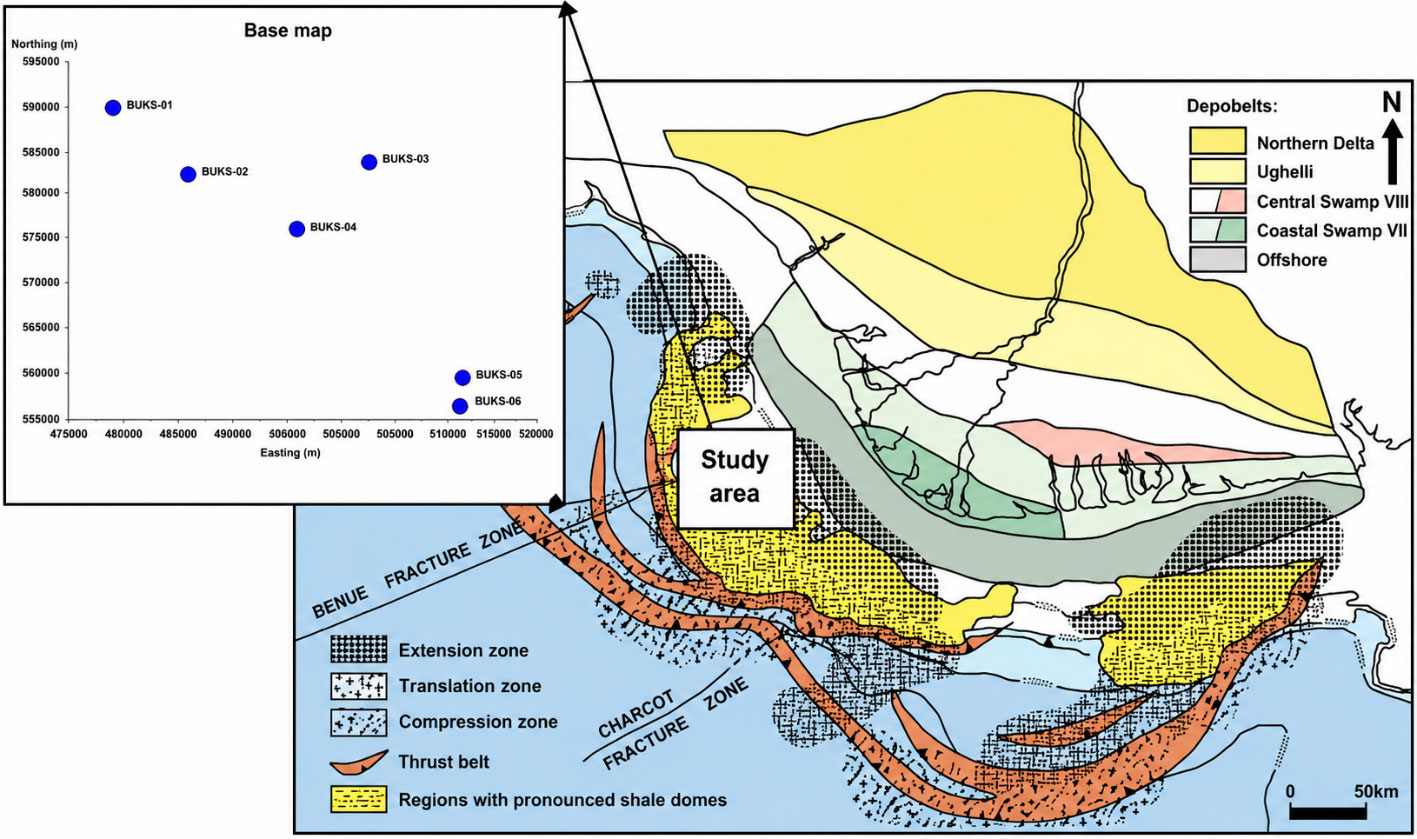
Hydrocarbon reserve estimation and reservoir characterization remain critical aspects of field development planning, particularly in mature offshore basins such as the Niger Delta. This study integrates 3D seismic interpretation with petrophysical analysis to evaluate reservoir quality and estimate hydrocarbon volumes within the BUKS offshore field, Niger Delta, Nigeria. Structural interpretation of the seismic data identified a NNW-trending rollover anticline associated with four major listric growth faults (F1–F4), forming the principal trapping system in the field. Petrophysical evaluation of four wells revealed favourable reservoir properties, with average porosity values ranging from 25% to 31%, permeability between 83 and 1452 mD, and shale volume varying from 20.5% to 38.6%. Water saturation values range from 15% to 41%, corresponding to hydrocarbon saturation values of 59%–85%, indicating good hydrocarbon potential across the mapped reservoirs. Volumetric calculations based on the interpreted reservoir parameters yielded a combined Stock Tank Oil Initially in Place (STOIIP) estimate of approximately 45.37 MMSTB, while a conservative recovery factor of 10% suggests recoverable reserves of about 4.54 MMSTB. The results indicate that the BUKS field possesses good reservoir quality, and the recoverable volume, while modest, may warrant further appraisal to assess development options, including potential tie-back to existing regional infrastructure. The study further demonstrates that integrating seismic interpretation with conventional petrophysical evaluation provides a practical and reliable approach for preliminary reserve estimation and field appraisal in offshore Niger Delta reservoirs.
Graphical Abstract
Keywords
Data Availability Statement
Funding
Conflicts of Interest
AI Use Statement
Ethical Approval and Consent to Participate
References
- Tuttle, M. L., Charpentier, R. R., & Brownfield, M. E. (1999). The Niger Delta Petroleum System: Niger Delta Province, Nigeria, Cameroon, and Equatorial Guinea, Africa (pp. 3-10). Washington, DC, USA: US Department of the Interior, US Geological Survey.
[CrossRef] [Google Scholar] - Corredor, F., Shaw, J. H., & Bilotti, F. (2005). Structural styles in the deep-water fold and thrust belts of the Niger Delta. AAPG bulletin, 89(6), 753-780.
[CrossRef] [Google Scholar] - Osinowo, O. O., Ayorinde, J. O., Nwankwo, C. P., Ekeng, O. M., & Taiwo, O. B. (2018). Reservoir description and characterization of Eni field Offshore Niger Delta, southern Nigeria. Journal of Petroleum Exploration and Production Technology, 8(2), 381-397.
[CrossRef] [Google Scholar] - Ugbor, C. C., Umejuru, I., & Nwokocha, C. S. (2025). Three-Dimensional Modelling and Volumetric Analysis Using Seismic and Well Log Data at DINO Oil Field, Niger Delta Basin Nigeria. Journal of Geoscience and Environment Protection, 13(03), 106-124.
[CrossRef] [Google Scholar] - Haldorsen, H. H., & Damsleth, E. (1993). Challenges in reservoir characterization: GEOHORIZONS. AAPG bulletin, 77(4), 541-551.
[CrossRef] [Google Scholar] - Webber, K. J., & Van Geuns, L. C. (1990). Framework for constructing clastic reservoir simulation models. Journal of Petroleum Technology, 42(10), 1248-1297.
[CrossRef] [Google Scholar] - Asquith, G., Krygowski, D., Henderson, S., & Hurley, N. (Eds.). (2004). Basic well log analysis (AAPG Methods in Exploration Series No. 16). American Association of Petroleum Geologists.
[CrossRef] [Google Scholar] - Craft, B. C., Hawkins, M. F., & Terry, R. E. (1991). Applied Petroleum Reservoir Engineering (2nd ed.). Prentice Hall, Englewood Cliffs, NJ.
[Google Scholar] - Edwards, J. D., & Santogrossi, P. A. (Eds.). (1990). Divergent/passive margin basins (AAPG Memoir 48). American Association of Petroleum Geologists.
[CrossRef] [Google Scholar] - Evamy, B. D., Haremboure, J., Kamerling, P., Knaap, W. A., Molloy, F. A., & Rowlands, P. H. (1978). Hydrocarbon habitat of Tertiary Niger delta. AAPG bulletin, 62(1), 1-39.
[CrossRef] [Google Scholar] - Stacher, P. (1995). Present understanding of the Niger Delta hydrocarbon habitat. In Geology of deltas (pp. 257-267). https://pascal-francis.inist.fr/vibad/index.php?action=getRecordDetail&idt=6312061
[Google Scholar] - Short, K. C., & Stäuble, A. J. (1967). Outline of geology of Niger Delta. AAPG bulletin, 51(5), 761-779.
[CrossRef] [Google Scholar] - Reijers, T. J. A., Petters, S. W., & Nwajide, C. S. (1997). The Niger delta basin. In Sedimentary basins of the world (Vol. 3, pp. 151-172). Elsevier.
[CrossRef] [Google Scholar] - Damuth, J. E. (1994). Neogene gravity tectonics and depositional processes on the deep Niger Delta continental margin. Marine and Petroleum Geology, 11(3), 320-346.
[CrossRef] [Google Scholar] - Doust, H. (1990). Petroleum geology of the Niger Delta. Geological Society, London, Special Publications, 50(1), 365-365.
[CrossRef] [Google Scholar] - Asquith, G. B., & Gibson, C. R. (1982). Basic well log analysis for geologists (Vol. 3). Tulsa: American Association of Petroleum Geologists.
[CrossRef] [Google Scholar] - Larionov, V. V. (1969). Radiometry of boreholes. Nedra, Moscow, 127. https://www.geokniga.org/books/13701
[Google Scholar] - Rider, M. H. (1996). The Geological Interpretation of Well Logs (2nd ed.). Rider-French Consulting Ltd., Sutherland, Scotland, 280 pp. https://www.osti.gov/etdeweb/biblio/408200
[Google Scholar] - Winsauer, W. O., Shearin Jr, H. M., Masson, P. Y., & Williams, M. (1952). Resistivity of brine-saturated sands in relation to pore geometry. AAPG bulletin, 36(2), 253-277.
[CrossRef] [Google Scholar] - Archie, G. E. (1947). Electrical resistivity an aid in core-analysis interpretation. AAPG Bulletin, 31(2), 350-366.
[CrossRef] [Google Scholar] - Morris, R. L., & Biggs, W. P. (1967, June). Using log-derived values of water saturation and porosity. In SPWLA annual logging symposium (pp. SPWLA-1967). SPWLA. https://onepetro.org/SPWLAALS/proceedings-abstract/SPWLA-1967/SPWLA-1967/17853
[Google Scholar] - Wyllie, M. R. J., & Rose, W. D. (1950). Some theoretical considerations related to the quantitative evaluation of the physical characteristics of reservoir rock from electrical log data. Journal of Petroleum Technology, 2(04), 105-118.
[CrossRef] [Google Scholar] - Tehrani, D. H. (1985). An Analysis of a Volumetric Balance Equation for Calculation of Oil in Place and Water Influx. Journal of Petroleum Technology, 37(09), 1664-1670.
[CrossRef] [Google Scholar]
Cite This Article
TY  - JOUR
AU  - Onwubuariri, Chukwuebuka Nnamdi
AU  - Aigba, Paul Igienekpeme
AU  - Dinneya, Obinna Christian
AU  - Nwokoma, Esomchi Uzoma
PY  - 2026
DA  - 2026/07/02
TI  - Integrated Seismic Interpretation and Petrophysical Evaluation for Hydrocarbon Volumetric Estimation in the BUKS Offshore Field, Niger Delta, Nigeria
JO  - Reservoir Science
T2  - Reservoir Science
JF  - Reservoir Science
VL  - 2
IS  - 3
SP  - 261
EP  - 271
DO  - 10.62762/RS.2026.932280
UR  - https://www.icck.org/article/abs/RS.2026.932280
KW  - Niger Delta
KW  - BUKS field
KW  - seismic interpretation
KW  - petrophysical evaluation
KW  - empirical volumetric method
KW  - oil in place
AB  - Hydrocarbon reserve estimation and reservoir characterization remain critical aspects of field development planning, particularly in mature offshore basins such as the Niger Delta. This study integrates 3D seismic interpretation with petrophysical analysis to evaluate reservoir quality and estimate hydrocarbon volumes within the BUKS offshore field, Niger Delta, Nigeria. Structural interpretation of the seismic data identified a NNW-trending rollover anticline associated with four major listric growth faults (F1–F4), forming the principal trapping system in the field. Petrophysical evaluation of four wells revealed favourable reservoir properties, with average porosity values ranging from 25% to 31%, permeability between 83 and 1452 mD, and shale volume varying from 20.5% to 38.6%. Water saturation values range from 15% to 41%, corresponding to hydrocarbon saturation values of 59%–85%, indicating good hydrocarbon potential across the mapped reservoirs. Volumetric calculations based on the interpreted reservoir parameters yielded a combined Stock Tank Oil Initially in Place (STOIIP) estimate of approximately 45.37 MMSTB, while a conservative recovery factor of 10% suggests recoverable reserves of about 4.54 MMSTB. The results indicate that the BUKS field possesses good reservoir quality, and the recoverable volume, while modest, may warrant further appraisal to assess development options, including potential tie-back to existing regional infrastructure. The study further demonstrates that integrating seismic interpretation with conventional petrophysical evaluation provides a practical and reliable approach for preliminary reserve estimation and field appraisal in offshore Niger Delta reservoirs.
SN  - 3070-2356
PB  - Institute of Central Computation and Knowledge
LA  - English
ER  -
@article{Onwubuariri2026Integrated,
  author = {Chukwuebuka Nnamdi Onwubuariri and Paul Igienekpeme Aigba and Obinna Christian Dinneya and Esomchi Uzoma Nwokoma},
  title = {Integrated Seismic Interpretation and Petrophysical Evaluation for Hydrocarbon Volumetric Estimation in the BUKS Offshore Field, Niger Delta, Nigeria},
  journal = {Reservoir Science},
  year = {2026},
  volume = {2},
  number = {3},
  pages = {261-271},
  doi = {10.62762/RS.2026.932280},
  url = {https://www.icck.org/article/abs/RS.2026.932280},
  abstract = {Hydrocarbon reserve estimation and reservoir characterization remain critical aspects of field development planning, particularly in mature offshore basins such as the Niger Delta. This study integrates 3D seismic interpretation with petrophysical analysis to evaluate reservoir quality and estimate hydrocarbon volumes within the BUKS offshore field, Niger Delta, Nigeria. Structural interpretation of the seismic data identified a NNW-trending rollover anticline associated with four major listric growth faults (F1–F4), forming the principal trapping system in the field. Petrophysical evaluation of four wells revealed favourable reservoir properties, with average porosity values ranging from 25\% to 31\%, permeability between 83 and 1452 mD, and shale volume varying from 20.5\% to 38.6\%. Water saturation values range from 15\% to 41\%, corresponding to hydrocarbon saturation values of 59\%–85\%, indicating good hydrocarbon potential across the mapped reservoirs. Volumetric calculations based on the interpreted reservoir parameters yielded a combined Stock Tank Oil Initially in Place (STOIIP) estimate of approximately 45.37 MMSTB, while a conservative recovery factor of 10\% suggests recoverable reserves of about 4.54 MMSTB. The results indicate that the BUKS field possesses good reservoir quality, and the recoverable volume, while modest, may warrant further appraisal to assess development options, including potential tie-back to existing regional infrastructure. The study further demonstrates that integrating seismic interpretation with conventional petrophysical evaluation provides a practical and reliable approach for preliminary reserve estimation and field appraisal in offshore Niger Delta reservoirs.},
  keywords = {Niger Delta, BUKS field, seismic interpretation, petrophysical evaluation, empirical volumetric method, oil in place},
  issn = {3070-2356},
  publisher = {Institute of Central Computation and Knowledge}
}
Article Metrics
Publisher's Note
ICCK stays neutral with regard to jurisdictional claims in published maps and institutional affiliations.
Rights and Permissions
 Copyright © 2026 by the Author(s). Published by Institute of Central Computation and Knowledge. This article is an open access article distributed under the terms and conditions of the Creative Commons Attribution (CC BY) license (https://creativecommons.org/licenses/by/4.0/), which permits use, sharing, adaptation, distribution and reproduction in any medium or format, as long as you give appropriate credit to the original author(s) and the source, provide a link to the Creative Commons licence, and indicate if changes were made.

