
Coordinated Integration of Electric Vehicles and Photovoltaic Generation in Radial Distribution Networks: Technical Impacts, Flexibility, and Hosting Capacity




Article Information
Abstract
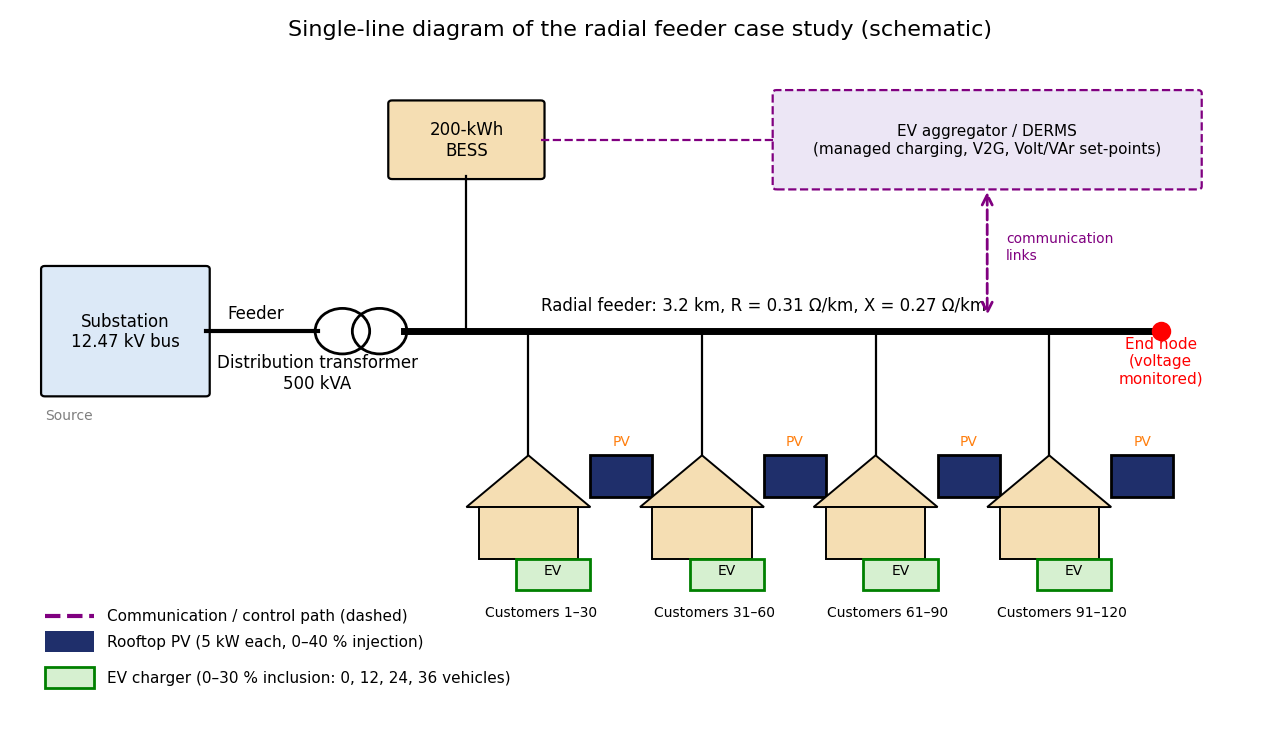
The growth of residential electric vehicle (EV) charging and rooftop photovoltaic (PV) generation is changing the operating conditions of radial distribution feeders: evening charging increases the loading of the distribution transformer and conductors, whereas midday PV export raises voltages and can reverse the power flow. Because these effects occur at different times of day, they are usually studied separately, and the way in which a measure aimed at one problem affects the other is insufficiently documented. This paper proposes a coordinated assessment methodology that combines stochastic EV charging, PV generation, a time-series load flow, PV inverter Volt/VAr control, transformer thermal aging, reliability indicators and hosting-capacity evaluation in one framework. Four charging and storage strategies are compared: unmanaged charging, time-of-use (TOU) response, coordinated charging with vehicle-to-grid (V2G) support, and coordinated charging complemented by a feeder-level battery energy storage system (BESS). Volt/VAr control of PV inverters is assessed separately. The methodology is demonstrated on a representative 0.4 kV low-voltage feeder supplied from a 12.47 kV network. The results indicate that unmanaged charging is the dominant cause of transformer overloading and accelerated insulation aging, that reactive-power control reduces but does not eliminate PV-induced voltage rise, and that coordinated charging, V2G and storage relax the evening loading and midday voltage constraints complementarily, increasing the feeder hosting capacity for EVs and PV. Reliability indicators follow the trend of transformer loading. Practical implications for distribution network operators and the study limitations are discussed.
Graphical Abstract
Keywords
Data Availability Statement
Funding
Conflicts of Interest
AI Use Statement
Ethical Approval and Consent to Participate
References
- Gonen, T. (2014). Electric power distribution engineering (3rd ed.). CRC Press.
[CrossRef] [Google Scholar] - Dugan, R. C., McGranaghan, M. F., & Beaty, H. W. (1996). Electrical power systems quality. McGraw-Hill. https://www.accessengineeringlibrary.com/binary/mheaeworks/773fbf0510c9c305/128c9e3c6268f565edd4e5546c092bb28282a44c1b99ff5b731e062770c52d54/book-summary.pdf
[Google Scholar] - Shafiee, S., Fotuhi-Firuzabad, M., & Rastegar, M. (2013). Investigating the impacts of plug-in hybrid electric vehicles on power distribution systems. IEEE Transactions on Smart Grid, 4(3), 1351-1360.
[CrossRef] [Google Scholar] - Clement-Nyns, K., Haesen, E., & Driesen, J. (2010). The impact of charging plug-in hybrid electric vehicles on a residential distribution grid. IEEE Transactions on Power Systems, 25(1), 371-380.
[CrossRef] [Google Scholar] - Taylor, J., Maitra, A., Alexander, M., Brooks, D., & Duvall, M. (2010, July). Evaluations of plug-in electric vehicle distribution system impacts. In IEEE PES General Meeting (pp. 1-6). IEEE.
[CrossRef] [Google Scholar] - Habib, S., Kamran, M., & Rashid, U. (2015). Impact analysis of vehicle-to-grid technology and charging strategies of electric vehicles on distribution networks - a review. Journal of Power Sources, 277, 205-214.
[CrossRef] [Google Scholar] - Yilmaz, M., & Krein, P. T. (2013). Review of the impact of vehicle-to-grid technologies on distribution systems and utility interfaces. IEEE Transactions on Power Electronics, 28(12), 5673-5689.
[CrossRef] [Google Scholar] - Brahmachary, R., & Ahmed, I. (2025). Optimal distribution network expansion and EV charging station allocation based on load forecasted using machine learning. IEEE Transactions on Industry Applications, 61(4), 5699-5713.
[CrossRef] [Google Scholar] - Walling, R. A., Saint, R., Dugan, R. C., Burke, J., & Kojovic, L. A. (2008). Summary of distributed resources impact on power delivery systems. IEEE Transactions on Power Delivery, 23(3), 1636-1644.
[CrossRef] [Google Scholar] - Katiraei, F., & Agüero, J. R. (2011). Solar PV integration challenges. IEEE power and energy magazine, 9(3), 62-71.
[CrossRef] [Google Scholar] - Jahangiri, P., & Aliprantis, D. C. (2013). Distributed Volt/VAr control by PV inverters. IEEE Transactions on Power Systems, 28(3), 3429-3439.
[CrossRef] [Google Scholar] - Tonkoski, R., Lopes, L. A., & El-Fouly, T. H. (2010). Coordinated active power curtailment of grid connected PV inverters for overvoltage prevention. IEEE Transactions on sustainable energy, 2(2), 139-147.
[CrossRef] [Google Scholar] - Brahma, S. M., & Girgis, A. A. (2004). Development of adaptive protection scheme for distribution systems with high penetration of distributed generation. IEEE Transactions on Power Delivery, 19(1), 56-63.
[CrossRef] [Google Scholar] - Photovoltaics, D. G., & Storage, E. (2018). IEEE standard for interconnection and interoperability of distributed energy resources with associated electric power systems interfaces. IEEE std, 1547(1547), 2018.
[CrossRef] [Google Scholar] - Woyte, A., Van Thong, V., Belmans, R., & Nijs, J. (2006). Voltage fluctuations on distribution level introduced by photovoltaic systems. IEEE Transactions on energy conversion, 21(1), 202-209.
[CrossRef] [Google Scholar] - Alam, M. J. E., Muttaqi, K. M., & Sutanto, D. (2013). Mitigation of rooftop solar PV impacts and evening peak support by managing available capacity of distributed energy storage systems. IEEE transactions on power systems, 28(4), 3874-3884.
[CrossRef] [Google Scholar] - Turitsyn, K., Šulc, P., Backhaus, S., & Chertkov, M. (2011). Options for control of reactive power by distributed photovoltaic generators. Proceedings of the IEEE, 99(6), 1063-1073.
[CrossRef] [Google Scholar] - Sortomme, E., Hindi, M. M., MacPherson, S. D. J., & Venkata, S. S. (2011). Coordinated charging of plug-in hybrid electric vehicles to minimize distribution system losses. IEEE Transactions on Smart Grid, 2(1), 198-205.
[CrossRef] [Google Scholar] - Umoh, V., Davidson, I., Adebiyi, A., & Ekpe, U. (2023). Methods and tools for PV and EV hosting capacity determination in low voltage distribution networks---A review. Energies, 16(8), 3609.
[CrossRef] [Google Scholar] - Zenhom, Z. M., Abdel Aleem, S. H. E., Zobaa, A. F., & Boghdady, T. A. (2024). A comprehensive review of renewables and electric vehicles hosting capacity in active distribution networks. IEEE Access, 12, 3672-3699.
[CrossRef] [Google Scholar] - Nutkani, I., Toole, H., Fernando, N., & Loh, P. C. A. (2024). Impact of EV charging on electrical distribution network and mitigating solutions - A review. IET Smart Grid, 7(5), 485-502.
[CrossRef] [Google Scholar] - Deilami, S., Masoum, A. S., Moses, P. S., & Masoum, M. A. S. (2011). Real-time coordination of plug-in electric vehicle charging in smart grids to minimize power losses and improve voltage profile. IEEE Transactions on Smart Grid, 2(3), 456-467.
[CrossRef] [Google Scholar] - Sundstrom, O., & Binding, C. (2011). Flexible charging optimization for electric vehicles considering distribution grid constraints. IEEE Transactions on Smart Grid, 3(1), 26-37.
[CrossRef] [Google Scholar] - Ma, Z., Callaway, D. S., & Hiskens, I. A. (2013). Decentralized charging control of large populations of plug-in electric vehicles. IEEE Transactions on Control Systems Technology, 21(1), 67-78.
[CrossRef] [Google Scholar] - IEEE Power and Energy Society. (2012). IEEE guide for loading mineral-oil-immersed transformers and step-voltage regulators (IEEE Std C57.91-2011). IEEE.
[CrossRef] [Google Scholar] - International Electrotechnical Commission. (2018). Power transformers - Part 7: Loading guide for mineral-oil-immersed power transformers (IEC 60076-7:2018). IEC. Retrieved from https://cdn.standards.iteh.ai/samples/22540/013e17b442e547a8a317649a48490f88/IEC-60076-7-2018.pdf
[Google Scholar] - Staszewski, L., & Rebizant, W. (2025). Quantifying overload risk: A parametric comparison of IEC 60076-7 and IEEE C57.91 standards for power transformers. Energies, 18(24), 6469.
[CrossRef] [Google Scholar] - Fernández, L. P., Román, T. G. S., Cossent, R., Domingo, C. M., & Frías, P. (2011). Assessment of the impact of plug-in electric vehicles on distribution networks. IEEE Transactions on Power Systems, 26(1), 206-213.
[CrossRef] [Google Scholar] - Kempton, W., & Tomić, J. (2005). Vehicle-to-grid power fundamentals: Calculating capacity and net revenue. Journal of power sources, 144(1), 268-279.
[CrossRef] [Google Scholar] - Oudalov, A., Cherkaoui, R., & Beguin, A. (2007, July). Sizing and optimal operation of battery energy storage system for peak shaving application. In 2007 IEEE Lausanne Power Tech (pp. 621-625). IEEE.
[CrossRef] [Google Scholar] - Brooks, A., Lu, E., Reicher, D., Spirakis, C., & Weihl, B. (2010). Demand dispatch. IEEE Power and Energy Magazine, 8(3), 20-29.
[CrossRef] [Google Scholar] - Dunn, B., Kamath, H., & Tarascon, J. M. (2011). Electrical energy storage for the grid: A battery of choices. Science, 334(6058), 928-935.
[CrossRef] [Google Scholar] - Hashemi, S., & {\Ostergaard, J. (2018). Efficient control of energy storage for increasing the PV hosting capacity of LV grids. IEEE Transactions on Smart Grid, 9(3), 2295-2303.
[CrossRef] [Google Scholar] - Navarro-Espinosa, A., & Ochoa, L. F. (2016). Probabilistic impact assessment of low carbon technologies in LV distribution systems. IEEE Transactions on Power Systems, 31(3), 2192-2203.
[CrossRef] [Google Scholar] - Acharya, S., Dvorkin, Y., Pandžić, H., & Karri, R. (2020). Cybersecurity of smart electric vehicle charging: A power grid perspective. IEEE Access, 8, 214434-214453.
[CrossRef] [Google Scholar] - Acharya, S., Dvorkin, Y., & Karri, R. (2020). Public plug-in electric vehicles + grid data: Is a new cyberattack vector viable? IEEE Transactions on Smart Grid, 11(6), 5099-5113.
[CrossRef] [Google Scholar] - IEEE Power and Energy Society. (2022). IEEE guide for electric power distribution reliability indices (IEEE Std 1366-2022). IEEE.
[CrossRef] [Google Scholar] - Billinton, R., & Allan, R. N. (1996). Reliability evaluation of power systems (2nd ed.). Plenum Press.
[CrossRef] [Google Scholar] - Skoplaki, E., & Palyvos, J. A. (2009). On the temperature dependence of photovoltaic module electrical performance: A review of efficiency/power correlations. Solar energy, 83(5), 614-624.
[CrossRef] [Google Scholar] - Kersting, W. H. (2012). Distribution system modeling and analysis (3rd ed.). CRC Press.
[CrossRef] [Google Scholar] - Teng, J. H. (2003). A direct approach for distribution system load flow solutions. IEEE Transactions on power delivery, 18(3), 882-887.
[CrossRef] [Google Scholar] - Shirmohammadi, D., Hong, H. W., Semlyen, A., & Luo, G. X. (1988). A compensation-based power flow method for weakly meshed distribution and transmission networks. IEEE Transactions on Power Systems, 3(2), 753-762.
[CrossRef] [Google Scholar] - European Committee for Electrotechnical Standardization. (2022). Voltage characteristics of electricity supplied by public electricity networks (EN 50160:2022). CENELEC. Retrieved from https://standards.iteh.ai/catalog/standards/clc/083c552d-f4b8-4373-a5ec-8a27b6c8d37d/en-50160-2022?srsltid=AYCX9vKpWr5bE8Lc_88SUn1jQx5sdFn3k3N2O6b95NUDvvABNbjR8kuA
[Google Scholar] - Stepka, E. (2020, October 26). ANSI C84.1-2020: Electric power systems voltage ratings (60 Hz). The ANSI Blog. Retrieved from https://blog.ansi.org/ansi/ansi-c84-1-2020-electric-voltage-ratings-60-hz/
[Google Scholar]
Cite This Article
TY  - JOUR
AU  - Brahmachary, Rupali
AU  - Teke, Ahmet
AU  - Babic, Aleksa
AU  - Miljanić, Zoran
PY  - 2026
DA  - 2026/11/25
TI  - Coordinated Integration of Electric Vehicles and Photovoltaic Generation in Radial Distribution Networks: Technical Impacts, Flexibility, and Hosting Capacity
JO  - ICCK Transactions on Electric Power Networks and Systems
T2  - ICCK Transactions on Electric Power Networks and Systems
JF  - ICCK Transactions on Electric Power Networks and Systems
VL  - 2
IS  - 4
SP  - 175
EP  - 203
DO  - 10.62762/TEPNS.2026.299860
UR  - https://www.icck.org/article/abs/tepns.2026.299860
KW  - electric vehicle (EV)
KW  - hosting capacity
KW  - photovoltaic (PV) system
KW  - vehicle-to-grid (V2G) system
KW  - Volt/VAr control
KW  - transformer aging
AB  - The growth of residential electric vehicle (EV) charging and rooftop photovoltaic (PV) generation is changing the operating conditions of radial distribution feeders: evening charging increases the loading of the distribution transformer and conductors, whereas midday PV export raises voltages and can reverse the power flow. Because these effects occur at different times of day, they are usually studied separately, and the way in which a measure aimed at one problem affects the other is insufficiently documented. This paper proposes a coordinated assessment methodology that combines stochastic EV charging, PV generation, a time-series load flow, PV inverter Volt/VAr control, transformer thermal aging, reliability indicators and hosting-capacity evaluation in one framework. Four charging and storage strategies are compared: unmanaged charging, time-of-use (TOU) response, coordinated charging with vehicle-to-grid (V2G) support, and coordinated charging complemented by a feeder-level battery energy storage system (BESS). Volt/VAr control of PV inverters is assessed separately. The methodology is demonstrated on a representative 0.4 kV low-voltage feeder supplied from a 12.47 kV network. The results indicate that unmanaged charging is the dominant cause of transformer overloading and accelerated insulation aging, that reactive-power control reduces but does not eliminate PV-induced voltage rise, and that coordinated charging, V2G and storage relax the evening loading and midday voltage constraints complementarily, increasing the feeder hosting capacity for EVs and PV. Reliability indicators follow the trend of transformer loading. Practical implications for distribution network operators and the study limitations are discussed.
SN  - 3070-2607
PB  - Institute of Central Computation and Knowledge
LA  - English
ER  -
@article{Brahmachary2026Coordinate,
  author = {Rupali Brahmachary and Ahmet Teke and Aleksa Babic and Zoran Miljanić},
  title = {Coordinated Integration of Electric Vehicles and Photovoltaic Generation in Radial Distribution Networks: Technical Impacts, Flexibility, and Hosting Capacity},
  journal = {ICCK Transactions on Electric Power Networks and Systems},
  year = {2026},
  volume = {2},
  number = {4},
  pages = {175-203},
  doi = {10.62762/TEPNS.2026.299860},
  url = {https://www.icck.org/article/abs/tepns.2026.299860},
  abstract = {The growth of residential electric vehicle (EV) charging and rooftop photovoltaic (PV) generation is changing the operating conditions of radial distribution feeders: evening charging increases the loading of the distribution transformer and conductors, whereas midday PV export raises voltages and can reverse the power flow. Because these effects occur at different times of day, they are usually studied separately, and the way in which a measure aimed at one problem affects the other is insufficiently documented. This paper proposes a coordinated assessment methodology that combines stochastic EV charging, PV generation, a time-series load flow, PV inverter Volt/VAr control, transformer thermal aging, reliability indicators and hosting-capacity evaluation in one framework. Four charging and storage strategies are compared: unmanaged charging, time-of-use (TOU) response, coordinated charging with vehicle-to-grid (V2G) support, and coordinated charging complemented by a feeder-level battery energy storage system (BESS). Volt/VAr control of PV inverters is assessed separately. The methodology is demonstrated on a representative 0.4 kV low-voltage feeder supplied from a 12.47 kV network. The results indicate that unmanaged charging is the dominant cause of transformer overloading and accelerated insulation aging, that reactive-power control reduces but does not eliminate PV-induced voltage rise, and that coordinated charging, V2G and storage relax the evening loading and midday voltage constraints complementarily, increasing the feeder hosting capacity for EVs and PV. Reliability indicators follow the trend of transformer loading. Practical implications for distribution network operators and the study limitations are discussed.},
  keywords = {electric vehicle (EV), hosting capacity, photovoltaic (PV) system, vehicle-to-grid (V2G) system, Volt/VAr control, transformer aging},
  issn = {3070-2607},
  publisher = {Institute of Central Computation and Knowledge}
}
Article Metrics
Publisher's Note
ICCK stays neutral with regard to jurisdictional claims in published maps and institutional affiliations.
Rights and Permissions


Portico
