Volume 3, Issue 1, ICCK Transactions on Intelligent Systematics
Volume 3, Issue 1, 2026
Submit Manuscript Edit a Special Issue
Academic Editor
Jianlei Kong
Jianlei Kong
Beijing Technology and Business University, China
Article QR Code
Article QR Code
Scan the QR code for reading
Popular articles
ICCK Transactions on Intelligent Systematics, Volume 3, Issue 1, 2026: 11-20

Open Access | Research Article | 29 January 2026
Enhanced Air Pollution Prediction via Adam-Optimized Multi-Head Attention and Hybrid Deep Learning
1 School of Electronic Information Engineering, Huaiyin Institute of Technology, Huaian 223003, China
2 School of Atmospheric Sciences, Nanjing University of Information Science and Technology, Nanjing 210044, China
3 School of Remote Sensing and Surveying Engineering, Nanjing University of Information Science and Technology, Nanjing 210044, China
* Corresponding Author: Xiaoqi Yin, [email protected]
ARK: ark:/57805/tis.2025.951370
Received: 25 September 2025, Accepted: 23 October 2025, Published: 29 January 2026  
Abstract
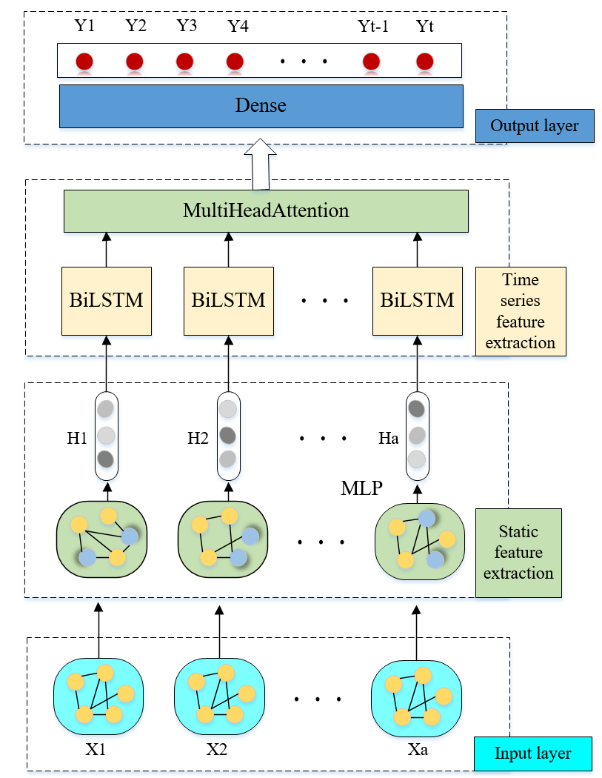
To address the challenge of traditional models in simultaneously capturing local fluctuations and global trends for air pollutant concentration prediction, this paper proposes a multimodal deep learning model named MLP-BiLSTM- MHAT. The model integrates static features via MLP, extracts temporal dependencies through bidirectional LSTM (BiLSTM), and employs a Multi-head Attention mechanism (MHAT) to fuse local and global features while enhancing interactions between static and temporal characteristics. An improved Adam algorithm dynamically optimizes learning rates to balance the influence of heterogenous features. Validated on multi-site air quality data from Beijing, experimental results demonstrate that MLP-BiLSTM-MHAT outperforms baseline models with an average reduction of 1.9% in RMSE, 4.2% in MAE, and a 1.8% improvement in R², showcasing superior accuracy and robustness across diverse pollutants and scenarios.

Graphical Abstract
Enhanced Air Pollution Prediction via Adam-Optimized Multi-Head Attention and Hybrid Deep Learning

Keywords
multimodal
deep learning network
improved Adam algorithm
air pollutant concentration prediction

Data Availability Statement
Data will be made available on request.

Funding
This work was supported without any funding.

Conflicts of Interest
The authors declare no conflicts of interest.

AI Use Statement
The authors declare that no generative AI was used in the preparation of this manuscript.

Ethical Approval and Consent to Participate
Not applicable.

References
  1. Wang, S., Qiao, L., Fang, W., Jing, G., & Zhang, Y. (2022). Air Pollution Prediction Via Graph Attention Network and Gated Recurrent Unit. Computers, Materials & Continua, 73(1).
    [CrossRef]   [Google Scholar]
  2. Zhang, A., Qi, Q., Jiang, L., Zhou, F., & Wang, J. (2013). Population exposure to PM2. 5 in the urban area of Beijing. PloS one, 8(5), e63486.
    [CrossRef]   [Google Scholar]
  3. Kim, Y., & Radoias, V. (2022). Severe air pollution exposure and long-term health outcomes. International Journal of Environmental Research and Public Health, 19(21), 14019.
    [CrossRef]   [Google Scholar]
  4. Bekkar, A., Hssina, B., Douzi, S., & Douzi, K. (2021). Air-pollution prediction in smart city, deep learning approach. Journal of big Data, 8(1), 161.
    [CrossRef]   [Google Scholar]
  5. Qin, D., Yu, J., Zou, G., Yong, R., Zhao, Q., & Zhang, B. (2019). A novel combined prediction scheme based on CNN and LSTM for urban PM 2.5 concentration. Ieee Access, 7, 20050-20059.
    [CrossRef]   [Google Scholar]
  6. Zhou, G., Xu, J., Xie, Y., Chang, L., Gao, W., Gu, Y., & Zhou, J. (2017). Numerical air quality forecasting over eastern China: An operational application of WRF-Chem. Atmospheric Environment, 153, 94-108.
    [CrossRef]   [Google Scholar]
  7. Hinojosa-Baliño, I., Infante-Vázquez, O., & Vallejo, M. (2019). Distribution of PM2. 5 air pollution in Mexico City: Spatial analysis with land-use regression model. Applied sciences, 9(14), 2936.
    [CrossRef]   [Google Scholar]
  8. Sharma, V., Ghosh, S., Mishra, V. N., & Kumar, P. (2025). Spatio-temporal Variations and Forecast of PM2. 5 concentration around selected Satellite Cities of Delhi, India using ARIMA model. Physics and Chemistry of the Earth, Parts A/B/C, 138, 103849.
    [CrossRef]   [Google Scholar]
  9. Amin, R., Salan, M. S. A., & Hossain, M. M. (2024). Measuring the impact of responsible factors on CO2 emission using generalized additive model (GAM). Heliyon, 10(4).
    [CrossRef]   [Google Scholar]
  10. Gourav, Rekhi, J. K., Nagrath, P., & Jain, R. (2019). Forecasting air quality of delhi using arima model. In Advances in Data Sciences, Security and Applications: Proceedings of ICDSSA 2019 (pp. 315-325). Singapore: Springer Singapore.
    [CrossRef]   [Google Scholar]
  11. Cortina–Januchs, M. G., Quintanilla–Dominguez, J., Vega–Corona, A., & Andina, D. (2015). Development of a model for forecasting of PM10 concentrations in Salamanca, Mexico. Atmospheric Pollution Research, 6(4), 626-634.
    [CrossRef]   [Google Scholar]
  12. Hornik, K., Stinchcombe, M., & White, H. (1989). Multilayer feedforward networks are universal approximators. Neural networks, 2(5), 359-366.
    [CrossRef]   [Google Scholar]
  13. Graves, A., & Schmidhuber, J. (2005). Framewise phoneme classification with bidirectional LSTM and other neural network architectures. Neural networks, 18(5-6), 602-610.
    [CrossRef]   [Google Scholar]
  14. Yang, H., Xiao, K., Xiang, X., Wang, X., Wang, X., Du, Y., ... & Yang, F. (2025). Prediction of on-road CO2 emissions with high spatio-temporal resolution implementing multilayer perceptron. Atmospheric Environment: X, 100368.
    [CrossRef]   [Google Scholar]
  15. Aamir, M., Bhatti, M. A., Bazai, S. U., Marjan, S., Mirza, A. M., Wahid, A., ... & Bhatti, U. A. (2022). Predicting the environmental change of carbon emission patterns in South Asia: a deep learning approach using BiLSTM. Atmosphere, 13(12), 2011.
    [CrossRef]   [Google Scholar]
  16. Vaswani, A., Shazeer, N., Parmar, N., Uszkoreit, J., Jones, L., Gomez, A. N., ... & Polosukhin, I. (2017). Attention is all you need. Advances in neural information processing systems, 30.
    [Google Scholar]
  17. Jin, X., Sun, T., Chen, W., Ma, H., Wang, Y., & Zheng, Y. (2024). Parameter adaptive non-model-based state estimation combining attention mechanism and LSTM. ICCK Transactions on Intelligent Systematics, 1(1), 40-48.
    [CrossRef]   [Google Scholar]
  18. Dai, Z., Yang, Z., Yang, Y., Carbonell, J. G., Le, Q., & Salakhutdinov, R. (2019, July). Transformer-xl: Attentive language models beyond a fixed-length context. In Proceedings of the 57th annual meeting of the association for computational linguistics (pp. 2978-2988).
    [CrossRef]   [Google Scholar]
  19. Yu, F., & Koltun, V. (2015). Multi-scale context aggregation by dilated convolutions. arXiv preprint arXiv:1511.07122.
    [Google Scholar]
  20. Li, W., & Jiang, X. (2023). Prediction of air pollutant concentrations based on TCN-BiLSTM-DMAttention with STL decomposition. Scientific Reports, 13(1), 4665.
    [CrossRef]   [Google Scholar]
  21. Jabeen, S., Li, X., Amin, M. S., Bourahla, O., Li, S., & Jabbar, A. (2023). A review on methods and applications in multimodal deep learning. ACM Transactions on Multimedia Computing, Communications and Applications, 19(2s), 1-41.
    [CrossRef]   [Google Scholar]
  22. Kinga, D., & Adam, J. B. (2015, May). A method for stochastic optimization. In International conference on learning representations (ICLR) (Vol. 5, No. 6).
    [Google Scholar]

Cite This Article
APA Style
Gu, C., Tan, Y., Yin, X., Li, X., Yang, Y., & Lv, Y. (2026). Enhanced Air Pollution Prediction via Adam-Optimized Multi-Head Attention and Hybrid Deep Learning. ICCK Transactions on Intelligent Systematics, 3(1), 11–20. https://doi.org/10.62762/TIS.2025.951370
Export Citation
RIS Format
Compatible with EndNote, Zotero, Mendeley, and other reference managers
RIS format data for reference managers
TY  - JOUR
AU  - Gu, Chenbin
AU  - Tan, Yimi
AU  - Yin, Xiaoqi
AU  - Li, Xuejun
AU  - Yang, Yudong
AU  - Lv, Yan
PY  - 2026
DA  - 2026/01/29
TI  - Enhanced Air Pollution Prediction via Adam-Optimized Multi-Head Attention and Hybrid Deep Learning
JO  - ICCK Transactions on Intelligent Systematics
T2  - ICCK Transactions on Intelligent Systematics
JF  - ICCK Transactions on Intelligent Systematics
VL  - 3
IS  - 1
SP  - 11
EP  - 20
DO  - 10.62762/TIS.2025.951370
UR  - https://www.icck.org/article/abs/TIS.2025.951370
KW  - multimodal
KW  - deep learning network
KW  - improved Adam algorithm
KW  - air pollutant concentration prediction
AB  - To address the challenge of traditional models in simultaneously capturing local fluctuations and global trends for air pollutant concentration prediction, this paper proposes a multimodal deep learning model named MLP-BiLSTM- MHAT. The model integrates static features via MLP, extracts temporal dependencies through bidirectional LSTM (BiLSTM), and employs a Multi-head Attention mechanism (MHAT) to fuse local and global features while enhancing interactions between static and temporal characteristics. An improved Adam algorithm dynamically optimizes learning rates to balance the influence of heterogenous features. Validated on multi-site air quality data from Beijing, experimental results demonstrate that MLP-BiLSTM-MHAT outperforms baseline models with an average reduction of 1.9% in RMSE, 4.2% in MAE, and a 1.8% improvement in R², showcasing superior accuracy and robustness across diverse pollutants and scenarios.
SN  - 3068-5079
PB  - Institute of Central Computation and Knowledge
LA  - English
ER  - 
BibTeX Format
Compatible with LaTeX, BibTeX, and other reference managers
BibTeX format data for LaTeX and reference managers
@article{Gu2026Enhanced,
  author = {Chenbin Gu and Yimi Tan and Xiaoqi Yin and Xuejun Li and Yudong Yang and Yan Lv},
  title = {Enhanced Air Pollution Prediction via Adam-Optimized Multi-Head Attention and Hybrid Deep Learning},
  journal = {ICCK Transactions on Intelligent Systematics},
  year = {2026},
  volume = {3},
  number = {1},
  pages = {11-20},
  doi = {10.62762/TIS.2025.951370},
  url = {https://www.icck.org/article/abs/TIS.2025.951370},
  abstract = {To address the challenge of traditional models in simultaneously capturing local fluctuations and global trends for air pollutant concentration prediction, this paper proposes a multimodal deep learning model named MLP-BiLSTM- MHAT. The model integrates static features via MLP, extracts temporal dependencies through bidirectional LSTM (BiLSTM), and employs a Multi-head Attention mechanism (MHAT) to fuse local and global features while enhancing interactions between static and temporal characteristics. An improved Adam algorithm dynamically optimizes learning rates to balance the influence of heterogenous features. Validated on multi-site air quality data from Beijing, experimental results demonstrate that MLP-BiLSTM-MHAT outperforms baseline models with an average reduction of 1.9\% in RMSE, 4.2\% in MAE, and a 1.8\% improvement in R², showcasing superior accuracy and robustness across diverse pollutants and scenarios.},
  keywords = {multimodal, deep learning network, improved Adam algorithm, air pollutant concentration prediction},
  issn = {3068-5079},
  publisher = {Institute of Central Computation and Knowledge}
}

Article Metrics
Citations:

Crossref

0

Scopus

0

Web of Science

0
Article Access Statistics:
Views: 51
PDF Downloads: 27

Publisher's Note
ICCK stays neutral with regard to jurisdictional claims in published maps and institutional affiliations.

Rights and Permissions
CC BY Copyright © 2026 by the Author(s). Published by Institute of Central Computation and Knowledge. This article is an open access article distributed under the terms and conditions of the Creative Commons Attribution (CC BY) license (https://creativecommons.org/licenses/by/4.0/), which permits use, sharing, adaptation, distribution and reproduction in any medium or format, as long as you give appropriate credit to the original author(s) and the source, provide a link to the Creative Commons licence, and indicate if changes were made.
ICCK Transactions on Intelligent Systematics

ICCK Transactions on Intelligent Systematics

ISSN: 3068-5079 (Online) | ISSN: 3069-003X (Print)

Email: [email protected]

Portico

Portico

All published articles are preserved here permanently:
https://www.portico.org/publishers/icck/