
DPMF: Dual-Path Multi-timescale Fusion with Phenology-Gated Prediction for Tomato State and Daily Water-Nutrient Flux Estimation





Article Information
Abstract
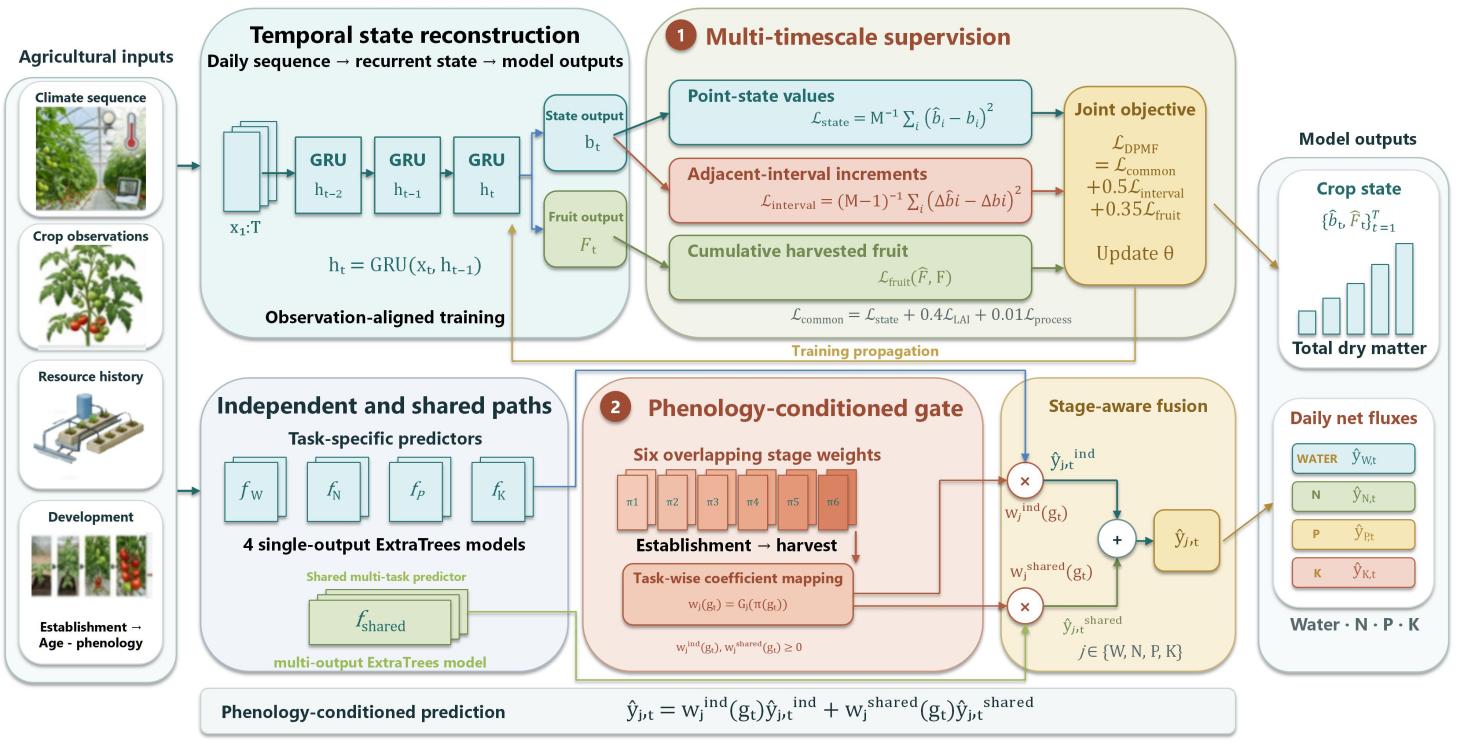
Full-cycle management of greenhouse tomato requires continuous information on crop state together with estimates of daily water and nutrient use, yet destructive biomass measurements are sparse, and a single fixed model shared across resources is prone to stage-dependent negative transfer. This study proposes Dual-Path Multi-timescale Fusion (DPMF), a development-aware framework for reconstructing crop state from sparse observations and estimating daily resource fluxes. The state path combines a process-based dry-matter prior with a gated recurrent unit trained on three kinds of supervision: point states, biomass increments between adjacent samples, and cumulative harvested-fruit dry matter. The resource path uses smooth phenology gating to weight task-specific and shared ExtraTrees predictions across six crop-development stages, so that information is shared between resources only where sharing does not degrade accuracy. On 64 destructive samples from seven light-temperature treatments, DPMF achieved a root mean square error (RMSE) of $132.821\,\mathrm{g\,m^{-2}}$ and a mean absolute error (MAE) of $65.246\,\mathrm{g\,m^{-2}}$, 6.09% and 5.31% lower in RMSE than interpolation-based and point-only supervision, respectively. On 154 greenhouse test dates, DPMF reduced RMSE relative to a fixed shared model by 4.24%, 5.34%, 2.51% and 0.67% for water, nitrogen (N), phosphorus (P) and potassium (K), respectively. DPMF thus offers a single modelling basis for crop-state reconstruction and coordinated water-nutrient estimation.
Graphical Abstract
Keywords
Data Availability Statement
Funding
Conflicts of Interest
AI Use Statement
Ethical Approval and Consent to Participate
References
- Shamshiri, R., Kalantari, F., Ting, K. C., Thorp, K. R., Hameed, I. A., Weltzien, C., ... & Shad, Z. M. (2018). Advances in greenhouse automation and controlled environment agriculture: A transition to plant factories and urban agriculture. International Journal of Agricultural and Biological Engineering, 11(1), 1-22. https://dx.doi.org/10.25165/j.ijabe.20181101.3210
[Google Scholar] - Van Klompenburg, T., Kassahun, A., & Catal, C. (2020). Crop yield prediction using machine learning: A systematic literature review. Computers and electronics in agriculture, 177, 105709.
[CrossRef] [Google Scholar] - Kamilaris, A., & Prenafeta-Boldú, F. X. (2018). Deep learning in agriculture: A survey. Computers and electronics in agriculture, 147, 70-90.
[CrossRef] [Google Scholar] - Liakos, K. G., Busato, P., Moshou, D., Pearson, S., & Bochtis, D. (2018). Machine learning in agriculture: A review. Sensors, 18(8), 2674.
[CrossRef] [Google Scholar] - Lim, B., & Zohren, S. (2021). Time-series forecasting with deep learning: a survey. Philosophical transactions of the royal society a: mathematical, physical and engineering sciences, 379(2194).
[CrossRef] [Google Scholar] - Cho, K., Van Merriënboer, B., Gulçehre, Ç., Bahdanau, D., Bougares, F., Schwenk, H., & Bengio, Y. (2014, October). Learning phrase representations using RNN encoder–decoder for statistical machine translation. In Proceedings of the 2014 conference on empirical methods in natural language processing (EMNLP) (pp. 1724-1734).
[CrossRef] [Google Scholar] - Caruana, R. (1997). Multitask learning. Machine Learning, 28(1), 41-75.
[CrossRef] [Google Scholar] - Evgeniou, T., & Pontil, M. (2004, August). Regularized multi--task learning. In Proceedings of the tenth ACM SIGKDD international conference on Knowledge discovery and data mining (pp. 109-117).
[CrossRef] [Google Scholar] - Kendall, A., Gal, Y., & Cipolla, R. (2018). Multi-task learning using uncertainty to weigh losses for scene geometry and semantics. In Proceedings of the IEEE Conference on Computer Vision and Pattern Recognition (pp. 7482-7491).
[CrossRef] [Google Scholar] - Zhang, Y., & Yang, Q. (2021). A survey on multi-task learning. IEEE transactions on knowledge and data engineering, 34(12), 5586-5609.
[CrossRef] [Google Scholar] - Ma, J., Zhao, Z., Yi, X., Chen, J., Hong, L., & Chi, E. H. (2018). Modeling task relationships in multi-task learning with multi-gate mixture-of-experts. In Proceedings of the 24th ACM SIGKDD International Conference on Knowledge Discovery and Data Mining (pp. 1930-1939).
[CrossRef] [Google Scholar] - Breiman, L. (2001). Random forests. Machine Learning, 45(1), 5-32.
[CrossRef] [Google Scholar] - Geurts, P., Ernst, D., & Wehenkel, L. (2006). Extremely randomized trees. Machine learning, 63(1), 3-42.
[CrossRef] [Google Scholar] - Hemming, S., de Zwart, F., Elings, A., Petropoulou, A., & Righini, I. (2020). Cherry tomato production in intelligent greenhouses--Sensors and AI for control of climate, irrigation, crop yield, and quality. Sensors, 20(22), 6430.
[CrossRef] [Google Scholar] - Hemming, S., de Zwart, F., Elings, A., Petropoulou, A., & Righini, I. (2020). Autonomous greenhouse challenge, (2019). 4TU. ResearchData Data Set, 678.
[CrossRef] [Google Scholar] - Maree, S. C., Zhang, P., van Marrewijk, B. M., de Zwart, F., Bijlaard, M., & Hemming, S. (2025). Autonomous greenhouse cultivation of dwarf tomato: Performance evaluation of intelligent algorithms for multiple-sensor feedback. Sensors, 25(14), 4321.
[CrossRef] [Google Scholar] - Maree, S., Zhang, P., van Marrewijk, B., de Zwart, F., Bijlaard, M., & Hemming, S. (2024). 4th Autonomous Greenhouse Challenge: Dwarf Tomato Timeseries and Images. 4TU.ResearchData.
[CrossRef] [Google Scholar] - Allen, R. G., Pereira, L. S., Raes, D., & Smith, M. (1998). Crop evapotranspiration-Guidelines for computing crop water requirements-FAO Irrigation and drainage paper 56. Fao, rome, 300(9), D05109. https://www.fao.org/3/X0490E/X0490E00.htm
[Google Scholar] - Martínez-Ruiz, A., López-Cruz, I. L., Ruiz-García, A., Pineda-Pineda, J., & Prado-Hernández, J. V. (2019). HortSyst: A dynamic model to predict growth, nitrogen uptake, and transpiration of greenhouse tomatoes. Chilean journal of agricultural research, 79(1), 89-102.
[CrossRef] [Google Scholar] - Martínez-Ruiz, A., López-Cruz, I. L., Ruiz-García, A., Pineda-Pineda, J., Sánchez-García, P., & Mendoza-Pérez, C. (2021). Uncertainty analysis of the HORTSYST model applied to fertigated tomatoes cultivated in a hydroponic greenhouse system. Spanish Journal of Agricultural Research, 19(3), e0802-e0802.
[CrossRef] [Google Scholar] - de Oliveira, M. P. G., Zorzeto-Cesar, T. Q., de Faissol Attux, R. R., & Rodrigues, L. H. A. (2025). Leveraging data from plant monitoring into crop models. Information Processing in Agriculture, 12(3), 408-429.
[CrossRef] [Google Scholar] - Locatelli, S., Barrera, W., Jr., Verdi, L., Nicoletto, C., Dalla Marta, A., & Maucieri, C. (2024). Modelling the response of tomato on deficit irrigation under greenhouse conditions. Scientia Horticulturae, 326, 112770.
[CrossRef] [Google Scholar] - Heuvelink, E. (1995). Dry matter production in a tomato crop: Measurements and simulation. Annals of Botany, 75(4), 369-379.
[CrossRef] [Google Scholar] - Heuvelink, E. (1999). Evaluation of a dynamic simulation model for tomato crop growth and development. Annals of Botany, 83(4), 413-422.
[CrossRef] [Google Scholar] - van Ittersum, M. K., Leffelaar, P. A., Van Keulen, H., Kropff, M. J., Bastiaans, L., & Goudriaan, J. (2003). On approaches and applications of the Wageningen crop models. European journal of agronomy, 18(3-4), 201-234.
[CrossRef] [Google Scholar] - Katzin, D., van Mourik, S., Kempkes, F., & van Henten, E. J. (2020). GreenLight--An open source model for greenhouses with supplemental lighting: Evaluation of heat requirements under LED and HPS lamps. Biosystems Engineering, 194, 61-81.
[CrossRef] [Google Scholar] - Gallardo, M., Fernández, M. D., Giménez, C., Padilla, F. M., & Thompson, R. B. (2016). Revised VegSyst model to calculate dry matter production, critical N uptake and ETc of several vegetable species grown in Mediterranean greenhouses. Agricultural systems, 146, 30-43.
[CrossRef] [Google Scholar] - Gallardo, M., Thompson, R. B., Giménez, C., Padilla, F. M., & Stöckle, C. O. (2014). Prototype decision support system based on the VegSyst simulation model to calculate crop N and water requirements for tomato under plastic cover. Irrigation Science, 32(3), 237-253.
[CrossRef] [Google Scholar] - Gallardo, M., Elia, A., & Thompson, R. B. (2020). Decision support systems and models for aiding irrigation and nutrient management of vegetable crops. Agricultural Water Management, 240, 106209.
[CrossRef] [Google Scholar] - Higashide, T. (2022). Review of dry matter production and growth modelling to improve the yield of greenhouse tomatoes. The Horticulture Journal, 91(3), 247-266.
[CrossRef] [Google Scholar] - Gallardo, M., Cuartero, J., de la Torre, L. A., Padilla, F. M., Segura, M. L., & Thompson, R. B. (2021). Modelling nitrogen, phosphorus, potassium, calcium and magnesium uptake, and uptake concentration, of greenhouse tomato with the VegSyst model. Scientia Horticulturae, 279, 109862.
[CrossRef] [Google Scholar] - Gallardo, M., Peña-Fleitas, M. T., Padilla, F. M., Cedeño, J., & Thompson, R. B. (2023). Prescriptive-corrective irrigation and macronutrient management in greenhouse soil-grown tomato using the vegsyst-DSS v2 decision support tool. Horticulturae, 9(10), 1128.
[CrossRef] [Google Scholar] - Berrueta, C., Grasso, R., García, C., Thompson, R. B., & Gallardo, M. (2023). Use of the VegSyst model to simulate seasonal dry matter production, N and K uptake and evapotranspiration in greenhouse soil-grown tomato in Uruguay. Agricultural Water Management, 286, 108395.
[CrossRef] [Google Scholar] - Carmassi, G., Cialli, S., Cela, F., Romero, E. B., Gallardo, M., & Incrocci, L. (2025). Use of the VegSyst v3 model to simulate seasonal dry matter production, uptake of nutrients, and evapotranspiration in a greenhouse soilless tomato crop in Tuscany. Agricultural Water Management, 314, 109508.
[CrossRef] [Google Scholar] - Gallardo, M., Cedeño, J. M., Magán, J. J., Fernández, M. D., & Thompson, R. B. (2025). Adaptation of VegSyst-DSS for N, P and K recommendations for grafted tomato grown in perlite in Mediterranean greenhouses. Agricultural Water Management, 310, 109351.
[CrossRef] [Google Scholar] - Faliagka, S., Naounoulis, I., Gallardo, M., & Katsoulas, N. (2026). Adaptation of the VegSyst model to predict crop nutrient uptake and water needs for precise soilless crop fertigation in greenhouses. Irrigation Science, 44(3), 66.
[CrossRef] [Google Scholar] - Jin, X., Kumar, L., Li, Z., Feng, H., Xu, X., Yang, G., & Wang, J. (2018). A review of data assimilation of remote sensing and crop models. European journal of agronomy, 92, 141-152.
[CrossRef] [Google Scholar] - Zhou, X., Liu, Q., Katzin, D., Qian, T., Heuvelink, E., & Marcelis, L. F. M. (2023). Boosting the prediction accuracy of a process-based greenhouse climate-tomato production model by particle filtering and deep learning. Computers and Electronics in Agriculture, 211, 107980.
[CrossRef] [Google Scholar] - Gong, L., Yu, M., Cutsuridis, V., Kollias, S., & Pearson, S. (2022). A novel model fusion approach for greenhouse crop yield prediction. Horticulturae, 9(1), 5.
[CrossRef] [Google Scholar] - Florakis, K., Trevezas, S., & Letort, V. (2023). Predicting tomato water consumption in a hydroponic greenhouse: contribution of light interception models. Frontiers in Plant Science, 14, 1264915.
[CrossRef] [Google Scholar] - Simm, J., De Abril, I. M., & Sugiyama, M. (2014). Tree-based ensemble multi-task learning method for classification and regression. IEICE TRANSACTIONS on Information and Systems, 97(6), 1677-1681.
[CrossRef] [Google Scholar] - Ge, J., Zhao, L., Yu, Z., Liu, H., Zhang, L., Gong, X., & Sun, H. (2022). Prediction of greenhouse tomato crop evapotranspiration using XGBoost machine learning model. Plants, 11(15), 1923.
[CrossRef] [Google Scholar] - Gong, L., Yu, M., Jiang, S., Cutsuridis, V., & Pearson, S. (2021). Deep learning based prediction on greenhouse crop yield combined TCN and RNN. Sensors, 21(13), 4537.
[CrossRef] [Google Scholar] - Lin, Y. S., Fang, S. L., Kang, L., Chen, C. C., Yao, M. H., & Kuo, B. J. (2024). Combining recurrent neural network and sigmoid growth models for short-term temperature forecasting and tomato growth prediction in a plastic greenhouse. Horticulturae, 10(3), 230.
[CrossRef] [Google Scholar]
Cite This Article
TY  - JOUR
AU  - Fang, Chenlei
AU  - Cui, Youlin
AU  - Miao, Yisheng
AU  - Zhao, Chunjiang
PY  - 2026
DA  - 2026/10/23
TI  - DPMF: Dual-Path Multi-timescale Fusion with Phenology-Gated Prediction for Tomato State and Daily Water-Nutrient Flux Estimation
JO  - ICCK Transactions on Intelligent Systematics
T2  - ICCK Transactions on Intelligent Systematics
JF  - ICCK Transactions on Intelligent Systematics
VL  - 3
IS  - 4
SP  - 209
EP  - 228
DO  - 10.62762/TIS.2026.964269
UR  - https://www.icck.org/article/abs/TIS.2026.964269
KW  - greenhouse tomato
KW  - crop-state reconstruction
KW  - multi-timescale supervision
KW  - phenology
KW  - multi-task learning
KW  - precision fertigation
KW  - water and nutrient flux
AB  - Full-cycle management of greenhouse tomato requires continuous information on crop state together with estimates of daily water and nutrient use, yet destructive biomass measurements are sparse, and a single fixed model shared across resources is prone to stage-dependent negative transfer. This study proposes Dual-Path Multi-timescale Fusion (DPMF), a development-aware framework for reconstructing crop state from sparse observations and estimating daily resource fluxes. The state path combines a process-based dry-matter prior with a gated recurrent unit trained on three kinds of supervision: point states, biomass increments between adjacent samples, and cumulative harvested-fruit dry matter. The resource path uses smooth phenology gating to weight task-specific and shared ExtraTrees predictions across six crop-development stages, so that information is shared between resources only where sharing does not degrade accuracy. On 64 destructive samples from seven light-temperature treatments, DPMF achieved a root mean square error (RMSE) of $132.821\,\mathrm{g\,m^{-2}}$ and a mean absolute error (MAE) of $65.246\,\mathrm{g\,m^{-2}}$, 6.09% and 5.31% lower in RMSE than interpolation-based and point-only supervision, respectively. On 154 greenhouse test dates, DPMF reduced RMSE relative to a fixed shared model by 4.24%, 5.34%, 2.51% and 0.67% for water, nitrogen (N), phosphorus (P) and potassium (K), respectively. DPMF thus offers a single modelling basis for crop-state reconstruction and coordinated water-nutrient estimation.
SN  - 3068-5079
PB  - Institute of Central Computation and Knowledge
LA  - English
ER  -
@article{Fang2026DPMF,
  author = {Chenlei Fang and Youlin Cui and Yisheng Miao and Chunjiang Zhao},
  title = {DPMF: Dual-Path Multi-timescale Fusion with Phenology-Gated Prediction for Tomato State and Daily Water-Nutrient Flux Estimation},
  journal = {ICCK Transactions on Intelligent Systematics},
  year = {2026},
  volume = {3},
  number = {4},
  pages = {209-228},
  doi = {10.62762/TIS.2026.964269},
  url = {https://www.icck.org/article/abs/TIS.2026.964269},
  abstract = {Full-cycle management of greenhouse tomato requires continuous information on crop state together with estimates of daily water and nutrient use, yet destructive biomass measurements are sparse, and a single fixed model shared across resources is prone to stage-dependent negative transfer. This study proposes Dual-Path Multi-timescale Fusion (DPMF), a development-aware framework for reconstructing crop state from sparse observations and estimating daily resource fluxes. The state path combines a process-based dry-matter prior with a gated recurrent unit trained on three kinds of supervision: point states, biomass increments between adjacent samples, and cumulative harvested-fruit dry matter. The resource path uses smooth phenology gating to weight task-specific and shared ExtraTrees predictions across six crop-development stages, so that information is shared between resources only where sharing does not degrade accuracy. On 64 destructive samples from seven light-temperature treatments, DPMF achieved a root mean square error (RMSE) of \$132.821\,\mathrm{g\,m^{-2}}\$ and a mean absolute error (MAE) of \$65.246\,\mathrm{g\,m^{-2}}\$, 6.09\% and 5.31\% lower in RMSE than interpolation-based and point-only supervision, respectively. On 154 greenhouse test dates, DPMF reduced RMSE relative to a fixed shared model by 4.24\%, 5.34\%, 2.51\% and 0.67\% for water, nitrogen (N), phosphorus (P) and potassium (K), respectively. DPMF thus offers a single modelling basis for crop-state reconstruction and coordinated water-nutrient estimation.},
  keywords = {greenhouse tomato, crop-state reconstruction, multi-timescale supervision, phenology, multi-task learning, precision fertigation, water and nutrient flux},
  issn = {3068-5079},
  publisher = {Institute of Central Computation and Knowledge}
}
Article Metrics
Publisher's Note
ICCK stays neutral with regard to jurisdictional claims in published maps and institutional affiliations.
Rights and Permissions
 Copyright © 2026 by the Author(s). Published by Institute of Central Computation and Knowledge. This article is an open access article distributed under the terms and conditions of the Creative Commons Attribution (CC BY) license (https://creativecommons.org/licenses/by/4.0/), which permits use, sharing, adaptation, distribution and reproduction in any medium or format, as long as you give appropriate credit to the original author(s) and the source, provide a link to the Creative Commons licence, and indicate if changes were made.


Portico