

The Medieval Text and the Modern Question: AI for Multilingual Semantic Retrieval across Centuries


Article Information
Abstract
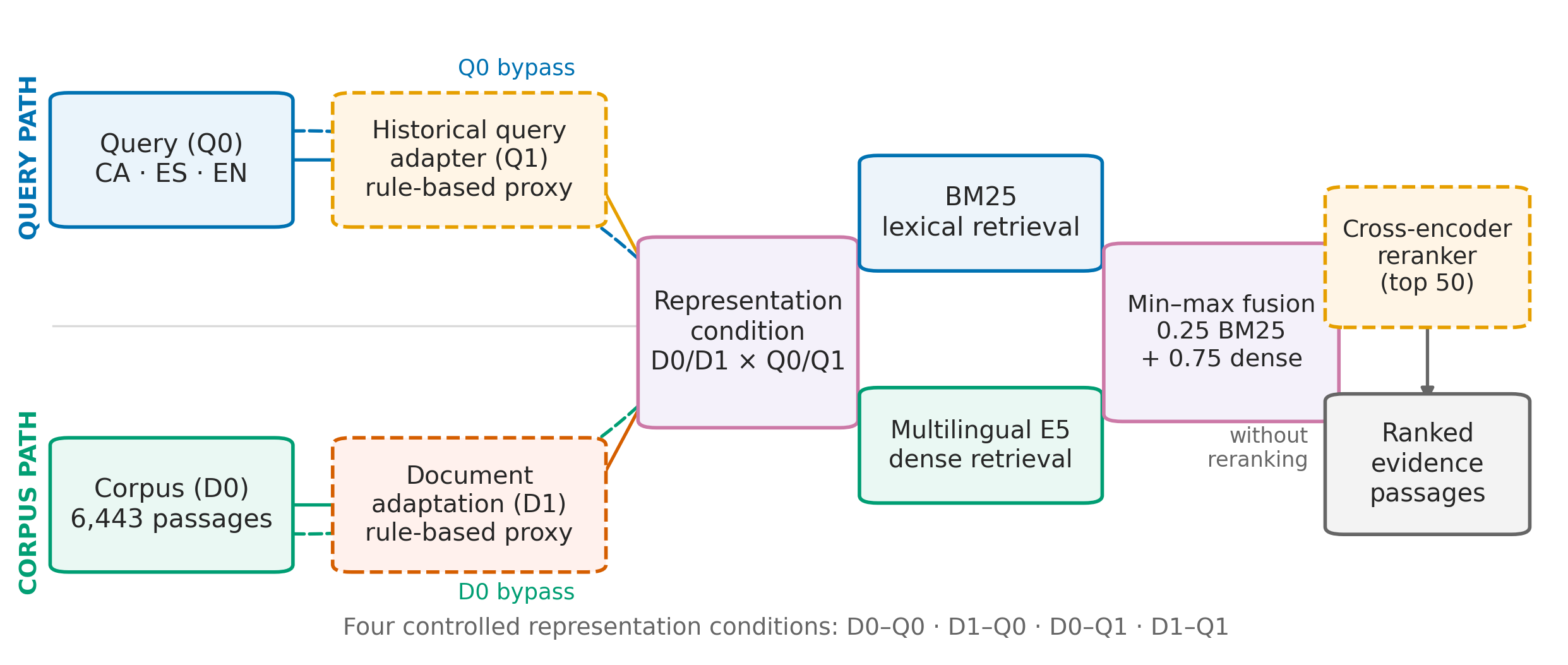
Multilingual access to medieval literature requires retrieval systems to bridge historical and cross-lingual semantic variation. This article introduces HistRAG, a language-aware framework combining lexical retrieval, multilingual dense representations, historical adaptation, hybrid fusion, and cross-encoder reranking. HistRAG separates the effects of document modernization, query adaptation, and retrieval architecture within a unified experimental setting. The framework is evaluated on a heterogeneous collection of Medieval Catalan literature using equivalent queries in three contemporary languages. Results show that lexical retrieval is highly sensitive to query language, while multilingual dense representations provide more robust cross-lingual access. Fixed hybrid fusion offers no systematic advantage over dense retrieval, and historical adaptations produce heterogeneous, non-additive effects. Cross-encoder reranking achieves the strongest average effectiveness, although its contribution varies across languages and evaluation subsets. These findings support an architecture- and language-sensitive approach to semantic retrieval from historically distant collections and provide a reproducible basis for extending AI-enabled access to other medieval textual traditions.
Graphical Abstract
Keywords
Data Availability Statement
Funding
Conflicts of Interest
AI Use Statement
Ethical Approval and Consent to Participate
References
- Bollmann, M. (2019). A large-scale comparison of historical text normalization systems. In Proceedings of the 2019 Conference of the North American Chapter of the Association for Computational Linguistics: Human Language Technologies, Volume 1 (Long and Short Papers) (pp. 3885-3898).
[CrossRef] [Google Scholar] - Hamilton, W. L., Leskovec, J., & Jurafsky, D. (2016). Diachronic word embeddings reveal statistical laws of semantic change. In Proceedings of the 54th Annual Meeting of the Association for Computational Linguistics (Volume 1: Long Papers) (pp. 1489-1501).
[CrossRef] [Google Scholar] - Kutuzov, A., {\Ovrelid, L., Szymanski, T., & Velldal, E. (2018). Diachronic word embeddings and semantic shifts: A survey. In Proceedings of the 27th International Conference on Computational Linguistics (pp. 1384-1397). https://aclanthology.org/C18-1117/
[Google Scholar] - Tahmasebi, N., Borin, L., & Jatowt, A. (2021). Survey of computational approaches to lexical semantic change detection. Computational approaches to semantic change, 6(1).
[CrossRef] [Google Scholar] - Periti, F., & Montanelli, S. (2024). Lexical semantic change through large language models: a survey. ACM Computing Surveys, 56(11), 1-38.
[CrossRef] [Google Scholar] - Martinc, M., Kralj Novak, P., & Pollak, S. (2020). Leveraging contextual embeddings for detecting diachronic semantic shift. In Proceedings of the Twelfth Language Resources and Evaluation Conference (pp. 4811-4819). https://aclanthology.org/2020.lrec-1.592/
[Google Scholar] - Xu, X., Deng, K., Hu, F., & Li, L. (2019). An improved historical embedding without alignment. arXiv preprint arXiv:1910.08692.
[CrossRef] [Google Scholar] - Schlechtweg, D., Tahmasebi, N., Hengchen, S., Dubossarsky, H., & McGillivray, B. (2021, November). DWUG: A large resource of diachronic word usage graphs in four languages. In Proceedings of the 2021 conference on empirical methods in natural language processing (pp. 7079-7091).
[CrossRef] [Google Scholar] - Tsakalidis, A., Basile, P., Bazzi, M., Cucuringu, M., & McGillivray, B. (2021). DUKweb, diachronic word representations from the UK Web Archive corpus. Scientific Data, 8(1), 269.
[CrossRef] [Google Scholar] - Sánchez-Martínez, F., Martínez-Sempere, I., Ivars-Ribes, X., & Carrasco, R. C. (2013). An open diachronic corpus of historical Spanish. Language resources and evaluation, 47(4), 1327-1342.
[CrossRef] [Google Scholar] - Clérice, T., Pinche, A., Vlachou-Efstathiou, M., Chagué, A., Camps, J. B., Levenson, M. G., ... & Kiessling, B. (2024, August). CATMuS Medieval: A multilingual large-scale cross-century dataset in Latin script for handwritten text recognition and beyond. In International Conference on Document Analysis and Recognition (pp. 174-194). Cham: Springer Nature Switzerland.
[CrossRef] [Google Scholar] - Conneau, A., Khandelwal, K., Goyal, N., Chaudhary, V., Wenzek, G., Guzmán, F., ... & Stoyanov, V. (2020, July). Unsupervised cross-lingual representation learning at scale. In Proceedings of the 58th annual meeting of the association for computational linguistics (pp. 8440-8451).
[CrossRef] [Google Scholar] - Reimers, N., & Gurevych, I. (2020, November). Making monolingual sentence embeddings multilingual using knowledge distillation. In Proceedings of the 2020 conference on empirical methods in natural language processing (EMNLP) (pp. 4512-4525).
[CrossRef] [Google Scholar] - Gao, T., Yao, X., & Chen, D. (2021, November). Simcse: Simple contrastive learning of sentence embeddings. In Proceedings of the 2021 conference on empirical methods in natural language processing (pp. 6894-6910).
[CrossRef] [Google Scholar] - Shi, P., Zhang, R., Bai, R. H., & Lin, J. (2021, November). Cross-lingual training of dense retrievers for document retrieval. In Proceedings of the 1st Workshop on Multilingual Representation Learning (pp. 251-253).
[CrossRef] [Google Scholar] - Zhang, H., Gong, Y., Liu, D., Zhang, S., He, X., Lv, J., & Guo, J. (2024, May). Knowledge enhanced pre-training for cross-lingual dense retrieval. In Proceedings of the 2024 Joint International Conference on Computational Linguistics, Language Resources and Evaluation (LREC-COLING 2024) (pp. 9810-9821). https://aclanthology.org/2024.lrec-main.857/
[Google Scholar] - Wang, L., Yang, N., Huang, X., Yang, L., Majumder, R., & Wei, F. (2024). Multilingual E5 text embeddings: A technical report. arXiv preprint arXiv:2402.05672.
[CrossRef] [Google Scholar] - Thakur, N., Reimers, N., Rücklé, A., Srivastava, A., & Gurevych, I. (2021). Beir: A heterogenous benchmark for zero-shot evaluation of information retrieval models. arXiv preprint arXiv:2104.08663.
[CrossRef] [Google Scholar] - Muennighoff, N., Tazi, N., Magne, L., & Reimers, N. (2023). MTEB: Massive text embedding benchmark. In Proceedings of the 17th Conference of the European Chapter of the Association for Computational Linguistics (pp. 2014-2037).
[CrossRef] [Google Scholar] - Zhang, X., Thakur, N., Ogundepo, O., Kamalloo, E., Alfonso-Hermelo, D., Li, X., ... & Lin, J. (2023). MIRACL: A multilingual retrieval dataset covering 18 diverse languages. Transactions of the Association for Computational Linguistics, 11, 1114-1131.
[CrossRef] [Google Scholar] - Robertson, S. E., Walker, S., Jones, S., Hancock-Beaulieu, M. M., & Gatford, M. (1995). Okapi at TREC-3. In D. K. Harman (Ed.), Overview of the Third Text REtrieval Conference (TREC-3), NIST Special Publication 500-225 (pp. 109-126). Gaithersburg, MD: National Institute of Standards and Technology. https://trec.nist.gov/pubs/trec3/t3_proceedings.html
[Google Scholar] - Schütze, H., Manning, C. D., & Raghavan, P. (2008). Introduction to information retrieval. Cambridge: Cambridge University Press.
[CrossRef] [Google Scholar] - Nogueira, R., & Cho, K. (2019). Passage re-ranking with BERT. arXiv preprint arXiv:1901.04085.
[CrossRef] [Google Scholar] - Yadav, N., Monath, N., Angell, R., Zaheer, M., & McCallum, A. (2022). Efficient nearest neighbor search for cross-encoder models using matrix factorization. In Proceedings of the 2022 Conference on Empirical Methods in Natural Language Processing (pp. 2171-2194).
[CrossRef] [Google Scholar] - Vast, M., Morand, V., van Cooten, B., Soulier, L., Mothe, J., & Piwowarski, B. (2026). MICE: Minimal interaction cross-encoders for efficient re-ranking. arXiv preprint arXiv:2602.16299.
[CrossRef] [Google Scholar] - Purday, J. (2009). Think culture: Europeana.eu from concept to construction. The Electronic Library, 27(6), 919-937.
[CrossRef] [Google Scholar] - Akhoon, I. u. H., & Khan, M. Y. (2022). Evaluating the World Digital Library: A digital framework for global cultural preservation. ShodhKosh: Journal of Visual and Performing Arts, 3(2), 1074-1081.
[CrossRef] [Google Scholar] - Lin, S. C., & Yen, E. (2012). An introduction to Taiwan e-Learning and Digital Archives Program (TELDAP). International Journal of Humanities and Arts Computing, 6(1-2), 1-7.
[CrossRef] [Google Scholar] - Babka, L. (2026). From the Middle Ages to the Present–Making the Written Heritage available in the Manuscriptorium, Kramerius and eSbirky. cz Digital Libraries. Z Badań nad Książką i Księgozbiorami Historycznymi, 20(1), 121-131.
[CrossRef] [Google Scholar] - Xu, L., Lu, L., Liu, M., Song, C., & Wu, L. (2024). Nanjing Yunjin intelligent question-answering system based on knowledge graphs and retrieval augmented generation technology. Heritage Science, 12(1), 118.
[CrossRef] [Google Scholar] - Murugaraj, K., Lamsiyah, S., During, M., & Theobald, M. (2025). Topic-RAG for historical newspapers: Enhancing information retrieval in humanities research through topic-based retrieval-augmented generation. Computational Humanities Research, 1, e15.
[CrossRef] [Google Scholar] - Konstantinidis, S., Lotfy, H., Erne, A., Zahiragic, F., Kan, M. Y., & Vlachos, M. (2026). Improving Access to Historical Archives with Real-time RAG-based Systems. arXiv preprint arXiv:2607.03440.
[CrossRef] [Google Scholar] - Bonifacio, L., Jeronymo, V., Abonizio, H. Q., Campiotti, I., Fadaee, M., Lotufo, R., & Nogueira, R. (2021). mMARCO: A multilingual version of the MS MARCO passage ranking dataset. arXiv preprint arXiv:2108.13897.
[CrossRef] [Google Scholar] - Holm, S. (1979). A simple sequentially rejective multiple test procedure. Scandinavian Journal of Statistics, 6(2), 65-70. https://www.jstor.org/stable/4615733
[Google Scholar]
Cite This Article
TY  - JOUR
AU  - Mestre, Antoni
PY  - 2026
DA  - 2026/10/23
TI  - The Medieval Text and the Modern Question: AI for Multilingual Semantic Retrieval across Centuries
JO  - ICCK Transactions on Machine Intelligence
T2  - ICCK Transactions on Machine Intelligence
JF  - ICCK Transactions on Machine Intelligence
VL  - 2
IS  - 4
SP  - 236
EP  - 256
DO  - 10.62762/TMI.2026.633155
UR  - https://www.icck.org/article/abs/TMI.2026.633155
KW  - natural language processing
KW  - language-aware machine intelligence
KW  - multilingual semantic retrieval
KW  - hybrid information retrieval
KW  - medieval literature
AB  - Multilingual access to medieval literature requires retrieval systems to bridge historical and cross-lingual semantic variation. This article introduces HistRAG, a language-aware framework combining lexical retrieval, multilingual dense representations, historical adaptation, hybrid fusion, and cross-encoder reranking. HistRAG separates the effects of document modernization, query adaptation, and retrieval architecture within a unified experimental setting. The framework is evaluated on a heterogeneous collection of Medieval Catalan literature using equivalent queries in three contemporary languages. Results show that lexical retrieval is highly sensitive to query language, while multilingual dense representations provide more robust cross-lingual access. Fixed hybrid fusion offers no systematic advantage over dense retrieval, and historical adaptations produce heterogeneous, non-additive effects. Cross-encoder reranking achieves the strongest average effectiveness, although its contribution varies across languages and evaluation subsets. These findings support an architecture- and language-sensitive approach to semantic retrieval from historically distant collections and provide a reproducible basis for extending AI-enabled access to other medieval textual traditions.
SN  - 3068-7403
PB  - Institute of Central Computation and Knowledge
LA  - English
ER  -
@article{Mestre2026The,
  author = {Antoni Mestre},
  title = {The Medieval Text and the Modern Question: AI for Multilingual Semantic Retrieval across Centuries},
  journal = {ICCK Transactions on Machine Intelligence},
  year = {2026},
  volume = {2},
  number = {4},
  pages = {236-256},
  doi = {10.62762/TMI.2026.633155},
  url = {https://www.icck.org/article/abs/TMI.2026.633155},
  abstract = {Multilingual access to medieval literature requires retrieval systems to bridge historical and cross-lingual semantic variation. This article introduces HistRAG, a language-aware framework combining lexical retrieval, multilingual dense representations, historical adaptation, hybrid fusion, and cross-encoder reranking. HistRAG separates the effects of document modernization, query adaptation, and retrieval architecture within a unified experimental setting. The framework is evaluated on a heterogeneous collection of Medieval Catalan literature using equivalent queries in three contemporary languages. Results show that lexical retrieval is highly sensitive to query language, while multilingual dense representations provide more robust cross-lingual access. Fixed hybrid fusion offers no systematic advantage over dense retrieval, and historical adaptations produce heterogeneous, non-additive effects. Cross-encoder reranking achieves the strongest average effectiveness, although its contribution varies across languages and evaluation subsets. These findings support an architecture- and language-sensitive approach to semantic retrieval from historically distant collections and provide a reproducible basis for extending AI-enabled access to other medieval textual traditions.},
  keywords = {natural language processing, language-aware machine intelligence, multilingual semantic retrieval, hybrid information retrieval, medieval literature},
  issn = {3068-7403},
  publisher = {Institute of Central Computation and Knowledge}
}
Article Metrics
Publisher's Note
ICCK stays neutral with regard to jurisdictional claims in published maps and institutional affiliations.
Rights and Permissions


Portico
