
Enhancing Ocular Health Precision: Cataract Detection Using Fundus Images and ResNet-50




Article Information
Abstract
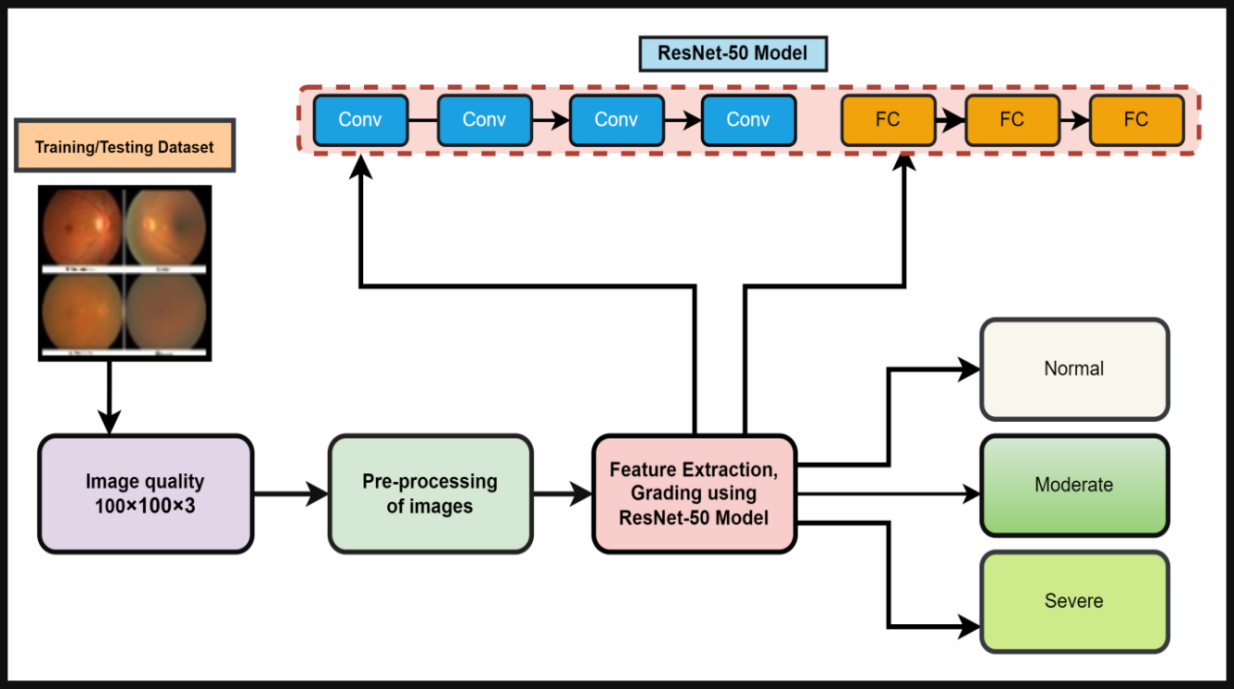
Cataracts are a leading cause of blindness in Pakistan, contributing to more than 54% of blindness cases in Pakistan, primarily due to poor living conditions, nutritional deficiencies, and limited healthcare access. Early detection is critical to avoid invasive treatments, but current diagnostic approaches often identify cataracts at advanced stages. This paper presents an advanced,automated cataract detection system using deep learning specifically the ResNet-50 architecture, to address this gap. The model processes fundus retinal images curated from diverse datasets, classified by ophthalmologic experts through a rigorous three-stage process. By leveraging the ResNet-50 model, cataracts are categorized into normal,moderate,and severe, achieving an accuracy of 97.15% on full images. Notably, the system performs well even on partial images with 70% visibility, maintaining an accuracy of 95.23%, thus minimizing the need for extensive images restoration. The dataset was augmented to include 17,500 images,ensuring robust training. The model's ability to detect cataracts with high precision in images with varying visibility(70%, 80%, 85% and beyond) demonstrate its flexibility and reliability, consistently achieving accuracy above 95.50%. This research offers a non-invasive, efficient solution particularly suited for remote areas, addressing the limitations of the late-stage diagnoses. It represents a significant advancement in cataract detection and has the potential to revolutionize global cataracts identification through early, accurate intervention.
Graphical Abstract
Keywords
Data Availability Statement
Funding
Conflicts of Interest
Ethical Approval and Consent to Participate
References
- Cvekl, A., & Vijg, J. (2024). Aging of the eye: Lessons from cataracts and age-related macular degeneration. Ageing Research Reviews, 99, 102407.
[CrossRef] [Google Scholar] - Khalil, I., Mehmood, A., Kim, H., & Kim, J. (2024). OCTNet: A Modified Multi-Scale Attention Feature Fusion Network with InceptionV3 for Retinal OCT Image Classification. Mathematics, 12(19), 3003.
[Google Scholar] - Salmon, J. F. (2019). Kanski's clinical ophthalmology e-book: a systematic approach. Elsevier Health Sciences.
[Google Scholar] - Junayed, M. S., Islam, M. B., Sadeghzadeh, A., & Rahman, S. (2021). CataractNet: An automated cataract detection system using deep learning for fundus images. IEEE access, 9, 128799-128808.
[CrossRef] [Google Scholar] - Tham, Y. C., Goh, J. H. L., Anees, A., Lei, X., Rim, T. H., Chee, M. L., ... & Cheng, C. Y. (2022). Detecting visually significant cataract using retinal photograph-based deep learning. Nature aging, 2(3), 264-271.
[CrossRef] [Google Scholar] - Burton, M., Fergusson, E., Hart, A., Knight, K., Lary, D., & Liu, C. (1997). The prevalence of cataract in two villages of northern Pakistan with different levels of ultraviolet radiation. Eye, 11(1), 95-101.
[CrossRef] [Google Scholar] - Jadoon, Z., Shah, S. P., Bourne, R., Dineen, B., Khan, M. A., Gilbert, C. E., ... & Pakistan National Eye Survey Study Group. (2007). Cataract prevalence, cataract surgical coverage and barriers to uptake of cataract surgical services in Pakistan: the Pakistan National Blindness and Visual Impairment Survey. British Journal of Ophthalmology, 91(10), 1269-1273.
[CrossRef] [Google Scholar] - Anyolo, F. (2008). Factors influencing cataract surgical services at Oshakati intermediate hospital in the Northern vision 2020 district of Namibia. Royal tropical institute (KIT).
[Google Scholar] - Hassan, B., Ahmed, R., Li, B., Noor, A., & Hassan, Z. U. (2019). A comprehensive study capturing vision loss burden in Pakistan (1990-2025): Findings from the Global Burden of Disease (GBD) 2017 study. PloS one, 14(5), e0216492.
[CrossRef] [Google Scholar] - Vasavada, A. R., Mamidipudi, P. R., & Sharma, P. S. (2004). Morphology of and visual performance with posterior subcapsular cataract. Journal of Cataract & Refractive Surgery, 30(10), 2097-2104.
[CrossRef] [Google Scholar] - Lenhart, P. D., & Lambert, S. R. (2022). Current management of infantile cataracts. Survey of ophthalmology, 67(5), 1476-1505.
[CrossRef] [Google Scholar] - Gupta, V., Jaiswal, A., Choudhury, T., & Sachdeva, N. (2022). Cataract Detection on Ocular Fundus Images Using Machine Learning. In Emerging Technologies in Data Mining and Information Security: Proceedings of IEMIS 2022, Volume 2 (pp. 185-192). Singapore: Springer Nature Singapore.
[CrossRef] [Google Scholar] - Zhang, X. Q., Hu, Y., Xiao, Z. J., Fang, J. S., Higashita, R., & Liu, J. (2022). Machine learning for cataract classification/grading on ophthalmic imaging modalities: a survey. Machine Intelligence Research, 19(3), 184-208.
[CrossRef] [Google Scholar] - Koh, J. E., Ng, E. Y., Bhandary, S. V., Laude, A., & Acharya, U. R. (2018). Automated detection of retinal health using PHOG and SURF features extracted from fundus images. Applied Intelligence, 48(5), 1379-1393.
[CrossRef] [Google Scholar] - González‐Gonzalo, C., Sánchez‐Gutiérrez, V., Hernández‐Martínez, P., Contreras, I., Lechanteur, Y. T., Domanian, A., ... & Sánchez, C. I. (2020). Evaluation of a deep learning system for the joint automated detection of diabetic retinopathy and age‐related macular degeneration. Acta ophthalmologica, 98(4), 368-377.
[CrossRef] [Google Scholar] - Canatan, A. N. (2024). Restoring sight: exploring cataracts as the leading treatable cause of blindness: a narrative review. Turkish Medical Student Journal.
[CrossRef] [Google Scholar] - Vision Loss Expert Group of the Global Burden of Disease Study. (2024). Global estimates on the number of people blind or visually impaired by cataract: a meta-analysis from 2000 to 2020. Eye, 38(11), 2156.
[CrossRef] [Google Scholar] - Khairallah, M., Kahloun, R., Bourne, R., Limburg, H., Flaxman, S. R., Jonas, J. B., ... & Vision Loss Expert Group of the Global Burden of Disease Study. (2015). Number of people blind or visually impaired by cataract worldwide and in world regions, 1990 to 2010. Investigative ophthalmology & visual science, 56(11), 6762-6769.
[CrossRef] [Google Scholar] - World Health Organization. (2000). Elimination of avoidable visual disability due to refractive errors: report of an informal planning meeting, Geneva, 3-5 July 2000 (No. WHO/PBL/00.79). World Health Organization.
[Google Scholar] - McCormick, I., Butcher, R., Evans, J. R., Mactaggart, I. Z., Limburg, H., Jolley, E., ... & Zhang, X. J. (2022). Effective cataract surgical coverage in adults aged 50 years and older: estimates from population-based surveys in 55 countries. The Lancet Global Health, 10(12), e1744-e1753.
[CrossRef] [Google Scholar] - Shaheen, I., & Akram, M. U. (2017, July). An integrated framework for clinical grading of cataract. In 2017 1st International Conference on Next Generation Computing Applications (NextComp) (pp. 92-97). IEEE.
[CrossRef] [Google Scholar] - Zhang, H., Niu, K., Xiong, Y., Yang, W., He, Z., & Song, H. (2019). Automatic cataract grading methods based on deep learning. Computer methods and programs in biomedicine, 182, 104978.
[CrossRef] [Google Scholar] - Song, W., Cao, Y., Qiao, Z., Wang, Q., & Yang, J. J. (2019, July). An improved semi-supervised learning method on cataract fundus image classification. In 2019 IEEE 43rd annual computer software and applications conference (COMPSAC) (Vol. 2, pp. 362-367). IEEE.
[CrossRef] [Google Scholar] - Jagadale, A. B., Sonavane, S. S., & Jadav, D. V. (2019, April). Computer aided system for early detection of nuclear cataract using circle Hough transform. In 2019 3rd international conference on trends in electronics and informatics (ICOEI) (pp. 1009-1012). IEEE.
[CrossRef] [Google Scholar] - Cao, L., Li, H., Zhang, Y., Zhang, L., & Xu, L. (2020). Hierarchical method for cataract grading based on retinal images using improved Haar wavelet. Information Fusion, 53, 196-208.
[CrossRef] [Google Scholar] - Harini, V., & Bhanumathi, V. (2016, April). Automatic cataract classification system. In 2016 international conference on communication and signal processing (ICCSP) (pp. 0815-0819). IEEE.
[CrossRef] [Google Scholar] - Askarian, B., Ho, P., & Chong, J. W. (2021). Detecting cataract using smartphones. IEEE Journal of Translational Engineering in Health and Medicine, 9, 1-10.
[CrossRef] [Google Scholar] - Hossain, M. R., Afroze, S., Siddique, N., & Hoque, M. M. (2020, June). Automatic detection of eye cataract using deep convolution neural networks (DCNNs). In 2020 IEEE region 10 symposium (TENSYMP) (pp. 1333-1338). IEEE.
[CrossRef] [Google Scholar] - Rana, J., & Galib, S. M. (2017, December). Cataract detection using smartphone. In 2017 3rd international conference on electrical information and communication technology (EICT) (pp. 1-4). IEEE.
[CrossRef] [Google Scholar] - Guo, L., Yang, J. J., Peng, L., Li, J., & Liang, Q. (2015). A computer-aided healthcare system for cataract classification and grading based on fundus image analysis. Computers in Industry, 69, 72-80.
[CrossRef] [Google Scholar] - Yang, J. J., Li, J., Shen, R., Zeng, Y., He, J., Bi, J., ... & Wang, Q. (2016). Exploiting ensemble learning for automatic cataract detection and grading. Computer methods and programs in biomedicine, 124, 45-57.
[CrossRef] [Google Scholar] - Pratap, T., & Kokil, P. (2019). Computer-aided diagnosis of cataract using deep transfer learning. Biomedical Signal Processing and Control, 53, 101533.
[CrossRef] [Google Scholar] - Xiong, Y., He, Z., Niu, K., Zhang, H., & Song, H. (2018, December). Automatic cataract classification based on multi-feature fusion and SVM. In 2018 IEEE 4th International Conference on Computer and Communications (ICCC) (pp. 1557-1561). IEEE.
[CrossRef] [Google Scholar] - Porwal, P., Pachade, S., Kamble, R., Kokare, M., Deshmukh, G., Sahasrabuddhe, V., & Meriaudeau, F. (2018). Indian diabetic retinopathy image dataset (IDRiD): a database for diabetic retinopathy screening research. Data, 3(3), 25.
[CrossRef] [Google Scholar] - Zhang, Z., Liu, J., Yin, F., Lee, B. H., Wong, D. W. K., & Sung, K. R. (2013, June). ACHIKO-K: Database of fundus images from glaucoma patients. In 2013 IEEE 8th conference on industrial electronics and applications (ICIEA) (pp. 228-231). IEEE.
[CrossRef] [Google Scholar] - Li, N., Li, T., Hu, C., Wang, K., & Kang, H. (2021). A benchmark of ocular disease intelligent recognition: One shot for multi-disease detection. In Benchmarking, Measuring, and Optimizing: Third BenchCouncil International Symposium, Bench 2020, Virtual Event, November 15–16, 2020, Revised Selected Papers 3 (pp. 177-193). Springer International Publishing.
[CrossRef] [Google Scholar] - Ganokratanaa, T., Ketcham, M., & Pramkeaw, P. (2023). Advancements in cataract detection: The systematic development of LeNet-convolutional neural network models. Journal of Imaging, 9(10), 197.
[CrossRef] [Google Scholar] - He, K., Zhang, X., Ren, S., & Sun, J. (2016). Deep residual learning for image recognition. In Proceedings of the IEEE conference on computer vision and pattern recognition (pp. 770-778).
[Google Scholar] - Mahmood, S. S., Chaabouni, S., & Fakhfakh, A. (2024). Improving automated detection of cataract disease through transfer learning using ResNet50. Engineering, Technology & Applied Science Research, 14(5), 17541-17547.
[CrossRef] [Google Scholar] - Cong, S., & Zhou, Y. (2023). A review of convolutional neural network architectures and their optimizations. Artificial Intelligence Review, 56(3), 1905-1969.
[CrossRef] [Google Scholar] - Yusuf, M., Theophilous, S., Adejoke, J., & Hassan, A. B. (2019, October). Web-based cataract detection system using deep convolutional neural network. In 2019 2nd International Conference of the IEEE Nigeria Computer Chapter (NigeriaComputConf) (pp. 1-7). IEEE.
[CrossRef] [Google Scholar] - Gao, X., Li, H., Lim, J. H., & Wong, T. Y. (2011, September). Computer-aided cataract detection using enhanced texture features on retro-illumination lens images. In 2011 18th IEEE International Conference on Image Processing (pp. 1565-1568). IEEE.
[CrossRef] [Google Scholar] - Fuadah, Y. N., Setiawan, A. W., & Mengko, T. L. R. (2015, May). Performing high accuracy of the system for cataract detection using statistical texture analysis and K-Nearest Neighbor. In 2015 International Seminar on Intelligent Technology and Its Applications (ISITIA) (pp. 85-88). IEEE.
[CrossRef] [Google Scholar] - Zhang, L., Li, J., Han, H., Liu, B., Yang, J., & Wang, Q. (2017, May). Automatic cataract detection and grading using deep convolutional neural network. In 2017 IEEE 14th international conference on networking, sensing and control (ICNSC) (pp. 60-65). IEEE.
[CrossRef] [Google Scholar] - Ran, J., Niu, K., He, Z., Zhang, H., & Song, H. (2018, August). Cataract detection and grading based on combination of deep convolutional neural network and random forests. In 2018 international conference on network infrastructure and digital content (IC-NIDC) (pp. 155-159). IEEE.
[CrossRef] [Google Scholar] - Sigit, R., Triyana, E., & Rochmad, M. (2019, October). Cataract detection using single layer perceptron based on smartphone. In 2019 3rd International Conference on Informatics and Computational Sciences (ICICoS) (pp. 1-6). IEEE.
[CrossRef] [Google Scholar] - Khan, M. S. M., Ahmed, M., Rasel, R. Z., & Khan, M. M. (2021, May). Cataract detection using convolutional neural network with VGG-19 model. In 2021 IEEE World AI IoT Congress (AIIoT) (pp. 0209-0212). IEEE.
[CrossRef] [Google Scholar] - Lahmar, C., & Idri, A. (2022). On the value of deep learning for diagnosing diabetic retinopathy. Health and Technology, 12(1), 89-105.
[CrossRef] [Google Scholar] - Pan, Y., Liu, J., Cai, Y., Yang, X., Zhang, Z., Long, H., ... & Tan, Z. (2023). Fundus image classification using Inception V3 and ResNet-50 for the early diagnostics of fundus diseases. Frontiers in Physiology, 14, 1126780.
[CrossRef] [Google Scholar] - Puchaicela-Lozano, M. S., Zhinin-Vera, L., Andrade-Reyes, A. J., Baque-Arteaga, D. M., Cadena-Morejón, C., Tirado-Espín, A., ... & Meneses, F. V. (2023). Deep Learning for Glaucoma Detection: R-CNN ResNet-50 and Image Segmentation. Journal of Advances in Information Technology, 14(6), 1186-1197.
[CrossRef] [Google Scholar] - Xiong, L., Li, H., & Xu, L. (2017). An approach to evaluate blurriness in retinal images with vitreous opacity for cataract diagnosis. Journal of healthcare engineering, 2017(1), 5645498.
[CrossRef] [Google Scholar] - Bragança, C. P., Torres, J. M., Soares, C. P. D. A., & Macedo, L. O. (2022, November). Detection of glaucoma on fundus images using deep learning on a new image set obtained with a smartphone and handheld ophthalmoscope. In Healthcare (Vol. 10, No. 12, p. 2345). MDPI.
[CrossRef] [Google Scholar] - Li, L., Xu, M., Liu, H., Li, Y., Wang, X., Jiang, L., ... & Wang, N. (2019). A large-scale database and a CNN model for attention-based glaucoma detection. IEEE transactions on medical imaging, 39(2), 413-424.
[CrossRef] [Google Scholar]
Cited By (11)
-
Xu Wang, Zhaoshui He, Hao Liang, Jing Guo, Zhijie Lin, Liqiang Zhang, Xingfang Pan. APCA-Net: Adaptive Patch-Correlation Attention Network for Vision-Based Human Hand Acupoint Detection in Acupuncture.
IEEE Transactions on Human-Machine Systems, 2026 , 56 (3).
[CrossRef] -
Fengjun Hu, Fan Wu, Dongping Zhang, Hanjie Gu. Privacy-Preserving Data Augmentation for Digital Pathology Using Improved DCGAN.
IEEE Journal of Biomedical and Health Informatics, 2026 , 30 (5).
[CrossRef] -
Pande Komang Wahyu Pradana, Ida Ayu Prama Yanthi, Abdi Sastra Gunanegara. Role of artificial intelligence in detecting and grading cataracts using color fundus photographs: A systematic review and meta-analysis.
Acta Marisiensis - Seria Medica, 2026 , 72 (1).
[CrossRef] -
Xin Li. Student face detection based on ResNet18 residual network for classroom quality assessment.
Discover Artificial Intelligence, 2026 , 6 (1).
[CrossRef] -
Wajahat Akbar, Shuguang Li, Altaf Hussain, Tahir Ali Shah, Abdullah Soomro, Muhammad Inam Ul Haq. .
2026 International Conference on Robotics, Automation and Intelligent Transportation Systems (RAITS), 2026 .
[CrossRef] -
Sultan Büşra Ay Kartbak, Mehmet Birol Özel, Duygu Nur Cesur Kocakaya, Muhammet Çakmak, Enver Alper Sinanoğlu. Classification of Intraoral Photographs with Deep Learning Algorithms Trained According to Cephalometric Measurements.
Diagnostics, 2025 , 15 (9).
[CrossRef] -
Mohsin A. Farhad, Abdul Razaque, Samat B. Mukhanov, Dina S. M. Hassan, Hari Mohan Rai. Enhanced Lesion Localization and Classification in Ocular Tumor Detection Using Grad-CAM and Transfer Learning.
IEEE Access, 2025 , 13 .
[CrossRef] -
Abdul Rahaman Wahab Sait, Ramprasad Nagaraj. Diabetic Foot Ulcers Detection Model Using a Hybrid Convolutional Neural Networks–Vision Transformers.
Diagnostics, 2025 , 15 (6).
[CrossRef] -
Deepak Banerjee, Raghavendra Sridhar, Rashi Nimesh Kumar Dhenia, Ishva Jitendrakumar Kanani, Anuj Kumar Jain, Gaurav Sharma. .
2025 Global Conference on Information Technology and Communication Networks (GITCON), 2025 .
[CrossRef] -
Wajahat Akbar, Shuguang Li, Abdullah Soomro, Altaf Hussain, Razaz Waheeb Attar, Tariq Hussain, Amal Hassan Alhazmi, Reem Alsagri. TraHeaLRG: Transformative Healthcare Leveraging LSTM and GRU Models Toward Improved Accuracy for Chest X-Ray Report Generation.
International Journal of Pattern Recognition and Artificial Intelligence, 2025 , 39 (15).
[CrossRef] -
Tiyu Fang, Mingxin Zhang, Ran Song, Xiaolei Li, Zhiyuan Wei, Wei Zhang. Human-Guided Data Augmentation via Diffusion Model for Surface Defect Recognition Under Limited Data.
IEEE Transactions on Instrumentation and Measurement, 2025 , 74 .
[CrossRef]
Cite This Article
TY  - JOUR
AU  - Khan, Irshad
AU  - Akbar, Wajahat
AU  - Soomro, Abdullah
AU  - Hussain, Tariq
AU  - Khalil, Irshad
AU  - Khan, Muhammad Nawaz
AU  - Salam, Abdu
PY  - 2024
DA  - 2024/10/29
TI  - Enhancing Ocular Health Precision: Cataract Detection Using Fundus Images and ResNet-50
JO  - ICCK Transactions on Intelligent Systematics
T2  - ICCK Transactions on Intelligent Systematics
JF  - ICCK Transactions on Intelligent Systematics
VL  - 1
IS  - 3
SP  - 145
EP  - 160
DO  - 10.62762/TIS.2024.640345
UR  - https://www.icck.org/article/abs/TIS.2024.640345
KW  - cataract detection
KW  - deep learning
KW  - ResNet-50
KW  - eye fundus images
KW  - health care
KW  - partial image
AB  - Cataracts are a leading cause of blindness in Pakistan, contributing to more than 54% of blindness cases in Pakistan, primarily due to poor living conditions, nutritional deficiencies, and limited healthcare access. Early detection is critical to avoid invasive treatments, but current diagnostic approaches often identify cataracts at advanced stages. This paper presents an advanced,automated cataract detection system using deep learning specifically the ResNet-50 architecture, to address this gap. The model processes fundus retinal images curated from diverse datasets, classified by ophthalmologic experts through a rigorous three-stage process. By leveraging the ResNet-50 model, cataracts are categorized into normal,moderate,and severe, achieving an accuracy of 97.15% on full images. Notably, the system performs well even on partial images with 70% visibility, maintaining an accuracy of 95.23%, thus minimizing the need for extensive images restoration. The dataset was augmented to include 17,500 images,ensuring robust training. The model's ability to detect cataracts with high precision in images with varying visibility(70%, 80%, 85% and beyond) demonstrate its flexibility and reliability, consistently achieving accuracy above 95.50%. This research offers a non-invasive, efficient solution particularly suited for remote areas, addressing the limitations of the late-stage diagnoses. It represents a significant advancement in cataract detection and has the potential to revolutionize global cataracts identification through early, accurate intervention.
SN  - 3068-5079
PB  - Institute of Central Computation and Knowledge
LA  - English
ER  -
@article{Khan2024Enhancing,
  author = {Irshad Khan and Wajahat Akbar and Abdullah Soomro and Tariq Hussain and Irshad Khalil and Muhammad Nawaz Khan and Abdu Salam},
  title = {Enhancing Ocular Health Precision: Cataract Detection Using Fundus Images and ResNet-50},
  journal = {ICCK Transactions on Intelligent Systematics},
  year = {2024},
  volume = {1},
  number = {3},
  pages = {145-160},
  doi = {10.62762/TIS.2024.640345},
  url = {https://www.icck.org/article/abs/TIS.2024.640345},
  abstract = {Cataracts are a leading cause of blindness in Pakistan, contributing to more than 54\% of blindness cases in Pakistan, primarily due to poor living conditions, nutritional deficiencies, and limited healthcare access. Early detection is critical to avoid invasive treatments, but current diagnostic approaches often identify cataracts at advanced stages. This paper presents an advanced,automated cataract detection system using deep learning specifically the ResNet-50 architecture, to address this gap. The model processes fundus retinal images curated from diverse datasets, classified by ophthalmologic experts through a rigorous three-stage process. By leveraging the ResNet-50 model, cataracts are categorized into normal,moderate,and severe, achieving an accuracy of 97.15\% on full images. Notably, the system performs well even on partial images with 70\% visibility, maintaining an accuracy of 95.23\%, thus minimizing the need for extensive images restoration. The dataset was augmented to include 17,500 images,ensuring robust training. The model's ability to detect cataracts with high precision in images with varying visibility(70\%, 80\%, 85\% and beyond) demonstrate its flexibility and reliability, consistently achieving accuracy above 95.50\%. This research offers a non-invasive, efficient solution particularly suited for remote areas, addressing the limitations of the late-stage diagnoses. It represents a significant advancement in cataract detection and has the potential to revolutionize global cataracts identification through early, accurate intervention.},
  keywords = {cataract detection, deep learning, ResNet-50, eye fundus images, health care, partial image},
  issn = {3068-5079},
  publisher = {Institute of Central Computation and Knowledge}
}
Publisher's Note
ICCK stays neutral with regard to jurisdictional claims in published maps and institutional affiliations.
Rights and Permissions


Portico