


Determination of Reserve Parameters of Gulong Shale Oil Reservoir and Its Geological Significance


Article Information
Abstract
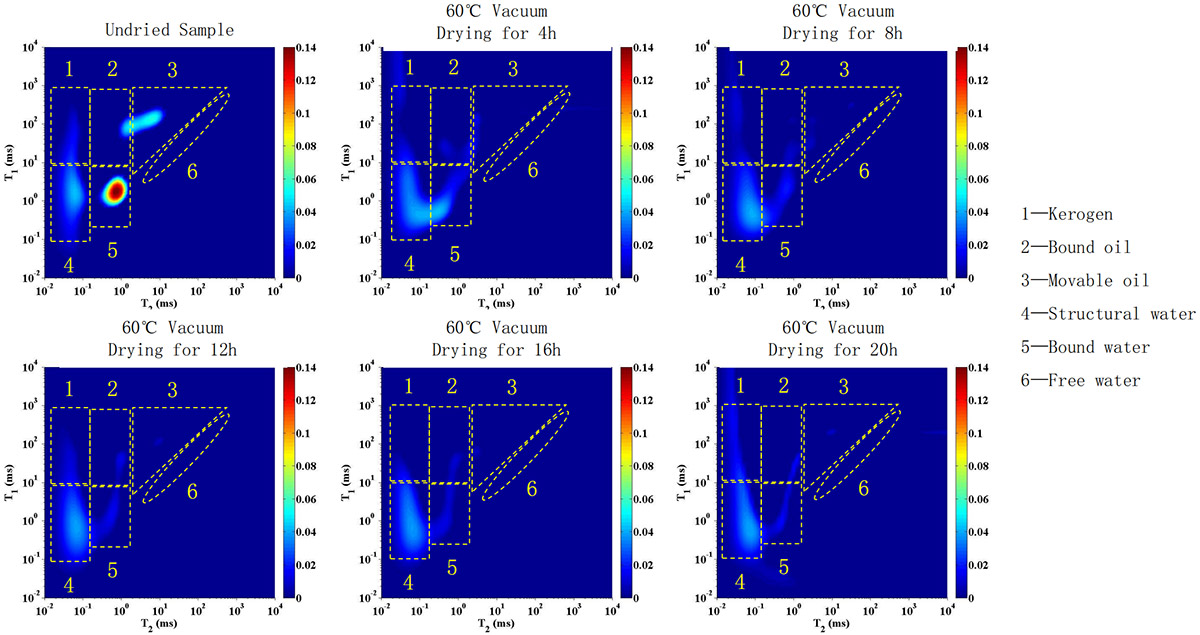
The pore structure of continental shale reservoirs is complex and diverse, exhibiting multi-scale pore size distributions spanning from nanometers to micrometers. In particular, accurate porosity measurement has remained a major challenge in shale reservoir characterization. To achieve accurate porosity determination for continental shale, this study takes the Gulong shale as a case example. Based on the fluid occupancy characteristics of shale pores, the pore space is classified into three types: gas-occupied, water-occupied, and oil-occupied pores. The volumes of these three pore types are measured experimentally via kerosene saturation, ethanol extraction, and solvent washing, respectively, thereby establishing a method for measuring the total porosity of continental shale reservoirs---termed the fluid summation method. The results demonstrate that the micro- to nano-scale pores of Gulong shale exhibit strong imbibition of kerosene, enabling kerosene to serve as an effective saturating fluid for characterizing the gas-occupied pore volume; the free water and clay-bound water in shale can be fully extracted by soaking the crushed sample (particle size: 2--5~mm) in absolute ethanol; and dichloromethane, characterized by strong polarity and a low boiling point, proves to be an effective oil-washing reagent. Validation confirms that the fluid summation method yields accurate porosity measurements for fresh cores of Gulong shale. The successful application of this method provides a reliable basis for the accurate determination of reserve parameters of continental shale oil and gas reservoirs in China, as well as for understanding pore evolution mechanisms and optimizing the identification of sweet spots and sweet intervals.
Graphical Abstract
Keywords
Data Availability Statement
Funding
Conflicts of Interest
AI Use Statement
Ethical Approval and Consent to Participate
References
- Yang, F., Ning, Z. F., Hu, C. P., Wang, B., Peng, K., & Liu, H. Q. (2013). Characterization of microscopic pore structures in shale reservoirs. Acta Petrolei Sinica, 34(02), 301-311.
[CrossRef] [Google Scholar] - Ma, B., Hu, Q., Yang, S., Yin, N., Qiao, H., Zhang, T., & Meng, M. (2020). Multiple approaches to quantifying the effective porosity of lacustrine shale oil reservoirs in Bohai Bay Basin, East China. Geofluids, 2020(1), 8856620.
[CrossRef] [Google Scholar] - Fu, Y., Jiang, Y., Chen, H., Zhou, K., Qiu, X., Zhang, H., Liu, X., Gu, Y., & Jiang, Z. (2020). Analysis and enlightenment of porosity differences between shale plug samples and crushed samples. Petroleum Geology & Experiment, 42(2), 302-310.
[CrossRef] [Google Scholar] - Zhang, A. D., Wang, J. P., Wang, Y. C., ... & Tan, W. (2021). Reservoir space types and oil occurrence of Gulong shale in Songliao Basin. Petroleum Geology & Oilfield Development in Daqing, 40(05), 68-77. https://dqske.cbpt.cnki.net/WKD/WebPublication/paperDigest.aspx?paperID=913f37c2-3d44-4e3a-83bd-8be8abf206c3
[Google Scholar] - Zhao, X., Liu, B., Guo, R. T., & ... (2017). Progress in reservoir characterization technology and its application. Petroleum Geology & Experiment, 39(02), 287-294. http://dx.doi.org/10.11781/sysydz201702287
[Google Scholar] - Yuan, Y., & Rezaee, R. (2019). Comparative porosity and pore structure assessment in shales: Measurement techniques, influencing factors and implications for reservoir characterization. Energies, 12(11), 2094.
[CrossRef] [Google Scholar] - Fu, Y., Jiang, Y., CHEN, H., XIA, G., ZHOU, K., WANG, J., ... & GU, Y. (2020). Optimization of GRI porosity determination method for marine shale. Natural Gas Industry, 40(10), 20-28. https://www.sciengine.com/NGI/doi/10.3787/j.issn.1000-0976.2020.10.003
[Google Scholar] - Wang, Y. H., Liang, J. P., Zhang, J. Y., ... & Xia, D. (2020). Resource potential and exploration direction of Gulong shale oil in Songliao Basin. Petroleum Geology & Oilfield Development in Daqing, 39(03), 20-34. https://dqske.cbpt.cnki.net/WKD/WebPublication/paperDigest.aspx?paperID=45e2ab0f-b0bf-4e63-948a-04047d3699de
[Google Scholar] - Shao, H. M., Gao, B., Pan, H. F., ... & Li, L. (2021). Diagenesis-pore evolution of Gulong shale in Songliao Basin. Petroleum Geology & Oilfield Development in Daqing, 40(05), 56-67. https://dqske.cbpt.cnki.net/WKD/WebPublication/paperDigest.aspx?paperID=f3a05a21-4230-48b7-8153-f0df232e8cd8
[Google Scholar] - Sun, L. D(2020).Gulong Shale Oil(Preface). Petroleum Geology & Oilfield Development in Daqing, 39(03), 1-7. https://dqsk.cbpt.cnki.net/WKD2/WebPublication/paperDigest.aspx?paperID=8a81ef12-440f-4efa-81a2-2273579778c3
[Google Scholar] - Li, J., Wang, S., Lu, S., Zhang, P., Cai, J., Zhao, J., & Li, W. (2019). Microdistribution and mobility of water in gas shale: A theoretical and experimental study. Marine and Petroleum Geology, 102, 496-507.
[CrossRef] [Google Scholar] - Liang, L., Luo, D., Liu, X., & Xiong, J. (2016). Experimental study on the wettability and adsorption characteristics of Longmaxi Formation shale in the Sichuan Basin, China. Journal of Natural Gas Science and Engineering, 33, 1107-1118.
[CrossRef] [Google Scholar] - Kang, Y., Liu, K. Q., Zhu, R. K., Yin, G. G., Zhang, J. Y., & Zhang, S. R. (2024). The evolution of clay mineral and its indication of hydrocarbons under overpressure: An example from the shale of the Qingshankou formation in the Gulong Sag. Petroleum Science, 21(6), 3867-3883.
[CrossRef] [Google Scholar] - Yan, W. L., Zhang, Z. Q., Chen, L. C., ... & Wang, W. (2021). New evaluating method of oil saturation in Gulong shale based on NMR technique. Petroleum Geology & Oilfield Development in Daqing, 40(05), 78-86. https://dqske.cbpt.cnki.net/WKD/WebPublication/paperDigest.aspx?paperID=68de8ad8-a37c-4d03-bbc3-9ada1fdd14b6
[Google Scholar] - Bi, X., Li, J., & Lian, C. (2024). A comprehensive logging evaluation method for identifying high-quality shale gas reservoirs based on multifractal spectra analysis. Scientific Reports, 14(1), 26107.
[CrossRef] [Google Scholar] - Hazra, B., Dutta, S., & Kumar, S. (2017). TOC calculation of organic matter rich sediments using Rock-Eval pyrolysis: Critical consideration and insights. International Journal of Coal Geology, 169, 106-115.
[CrossRef] [Google Scholar] - Fu, Q., Hu, Z., Qin, T., Feng, D., Yang, B., Zhu, Z., & Xing, L. (2023). Diagenesis and Pore Formation Evolution of Continental Shale in the Da’anzhai Lower Jurassic Section in the Sichuan Basin. Minerals, 13(4), 535.
[CrossRef] [Google Scholar] - Chen, S., Han, Y., Fu, C., Zhu, Y., & Zuo, Z. (2016). Micro and nano-size pores of clay minerals in shale reservoirs: Implication for the accumulation of shale gas. Sedimentary geology, 342, 180-190.
[CrossRef] [Google Scholar] - Okon, A. N., Adewole, S. E., & Uguma, E. M. (2021). Artificial neural network model for reservoir petrophysical properties: porosity, permeability and water saturation prediction. Modeling Earth Systems and Environment, 7(4), 2373-2390.
[CrossRef] [Google Scholar] - Chen, L., Lin, W., Chen, P., Jiang, S., Liu, L., & Hu, H. (2021). Porosity prediction from well logs using back propagation neural network optimized by genetic algorithm in one heterogeneous oil reservoirs of Ordos Basin, China. Journal of Earth Science, 32(4), 828-838.
[CrossRef] [Google Scholar] - Sun, L., Liu, H., He, W., Li, G., Zhu, R., Jin, X., & Meng, S. G. (2021). An analysis of major scientific problems and research paths of Gulong shale oil in Daqing Oilfield, NE China. Petroleum Exploration and Development, 48(3), 527-540.
[CrossRef] [Google Scholar] - Meng, Q. A., Lin, T. F., Zhang, J. Y., ... & Cheng, X. (2022). In-situ accumulation process and reservoir characteristics of shale oil: A case study of Gulong shale oil in Songliao Basin. Petroleum Geology & Oilfield Development in Daqing, 41(3), 24-37. https://dqsk.cbpt.cnki.net/WKD2/WebPublication/paperDigest.aspx?paperID=6f6c8354-647f-4977-b39b-4065eea38e6b
[Google Scholar] - Zhao, G., Cheng, L., Jia, P., Liu, Y., Feng, H., Kuang, T., & Wang, Q. (2024). Initial occurrence state and movability evaluation of the gulong shale oil reservoir, Songliao basin. Energies, 17(6), 1358.
[CrossRef] [Google Scholar] - Sun, L., Jia, C., Zhang, J., Cui, B., Bai, J., Huo, Q., ... & Liu, W. (2024). Resource potential of Gulong shale oil in the key areas of Songliao Basin. Acta Petrolei Sinica, 45(12), 1699. https://www.syxb-cps.com.cn/EN/Y2024/V45/I12/1699
[Google Scholar]
Cite This Article
TY  - JOUR
AU  - Zhang, Ke
AU  - Gao, Yanfeng
AU  - Chen, Siqi
AU  - Tan, Zhiwei
AU  - Wu, Xiaopeng
AU  - Wang, Wentao
AU  - Tian, Yuxin
AU  - Su, Yong
AU  - Liu, Shichao
AU  - Wang, Haiyong
PY  - 2026
DA  - 2026/07/20
TI  - Determination of Reserve Parameters of Gulong Shale Oil Reservoir and Its Geological Significance
JO  - Reservoir Science
T2  - Reservoir Science
JF  - Reservoir Science
VL  - 2
IS  - 4
SP  - 276
EP  - 288
DO  - 10.62762/RS.2026.864544
UR  - https://www.icck.org/article/abs/RS.2026.864544
KW  - Gulong shale oil
KW  - total porosity
KW  - fluid addition method
KW  - reserve parameters
KW  - continental shale reservoir
AB  - The pore structure of continental shale reservoirs is complex and diverse, exhibiting multi-scale pore size distributions spanning from nanometers to micrometers. In particular, accurate porosity measurement has remained a major challenge in shale reservoir characterization. To achieve accurate porosity determination for continental shale, this study takes the Gulong shale as a case example. Based on the fluid occupancy characteristics of shale pores, the pore space is classified into three types: gas-occupied, water-occupied, and oil-occupied pores. The volumes of these three pore types are measured experimentally via kerosene saturation, ethanol extraction, and solvent washing, respectively, thereby establishing a method for measuring the total porosity of continental shale reservoirs---termed the fluid summation method. The results demonstrate that the micro- to nano-scale pores of Gulong shale exhibit strong imbibition of kerosene, enabling kerosene to serve as an effective saturating fluid for characterizing the gas-occupied pore volume; the free water and clay-bound water in shale can be fully extracted by soaking the crushed sample (particle size: 2--5~mm) in absolute ethanol; and dichloromethane, characterized by strong polarity and a low boiling point, proves to be an effective oil-washing reagent. Validation confirms that the fluid summation method yields accurate porosity measurements for fresh cores of Gulong shale. The successful application of this method provides a reliable basis for the accurate determination of reserve parameters of continental shale oil and gas reservoirs in China, as well as for understanding pore evolution mechanisms and optimizing the identification of sweet spots and sweet intervals.
SN  - 3070-2356
PB  - Institute of Central Computation and Knowledge
LA  - English
ER  -
@article{Zhang2026Determinat,
  author = {Ke Zhang and Yanfeng Gao and Siqi Chen and Zhiwei Tan and Xiaopeng Wu and Wentao Wang and Yuxin Tian and Yong Su and Shichao Liu and Haiyong Wang},
  title = {Determination of Reserve Parameters of Gulong Shale Oil Reservoir and Its Geological Significance},
  journal = {Reservoir Science},
  year = {2026},
  volume = {2},
  number = {4},
  pages = {276-288},
  doi = {10.62762/RS.2026.864544},
  url = {https://www.icck.org/article/abs/RS.2026.864544},
  abstract = {The pore structure of continental shale reservoirs is complex and diverse, exhibiting multi-scale pore size distributions spanning from nanometers to micrometers. In particular, accurate porosity measurement has remained a major challenge in shale reservoir characterization. To achieve accurate porosity determination for continental shale, this study takes the Gulong shale as a case example. Based on the fluid occupancy characteristics of shale pores, the pore space is classified into three types: gas-occupied, water-occupied, and oil-occupied pores. The volumes of these three pore types are measured experimentally via kerosene saturation, ethanol extraction, and solvent washing, respectively, thereby establishing a method for measuring the total porosity of continental shale reservoirs---termed the fluid summation method. The results demonstrate that the micro- to nano-scale pores of Gulong shale exhibit strong imbibition of kerosene, enabling kerosene to serve as an effective saturating fluid for characterizing the gas-occupied pore volume; the free water and clay-bound water in shale can be fully extracted by soaking the crushed sample (particle size: 2--5~mm) in absolute ethanol; and dichloromethane, characterized by strong polarity and a low boiling point, proves to be an effective oil-washing reagent. Validation confirms that the fluid summation method yields accurate porosity measurements for fresh cores of Gulong shale. The successful application of this method provides a reliable basis for the accurate determination of reserve parameters of continental shale oil and gas reservoirs in China, as well as for understanding pore evolution mechanisms and optimizing the identification of sweet spots and sweet intervals.},
  keywords = {Gulong shale oil, total porosity, fluid addition method, reserve parameters, continental shale reservoir},
  issn = {3070-2356},
  publisher = {Institute of Central Computation and Knowledge}
}
Article Metrics
Publisher's Note
ICCK stays neutral with regard to jurisdictional claims in published maps and institutional affiliations.
Rights and Permissions
 Copyright © 2026 by the Author(s). Published by Institute of Central Computation and Knowledge. This article is an open access article distributed under the terms and conditions of the Creative Commons Attribution (CC BY) license (https://creativecommons.org/licenses/by/4.0/), which permits use, sharing, adaptation, distribution and reproduction in any medium or format, as long as you give appropriate credit to the original author(s) and the source, provide a link to the Creative Commons licence, and indicate if changes were made.

