A Digital-Twin-Driven Cyber–Physical Framework for Real-Time Energy Management and Secure Operation of Renewable Energy Systems




Article Information
Abstract
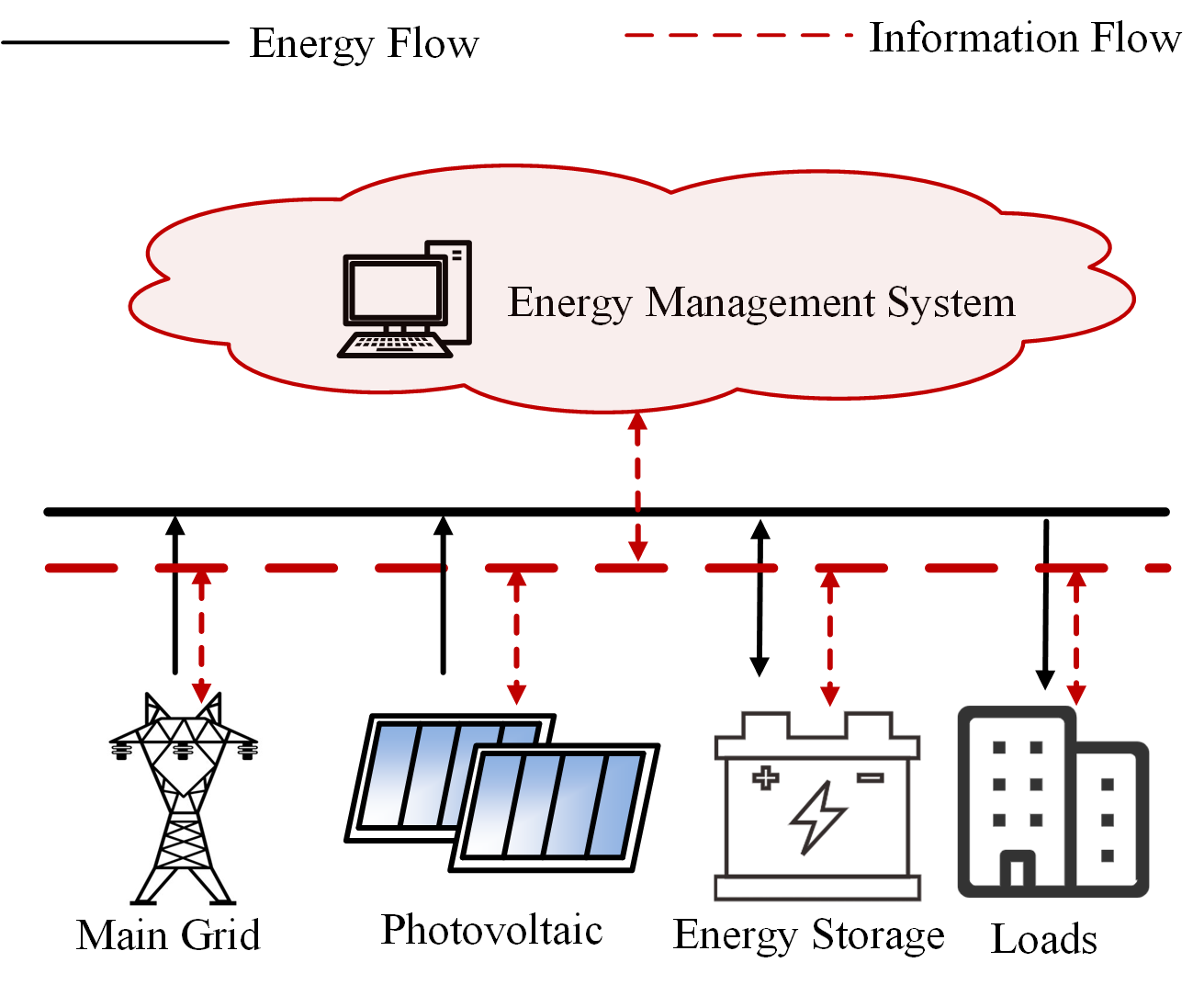
Real-time optimal operation and control acts as the intelligent core of renewable energy systems, yet intermittent generation and time-varying loads introduce uncertainties that hinder secure and efficient operation. To address this issue, this paper proposes a digital-twin-driven cyber–physical framework for real-time energy management and secure operation, enabling tight synchronization and closed-loop interaction between physical assets and their digital counterparts. A simplified multi-source data fusion Transformer is developed to improve forecasting accuracy by continuously integrating historical power data and key environmental factors (e.g., temperature, wind speed, and solar radiation). Based on the twin-enabled predictive information and state feedback, a Transformer–Adaptive Dynamic Programming (TM-ADP) method is further proposed for real-time optimal scheduling of grid-connected renewable energy systems. In addition, a YOLOv8-based multi-target detection module is incorporated to enhance operational safety through intelligent visual monitoring of photovoltaic panels. Experiments on a digital twin platform validate that the proposed framework improves operational efficiency, reliability, and safety under uncertain operating conditions.
Graphical Abstract
Keywords
Data Availability Statement
Funding
Conflicts of Interest
AI Use Statement
Ethical Approval and Consent to Participate
References
- Ahmad, S., Shafiullah, M., Ahmed, C. B., & Alowaifeer, M. (2023). A review of microgrid energy management and control strategies. IEEE Access, 11, 21729-21757.
[CrossRef] [Google Scholar] - Guo, C., Wang, X., Zheng, Y., & Zhang, F. (2022). Real-time optimal energy management of microgrid with uncertainties based on deep reinforcement learning. Energy, 238, 121873.
[CrossRef] [Google Scholar] - Chen, R., Fang, Z., Yuan, J., Zhou, J., Liu, Q., Zeng, X., & Li, J. (2026). A smooth distributed and multi-objective ADP-based power system optimal operation control method. Sustainable Energy Technologies and Assessments, 87, 104903.
[CrossRef] [Google Scholar] - Fan, X., & Li, Y. (2023). Energy management of renewable based power grids using artificial intelligence: Digital twin of renewables. Solar Energy, 262, 111867.
[CrossRef] [Google Scholar] - Shen, Z., Xu, W., Li, W., Shi, Y., & Gao, F. (2023). Digital twin application for attach detection and mitigation of PV-based smart systems using fast and accurate hybrid machine learning algorithm. Solar Energy, 250, 377-387.
[CrossRef] [Google Scholar] - Zhang, Y., Liu, L., Yuan, F., Zhai, H., & Song, C. (2023). Multifactor and multiscale method for power load forecasting. Knowledge-Based Systems, 268, 110476.
[CrossRef] [Google Scholar] - Zhi, Y., Sun, T., & Yang, X. (2023). A physical model with meteorological forecasting for hourly rooftop photovoltaic power prediction. Journal of Building Engineering, 75, 106997.
[CrossRef] [Google Scholar] - Xie, H., Yuan, B., Hu, C., Gao, Y., Wang, F., Wang, C., ... & Chu, P. (2024). ST-YOLO: A defect detection method for photovoltaic modules based on infrared thermal imaging and machine vision technology. PloS one, 19(12), e0310742.
[CrossRef] [Google Scholar] - Majeed, M. A., Phichaisawat, S., Asghar, F., & Hussan, U. (2023). Optimal energy management system for grid-tied microgrid: An improved adaptive genetic algorithm. IEEE Access, 11, 117351-117361.
[CrossRef] [Google Scholar] - Zhao, Z., Guo, J., Luo, X., Lai, C. S., Yang, P., Lai, L. L., ... & Shahidehpour, M. (2022). Distributed robust model predictive control-based energy management strategy for islanded multi-microgrids considering uncertainty. IEEE transactions on smart grid, 13(3), 2107-2120.
[CrossRef] [Google Scholar] - Zhang, C., Zhou, Q., Shuai, B., Williams, H., Li, Y., Hua, L., & Xu, H. (2022). Dedicated adaptive particle swarm optimization algorithm for digital twin based control optimization of the plug-in hybrid vehicle. IEEE Transactions on Transportation Electrification, 9(2), 3137-3148.
[CrossRef] [Google Scholar] - Lin, Z., Song, C., Zhao, J., & Yin, H. (2022). Improved approximate dynamic programming for real-time economic dispatch of integrated microgrids. Energy, 255, 124513.
[CrossRef] [Google Scholar] - Ye, Y., Wang, H., Chen, P., Tang, Y., & Strbac, G. (2023). Safe deep reinforcement learning for microgrid energy management in distribution networks with leveraged spatial–temporal perception. IEEE Transactions on Smart Grid, 14(5), 3759-3775.
[CrossRef] [Google Scholar]
Cite This Article
TY  - JOUR
AU  - Yuan, Jun
AU  - Fang, Zhizhao
AU  - Chen, Rongjun
AU  - Zhou, Jiayu
AU  - Liu, Qun
AU  - Zeng, Xianxian
AU  - Li, Jiawen
AU  - Ren, Jinchang
AU  - Zhao, Huimin
AU  - Yang, Wen
PY  - 2026
DA  - 2026/09/29
TI  - A Digital-Twin-Driven Cyber–Physical Framework for Real-Time Energy Management and Secure Operation of Renewable Energy Systems
JO  - Chinese Journal of Information Fusion
T2  - Chinese Journal of Information Fusion
JF  - Chinese Journal of Information Fusion
VL  - 3
IS  - 3
SP  - 226
EP  - 237
DO  - 10.62762/CJIF.2025.690291
UR  - https://www.icck.org/article/abs/CJIF.2025.690291
KW  - digital twins
KW  - cyber–physical fusion prediction
KW  - real-time management
KW  - secure operation
AB  - Real-time optimal operation and control acts as the intelligent core of renewable energy systems, yet intermittent generation and time-varying loads introduce uncertainties that hinder secure and efficient operation. To address this issue, this paper proposes a digital-twin-driven cyber–physical framework for real-time energy management and secure operation, enabling tight synchronization and closed-loop interaction between physical assets and their digital counterparts. A simplified multi-source data fusion Transformer is developed to improve forecasting accuracy by continuously integrating historical power data and key environmental factors (e.g., temperature, wind speed, and solar radiation). Based on the twin-enabled predictive information and state feedback, a Transformer–Adaptive Dynamic Programming (TM-ADP) method is further proposed for real-time optimal scheduling of grid-connected renewable energy systems. In addition, a YOLOv8-based multi-target detection module is incorporated to enhance operational safety through intelligent visual monitoring of photovoltaic panels. Experiments on a digital twin platform validate that the proposed framework improves operational efficiency, reliability, and safety under uncertain operating conditions.
SN  - 2998-3371
PB  - Institute of Central Computation and Knowledge
LA  - English
ER  -
@article{Yuan2026A,
  author = {Jun Yuan and Zhizhao Fang and Rongjun Chen and Jiayu Zhou and Qun Liu and Xianxian Zeng and Jiawen Li and Jinchang Ren and Huimin Zhao and Wen Yang},
  title = {A Digital-Twin-Driven Cyber–Physical Framework for Real-Time Energy Management and Secure Operation of Renewable Energy Systems},
  journal = {Chinese Journal of Information Fusion},
  year = {2026},
  volume = {3},
  number = {3},
  pages = {226-237},
  doi = {10.62762/CJIF.2025.690291},
  url = {https://www.icck.org/article/abs/CJIF.2025.690291},
  abstract = {Real-time optimal operation and control acts as the intelligent core of renewable energy systems, yet intermittent generation and time-varying loads introduce uncertainties that hinder secure and efficient operation. To address this issue, this paper proposes a digital-twin-driven cyber–physical framework for real-time energy management and secure operation, enabling tight synchronization and closed-loop interaction between physical assets and their digital counterparts. A simplified multi-source data fusion Transformer is developed to improve forecasting accuracy by continuously integrating historical power data and key environmental factors (e.g., temperature, wind speed, and solar radiation). Based on the twin-enabled predictive information and state feedback, a Transformer–Adaptive Dynamic Programming (TM-ADP) method is further proposed for real-time optimal scheduling of grid-connected renewable energy systems. In addition, a YOLOv8-based multi-target detection module is incorporated to enhance operational safety through intelligent visual monitoring of photovoltaic panels. Experiments on a digital twin platform validate that the proposed framework improves operational efficiency, reliability, and safety under uncertain operating conditions.},
  keywords = {digital twins, cyber–physical fusion prediction, real-time management, secure operation},
  issn = {2998-3371},
  publisher = {Institute of Central Computation and Knowledge}
}
Article Metrics
Publisher's Note
ICCK stays neutral with regard to jurisdictional claims in published maps and institutional affiliations.
Rights and Permissions
 Copyright © 2026 by the Author(s). Published by Institute of Central Computation and Knowledge. This article is an open access article distributed under the terms and conditions of the Creative Commons Attribution (CC BY) license (https://creativecommons.org/licenses/by/4.0/), which permits use, sharing, adaptation, distribution and reproduction in any medium or format, as long as you give appropriate credit to the original author(s) and the source, provide a link to the Creative Commons licence, and indicate if changes were made.


Portico