Lightweight SAR Ship Detection Network Based on Adaptive Spatial Feature Fusion and Channel Attention



Article Information
Abstract
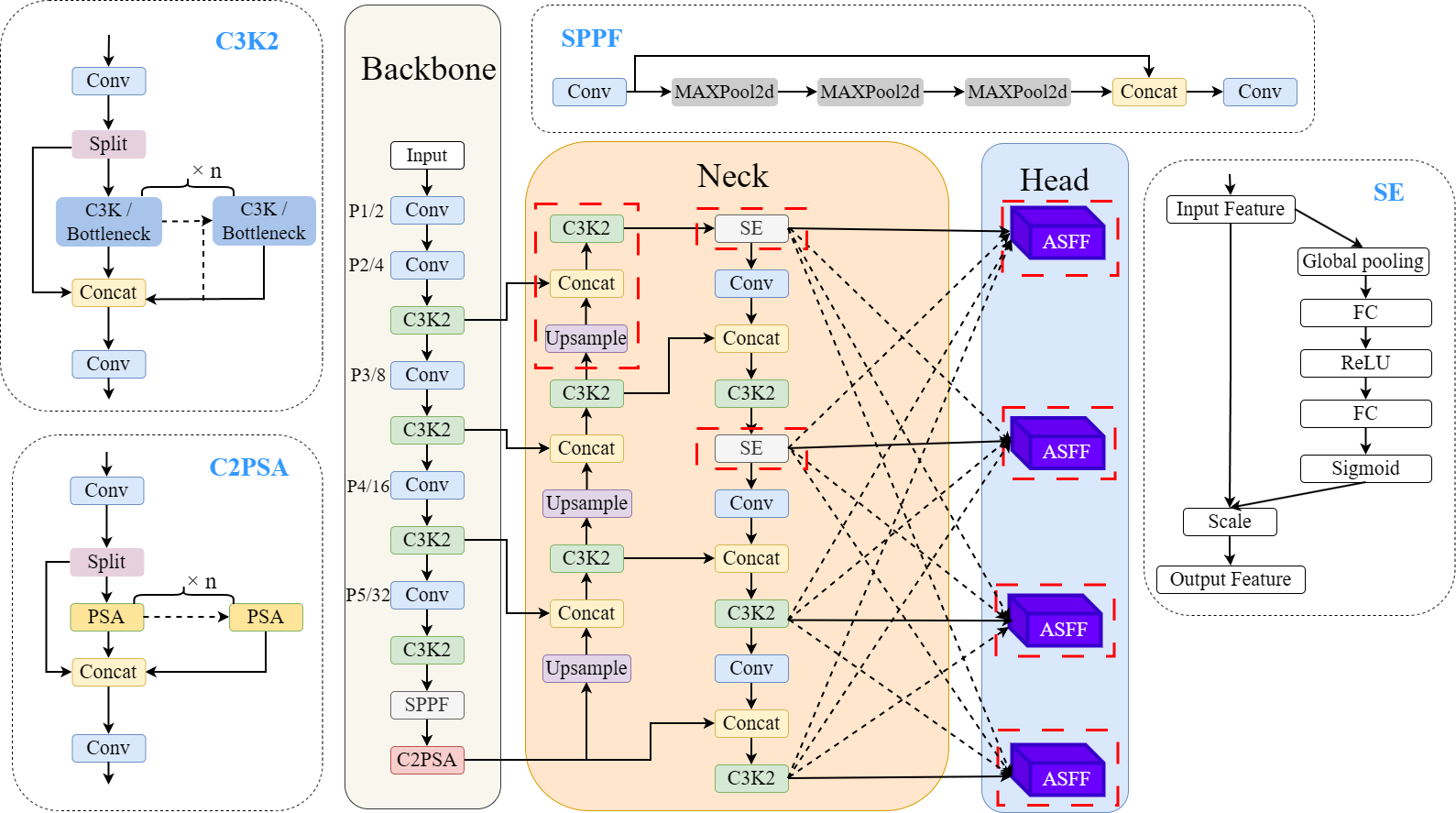
Ship detection in Synthetic Aperture Radar (SAR) images remains challenging due to coherent speckle noise, complex inshore clutter, and large variations in target scale, especially for tiny ships. To address these issues, this paper proposes a lightweight SAR ship detection network based on YOLOv11n. The proposed model introduces a high-resolution P2 detection branch to preserve fine spatial details that may be weakened during repeated downsampling. To improve multi-scale feature representation, a Four-Head Adaptive Spatial Feature Fusion (FASFF) structure is adopted to adaptively combine features from P2, P3, P4, and P5. In addition, the Squeeze-and-Excitation (SE) attention module is inserted into the high-resolution branches of the Neck to recalibrate channel responses and suppress clutter-dominant features during feature aggregation. Experiments on a fixed subset of the SAR-Ship-Dataset show that the proposed YOLOv11n-SE-FASFF model improves Recall and mAP50-95 compared with the YOLOv11n baseline. Specifically, Recall increases from 0.898 to 0.926, and mAP50-95 increases from 0.614 to 0.632. The model contains 3.01 M parameters and achieves an inference speed of 196 FPS with 640 × 640 input images on an NVIDIA GeForce RTX 5060Ti GPU. Additional cross-dataset evaluation on SSDD and HRSID without fine-tuning further suggests that the proposed model has a certain degree of transferability under different SAR data conditions.
Graphical Abstract
Keywords
Data Availability Statement
Funding
Conflicts of Interest
AI Use Statement
Ethical Approval and Consent to Participate
References
- Moreira, A., Prats-Iraola, P., Younis, M., Krieger, G., Hajnsek, I., & Papathanassiou, K. P. (2013). A tutorial on synthetic aperture radar. IEEE Geoscience and remote sensing magazine, 1(1), 6-43.
[CrossRef] [Google Scholar] - Leng, X., Ji, K., Yang, K., & Zou, H. (2015). A bilateral CFAR algorithm for ship detection in SAR images. IEEE Geoscience and Remote Sensing Letters, 12(7), 1536-1540.
[CrossRef] [Google Scholar] - Rohling, H. (1983). Radar CFAR thresholding in clutter and multiple target situations. IEEE transactions on aerospace and electronic systems, (4), 608-621.
[CrossRef] [Google Scholar] - Gandhi, P. P., & Kassam, S. A. (1988). Analysis of CFAR processors in nonhomogeneous background. IEEE Transactions on Aerospace and Electronic systems, 24(4), 427-445.
[CrossRef] [Google Scholar] - Ward, K. D., Watts, S., & Tough, R. J. (2006). Sea clutter: scattering, the K distribution and radar performance (Vol. 20). IET.
[CrossRef] [Google Scholar] - Ren, S., He, K., Girshick, R., & Sun, J. (2015). Faster R-CNN: Towards real-time object detection with region proposal networks. In Advances in Neural Information Processing Systems, 28, (pp. 91–99).
[Google Scholar] - Liu, W., Anguelov, D., Erhan, D., Szegedy, C., Reed, S., Fu, C. Y., & Berg, A. C. (2016, September). Ssd: Single shot multibox detector. In European conference on computer vision (pp. 21-37). Cham: Springer International Publishing.
[CrossRef] [Google Scholar] - Lin, T. Y., Goyal, P., Girshick, R., He, K., & Dollár, P. (2018). Focal Loss for Dense Object Detection. IEEE Transactions on Pattern Analysis and Machine Intelligence, 42(2), 318-327.
[CrossRef] [Google Scholar] - Redmon, J. (2018). Yolov3: An incremental improvement. arXiv preprint arXiv:1804.02767.
[CrossRef] [Google Scholar] - Bochkovskiy, A., Wang, C. Y., & Liao, H. Y. M. (2020). Yolov4: Optimal speed and accuracy of object detection. arXiv preprint arXiv:2004.10934.
[CrossRef] [Google Scholar] - Wang, C. Y., Bochkovskiy, A., & Liao, H. Y. M. (2023, June). YOLOv7: Trainable Bag-of-Freebies Sets New State-of-the-Art for Real-Time Object Detectors. In 2023 IEEE/CVF Conference on Computer Vision and Pattern Recognition (CVPR) (pp. 7464-7475). IEEE.
[CrossRef] [Google Scholar] - Zhang, T., Zhang, X., Li, J., Xu, X., Wang, B., Zhan, X., ... & Wei, S. (2021). SAR ship detection dataset (SSDD): Official release and comprehensive data analysis. Remote Sensing, 13(18), 3690.
[CrossRef] [Google Scholar] - Terven, J., Córdova-Esparza, D. M., & Romero-González, J. A. (2023). A comprehensive review of yolo architectures in computer vision: From yolov1 to yolov8 and yolo-nas. Machine learning and knowledge extraction, 5(4), 1680-1716.
[CrossRef] [Google Scholar] - Wang, A., Chen, H., Liu, L., Chen, K., Lin, Z., Han, J., & Ding, G. (2024). Yolov10: Real-time end-to-end object detection. Advances in neural information processing systems, 37, 107984-108011.
[Google Scholar] - Liu, S., Huang, D., & Wang, Y. (2019). Learning spatial fusion for single-shot object detection. arXiv preprint arXiv:1911.09516.
[CrossRef] [Google Scholar] - Hu, J., Shen, L., Albanie, S., Sun, G., & Wu, E. (2019). Squeeze-and-Excitation Networks. IEEE Transactions on Pattern Analysis and Machine Intelligence, 42(8), 2011-2023.
[CrossRef] [Google Scholar] - Lin, T. Y., Dollár, P., Girshick, R., He, K., Hariharan, B., & Belongie, S. (2017, July). Feature Pyramid Networks for Object Detection. In 2017 IEEE Conference on Computer Vision and Pattern Recognition (CVPR) (pp. 936-944). IEEE.
[CrossRef] [Google Scholar] - Liu, S., Qi, L., Qin, H., Shi, J., & Jia, J. (2018, June). Path Aggregation Network for Instance Segmentation. In 2018 IEEE/CVF Conference on Computer Vision and Pattern Recognition (pp. 8759-8768). IEEE.
[CrossRef] [Google Scholar] - Cui, Z., Li, Q., Cao, Z., & Liu, N. (2019). Dense attention pyramid networks for multi-scale ship detection in SAR images. IEEE Transactions on Geoscience and Remote Sensing, 57(11), 8983-8997.
[CrossRef] [Google Scholar] - Tang, L., Tang, W., Qu, X., Han, Y., Wang, W., & Zhao, B. (2022). A scale-aware pyramid network for multi-scale object detection in SAR images. Remote Sensing, 14(4), 973.
[CrossRef] [Google Scholar] - Zhou, K., Zhang, M., Wang, H., & Tan, J. (2022). Ship detection in SAR images based on multi-scale feature extraction and adaptive feature fusion. Remote Sensing, 14(3), 755.
[CrossRef] [Google Scholar] - Huang, Y. X., Liu, H. I., Shuai, H. H., & Cheng, W. H. (2024, September). Dq-detr: Detr with dynamic query for tiny object detection. In European Conference on Computer Vision (pp. 290-305). Cham: Springer Nature Switzerland.
[CrossRef] [Google Scholar] - Li, Z., An, W., Guo, G., Wang, L., Wang, Y., & Lin, Z. (2025). SpecDETR: A transformer-based hyperspectral point object detection network. ISPRS Journal of Photogrammetry and Remote Sensing, 226, 221-246.
[CrossRef] [Google Scholar] - Wang, S., Xia, C., Lv, F., & Shi, Y. (2025, February). RT-DETRv3: Real-Time End-to-End Object Detection with Hierarchical Dense Positive Supervision. In 2025 IEEE/CVF Winter Conference on Applications of Computer Vision (WACV) (pp. 1628-1636). IEEE.
[CrossRef] [Google Scholar] - Huang, S. Q., Liu, D. Z., Gao, G. Q., & Guo, X. J. (2009). A novel method for speckle noise reduction and ship target detection in SAR images. Pattern Recognition, 42(7), 1533-1542.
[CrossRef] [Google Scholar] - Chen, S. W., Cui, X. C., Wang, X. S., & Xiao, S. P. (2021). Speckle-free SAR image ship detection. IEEE Transactions on Image Processing, 30, 5969-5983.
[CrossRef] [Google Scholar] - Xiao, C., An, W., Zhang, Y., Su, Z., Li, M., Sheng, W., ... & Liu, L. (2024). Highly efficient and unsupervised framework for moving object detection in satellite videos. IEEE Transactions on Pattern Analysis and Machine Intelligence, 46(12), 11532-11539.
[CrossRef] [Google Scholar] - Zhou, J., Xiao, C., Peng, B., Liu, T., Liu, Z., Liu, Y., & Liu, L. (2025). MaDiNet: Mamba diffusion network for SAR target detection. IEEE Transactions on Circuits and Systems for Video Technology, 35(11), 10787–10800.
[CrossRef] [Google Scholar] - Wang, Y., Wang, C., Zhang, H., Dong, Y., & Wei, S. (2019). A SAR dataset of ship detection for deep learning under complex backgrounds. Remote Sensing, 11(7), 765.
[CrossRef] [Google Scholar] - Wei, S., Zeng, X., Qu, Q., Wang, M., Su, H., & Shi, J. (2020). HRSID: A high-resolution SAR images dataset for ship detection and instance segmentation. IEEE Access, 8, 120234–120254.
[CrossRef] [Google Scholar]
Cite This Article
TY  - JOUR
AU  - Zhang, Chi
AU  - Zhao, Shuyi
AU  - Ma, Jun
AU  - Ren, Xunhuan
AU  - Tsviatkou, Viktar Yurevich
PY  - 2026
DA  - 2026/06/13
TI  - Lightweight SAR Ship Detection Network Based on Adaptive Spatial Feature Fusion and Channel Attention
JO  - Chinese Journal of Information Fusion
T2  - Chinese Journal of Information Fusion
JF  - Chinese Journal of Information Fusion
VL  - 3
IS  - 2
SP  - 138
EP  - 152
DO  - 10.62762/CJIF.2025.982112
UR  - https://www.icck.org/article/abs/CJIF.2025.982112
KW  - SAR ship detection
KW  - YOLOv11
KW  - small target detection
AB  - Ship detection in Synthetic Aperture Radar (SAR) images remains challenging due to coherent speckle noise, complex inshore clutter, and large variations in target scale, especially for tiny ships. To address these issues, this paper proposes a lightweight SAR ship detection network based on YOLOv11n. The proposed model introduces a high-resolution P2 detection branch to preserve fine spatial details that may be weakened during repeated downsampling. To improve multi-scale feature representation, a Four-Head Adaptive Spatial Feature Fusion (FASFF) structure is adopted to adaptively combine features from P2, P3, P4, and P5. In addition, the Squeeze-and-Excitation (SE) attention module is inserted into the high-resolution branches of the Neck to recalibrate channel responses and suppress clutter-dominant features during feature aggregation. Experiments on a fixed subset of the SAR-Ship-Dataset show that the proposed YOLOv11n-SE-FASFF model improves Recall and mAP50-95 compared with the YOLOv11n baseline. Specifically, Recall increases from 0.898 to 0.926, and mAP50-95 increases from 0.614 to 0.632. The model contains 3.01 M parameters and achieves an inference speed of 196 FPS with 640 × 640 input images on an NVIDIA GeForce RTX 5060Ti GPU. Additional cross-dataset evaluation on SSDD and HRSID without fine-tuning further suggests that the proposed model has a certain degree of transferability under different SAR data conditions.
SN  - 2998-3371
PB  - Institute of Central Computation and Knowledge
LA  - English
ER  -
@article{Zhang2026Lightweigh,
  author = {Chi Zhang and Shuyi Zhao and Jun Ma and Xunhuan Ren and Viktar Yurevich Tsviatkou},
  title = {Lightweight SAR Ship Detection Network Based on Adaptive Spatial Feature Fusion and Channel Attention},
  journal = {Chinese Journal of Information Fusion},
  year = {2026},
  volume = {3},
  number = {2},
  pages = {138-152},
  doi = {10.62762/CJIF.2025.982112},
  url = {https://www.icck.org/article/abs/CJIF.2025.982112},
  abstract = {Ship detection in Synthetic Aperture Radar (SAR) images remains challenging due to coherent speckle noise, complex inshore clutter, and large variations in target scale, especially for tiny ships. To address these issues, this paper proposes a lightweight SAR ship detection network based on YOLOv11n. The proposed model introduces a high-resolution P2 detection branch to preserve fine spatial details that may be weakened during repeated downsampling. To improve multi-scale feature representation, a Four-Head Adaptive Spatial Feature Fusion (FASFF) structure is adopted to adaptively combine features from P2, P3, P4, and P5. In addition, the Squeeze-and-Excitation (SE) attention module is inserted into the high-resolution branches of the Neck to recalibrate channel responses and suppress clutter-dominant features during feature aggregation. Experiments on a fixed subset of the SAR-Ship-Dataset show that the proposed YOLOv11n-SE-FASFF model improves Recall and mAP50-95 compared with the YOLOv11n baseline. Specifically, Recall increases from 0.898 to 0.926, and mAP50-95 increases from 0.614 to 0.632. The model contains 3.01 M parameters and achieves an inference speed of 196 FPS with 640 × 640 input images on an NVIDIA GeForce RTX 5060Ti GPU. Additional cross-dataset evaluation on SSDD and HRSID without fine-tuning further suggests that the proposed model has a certain degree of transferability under different SAR data conditions.},
  keywords = {SAR ship detection, YOLOv11, small target detection},
  issn = {2998-3371},
  publisher = {Institute of Central Computation and Knowledge}
}
Article Metrics
Publisher's Note
ICCK stays neutral with regard to jurisdictional claims in published maps and institutional affiliations.
Rights and Permissions
 Copyright © 2026 by the Author(s). Published by Institute of Central Computation and Knowledge. This article is an open access article distributed under the terms and conditions of the Creative Commons Attribution (CC BY) license (https://creativecommons.org/licenses/by/4.0/), which permits use, sharing, adaptation, distribution and reproduction in any medium or format, as long as you give appropriate credit to the original author(s) and the source, provide a link to the Creative Commons licence, and indicate if changes were made.


Portico