A Multi-Scale UAV Cluster Detection and Counting Framework Based on Multi-Source Information Fusion and Enhanced YOLOv9



Article Information
Abstract
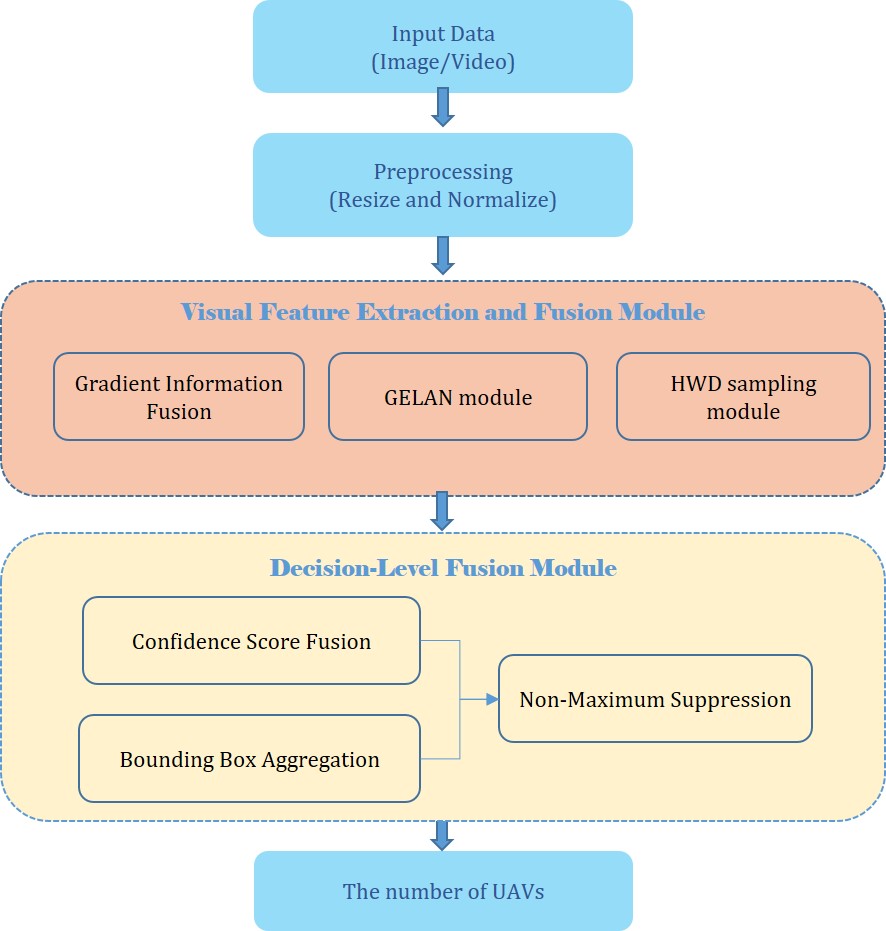
To address the safety hazards posed by unauthorized "black flight" of unmanned aerial vehicle (UAV) clusters, as well as the limitations of existing detection methods in tiny target recognition and complex environment adaptability, this paper proposes a real-time detection and counting method based on a feature fusion framework. The core contribution of this work is a novel multi-level fusion architecture that aggregates multi-scale visual features to enhance detection robustness under challenging conditions. First, we construct a multi scene UAV data set containing 7,113 images, and design a dedicated feature fusion module based on improved YOLOv9 backbone. The Haar Wavelet Down-sampling (HWD) module is introduced to fuse high-frequency edge details with low-frequency approximation features, preserving critical texture information that is essential for tiny target detection. The Programmable Gradient Information (PGI) mechanism is adopted as an auxiliary reversible branch, which propagates reliable deep-layer gradient information to shallow layers to effectively mitigate the information bottleneck problem. Second, a decision-level fusion strategy is developed to aggregate confidence scores and localization outputs from multi-scale predictions. The strategy is further optimized with a tailored Non-Maximum Suppression (NMS) algorithm to resolve occlusion issues in dense UAV clusters. Evaluations on the self-built dense UAV dataset show that the proposed method achieves a detection accuracy of 85% with a per-frame processing time of 0.10–0.15 s. Tests across diverse scenarios validate that the method can accurately locate and identify UAV targets. By achieving a favorable balance between detection accuracy and real-time performance, the proposed method effectively alleviates the missed detection and false detection problems in dense UAV cluster detection tasks.
Graphical Abstract
Keywords
Data Availability Statement
Funding
Conflicts of Interest
AI Use Statement
Ethical Approval and Consent to Participate
References
- Ahmad, T., Morel, A., Cheng, N., Palaniappan, K., Calyam, P., Sun, K., & Pan, J. (2025). Future UAV/drone systems for intelligent active surveillance and monitoring. ACM Computing Surveys, 58(2), 1-37.
[CrossRef] [Google Scholar] - Liao, X., Xu, C., & Yue, H. (2019, June). Enable UAVs safely flight in low-altitude: A Preliminary research of the public air route network of UAVs. In 2019 International Conference on Unmanned Aircraft Systems (ICUAS) (pp. 959-964). IEEE.
[CrossRef] [Google Scholar] - Wang, F., Wang, H., Qin, Z., & Tang, J. (2023). UAV target detection algorithm based on improved YOLOv8. IEEE Access, 11, 116534–116544.
[CrossRef] [Google Scholar] - Jin, W. C., Oh, D., Lee, S. C., & Choi, J. W. (2025, November). Motion-Based Bird-UAV Classification Using 3D-CNN for Long-Range Anti-UAV Systems. In Proceedings of the 34th ACM International Conference on Information and Knowledge Management (pp. 6867-6868).
[CrossRef] [Google Scholar] - Norbelt, M., Luo, X., Sun, J., Wang, J., Claude, U., & Wisal, M. (2024, July). Detecting UAV Target with Deep Convolutional Neural Network. In Proceedings of the 2024 6th International Electronics Communication Conference (pp. 11-18).
[CrossRef] [Google Scholar] - Zhao, Y., Wang, L., Lei, G., Guo, C., & Ma, Q. (2024). Lightweight UAV small target detection and perception based on improved YOLOv8-E. Drones, 8(11), 681.
[CrossRef] [Google Scholar] - Jiang, M., Si, Z., Yang, K., & Zhang, Y. (2024, July). Improved YOLOv8-Based Lightweight Object Detection on Drone Images. In International Conference on Intelligent Computing (pp. 426-434). Singapore: Springer Nature Singapore.
[CrossRef] [Google Scholar] - Han, J., Cao, R., Brighente, A., & Conti, M. (2023). Light-YOLOv5: A lightweight drone detector for resource-constrained cameras. IEEE Internet of Things Journal, 11(6), 11046-11057.
[CrossRef] [Google Scholar] - Jiang, N., Wang, K., Peng, X., Yu, X., Wang, Q., Xing, J., ... & Han, Z. (2023). Anti-UAV: A large multi-modal benchmark for UAV tracking. IEEE Transactions on Multimedia, 25, 486–500.
[CrossRef] [Google Scholar] - Gao, D., Tang, J., Li, H., Wang, B., Qiu, J., Chen, S., & Mei, X. (2024). A novel dataset and detection method for unmanned aerial vehicles using an improved YOLOv9 algorithm. Sensors, 24(23), 7512.
[CrossRef] [Google Scholar] - Al-Emadi, S., Al-Ali, A., Mohammad, A., & Al-Ali, A. (2019, June). Audio based drone detection and identification using deep learning. In 2019 15th International Wireless Communications & Mobile Computing Conference (IWCMC) (pp. 459-464). IEEE.
[CrossRef] [Google Scholar] - Medaiyese, O. O., Ezuma, M., Lauf, A. P., & Adeniran, A. A. (2022). Hierarchical learning framework for UAV detection and identification. IEEE Journal of Radio Frequency Identification, 6, 176-188.
[CrossRef] [Google Scholar] - Al-Emadi, S., Al-Ali, A., & Al-Ali, A. (2021). Audio-based drone detection and identification using deep learning techniques with dataset enhancement through generative adversarial networks. Sensors, 21(15), 4953.
[CrossRef] [Google Scholar] - McCoy, J., Rawal, A., Rawat, D. B., & Sadler, B. M. (2022). Ensemble deep learning for sustainable multimodal UAV classification. IEEE Transactions on Intelligent Transportation Systems, 24(12), 15425-15434.
[CrossRef] [Google Scholar] - Alipour-Fanid, A., Dabaghchian, M., Wang, N., Wang, P., Zhao, L., & Zeng, K. (2019). Machine learning-based delay-aware UAV detection and operation mode identification over encrypted Wi-Fi traffic. IEEE Transactions on Information Forensics and Security, 15, 2346-2360.
[CrossRef] [Google Scholar] - Ma, C., Fu, Y., Wang, D., Guo, R., Zhao, X., & Fang, J. (2023). YOLO-UAV: Object detection method of unmanned aerial vehicle imagery based on efficient multi-scale feature fusion. IEEE Access, 11, 126857-126878.
[CrossRef] [Google Scholar] - Wang, C. Y., Yeh, I. H., & Mark Liao, H. Y. (2024, September). Yolov9: Learning what you want to learn using programmable gradient information. In European conference on computer vision (pp. 1-21). Cham: Springer Nature Switzerland.
[CrossRef] [Google Scholar] - Tishby, N., & Zaslavsky, N. (2015, April). Deep learning and the information bottleneck principle. In 2015 IEEE Information Theory Workshop (ITW) (pp. 1-5). IEEE.
[CrossRef] [Google Scholar] - Zhai, X., Huang, Z., Li, T., Liu, H., & Wang, S. (2023). YOLO-Drone: an optimized YOLOv8 network for tiny UAV object detection. Electronics, 12(17), 3664.
[CrossRef] [Google Scholar] - Gomez, A. N., Ren, M., Urtasun, R., & Grosse, R. B. (2017). The reversible residual network: Backpropagation without storing activations. Advances in neural information processing systems, 30.
[Google Scholar] - Xu, S., Cui, K., Chen, G., & Zhang, M. (2025). SGA-YOLOv8: Sobel-GELAN and AIFI-dilated-attention fusion network for UAV remote-sensing small target detection. The Journal of Supercomputing, 81(14), 1291.
[CrossRef] [Google Scholar] - Wang, C. Y., Liao, H. Y. M., Wu, Y. H., Chen, P. Y., Hsieh, J. W., & Yeh, I. H. (2020, June). CSPNet: A new backbone that can enhance learning capability of CNN. In 2020 IEEE/CVF conference on computer vision and pattern recognition workshops (CVPRW) (pp. 1571-1580). IEEE.
[CrossRef] [Google Scholar] - Sakib Bin Islam, M., Chowdhury, M. E., Hasan-Zia, M., Kashem, S. B. A., Majid, M. E., Ansaruddin Kunju, A. K., ... & Nashbat, M. (2025). VisioDECT: a novel approach to drone detection using CBAM-integrated YOLO and GELAN-E models. Neural Computing and Applications, 37(24), 20181-20204.
[CrossRef] [Google Scholar] - Hu, K., Lu, J., Zheng, C., Xiang, Q., & Miao, L. (2025). MFF‐YOLOv8: Small Object Detection Based on Multi‐Scale Feature Fusion for UAV Remote Sensing Images. IET Image Processing, 19(1), e70066.
[CrossRef] [Google Scholar] - Bai, C., Zhang, K., Jin, H., Qian, P., Zhai, R., & Lu, K. (2025). SFFEF-YOLO: Small object detection network based on fine-grained feature extraction and fusion for unmanned aerial images. Image and Vision Computing, 156, 105469.
[CrossRef] [Google Scholar] - Zhang, H., Peng, Y., & Liu, Y. L. (2025). UAV aerial photography target detection based on improved YOLOv9. The Journal of Supercomputing, 81(3), 492.
[CrossRef] [Google Scholar] - Xu, G., Liao, W., Zhang, X., Li, C., He, X., & Wu, X. (2023). Haar wavelet downsampling: A simple but effective downsampling module for semantic segmentation. Pattern recognition, 143, 109819.
[CrossRef] [Google Scholar] - Bodla, N., Singh, B., Chellappa, R., & Davis, L. S. (2017, October). Soft-NMS—Improving object detection with one line of code. In 2017 IEEE international conference on computer vision (ICCV) (pp. 5562-5570). IEEE.
[CrossRef] [Google Scholar] - Huang, J. (2025, June). Small target detection algorithm based on improved YOLOv8s. In 2025 5th International Conference on Artificial Intelligence, Big Data and Algorithms (CAIBDA) (pp. 59-62). IEEE.
[CrossRef] [Google Scholar]
Cite This Article
TY  - JOUR
AU  - Lu, Xinpeng
AU  - Chen, Shijie
AU  - Sun, Jiashuo
AU  - Yin, Zhichao
AU  - Hu, Moufa
PY  - 2026
DA  - 2026/09/25
TI  - A Multi-Scale UAV Cluster Detection and Counting Framework Based on Multi-Source Information Fusion and Enhanced YOLOv9
JO  - Chinese Journal of Information Fusion
T2  - Chinese Journal of Information Fusion
JF  - Chinese Journal of Information Fusion
VL  - 3
IS  - 3
SP  - 166
EP  - 177
DO  - 10.62762/CJIF.2026.233582
UR  - https://www.icck.org/article/abs/CJIF.2026.233582
KW  - UAV cluster
KW  - target detection
KW  - YOLOv9
KW  - deep learning
KW  - low altitude safety
KW  - feature fusion
AB  - To address the safety hazards posed by unauthorized "black flight" of unmanned aerial vehicle (UAV) clusters, as well as the limitations of existing detection methods in tiny target recognition and complex environment adaptability, this paper proposes a real-time detection and counting method based on a feature fusion framework. The core contribution of this work is a novel multi-level fusion architecture that aggregates multi-scale visual features to enhance detection robustness under challenging conditions. First, we construct a multi scene UAV data set containing 7,113 images, and design a dedicated feature fusion module based on improved YOLOv9 backbone. The Haar Wavelet Down-sampling (HWD) module is introduced to fuse high-frequency edge details with low-frequency approximation features, preserving critical texture information that is essential for tiny target detection. The Programmable Gradient Information (PGI) mechanism is adopted as an auxiliary reversible branch, which propagates reliable deep-layer gradient information to shallow layers to effectively mitigate the information bottleneck problem. Second, a decision-level fusion strategy is developed to aggregate confidence scores and localization outputs from multi-scale predictions. The strategy is further optimized with a tailored Non-Maximum Suppression (NMS) algorithm to resolve occlusion issues in dense UAV clusters. Evaluations on the self-built dense UAV dataset show that the proposed method achieves a detection accuracy of 85% with a per-frame processing time of 0.10–0.15 s. Tests across diverse scenarios validate that the method can accurately locate and identify UAV targets. By achieving a favorable balance between detection accuracy and real-time performance, the proposed method effectively alleviates the missed detection and false detection problems in dense UAV cluster detection tasks.
SN  - 2998-3371
PB  - Institute of Central Computation and Knowledge
LA  - English
ER  -
@article{Lu2026A,
  author = {Xinpeng Lu and Shijie Chen and Jiashuo Sun and Zhichao Yin and Moufa Hu},
  title = {A Multi-Scale UAV Cluster Detection and Counting Framework Based on Multi-Source Information Fusion and Enhanced YOLOv9},
  journal = {Chinese Journal of Information Fusion},
  year = {2026},
  volume = {3},
  number = {3},
  pages = {166-177},
  doi = {10.62762/CJIF.2026.233582},
  url = {https://www.icck.org/article/abs/CJIF.2026.233582},
  abstract = {To address the safety hazards posed by unauthorized "black flight" of unmanned aerial vehicle (UAV) clusters, as well as the limitations of existing detection methods in tiny target recognition and complex environment adaptability, this paper proposes a real-time detection and counting method based on a feature fusion framework. The core contribution of this work is a novel multi-level fusion architecture that aggregates multi-scale visual features to enhance detection robustness under challenging conditions. First, we construct a multi scene UAV data set containing 7,113 images, and design a dedicated feature fusion module based on improved YOLOv9 backbone. The Haar Wavelet Down-sampling (HWD) module is introduced to fuse high-frequency edge details with low-frequency approximation features, preserving critical texture information that is essential for tiny target detection. The Programmable Gradient Information (PGI) mechanism is adopted as an auxiliary reversible branch, which propagates reliable deep-layer gradient information to shallow layers to effectively mitigate the information bottleneck problem. Second, a decision-level fusion strategy is developed to aggregate confidence scores and localization outputs from multi-scale predictions. The strategy is further optimized with a tailored Non-Maximum Suppression (NMS) algorithm to resolve occlusion issues in dense UAV clusters. Evaluations on the self-built dense UAV dataset show that the proposed method achieves a detection accuracy of 85\% with a per-frame processing time of 0.10–0.15 s. Tests across diverse scenarios validate that the method can accurately locate and identify UAV targets. By achieving a favorable balance between detection accuracy and real-time performance, the proposed method effectively alleviates the missed detection and false detection problems in dense UAV cluster detection tasks.},
  keywords = {UAV cluster, target detection, YOLOv9, deep learning, low altitude safety, feature fusion},
  issn = {2998-3371},
  publisher = {Institute of Central Computation and Knowledge}
}
Article Metrics
Publisher's Note
ICCK stays neutral with regard to jurisdictional claims in published maps and institutional affiliations.
Rights and Permissions
 Copyright © 2026 by the Author(s). Published by Institute of Central Computation and Knowledge. This article is an open access article distributed under the terms and conditions of the Creative Commons Attribution (CC BY) license (https://creativecommons.org/licenses/by/4.0/), which permits use, sharing, adaptation, distribution and reproduction in any medium or format, as long as you give appropriate credit to the original author(s) and the source, provide a link to the Creative Commons licence, and indicate if changes were made.


Portico