Multi-Dimensional Visual Feature Fusion for UAV Maneuver Recognition in Power Transmission Line Protection



Article Information
Abstract
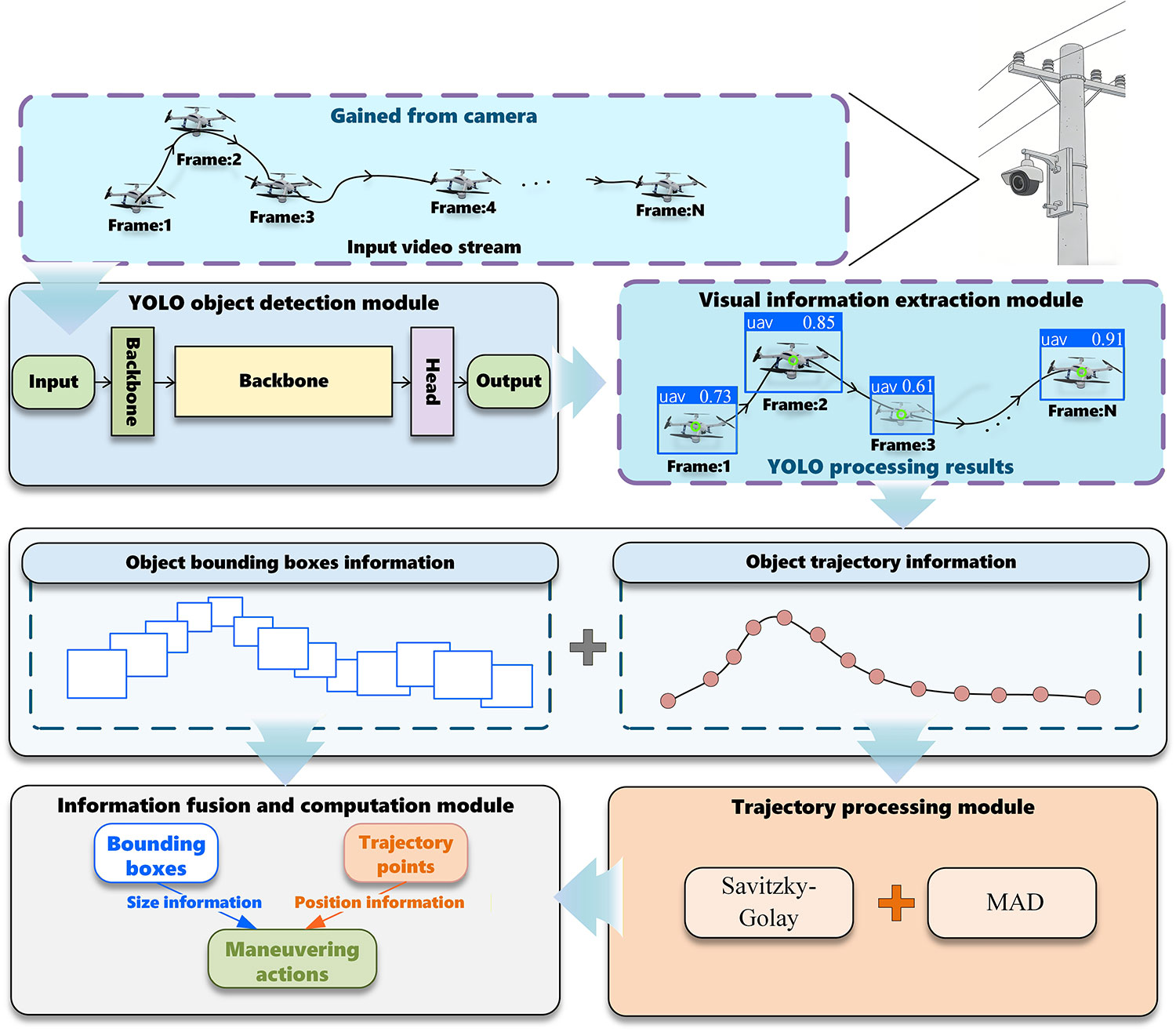
The increasing popularity of civilian unmanned aerial vehicles (UAVs) poses serious safety challenges to low-altitude airspace near power transmission and distribution lines. Existing monitoring technologies rely heavily on expensive radar or radio frequency devices that are susceptible to interference, while mainstream vision schemes are typically limited to object detection and fail to analyze flight intentions. To address these problems, this paper proposes a UAV maneuver recognition method for transmission and distribution line protection, providing precise semantic support for action-based risk warnings through multi-dimensional visual feature fusion. First, a YOLO object detection model extracts real-time UAV bounding boxes and trajectories from video streams to construct raw motion state sequences. Second, to suppress detection noise while preserving critical maneuvering features, a feature-preserving trajectory reconstruction algorithm based on median absolute deviation (MAD) enhancement (FP-SGM) is proposed, which combines a Savitzky-Golay (S-G) filter with an adaptive statistical threshold. On this basis, a multi-dimensional feature space comprising trajectory and scale features is constructed to design a cascade decision strategy. By fusing these features, the lateral and radial motions of UAVs are effectively decoupled, achieving robust recognition of four typical maneuvers: ‘Hovering’, ‘Circling’, ‘Approaching’, and ‘Receding’. Simulation experiments on the Gazebo platform demonstrate a 95% accuracy rate in maneuver recognition. The results indicate that this low-cost method presents a viable potential for integration into existing surveillance terminals, laying a foundation for intelligent power line defense systems.
Graphical Abstract
Keywords
Data Availability Statement
Funding
Conflicts of Interest
AI Use Statement
Ethical Approval and Consent to Participate
References
- Lin, X., Niu, Y., Yu, X., Fan, Z., Zhuang, J., & Zou, A. M. (2025). Paying more attention on backgrounds: Background-centric attention for UAV detection. Neural Networks, 185, 107182.
[CrossRef] [Google Scholar] - Shakhatreh, H., Sawalmeh, A. H., Al-Fuqaha, A., Dou, Z., Almaita, E., Khalil, I., ... & Guizani, M. (2019). Unmanned aerial vehicles (UAVs): A survey on civil applications and key research challenges. IEEE access, 7, 48572-48634.
[CrossRef] [Google Scholar] - Nafar, N., Fatemi, M., & Rezaei-Moghaddam, K. (2025). Decoding drone adoption in agriculture: A comparative analysis of behavioral models. Information Processing in Agriculture.
[CrossRef] [Google Scholar] - Adeoye, Y., Onotole, E., Ogunyankinnu, T., Aipoh, G., Osunkanmibi, A., & Egbemhenghe, J. (2025). Artificial intelligence in logistics and distribution: The function of AI in dynamic route planning for transportation including self-driving trucks and drone delivery systems. World Journal of Advanced Research and Reviews, 25(02), 155-167.
[CrossRef] [Google Scholar] - Xu, B., Zhao, Y., Wang, T., & Chen, Q. (2023). Development of power transmission line detection technology based on unmanned aerial vehicle image vision. SN Applied Sciences, 5(3), 72.
[CrossRef] [Google Scholar] - Tian, J., Wang, C., Cao, J., & Wang, X. (2024). Fully convolutional network-based fast UAV detection in pulse Doppler radar. IEEE Transactions on Geoscience and Remote Sensing, 62, 1-12.
[CrossRef] [Google Scholar] - Lee, H., Han, S., Byeon, J. I., Han, S., Myung, R., Joung, J., & Choi, J. (2023). CNN-based UAV detection and classification using sensor fusion. IEEE Access, 11, 68791-68808.
[CrossRef] [Google Scholar] - Wang, J., Liu, Y., & Song, H. (2021). Counter-unmanned aircraft system (s)(C-UAS): State of the art, challenges, and future trends. IEEE Aerospace and Electronic Systems Magazine, 36(3), 4-29.
[CrossRef] [Google Scholar] - Chamola, V., Kotesh, P., Agarwal, A., Gupta, N., & Guizani, M. (2021). A comprehensive review of unmanned aerial vehicle attacks and neutralization techniques. Ad Hoc Networks, 111, 102324.
[CrossRef] [Google Scholar] - Jang, B., Seo, Y., On, B., & Im, S. (2018, January). Euclidean distance based algorithm for UAV acoustic detection. In 2018 International conference on electronics, information, and communication (ICEIC) (pp. 1-2). IEEE.
[CrossRef] [Google Scholar] - Seidaliyeva, U., Ilipbayeva, L., Taissariyeva, K., Smailov, N., & Matson, E. T. (2023). Advances and challenges in drone detection and classification techniques: A state-of-the-art review. Sensors, 24(1), 125.
[CrossRef] [Google Scholar] - Ding, G., Ren, Y., Liu, Y., Zhao, Q., & Li, S. (2025). Vision-based anti-Unmanned aerial technology: Opportunities and challenges. IEEE Geoscience and Remote Sensing Magazine, 3(4), 382-405.
[CrossRef] [Google Scholar] - Zou, Z., Chen, K., Shi, Z., Guo, Y., & Ye, J. (2023). Object detection in 20 years: A survey. Proceedings of the IEEE, 111(3), 257-276.
[CrossRef] [Google Scholar] - Liu, Z., An, P., Yang, Y., Qiu, S., Liu, Q., & Xu, X. (2024). Vision-based drone detection in complex environments: A survey. Drones, 8(11), 643.
[CrossRef] [Google Scholar] - Bosquet, B., Mucientes, M., & Brea, V. M. (2020). STDnet: Exploiting high resolution feature maps for small object detection. Engineering Applications of Artificial Intelligence, 91, 103615.
[CrossRef] [Google Scholar] - Zheng, Y., Chen, Z., Lv, D., Li, Z., Lan, Z., & Zhao, S. (2021). Air-to-air visual detection of micro-uavs: An experimental evaluation of deep learning. IEEE Robotics and automation letters, 6(2), 1020-1027.
[CrossRef] [Google Scholar] - Steininger, D., Widhalm, V., Simon, J., Kriegler, A., & Sulzbachner, C. (2021). The aircraft context dataset: Understanding and optimizing data variability in aerial domains. In Proceedings of the IEEE/CVF International Conference on Computer Vision (pp. 3823-3832).
[CrossRef] [Google Scholar] - Zhao, J., Zhang, J., Li, D., & Wang, D. (2022). Vision-based anti-UAV detection and tracking. IEEE Transactions on Intelligent Transportation Systems, 23(12), 25323-25334.
[CrossRef] [Google Scholar] - Liu, Y., Sun, Z., Xi, L., Zhang, L., Dong, W., Chen, C., ... & Deng, F. (2025). MMFW-UAV dataset: multi-sensor and multi-view fixed-wing UAV dataset for air-to-air vision tasks. Scientific data, 12(1), 185.
[CrossRef] [Google Scholar] - Hu, Y., Wu, X., Zheng, G., & Liu, X. (2019, July). Object detection of UAV for anti-UAV based on improved YOLO v3. In 2019 Chinese Control Conference (CCC) (pp. 8386-8390). IEEE.
[CrossRef] [Google Scholar] - Zhizhong, X., Jingen, W., Zhenghao, H., & Yuhui, S. (2020, October). Research on multi UAV target detection algorithm in the air based on improved CenterNet. In 2020 International Conference on Big Data & Artificial Intelligence & Software Engineering (ICBASE) (pp. 367-372). IEEE.
[CrossRef] [Google Scholar] - Misbah, M., Khan, M. U., Kaleem, Z., Muqaibel, A., Alam, M. Z., Liu, R., & Yuen, C. (2024). MSF-GhostNet: computationally efficient YOLO for detecting drones in low-light conditions. IEEE Journal of Selected Topics in Applied Earth Observations and Remote Sensing, 18, 3840-3851.
[CrossRef] [Google Scholar] - Du, Y., Wu, T., Dai, Z., Xie, H., Hu, C., & Wei, S. (2025). F-yolov7: Fast and robust real-time UAV detection. Computing, 107(1), 50.
[CrossRef] [Google Scholar] - Wang, Z., Chen, J., Wang, J., & Shen, Q. (2023). Intention recognition of UAV swarm with data-driven methods. Aerospace Systems, 6(4), 703-714.
[CrossRef] [Google Scholar] - Perrusquía, A., Guo, W., Fraser, B., & Wei, Z. (2024). Uncovering drone intentions using control physics informed machine learning. Communications Engineering, 3(1), 36.
[CrossRef] [Google Scholar] - Shuaau, M., Thang, K. F., & Lai, N. S. (2019). Autonomous abnormal behaviour detection using trajectory analysis. International Journal of Electrical and Computer Engineering (IJECE), 2. http://doi.org/10.11591/ijece.v9i4.pp2403-2415
[Google Scholar] - Luan, T., Zhou, S., Zhang, Y., & Pan, W. (2025). Fast identification and detection algorithm for maneuverable unmanned aircraft based on multimodal data fusion. Mathematics, 13(11), 1825.
[CrossRef] [Google Scholar] - Gao, Y., Gan, Z., Chen, M., Ma, H., & Mao, X. (2023). Hybrid dual-scale neural network model for tracking complex maneuvering UAVs. Drones, 8(1), 3.
[CrossRef] [Google Scholar] - Khanam, R., & Hussain, M. (2024). Yolov11: An overview of the key architectural enhancements. arXiv preprint arXiv:2410.17725.
[CrossRef] [Google Scholar] - Schmid, M., Rath, D., & Diebold, U. (2022). Why and how Savitzky–Golay filters should be replaced. ACS Measurement Science Au, 2(2), 185.
[CrossRef] [Google Scholar] - Zhu, F., Chang, C., Li, Z., Li, B., & Li, L. (2024). A generic optimization-based enhancement method for trajectory data: Two plus one. Accident Analysis & Prevention, 200, 107532.
[CrossRef] [Google Scholar] - Xiao, K., Tan, S., Wang, G., An, X., Wang, X., & Wang, X. (2020, June). XTDrone: A customizable multi-rotor UAVs simulation platform. In 2020 4th International Conference on Robotics and Automation Sciences (ICRAS) (pp. 55-61). IEEE.
[CrossRef] [Google Scholar] - Meier, L., Honegger, D., & Pollefeys, M. (2015, May). PX4: A node-based multithreaded open source robotics framework for deeply embedded platforms. In 2015 IEEE international conference on robotics and automation (ICRA) (pp. 6235-6240). IEEE.
[CrossRef] [Google Scholar] - Rousseeuw, P. J., & Croux, C. (1993). Alternatives to the median absolute deviation. Journal of the American Statistical association, 88(424), 1273-1283.
[CrossRef] [Google Scholar] - Leys, C., Ley, C., Klein, O., Bernard, P., & Licata, L. (2013). Detecting outliers: Do not use standard deviation around the mean, use absolute deviation around the median. Journal of experimental social psychology, 49(4), 764-766.
[CrossRef] [Google Scholar]
Cite This Article
TY  - JOUR
AU  - Chen, Liangfeng
AU  - Xu, Ruiqi
AU  - Ma, Jinyu
AU  - Wang, Zheng
AU  - Li, Han
PY  - 2026
DA  - 2026/09/27
TI  - Multi-Dimensional Visual Feature Fusion for UAV Maneuver Recognition in Power Transmission Line Protection
JO  - Chinese Journal of Information Fusion
T2  - Chinese Journal of Information Fusion
JF  - Chinese Journal of Information Fusion
VL  - 3
IS  - 3
SP  - 189
EP  - 208
DO  - 10.62762/CJIF.2026.661309
UR  - https://www.icck.org/article/abs/CJIF.2026.661309
KW  - UAV maneuver recognition
KW  - object detection
KW  - feature fusion
KW  - transmission and distribution line protection
AB  - The increasing popularity of civilian unmanned aerial vehicles (UAVs) poses serious safety challenges to low-altitude airspace near power transmission and distribution lines. Existing monitoring technologies rely heavily on expensive radar or radio frequency devices that are susceptible to interference, while mainstream vision schemes are typically limited to object detection and fail to analyze flight intentions. To address these problems, this paper proposes a UAV maneuver recognition method for transmission and distribution line protection, providing precise semantic support for action-based risk warnings through multi-dimensional visual feature fusion. First, a YOLO object detection model extracts real-time UAV bounding boxes and trajectories from video streams to construct raw motion state sequences. Second, to suppress detection noise while preserving critical maneuvering features, a feature-preserving trajectory reconstruction algorithm based on median absolute deviation (MAD) enhancement (FP-SGM) is proposed, which combines a Savitzky-Golay (S-G) filter with an adaptive statistical threshold. On this basis, a multi-dimensional feature space comprising trajectory and scale features is constructed to design a cascade decision strategy. By fusing these features, the lateral and radial motions of UAVs are effectively decoupled, achieving robust recognition of four typical maneuvers: ‘Hovering’, ‘Circling’, ‘Approaching’, and ‘Receding’. Simulation experiments on the Gazebo platform demonstrate a 95% accuracy rate in maneuver recognition. The results indicate that this low-cost method presents a viable potential for integration into existing surveillance terminals, laying a foundation for intelligent power line defense systems.
SN  - 2998-3371
PB  - Institute of Central Computation and Knowledge
LA  - English
ER  -
@article{Chen2026MultiDimen,
  author = {Liangfeng Chen and Ruiqi Xu and Jinyu Ma and Zheng Wang and Han Li},
  title = {Multi-Dimensional Visual Feature Fusion for UAV Maneuver Recognition in Power Transmission Line Protection},
  journal = {Chinese Journal of Information Fusion},
  year = {2026},
  volume = {3},
  number = {3},
  pages = {189-208},
  doi = {10.62762/CJIF.2026.661309},
  url = {https://www.icck.org/article/abs/CJIF.2026.661309},
  abstract = {The increasing popularity of civilian unmanned aerial vehicles (UAVs) poses serious safety challenges to low-altitude airspace near power transmission and distribution lines. Existing monitoring technologies rely heavily on expensive radar or radio frequency devices that are susceptible to interference, while mainstream vision schemes are typically limited to object detection and fail to analyze flight intentions. To address these problems, this paper proposes a UAV maneuver recognition method for transmission and distribution line protection, providing precise semantic support for action-based risk warnings through multi-dimensional visual feature fusion. First, a YOLO object detection model extracts real-time UAV bounding boxes and trajectories from video streams to construct raw motion state sequences. Second, to suppress detection noise while preserving critical maneuvering features, a feature-preserving trajectory reconstruction algorithm based on median absolute deviation (MAD) enhancement (FP-SGM) is proposed, which combines a Savitzky-Golay (S-G) filter with an adaptive statistical threshold. On this basis, a multi-dimensional feature space comprising trajectory and scale features is constructed to design a cascade decision strategy. By fusing these features, the lateral and radial motions of UAVs are effectively decoupled, achieving robust recognition of four typical maneuvers: ‘Hovering’, ‘Circling’, ‘Approaching’, and ‘Receding’. Simulation experiments on the Gazebo platform demonstrate a 95\% accuracy rate in maneuver recognition. The results indicate that this low-cost method presents a viable potential for integration into existing surveillance terminals, laying a foundation for intelligent power line defense systems.},
  keywords = {UAV maneuver recognition, object detection, feature fusion, transmission and distribution line protection},
  issn = {2998-3371},
  publisher = {Institute of Central Computation and Knowledge}
}
Article Metrics
Publisher's Note
ICCK stays neutral with regard to jurisdictional claims in published maps and institutional affiliations.
Rights and Permissions
 Copyright © 2026 by the Author(s). Published by Institute of Central Computation and Knowledge. This article is an open access article distributed under the terms and conditions of the Creative Commons Attribution (CC BY) license (https://creativecommons.org/licenses/by/4.0/), which permits use, sharing, adaptation, distribution and reproduction in any medium or format, as long as you give appropriate credit to the original author(s) and the source, provide a link to the Creative Commons licence, and indicate if changes were made.


Portico