


In-situ Hydrogen Production in Natural Gas Reservoirs: From Methane Conversion Mechanisms to Techno-economic and Environmental Feasibility




Article Information
Abstract
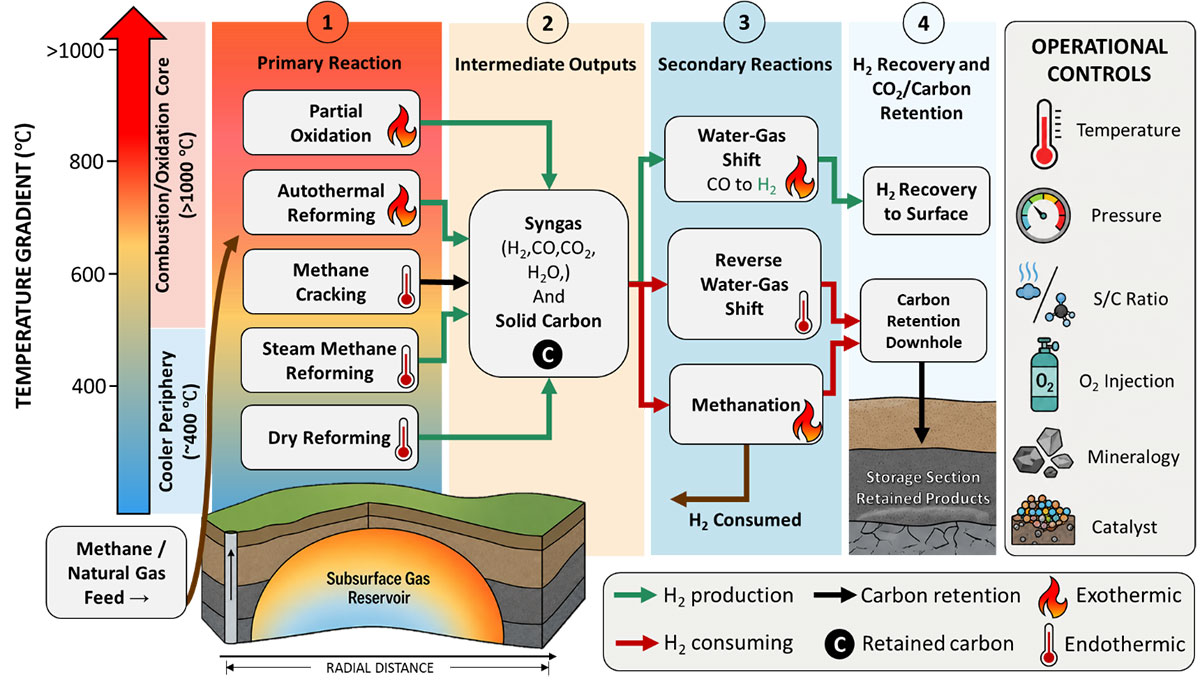
In-situ hydrogen production from natural gas reservoirs (IHP-NG) is an emerging pathway for low-carbon hydrogen by converting methane-rich subsurface resources while retaining carbon-bearing byproducts underground. This review critically evaluates the reaction mechanisms, experimental and modelling evidence, techno-economic position, life-cycle implications, and deployment challenges of IHP-NG. Unlike heavy-oil in-situ combustion gasification, IHP-NG is governed mainly by methane conversion reactions, including steam methane reforming, partial oxidation, autothermal reforming, methane cracking, dry reforming, and water--gas shift, alongside competing pathways such as methanation, reverse water--gas shift, and coking. Existing studies show that high temperature, adequate steam supply, controlled oxidant dosage, effective catalysis, and selective H2 recovery are essential for meaningful hydrogen generation. However, uncertainties remain around reservoir heterogeneity, heat management, catalyst stability, well integrity, H2 separation, and carbon retention. Techno-economic and life-cycle assessment indicates that IHP-NG is a process-integration concept, not an inherently cheaper or cleaner hydrogen route. Its competitiveness and carbon advantage depend on high H2 yield, reliable separation, infrastructure reuse, verifiable CO2 retention, low methane and H2 losses, and manageable monitoring and liability costs. Field-scale validation is therefore essential before IHP-NG can be deemed a credible low-carbon hydrogen pathway.
Graphical Abstract
Keywords
Data Availability Statement
Funding
Conflicts of Interest
AI Use Statement
Ethical Approval and Consent to Participate
References
- Griffiths, S., Sovacool, B. K., Kim, J., Bazilian, M., & Uratani, J. M. (2021). Industrial decarbonization via hydrogen: A critical and systematic review of developments, socio-technical systems and policy options. Energy Research & Social Science, 80, 102208.
[CrossRef] [Google Scholar] - Jayachandran, M., Gatla, R. K., Flah, A., Milyani, A. H., Milyani, H. M., Blazek, V., Prokop, L., Kraiem, H. (2024). Challenges and opportunities in green hydrogen adoption for decarbonizing hard-to-abate industries: A comprehensive review. IEEE Access, 12, 23363--23388.
[CrossRef] [Google Scholar] - IEA. (2025). Global Hydrogen Review 2025 [Report]. International Energy Agency. Retrieved from https://www.iea.org/reports/global-hydrogen-review-2025
[Google Scholar] - Lewis, E., McNaul, S., Jamieson, M., Henriksen, M. S., Matthews, H. S., Walsh, L., ... & Stevens, R. (2022). Comparison of commercial, state-of-the-art, fossil-based hydrogen production technologies (No. DOE/NETL-2022/3241). National Energy Technology Laboratory (NETL), Pittsburgh, PA, Morgantown, WV, and Albany, OR (United States). https://netl.doe.gov/projects/files/ComparisonofCommercialStateofArtFossilBasedHydrogenProductionTechnologies_041222.pdf
[Google Scholar] - AlHumaidan, F. S., Halabi, M. A., Rana, M. S., & Vinoba, M. (2023). Blue hydrogen: Current status and future technologies. Energy Conversion and Management, 283, 116840.
[CrossRef] [Google Scholar] - Howarth, R. W., & Jacobson, M. Z. (2021). How green is blue hydrogen?. Energy Science & Engineering, 9(10), 1676-1687.
[CrossRef] [Google Scholar] - Riemer, M., & Duscha, V. (2023). Carbon capture in blue hydrogen production is not where it is supposed to be-Evaluating the gap between practical experience and literature estimates. Applied Energy, 349, 121622.
[CrossRef] [Google Scholar] - Salahshoor, S., & Afzal, S. (2022). Subsurface technologies for hydrogen production from fossil fuel resources: A review and techno-economic analysis. International Journal of Hydrogen Energy.
[CrossRef] [Google Scholar] - Ifticene, M. A., Yan, K., & Yuan, Q. (2023). Fueling a carbon-zero future: Igniting hydrogen production from petroleum reservoirs via in-situ combustion gasification. Energy Conversion and Management, 298, 117770.
[CrossRef] [Google Scholar] - Okere, C. J., & Sheng, J. J. (2023). Review on clean hydrogen generation from petroleum reservoirs: Fundamentals, mechanisms, and field applications. International Journal of Hydrogen Energy, 48(97), 38188-38222.
[CrossRef] [Google Scholar] - Hassanpouryouzband, A., Veshareh, M. J., Wilkinson, M., Nick, H. M., Ngwenya, B. T., & Haszeldine, R. S. (2025). In situ hydrogen generation from underground fossil hydrocarbons. Joule, 9(2).
[CrossRef] [Google Scholar] - Smith, E. K., Barakat, S. M., Akande, O., Ogbaga, C. C., Okoye, P. U., & Okolie, J. A. (2024). Subsurface combustion and gasification for hydrogen production: Reaction mechanism, techno-economic and lifecycle assessment. Chemical Engineering Journal, 480, 148095.
[CrossRef] [Google Scholar] - Ozyurtkan, M. H., Çetin, C., & Temizel, C. (2026). A Review on In Situ Hydrogen Generation in Hydrocarbon Reservoirs. Gases, 6(1), 9.
[CrossRef] [Google Scholar] - Tackie-Otoo, B. N., Mahmoud, M., Murtaza, M., Raza, A., Kamal, M. S., Patil, S., ... & Attar, N. (2025). An integrated experimental and simulation study for the feasibility of underground H2 production from natural gas reservoirs. ACS omega, 10(23), 24510.
[CrossRef] [Google Scholar] - Dagle, R. A., Dagle, V., Bearden, M. D., Holladay, J. D., Krause, T. R., & Ahmed, S. (2017). An overview of natural gas conversion technologies for co-production of hydrogen and value-added solid carbon products.
[CrossRef] [Google Scholar] - Mukhina, E., Afanasev, P., Mukhametdinova, A., Alekhina, T., Askarova, A., Popov, E., & Cheremisin, A. (2024). A novel method for hydrogen synthesis in natural gas reservoirs. Fuel, 370, 131758.
[CrossRef] [Google Scholar] - Afanasev, P. A., Alekhina, T. V., Mukhametdinova, A. Z., Popov, E. Y., & Cheremisin, A. N. (2024, May). Exploring the potential of natural gas reservoirs for underground hydrogen generation. In SPE Gas & Oil Technology Showcase and Conference. SPE.
[CrossRef] [Google Scholar] - Tackie-Otoo, B. N., Mahmoud, M., Raza, A., Patil, S., Murtaza, M., Kamal, M. S., & Zahid, U. (2025). In-situ hydrogen production from natural gas reservoirs and gas separation by graphite packing: Process simulation and experimental study. Advances in Geo-Energy Research, 18(2), 165-179.
[CrossRef] [Google Scholar] - Afanasev, P., Popov, E., Cheremisin, A., Berenblyum, R., Mikitin, E., Sorokin, E., ... & Slavkina, O. (2021). An experimental study of the possibility of in situ hydrogen generation within gas reservoirs. Energies, 14(16), 5121.
[CrossRef] [Google Scholar] - Okere, C. J., & Sheng, J. J. (2024). A new modelling approach for in-situ hydrogen production from heavy oil reservoirs: Sensitivity analysis and process mechanisms. Energy, 302, 131817.
[CrossRef] [Google Scholar] - Mahinpey, N., Ambalae, A., & Asghari, K. (2007). In situ combustion in enhanced oil recovery (EOR): A review. Chemical Engineering Communications, 194(8), 995-1021.
[CrossRef] [Google Scholar] - Zhang, Y., Hu, G., Zhang, H., Liu, Q., & Zhou, J. (2021). Thermodynamic analysis and optimization for steam methane reforming hydrogen production system using high temperature gas-cooled reactor pebble-bed module. Journal of Nuclear Science and Technology, 58(12), 1359-1372.
[CrossRef] [Google Scholar] - Blaylock, D. W., Ogura, T., Green, W. H., & Beran, G. J. O. (2009). Computational investigation of thermochemistry and kinetics of steam methane reforming on Ni (111) under realistic conditions. The Journal of Physical Chemistry C, 113(12), 4898--4908.
[CrossRef] [Google Scholar] - Gubanova, E. L., Schuurman, Y., Sadykov, V. A., Mirodatos, C., & Van Veen, A. C. (2009). Evaluation of kinetic models for the partial oxidation of methane to synthesis gas over a Pt/PrCeZrOx catalyst coated on a triangular monolith. Chemical Engineering Journal, 154(1-3), 174--184.
[CrossRef] [Google Scholar] - Lapszewicz, J. A., & Jiang, X. Z. (1992, January). Mechanism of Partial Oxidation of Methane to Synthesis Gas. In Chemeca 92: The Impact of Government Policy on the Process Industries; Official Conference Proceedings (pp. 526-531). Parkville, Vic: Royal Australian Chemical Institute. https://search.informit.org/doi/abs/10.3316/informit.843718978290058
[Google Scholar] - Hickman, D. A., & Schmidt, L. D. (1993). Production of syngas by direct catalytic oxidation of methane. science, 259(5093), 343-346.
[CrossRef] [Google Scholar] - Enger, B. C., Lødeng, R., & Holmen, A. (2008). A review of catalytic partial oxidation of methane to synthesis gas with emphasis on reaction mechanisms over transition metal catalysts. Applied Catalysis A: General, 346(1-2), 1-27.
[CrossRef] [Google Scholar] - Mosayebi, A. (2020). Kinetic modeling of catalytic partial oxidation of methane over Ni-Rh/$\gamma$-Al2O3 catalyst for syngas formation. Journal of the Taiwan Institute of Chemical Engineers, 114, 36-46.
[CrossRef] [Google Scholar] - de Smet, C. R., de Croon, M. H., Berger, R. J., Marin, G. B., & Schouten, J. C. (2000). Kinetics for the partial oxidation of methane on a Pt gauze at low conversions. AIChE journal, 46(9), 1837-1849.
[CrossRef] [Google Scholar] - Wang, M., Chen, H. Y., Lugo-Jose, Y., Fedeyko, J. M., Toops, T. J., & Fidler, J. (2024). Mechanistic and Kinetic Analysis of Complete Methane Oxidation on a Practical PtPd/Al2O3 Catalyst. Catalysts, 14(12), 847.
[CrossRef] [Google Scholar] - CHEN, Y. M. (2011). Thermodynamic and kinetic analyses for hydrogen production via methane autothermal reforming. Journal of Fuel Chemistry and Technology, 39(08), 633-640. https://www.sciengine.com/JFCT-1/doi/10.0000/j.2097-213X.20113908633640
[Google Scholar] - Rowshanzamir, S., & Eikani, M. H. (2009). Autothermal reforming of methane to synthesis gas: Modeling and simulation. International journal of hydrogen energy, 34(3), 1292-1300.
[CrossRef] [Google Scholar] - Ratnasamy, C., & Wagner, J. P. (2009). Water gas shift catalysis. Catalysis Reviews, 51(3), 325-440.
[CrossRef] [Google Scholar] - Chen, W. H., & Chen, C. Y. (2020). Water gas shift reaction for hydrogen production and carbon dioxide capture: A review. Applied Energy, 258, 114078.
[CrossRef] [Google Scholar] - Pashchenko, D. (2020). Thermodynamic equilibrium analysis of steam methane reforming based on a conjugate solution of material balance and law action mass equations with the detailed energy balance. International Journal of Energy Research, 44(1), 438-447.
[CrossRef] [Google Scholar] - Jensen, C., & Duyar, M. S. (2021). Thermodynamic analysis of dry reforming of methane for valorization of landfill gas and natural gas. Energy Technology, 9(7), 2100106.
[CrossRef] [Google Scholar] - Agún, B., & Abánades, A. (2025). Comprehensive review on dry reforming of methane: Challenges and potential for greenhouse gas mitigation. International Journal of Hydrogen Energy, 103, 395-414.
[CrossRef] [Google Scholar] - Aramouni, N. A. K., Zeaiter, J., Kwapinski, W., & Ahmad, M. N. (2017). Thermodynamic analysis of methane dry reforming: Effect of the catalyst particle size on carbon formation. Energy Conversion and Management, 150, 614-622.
[CrossRef] [Google Scholar] - Sophiana, I. C., Steven, S., Khairunida'Shalihah, R., Iskandar, F., Devianto, H., Restiawaty, E., ... & Budhi, Y. W. (2024). Enhanced syngas production through dry reforming of methane with Ni/CeZrO2 catalyst: Kinetic parameter investigation and CO2-rich feed simulation. Chemical Engineering Journal Advances, 20, 100655.
[CrossRef] [Google Scholar] - Uehara, T., Asahara, M., & Miyasaka, T. (2024). CO2-Free hydrogen production by methane pyrolysis utilizing a portion of the produced hydrogen for combustion. Energies, 17(2), 367.
[CrossRef] [Google Scholar] - Chunxia, H. U., He, S., & Hejun, L. I. (2020). Methane pyrolysis in preparation of pyrolytic carbon: Thermodynamic and kinetic analysis by density functional theory. Chinese Journal of Aeronautics, 33(3), 1064--1073.
[CrossRef] [Google Scholar] - Mianowski, A., Szul, M., Radko, T., Sobolewski, A., & Iluk, T. (2024). Literature review on thermodynamic and kinetic limitations of thermal decomposition of methane. Energies, 17(19), 5007.
[CrossRef] [Google Scholar] - Chan, Y. H., Chan, Z. P., Lock, S. S. M., Yiin, C. L., Foong, S. Y., Wong, M. K., ... & Lam, S. S. (2024). Thermal pyrolysis conversion of methane to hydrogen (H2): A review on process parameters, reaction kinetics and techno-economic analysis. Chinese Chemical Letters, 35(8), 109329.
[CrossRef] [Google Scholar] - Yan, K., Yang, X., Ge, Y., Navar, R., & Yuan, Q. (2024). Iron-sandstone synergy: Advancing in-situ hydrogen production from natural gas via electromagnetic heating. International journal of hydrogen energy, 83, 1210-1218.
[CrossRef] [Google Scholar] - Chen, S., & Abdel-Mageed, A. M. (2023). Methanation reactions for chemical storage and purification of hydrogen: Overview and structure-reactivity correlations in supported metals. International Journal of Hydrogen Energy, 48(64), 24915-24935.
[CrossRef] [Google Scholar] - Stangeland, K., Kalai, D., Li, H., & Yu, Z. (2017). CO2 methanation: the effect of catalysts and reaction conditions. Energy Procedia, 105, 2022-2027.
[CrossRef] [Google Scholar] - Andrade, C., Martins, M., & Borges, A. (2025, December). From CO2 to Methane: A Thermodynamic Study of the Sabatier Reaction for Clean Energy Applications. In Proceedings (Vol. 133, No. 1, p. 1). MDPI.
[CrossRef] [Google Scholar] - Le, T., Striolo, A., Turner, C. H., & Cole, D. R. (2017). Confinement effects on carbon dioxide methanation: a novel mechanism for abiotic methane formation. Scientific Reports, 7(1), 9021.
[CrossRef] [Google Scholar] - Jadhav, S. G., & Vaidya, P. D. (2021). Reaction kinetics of reverse water gas shift over ZnO/Al2O3 catalyst. Catalysis in Green Chemistry and Engineering, 4(1).
[CrossRef] [Google Scholar] - Lalinde, J. A. H., Roongruangsree, P., Ilsemann, J., Baeumer, M., & Kopyscinski, J. (2020). CO2 methanation and reverse water gas shift reaction. Kinetic study based on in situ spatially-resolved measurements. Chemical Engineering Journal, 390, 124629.
[CrossRef] [Google Scholar] - Bustamante, F., Enick, R. M., Cugini, A. V., Killmeyer, R. P., Howard, B. H., Rothenberger, K. S., Ciocco, M. V., Morreale, B. D., Chattopadhyay, S., & Shi, S. (2004). High-temperature kinetics of the homogeneous reverse water-gas shift reaction. AIChE Journal, 50(5), 1028-1041.
[CrossRef] [Google Scholar] - Bartholomew, C. H. (1982). Carbon deposition in steam reforming and methanation. Catalysis Reviews: Science and Engineering, 24(1), 67-112.
[CrossRef] [Google Scholar] - Wang, D., Littlewood, P., Marks, T. J., Stair, P. C., & Weitz, E. (2022). Coking can enhance product yields in the dry reforming of methane. Acs Catalysis, 12(14), 8352-8362.
[CrossRef] [Google Scholar] - Kaporov, A., Shtyka, O., Ciesielski, R., Kedziora, A., Maniukiewicz, W., Szynkowska-Jozwik, M., ... & Maniecki, T. (2023). Effect of CaO, Al2O3, and MgO supports of Ni Catalysts on the formation of graphite-like carbon species during the boudouard reaction and methane cracking. Materials, 16(8), 3180.
[CrossRef] [Google Scholar] - Rui, Y., Zhu, B., Tang, Q., Yang, C., Wang, D., Pu, W., & Tang, X. (2022). Experimental study of the feasibility of in-situ hydrogen generation from gas reservoir. Energies, 15(21), 8185.
[CrossRef] [Google Scholar] - Huang, K., & Goodenough, J. B. (2009). 10 - Steam methane reforming and carbon formation in solid oxide fuel cells (SOFCs). Solid Oxide Fuel Cell Technology. Woodhead Publishing, pp. 183-196.
[CrossRef] [Google Scholar] - Song, P., Li, Y., Yin, Z., & Yuan, Q. (2023, May). Hydrogen generation from heavy oils via in-situ combustion gasification. In SPE western regional meeting. SPE.
[CrossRef] [Google Scholar] - Johnson Jr, L. A., Fahy, L. J., Romanowski, L. J., Barbour, R. V., & Thomas, K. P. (1980). An echoing in-situ combustion oil recovery project in a Utah tar sand. Journal of Petroleum Technology, 32(02), 295-305.
[CrossRef] [Google Scholar] - Hajdo, L. E., Hallam, R. J., & Vorndran, L. D. L. (1985, March). Hydrogen generation during in-situ combustion. In SPE Western Regional Meeting (pp. SPE-13661). SPE.
[CrossRef] [Google Scholar] - Hallam, R. J., Hajdo, L. E., Donnelly, J. K., & Baron, P. R. (1989). Thermal recovery of bitumen at Wolf Lake. SPE Reservoir Engineering, 4(02), 178-186.
[CrossRef] [Google Scholar] - Petrobank Energy and Resources Ltd. (2011). Whitesands experimental pilot project annual report. Alberta Innovates Energy and Environment Solutions. Retrieved from https://open.alberta.ca/publications/ietp-project-01-019 (Unpublished technical report.)
[Google Scholar] - Wei, W., Wang, J., Afshordi, S., & Gates, I. D. (2020). Detailed analysis of Toe-to-Heel Air Injection for heavy oil production. Journal of Petroleum Science and Engineering, 186, 106704.
[CrossRef] [Google Scholar] - Hanfi, M. A., Alade, O. S., Tanimu, A., Mahmoud, M., & Alarifi, S. A. (2024). Catalytic and noncatalytic in situ hydrogen production from heavy oil: a review of experimental studies. ACS omega, 9(51), 50118.
[CrossRef] [Google Scholar] - Yang, M., Chai, M., Yuan, S., Feng, T., Wang, S., Zhang, J., ... & Yu, J. (2024). In-situ combustion for heavy oil and oil sands recovery: Recent progress, field applications, and future perspectives. Energy & Fuels, 38(12), 10395-10420.
[CrossRef] [Google Scholar] - Hamdy, M., El-Adawy, M., & Nemitallah, M. A. (2025). Optimizing in-situ combustion gasification for enhanced clean hydrogen production with in-situ CO2 sequestration. Case Studies in Thermal Engineering, 72, 106440.
[CrossRef] [Google Scholar] - Fassihi, M. R., Moore, R. G., Pereira Almao, P., Mehta, S. A., Ursenbach, M. G., & Mallory, D. G. (2024). New insights on catalysts-supported in-situ upgrading of heavy oil and hydrogen generation during in-situ combustion oil recovery. SPE Journal, 29(07), 3689-3701.
[CrossRef] [Google Scholar] - Li, Y. B., Zhang, S. X., Luo, C., Zhao, S., Wei, B., & Pu, W. F. (2022). An experimental investigation in the formation damage mechanism of deposited coke in in-situ combustion process using nuclear magnetic resonance. Fuel, 313, 122703.
[CrossRef] [Google Scholar] - Maqbool, F., Abbas, S. Z., Ramirez-Solis, S., Dupont, V., & Mahmud, T. (2021). Modelling of one-dimensional heterogeneous catalytic steam methane reforming over various catalysts in an adiabatic packed bed reactor. International Journal of Hydrogen Energy, 46(7), 5112-5130.
[CrossRef] [Google Scholar] - Berenblyum, R., Aarra, M., Shiran, B., Solbakken, J., & Djurhuus, K. (2023, October). Experimental Investigation of In-Situ Hydrogen Segregation/Separation. In IOR+ 2023 (Vol. 2023, No. 1, pp. 1-11). European Association of Geoscientists & Engineers.
[CrossRef] [Google Scholar] - Saeed, M. S., & Zayer, H. A. (2025, September). Optimizing performance of hydrogen underground storage in aquifers by evaluating the impact of key operational design parameters. In SPE Middle East Oil and Gas Show and Conference. SPE.
[CrossRef] [Google Scholar] - Lin, C. Y., Chen, W. H., Lee, S. T., & Culham, W. E. (1984). Numerical simulation of combustion tube experiments and the associated kinetics of in-situ combustion processes. Society of Petroleum Engineers Journal, 24(06), 657-666.
[CrossRef] [Google Scholar] - Hascakir, B., Ross, C. M., Castanier, L. M., & Kovscek, A. R. (2013). Fuel formation and conversion during in-situ combustion of crude oil. SPE Journal, 18(06), 1217-1228.
[CrossRef] [Google Scholar] - Bai, X., Wu, S., Yang, C., Freitag, N., & Jia, N. (2022). Simulation of stability or failure of a combustion front during in-situ combustion in a Post-SAGD process. Results in Engineering, 16, 100635.
[CrossRef] [Google Scholar] - Mallory, D. G., Moore, R. G., & Mehta, S. A. (2018). Ramped temperature oxidation testing and in situ combustion projects. Energy & Fuels, 32(8), 8040-8056.
[CrossRef] [Google Scholar] - Yang, M., Liu, Y., Lu, N., Chai, M., Wang, S., Feng, Q., & Chen, Z. (2023). Integration of ramped temperature oxidation and combustion tube tests for kinetic modeling of heavy oil in-Situ combustion. Energy, 274, 127435.
[CrossRef] [Google Scholar] - Kapadia, P. R., Kallos, M. S., Leskiw, C., & Gates, I. D. (2009, June). Potential for hydrogen generation during in situ combustion of bitumen. In SPE Europec featured at EAGE Conference and Exhibition? (pp. SPE-122028). SPE.
[CrossRef] [Google Scholar] - Askarova, A. G., Afanasev, P. A., Popov, E. Y., Cheremisin, A. N., Malaniy, S. E., Volkov, D. A., & Cheremisin, A. N. (2024, May). In Situ Generation of Clean Hydrogen in Gas Reservoirs: Experimental and Numerical Study. In SPE Gas & Oil Technology Showcase and Conference. SPE.
[CrossRef] [Google Scholar] - Afanasev, P., Popov, E., Cheremisin, A., Mikitin, E., & Darishchev, V. (2023, March). In situ hydrogen generation within gas reservoirs. In SPE Gas & Oil Technology Showcase and Conference. SPE.
[CrossRef] [Google Scholar] - Alekhina, T., Mukhametdinova, A., Khayrullina, A., Afanasev, P., Askarova, A., Popov, E., Cheremisin, A., & Mukhina, E. (2025). Influence of catalyst variation on underground hydrogen generation in gas reservoirs: Impact on hydrogen yield and alteration of catalyst structure and rock properties. International Journal of Hydrogen Energy, 103, 740-754.
[CrossRef] [Google Scholar] - Nalbant Atak, Y., Colpan, C. O., & Iulianelli, A. (2021). A review on mathematical modeling of packed bed membrane reactors for hydrogen production from methane. International Journal of Energy Research, 45(15), 20601-20633.
[CrossRef] [Google Scholar] - Carapellucci, R., & Giordano, L. (2020). Steam, dry and autothermal methane reforming for hydrogen production: A thermodynamic equilibrium analysis. Journal of Power Sources, 469, 228391.
[CrossRef] [Google Scholar] - Szablowski, L., Wojcik, M., & Dybinski, O. (2025). Review of steam methane reforming as a method of hydrogen production. Energy, 316, 134540.
[CrossRef] [Google Scholar] - Amran, U. I., Ahmad, A., & Othman, M. R. (2017). Kinetic based simulation of methane steam reforming and water gas shift for hydrogen production using Aspen Plus. Chemical Engineering Transactions, 56, 1681–1686.
[CrossRef] [Google Scholar] - Gao, J., Wang, Y., Ping, Y., Hu, D., Xu, G., Gu, F., & Su, F. (2012). A thermodynamic analysis of methanation reactions of carbon oxides for the production of synthetic natural gas. RSC advances, 2(6), 2358-2368.
[CrossRef] [Google Scholar] - Ikpeka, P. M., & Ugwu, J. O. (2023). In situ hydrogen production from hydrocarbon reservoirs--modelling study. RSC Advances, 13(18), 12100-12113.
[CrossRef] [Google Scholar] - Askarova, A., Afanasev, P., Popov, E., Mikitin, E., Darishchev, V., & Cheremisin, A. (2023). Application of oil in situ combustion for the catalytic methane conversion in the porous medium of the gas reservoir. Journal of Petroleum Science and Engineering, 220, 111256.
[CrossRef] [Google Scholar] - Żogała, A. (2014). Critical analysis of underground coal gasification models. Part II: kinetic and computational fluid dynamics models. Journal of Sustainable Mining, 13(1), 29-37.
[CrossRef] [Google Scholar] - Ikpeka, P., Alozieuwa, E., Duru, U. I., & Ugwu, J. (2024). A parametric study on in-situ hydrogen production from hydrocarbon reservoirs--Effect of reservoir and well properties. International Journal of Hydrogen Energy, 80, 733-742.
[CrossRef] [Google Scholar] - Gillick, S., & Babaei, M. (2024). In-Situ Hydrogen Production from Natural Gas Wells with Subsurface Carbon Retention. SPE Journal, 29(4), 2119-2129.
[CrossRef] [Google Scholar] - Ngo, S. I., Lim, Y.-I., Kim, W., Seo, D. J., & Yoon, W. L. (2019). Computational fluid dynamics and experimental validation of a compact steam methane reformer for hydrogen production from natural gas. Applied Energy, 236, 340-353.
[CrossRef] [Google Scholar] - Xu, J., & Froment, G. F. (1989). Methane steam reforming, methanation and water‐gas shift: I. Intrinsic kinetics. AIChE journal, 35(1), 88-96.
[CrossRef] [Google Scholar] - Chehade, A. M. E. H., Daher, E. A., Assaf, J. C., Riachi, B., & Hamd, W. (2020). Simulation and optimization of hydrogen production by steam reforming of natural gas for refining and petrochemical demands in Lebanon. International Journal of Hydrogen Energy, 45(58), 33235-33247.
[CrossRef] [Google Scholar] - Abbas, S. Z., Dupont, V., & Mahmud, T. (2017). Kinetics study and modelling of steam methane reforming process over a NiO/Al$_2$O$_3$ catalyst in an adiabatic packed bed reactor. International Journal of Hydrogen Energy, 42(5), 2889-2903.
[CrossRef] [Google Scholar] - Tong, S., Miao, B., Zhang, L., & Chan, S. H. (2022). Decarbonizing natural gas: a review of catalytic decomposition and carbon formation mechanisms. Energies, 15(7), 2573.
[CrossRef] [Google Scholar] - Schädel, B. T., Duisberg, M., & Deutschmann, O. (2009). Steam reforming of methane, ethane, propane, butane, and natural gas over a rhodium-based catalyst. Catalysis today, 142(1-2), 42-51.
[CrossRef] [Google Scholar] - Askarova, A., Alekhina, T., Popov, E., Afanasev, P., Mukhametdinova, A., Smirnov, A., ... & Mukhina, E. (2025). Innovative technology for underground clean in situ hydrogen generation: Experimental and numerical insights for sustainable energy transition. Renewable Energy, 240, 122259.
[CrossRef] [Google Scholar] - Yuan, C., Afanasev, P., Askarova, A., Popov, E., & Cheremisin, A. (2025). In situ hydrogen generation in subsurface reservoirs of fossil fuels by thermal methods: Reaction mechanisms, kinetics, and catalysis. Applied Energy, 381, 125219.
[CrossRef] [Google Scholar] - Gillick, S., & Babaei, M. (2024). An Economic Analysis of In-Situ Hydrogen Production from Natural Gas Wells with Subsurface Carbon Retention. SPE Journal, 29(04), 3401-3411.
[CrossRef] [Google Scholar] - Yan, K., Cappello, V., Baek, K. H., Sun, P., & Yuan, Q. (2024, September). Energy efficiency, techno-economic viability, and life cycle assessment of In-Situ hydrogen production from natural gas reservoirs using electromagnetic heating. In SPE Annual Technical Conference and Exhibition? (p. D031S031R003). SPE.
[CrossRef] [Google Scholar] - Sierra-Jimenez, V., Brandt, K., Garcia, A., Garcia-Perez, M., & Wolcott, M. P. (2026). A techno-economic, carbon intensity, and policy assessment of hydrogen production in the United States. International journal of hydrogen energy, 231, 154856.
[CrossRef] [Google Scholar] - Ameyaw, A. D. A., Ampomah, W., & Morgan, A. (2026). Integrated Carbon Capture and Storage in Hydrogen Production: A Combined Techno-Economic and Life Cycle Assessment. Energy & Fuels, 40(3), 1661-1676.
[CrossRef] [Google Scholar] - Steward, D., Ramsden, T., & Zuboy, J. (2008). H2A production model, version 2 user guide. National Renewable Energy Laboratory (NREL), Golden, CO. https://docs.nlr.gov/docs/fy08osti/43983.pdf
[Google Scholar] - Elsayed, T., & Okoroafor, E. R. (2024, August). From capturing to sequestration: a comprehensive techno-economic analysis of CCS projects. In SPE Energy Transition Symposium. SPE.
[CrossRef] [Google Scholar] - Miłek, K., Szott, W., Tyburcy, J., & Lew, A. (2024). Reservoir Simulations of Hydrogen Generation from Natural Gas with CO2 EOR: A Case Study. Energies, 17(10), 2321.
[CrossRef] [Google Scholar] - Boretti, A., & Banik, B. K. (2021). Advances in hydrogen production from natural gas reforming. Advanced Energy and Sustainability Research, 2(11), 2100097.
[CrossRef] [Google Scholar] - Fernandez, D. M., Emadi, H., Hussain, A., & Thiyagarajan, S. R. (2024). A holistic review on wellbore integrity challenges associated with underground hydrogen storage. International Journal of Hydrogen Energy, 57, 240-262.
[CrossRef] [Google Scholar] - Martínez, I., Romano, M. C., Fernández, J. R., Chiesa, P., Murillo, R., & Abanades, J. C. (2014). Process design of a hydrogen production plant from natural gas with CO2 capture based on a novel Ca/Cu chemical loop. Applied energy, 114, 192-208.
[CrossRef] [Google Scholar] - Coelho, M. S., Coelho, P. J., Ferreira, A. F., & Surra, E. (2025). A systematic analysis of life cycle assessments in hydrogen energy systems. Hydrogen, 6(4), 96.
[CrossRef] [Google Scholar] - Zhuang, Y., Li, Zhenyang, Yao, D., Shan, C., Li, Zishen, Wu, Y. (2026). A review of the hydrogen production Technologies' global warming Potential: From the perspective of system boundary. Energy Conversion and Management: X, 29, 101429.
[CrossRef] [Google Scholar] - Shirinkina, E., Ilinykh, G., Mozzhegorova, Y., & Korotaev, V. (2023). Challenges in Life Cycle Assessment and carbon footprint of hydrogen. Ecology and Industry of Russia, 27, 48-55.
[CrossRef] [Google Scholar] - Plasynski, S. I., Litynski, J. T., McIlvried, H. G., Vikara, D. M., & Srivastava, R. D. (2011). The critical role of monitoring, verification, and accounting for geologic carbon dioxide storage projects. Environmental Geosciences, 18(1), 19-34.
[CrossRef] [Google Scholar] - Benson, S. M., & Cole, D. R. (2008). CO2 sequestration in deep sedimentary formations. Elements, 4(5), 325-331.
[CrossRef] [Google Scholar] - Jenkins, C., Chadwick, A., & Hovorka, S. D. (2015). The state of the art in monitoring and verification---ten years on. International Journal of Greenhouse Gas Control, 40, 312-349.
[CrossRef] [Google Scholar] - Alkan, H., Bauer, J. F., Burachok, O., Kowollik, P., Olbricht, M., & Amro, M. (2024). Hydrogen from Depleted/Depleting Hydrocarbon Reservoirs: A Reservoir Engineering Perspective. Applied Sciences, 14(14), 6217.
[CrossRef] [Google Scholar] - Sand, M., Skeie, R. B., Sandstad, M., Krishnan, S., Myhre, G., Bryant, H., ... & Stevenson, D. (2023). A multi-model assessment of the Global Warming Potential of hydrogen. Communications Earth & Environment, 4(1), 203.
[CrossRef] [Google Scholar] - Quarton, C. J., & Samsatli, S. (2020). Should we inject hydrogen into gas grids? Practicalities and whole-system value chain optimisation. Applied Energy, 275, 115172.
[CrossRef] [Google Scholar] - U.S. EPA. (2026). Post-injection site care and site closure, 40 C.F.R. § 146.93 [WWW Document]. Electronic Code of Federal Regulations. Retrieved from https://www.ecfr.gov/current/title-40/chapter-I/subchapter-D/part-146/subpart-H/section-146.93
[Google Scholar] - Bagheri, M., Ryan, S., Byers, D., & Raab, M. (2020). Reducing cost of CCUS associated with natural gas production by improving monitoring technologies. The APPEA Journal, 60(1), 1--9.
[CrossRef] [Google Scholar] - Trimi, P. M., Bellas, S., Vakalas, I., Gholami, R., Gaganis, V., Gontikaki, E., ... & Yentekakis, I. V. (2025). A Review of Caprock Integrity in Underground Hydrogen Storage Sites: Implication of Wettability, Interfacial Tension, and Diffusion. Hydrogen, 6(4), 91.
[CrossRef] [Google Scholar] - Wang, H., Chen, S., Deng, P., Wang, M., & Xu, Z. (2024, March). Pore-scale investigation of caprock integrity in underground hydrogen storage. In SPE Canadian Energy Technology Conference. SPE.
[CrossRef] [Google Scholar] - Ugarte, E. R., & Salehi, S. (2022). A review on well integrity issues for underground hydrogen storage. Journal of Energy Resources Technology, 144(4), 042001.
[CrossRef] [Google Scholar] - Moghadam, A., Machado, C. G., & Groenenberg, R. (2024, November). Well Integrity Assessment for Re-Use of Wells for Hydrogen Storage. In Fifth EAGE Global Energy Transition Conference & Exhibition (GET 2024) (Vol. 2024, No. 1, pp. 1-5). European Association of Geoscientists & Engineers.
[CrossRef] [Google Scholar] - Minakov, A. V., Meshkova, V. D., Guzey, D. V., & Pryazhnikov, M. I. (2023). Recent advances in the study of in situ combustion for enhanced oil recovery. Energies, 16(11), 4266.
[CrossRef] [Google Scholar] - Boeck, L. R., Melguizo-Gavilanes, J., & Shepherd, J. E. (2019). Hot surface ignition dynamics in premixed hydrogen--air near the lean flammability limit. Combustion and Flame, 210, 467-478.
[CrossRef] [Google Scholar] - Gan, Q., & Elsworth, D. (2014). Analysis of fluid injection-induced fault reactivation and seismic slip in geothermal reservoirs. Journal of Geophysical Research: Solid Earth, 119(4), 3340-3353.
[CrossRef] [Google Scholar] - Zhuang, L., Wang, L., Sun, C., Yoon, J. S., & Min, K. B. (2025). Thermally induced fault reactivation controlled by heating rate: Implications for long‐term safety assessment of deep geological repository. Geophysical Research Letters, 52(18), e2025GL117778.
[CrossRef] [Google Scholar] - Cheng, P., Zhang, C. P., & Miocic, J. M. (2026). Hydrogen storage caprock integrity: Challenges and mechanisms of clay-rich seals. International Journal of Hydrogen Energy, 209, 153599.
[CrossRef] [Google Scholar]
Cite This Article
TY  - JOUR
AU  - Attar, Nabil
AU  - Tackie-Otoo, Bennet Nii
AU  - Raza, Arshad
AU  - Mahmoud, Mohamed
AU  - Alafnan, Saad
AU  - Kamal, Muhammad Shahzad
PY  - 2026
DA  - 2026/09/25
TI  - In-situ Hydrogen Production in Natural Gas Reservoirs: From Methane Conversion Mechanisms to Techno-economic and Environmental Feasibility
JO  - Reservoir Science
T2  - Reservoir Science
JF  - Reservoir Science
VL  - 2
IS  - 4
SP  - 324
EP  - 364
DO  - 10.62762/RS.2026.563836
UR  - https://www.icck.org/article/abs/RS.2026.563836
KW  - sustainability
KW  - climate action
KW  - in-situ hydrogen production
KW  - techno-economic analysis
KW  - energy transition
KW  - risk assessment
AB  - In-situ hydrogen production from natural gas reservoirs (IHP-NG) is an emerging pathway for low-carbon hydrogen by converting methane-rich subsurface resources while retaining carbon-bearing byproducts underground. This review critically evaluates the reaction mechanisms, experimental and modelling evidence, techno-economic position, life-cycle implications, and deployment challenges of IHP-NG. Unlike heavy-oil in-situ combustion gasification, IHP-NG is governed mainly by methane conversion reactions, including steam methane reforming, partial oxidation, autothermal reforming, methane cracking, dry reforming, and water--gas shift, alongside competing pathways such as methanation, reverse water--gas shift, and coking. Existing studies show that high temperature, adequate steam supply, controlled oxidant dosage, effective catalysis, and selective H2 recovery are essential for meaningful hydrogen generation. However, uncertainties remain around reservoir heterogeneity, heat management, catalyst stability, well integrity, H2 separation, and carbon retention. Techno-economic and life-cycle assessment indicates that IHP-NG is a process-integration concept, not an inherently cheaper or cleaner hydrogen route. Its competitiveness and carbon advantage depend on high H2 yield, reliable separation, infrastructure reuse, verifiable CO2 retention, low methane and H2 losses, and manageable monitoring and liability costs. Field-scale validation is therefore essential before IHP-NG can be deemed a credible low-carbon hydrogen pathway.
SN  - 3070-2356
PB  - Institute of Central Computation and Knowledge
LA  - English
ER  -
@article{Attar2026Insitu,
  author = {Nabil Attar and Bennet Nii Tackie-Otoo and Arshad Raza and Mohamed Mahmoud and Saad Alafnan and Muhammad Shahzad Kamal},
  title = {In-situ Hydrogen Production in Natural Gas Reservoirs: From Methane Conversion Mechanisms to Techno-economic and Environmental Feasibility},
  journal = {Reservoir Science},
  year = {2026},
  volume = {2},
  number = {4},
  pages = {324-364},
  doi = {10.62762/RS.2026.563836},
  url = {https://www.icck.org/article/abs/RS.2026.563836},
  abstract = {In-situ hydrogen production from natural gas reservoirs (IHP-NG) is an emerging pathway for low-carbon hydrogen by converting methane-rich subsurface resources while retaining carbon-bearing byproducts underground. This review critically evaluates the reaction mechanisms, experimental and modelling evidence, techno-economic position, life-cycle implications, and deployment challenges of IHP-NG. Unlike heavy-oil in-situ combustion gasification, IHP-NG is governed mainly by methane conversion reactions, including steam methane reforming, partial oxidation, autothermal reforming, methane cracking, dry reforming, and water--gas shift, alongside competing pathways such as methanation, reverse water--gas shift, and coking. Existing studies show that high temperature, adequate steam supply, controlled oxidant dosage, effective catalysis, and selective H2 recovery are essential for meaningful hydrogen generation. However, uncertainties remain around reservoir heterogeneity, heat management, catalyst stability, well integrity, H2 separation, and carbon retention. Techno-economic and life-cycle assessment indicates that IHP-NG is a process-integration concept, not an inherently cheaper or cleaner hydrogen route. Its competitiveness and carbon advantage depend on high H2 yield, reliable separation, infrastructure reuse, verifiable CO2 retention, low methane and H2 losses, and manageable monitoring and liability costs. Field-scale validation is therefore essential before IHP-NG can be deemed a credible low-carbon hydrogen pathway.},
  keywords = {sustainability, climate action, in-situ hydrogen production, techno-economic analysis, energy transition, risk assessment},
  issn = {3070-2356},
  publisher = {Institute of Central Computation and Knowledge}
}
Article Metrics
Publisher's Note
ICCK stays neutral with regard to jurisdictional claims in published maps and institutional affiliations.
Rights and Permissions
 Copyright © 2026 by the Author(s). Published by Institute of Central Computation and Knowledge. This article is an open access article distributed under the terms and conditions of the Creative Commons Attribution (CC BY) license (https://creativecommons.org/licenses/by/4.0/), which permits use, sharing, adaptation, distribution and reproduction in any medium or format, as long as you give appropriate credit to the original author(s) and the source, provide a link to the Creative Commons licence, and indicate if changes were made.

