

Non-Invasive Parkinson's Disease Screening from Vocal Biomarkers: A Subject-Level Machine Learning Framework with Bayesian Optimisation and Explainable AI




Article Information
Abstract
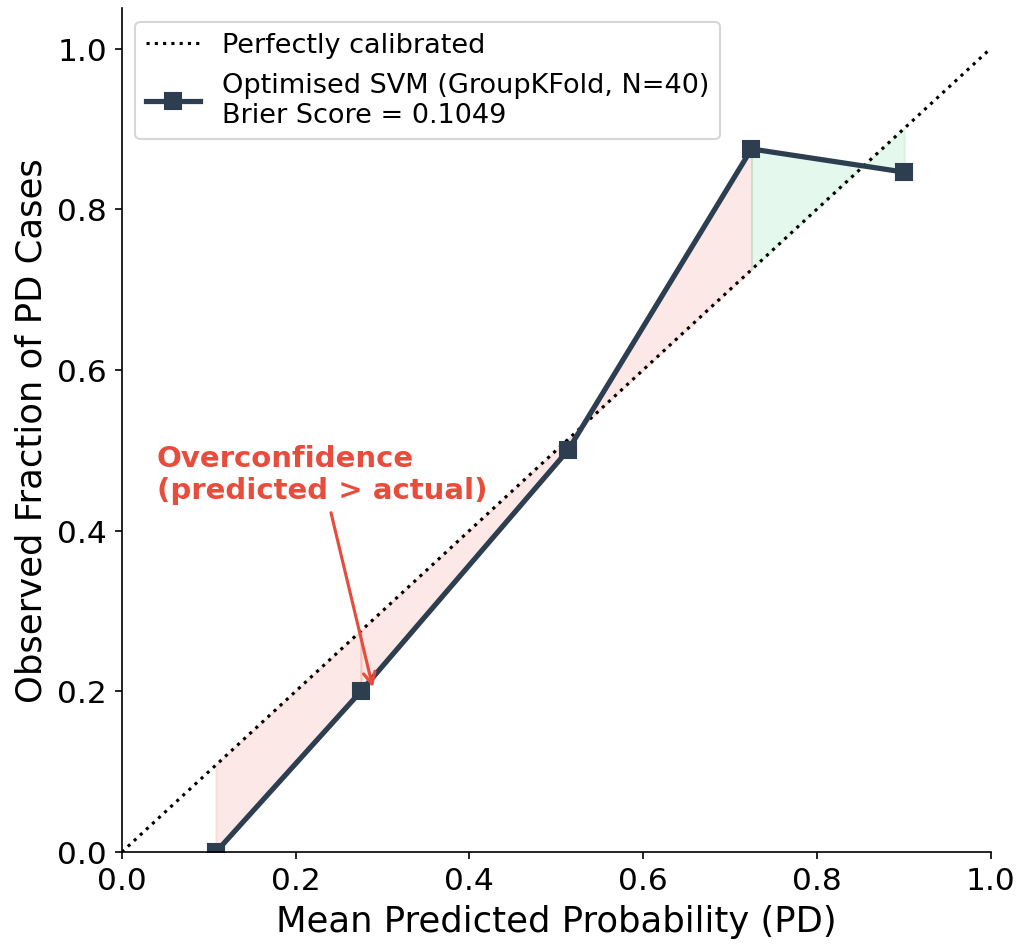
An estimated ten million people live with Parkinson's, yet timely diagnosis remains constrained by specialist assessment, costly imaging, and unequal care access. Phonation analysis offers a low-cost alternative: dopaminergic degeneration causes vocal impairments years before motor symptoms emerge, enabling community screening. However, existing ML approaches are limited by recording-level data leakage and opacity. This paper presents a four-phase acoustic framework-spanning signal acquisition, feature processing, and interpretable decision support-applied to a multi-type Parkinson's speech dataset (40 training, 28 blind-test). The framework enforces subject-level partitioning via GroupKFold to eliminate leakage, derives 104 participant-level acoustic features through multi-statistic aggregation (mean, median, standard deviation, interquartile range), and employs Bayesian optimisation using Optuna. The optimised SVM achieved 90.00% cross-validated accuracy, a 12.50 percentage-point improvement over the 77.50% benchmark. Cross-validated sensitivity was 95.00%, specificity 85.00%, Youden Index \(J=0.80\), Brier Score \(\mathrm{BS}=0.1049\). External validation on a held-out vowel-only cohort achieved 85.71% sensitivity, surpassing the benchmark. A permutation test (\(p=0.349\)) indicated no significant linear mapping between acoustic features and motor severity, motivating binary classification. Shapley Additive Explanations identified interquartile range of degree-of-voice-breaks and shimmer amplitude variability as primary diagnostic drivers, aligning with neuroacoustic evidence for aperiodic phonation. These results show that leakage prevention, variance-sensitive engineering, and transparent attribution together constitute a viable foundation for remote, telehealth-linked pre-screening instruments in resource-constrained settings.
Graphical Abstract
Keywords
Data Availability Statement
Funding
Conflicts of Interest
AI Use Statement
Ethical Approval and Consent to Participate
References
- Dorsey, E. R., Constantinescu, R., Thompson, J. P., Biglan, K. M., Holloway, R. G., Kieburtz, K., ... \& Tanner, C. M. (2007). Projected number of people with Parkinson disease in the most populous nations, 2005 through 2030. \textit{Neurology, 68}(5), 384–386. [\href{
[CrossRef] [Google Scholar] - Kalia, L. V., \& Lang, A. E. (2015). Parkinson's disease. \textit{The Lancet, 386}(9996), 896–912. [\href{
[CrossRef] [Google Scholar] - Postuma, R. B., Berg, D., Stern, M., Poewe, W., Olanow, C. W., Oertel, W., ... \& Deuschl, G. (2015). MDS clinical diagnostic criteria for Parkinson's disease. \textit{Movement disorders, 30}(12), 1591-1601. [\href{
[CrossRef] [Google Scholar] - Fearnley, J. M., \& Lees, A. J. (1991). Ageing and Parkinson's disease: substantia nigra regional selectivity. \textit{Brain, 114}(5), 2283-2301. [\href{
[CrossRef] [Google Scholar] - Ho, A. K., Iansek, R., Marigliani, C., Bradshaw, J. L., \& Gates, S. (1999). Speech impairment in a large sample of patients with Parkinson's disease. \textit{Behavioural neurology, 11}(3), 131-137. [\href{
[CrossRef] [Google Scholar] - Little, M. A., McSharry, P. E., Hunter, E. J., Spielman, J., \& Ramig, L. O. (2009). Suitability of dysphonia measurements for telemonitoring of Parkinson's disease. \textit{IEEE Transactions on Biomedical Engineering, 56}(4), 1010–1022. [\href{
[CrossRef] [Google Scholar] - National Institute for Health and Care Excellence. (2017). \textit{Parkinson's disease in adults: Diagnosis and management} (NICE Guideline NG71). Retrieved from \url{https://www.ncbi.nlm.nih.gov/books/NBK447153/}
[Google Scholar] - Tsanas, A., Little, M., McSharry, P., \& Ramig, L. (2009). Accurate telemonitoring of Parkinson's disease progression by non-invasive speech tests. \textit{Nature Precedings}, 1-1. [\href{
[CrossRef] [Google Scholar] - Sakar, B. E., Isenkul, M. E., Sakar, C. O., Sertbas, A., Gurgen, F., Delil, S., ... \& Kursun, O. (2013). Collection and analysis of a Parkinson speech dataset with multiple types of sound recordings. \textit{IEEE Journal of Biomedical and Health Informatics, 17}(4), 828–834. [\href{
[CrossRef] [Google Scholar] - Sakar, C. O., Serbes, G., Gunduz, A., Tunc, H. C., Nizam, H., Sakar, B. E., ... \& Apaydin, H. (2019). A comparative analysis of speech signal processing algorithms for Parkinson's disease classification and the use of the tunable Q-factor wavelet transform. \textit{Applied Soft Computing, 74}, 255-263. [\href{
[CrossRef] [Google Scholar] - Elshewey, A. M., Shams, M. Y., El-Rashidy, N., Elhady, A. M., Shohieb, S. M., \& Tarek, Z. (2023). Bayesian optimization with support vector machine model for Parkinson disease classification. \textit{Sensors, 23}(4), 2085. [\href{
[CrossRef] [Google Scholar] - Akiba, T., Sano, S., Yanase, T., Ohta, T., \& Koyama, M. (2019, July). Optuna: A next-generation hyperparameter optimization framework. In \textit{Proceedings of the 25th ACM SIGKDD international conference on knowledge discovery \& data mining} (pp. 2623-2631). ACM. [\href{
[CrossRef] [Google Scholar] - Saeb, S., Lonini, L., Jayaraman, A., Mohr, D. C., \& Kording, K. P. (2017). The need to approximate the use-case in clinical machine learning. \textit{Gigascience, 6}(5), gix019. [\href{
[CrossRef] [Google Scholar] - Shokrpour, S., MoghadamFarid, A., Bazzaz Abkenar, S., Haghi Kashani, M., Akbari, M., \& Sarvizadeh, M. (2025). Machine learning for Parkinson's disease: a comprehensive review of datasets, algorithms, and challenges. \textit{npj Parkinson's Disease, 11}(1), 187. [\href{
[CrossRef] [Google Scholar] - Raza, A., Ali, A., Kumar, A., Fatima, N., \& Ali, M. (2026). Bridging Predictive Modeling and Clinical Interpretability: An Explainable AI Approach to Parkinson's Disease Detection. \textit{Biomedical Informatics and Smart Healthcare, 2}(1), 20-37. [\href{
[CrossRef] [Google Scholar] - Holzinger, A., Langs, G., Denk, H., Zatloukal, K., \& Müller, H. (2019). Causability and explainability of artificial intelligence in medicine. \textit{WIREs Data Mining and Knowledge Discovery, 9}(4), e1312. [\href{
[CrossRef] [Google Scholar] - Lundberg, S. M., \& Lee, S. I. (2017). A unified approach to interpreting model predictions. \textit{Advances in neural information processing systems, 30}.
[Google Scholar] - Madany, M. E., Khalafallah, A., Ahmed, M. A., \& Shoukry, A. (2024, December). Diagnosis of Parkinson's disease using Kolmogorov-Arnold Networks. In \textit{2024 12th International Japan-Africa Conference on Electronics, Communications, and Computations (JAC-ECC)} (pp. 156-159). IEEE. [\href{
[CrossRef] [Google Scholar] - Farfoura, M. E., Alkhatib, A. A., \& Connie, T. (2026). Self-Explaining Neural Networks for Transparent Parkinson's Disease Screening. \textit{Sensors, 26}(9), 2671. [\href{
[CrossRef] [Google Scholar] - Teixeira, J. P., Oliveira, C., \& Lopes, C. (2013). Vocal acoustic analysis–jitter, shimmer and hnr parameters. \textit{Procedia technology, 9}, 1112-1122. [\href{
[CrossRef] [Google Scholar] - Mahajan, P., Uddin, S., Hajati, F., \& Moni, M. A. (2023, June). Ensemble learning for disease prediction: A review. In \textit{Healthcare} (Vol. 11, No. 12, p. 1808). MDPI. [\href{
[CrossRef] [Google Scholar] - Goberman, A. M., \& Coelho, C. (2002). Acoustic analysis of Parkinsonian speech I: Speech characteristics and L-Dopa therapy. \textit{NeuroRehabilitation, 17}(3), 237-246. [\href{
[CrossRef] [Google Scholar] - Rusz, J., Cmejla, R., Ruzickova, H., \& Ruzicka, E. (2011). Quantitative acoustic measurements for characterization of speech and voice disorders in early untreated Parkinson's disease. \textit{The journal of the Acoustical Society of America, 129}(1), 350-367. [\href{
[CrossRef] [Google Scholar]
Cite This Article
TY  - JOUR
AU  - Wyton, Ryan
AU  - Hasan, Raza
PY  - 2026
DA  - 2026/09/27
TI  - Non-Invasive Parkinson's Disease Screening from Vocal Biomarkers: A Subject-Level Machine Learning Framework with Bayesian Optimisation and Explainable AI
JO  - ICCK Transactions on Sensing, Communication, and Control
T2  - ICCK Transactions on Sensing, Communication, and Control
JF  - ICCK Transactions on Sensing, Communication, and Control
VL  - 3
IS  - 3
SP  - 197
EP  - 209
DO  - 10.62762/TSCC.2026.365257
UR  - https://www.icck.org/article/abs/TSCC.2026.365257
KW  - acoustic sensing
KW  - vocal biomarkers
KW  - multi-statistic feature fusion
KW  - remote health monitoring
KW  - intelligent decision support
KW  - explainable artificial intelligence
KW  - Bayesian optimisation
KW  - Parkinson's disease
AB  - An estimated ten million people live with Parkinson's, yet timely diagnosis remains constrained by specialist assessment, costly imaging, and unequal care access. Phonation analysis offers a low-cost alternative: dopaminergic degeneration causes vocal impairments years before motor symptoms emerge, enabling community screening. However, existing ML approaches are limited by recording-level data leakage and opacity. This paper presents a four-phase acoustic framework-spanning signal acquisition, feature processing, and interpretable decision support-applied to a multi-type Parkinson's speech dataset (40 training, 28 blind-test). The framework enforces subject-level partitioning via GroupKFold to eliminate leakage, derives 104 participant-level acoustic features through multi-statistic aggregation (mean, median, standard deviation, interquartile range), and employs Bayesian optimisation using Optuna. The optimised SVM achieved 90.00% cross-validated accuracy, a 12.50 percentage-point improvement over the 77.50% benchmark. Cross-validated sensitivity was 95.00%, specificity 85.00%, Youden Index \(J=0.80\), Brier Score \(\mathrm{BS}=0.1049\). External validation on a held-out vowel-only cohort achieved 85.71% sensitivity, surpassing the benchmark. A permutation test (\(p=0.349\)) indicated no significant linear mapping between acoustic features and motor severity, motivating binary classification. Shapley Additive Explanations identified interquartile range of degree-of-voice-breaks and shimmer amplitude variability as primary diagnostic drivers, aligning with neuroacoustic evidence for aperiodic phonation. These results show that leakage prevention, variance-sensitive engineering, and transparent attribution together constitute a viable foundation for remote, telehealth-linked pre-screening instruments in resource-constrained settings.
SN  - 3068-9287
PB  - Institute of Central Computation and Knowledge
LA  - English
ER  -
@article{Wyton2026NonInvasiv,
  author = {Ryan Wyton and Raza Hasan},
  title = {Non-Invasive Parkinson's Disease Screening from Vocal Biomarkers: A Subject-Level Machine Learning Framework with Bayesian Optimisation and Explainable AI},
  journal = {ICCK Transactions on Sensing, Communication, and Control},
  year = {2026},
  volume = {3},
  number = {3},
  pages = {197-209},
  doi = {10.62762/TSCC.2026.365257},
  url = {https://www.icck.org/article/abs/TSCC.2026.365257},
  abstract = {An estimated ten million people live with Parkinson's, yet timely diagnosis remains constrained by specialist assessment, costly imaging, and unequal care access. Phonation analysis offers a low-cost alternative: dopaminergic degeneration causes vocal impairments years before motor symptoms emerge, enabling community screening. However, existing ML approaches are limited by recording-level data leakage and opacity. This paper presents a four-phase acoustic framework-spanning signal acquisition, feature processing, and interpretable decision support-applied to a multi-type Parkinson's speech dataset (40 training, 28 blind-test). The framework enforces subject-level partitioning via GroupKFold to eliminate leakage, derives 104 participant-level acoustic features through multi-statistic aggregation (mean, median, standard deviation, interquartile range), and employs Bayesian optimisation using Optuna. The optimised SVM achieved 90.00\% cross-validated accuracy, a 12.50 percentage-point improvement over the 77.50\% benchmark. Cross-validated sensitivity was 95.00\%, specificity 85.00\%, Youden Index \(J=0.80\), Brier Score \(\mathrm{BS}=0.1049\). External validation on a held-out vowel-only cohort achieved 85.71\% sensitivity, surpassing the benchmark. A permutation test (\(p=0.349\)) indicated no significant linear mapping between acoustic features and motor severity, motivating binary classification. Shapley Additive Explanations identified interquartile range of degree-of-voice-breaks and shimmer amplitude variability as primary diagnostic drivers, aligning with neuroacoustic evidence for aperiodic phonation. These results show that leakage prevention, variance-sensitive engineering, and transparent attribution together constitute a viable foundation for remote, telehealth-linked pre-screening instruments in resource-constrained settings.},
  keywords = {acoustic sensing, vocal biomarkers, multi-statistic feature fusion, remote health monitoring, intelligent decision support, explainable artificial intelligence, Bayesian optimisation, Parkinson's disease},
  issn = {3068-9287},
  publisher = {Institute of Central Computation and Knowledge}
}
Article Metrics
Publisher's Note
ICCK stays neutral with regard to jurisdictional claims in published maps and institutional affiliations.
Rights and Permissions


Portico
