

Attention-Guided Wheat Disease Recognition Network through Multi-Scale Feature Optimization






Article Information
Abstract
Accurate and timely detection of wheat diseases remains crucial for sustainable agriculture, particularly in major wheat-producing regions. Wheat diseases pose a significant threat to global food security, need precise and timely detection to promote sustainable agriculture. Existing approaches consistently employ single-scale features with shallow-layered convolutional neural networks (CNNs). To bridge the research gaps, we introduce a novel Multi-Scale Wheat Disease Network (MSWDNet) with feature collaboration for wheat disease recognition supported by a comprehensive dataset collected from wheat fields. This study fills research gaps by introducing a novel technique to improve detection accuracy and promote wheat agriculture. Our network uses multistage architecture with progressive feature fusion, incorporating dilated convolution blocks and efficient channel attention mechanisms to capture both fine-grained details and broader contextual patterns. The custom dataset comprises 3,351 high-quality images across five classes collected under diverse environmental conditions. Through extensive experimentation with various CNN backbones, EfficientNet-B7 emerged as the optimal feature extractor, achieving 92.55% accuracy. Our complete architecture, enhanced with multi-scale feature integration and channel attention mechanisms, achieved 98.50% accuracy. Comprehensive ablation studies validate the effectiveness of each architectural component.
Graphical Abstract
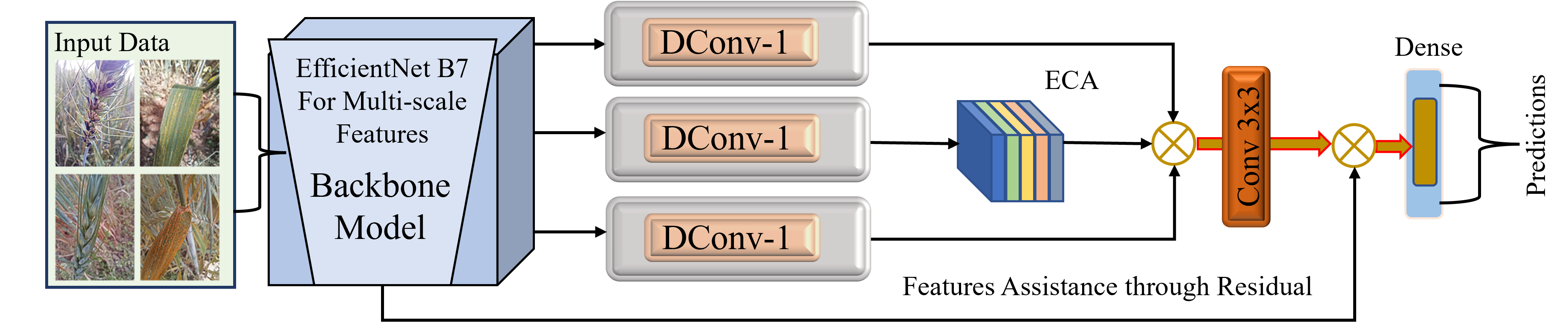
Keywords
Data Availability Statement
Funding
Conflicts of Interest
Ethical Approval and Consent to Participate
References
- Shiferaw, B., Smale, M., Braun, H. J., Duveiller, E., Reynolds, M., & Muricho, G. (2013). Crops that feed the world 10. Past successes and future challenges to the role played by wheat in global food security. Food Security, 5(3), 291–317.
[CrossRef] [Google Scholar] - Erenstein, O., Jaleta, M., Mottaleb, K. A., Sonder, K., Donovan, J., & Braun, H. J. (2022). Global trends in wheat production, consumption and trade. In Wheat Improvement: Food Security in a Changing Climate (pp. 47–66). Springer International Publishing.
[CrossRef] [Google Scholar] - Chai, Y., Senay, S., Horvath, D., & Pardey, P. (2022). Multi-peril pathogen risks to global wheat production: A probabilistic loss and investment assessment. Frontiers in Plant Science, 13, 1034600.
[CrossRef] [Google Scholar] - Figueroa, M., Hammond-Kosack, K. E., & Solomon, P. S. (2018). A review of wheat diseases—a field perspective. Molecular Plant Pathology, 19(6), 1523–1536.
[CrossRef] [Google Scholar] - Kloppe, T., Boshoff, W., Pretorius, Z., Lesch, D., Akin, B., Morgounov, A., ... & Cowger, C. (2022). Virulence of Blumeria graminis f. sp. tritici in Brazil, South Africa, Turkey, Russia, and Australia. Frontiers in Plant Science, 13, 954958.
[CrossRef] [Google Scholar] - Savary, S., Willocquet, L., Pethybridge, S. J., Esker, P., McRoberts, N., & Nelson, A. (2019). The global burden of pathogens and pests on major food crops. Nature ecology & evolution, 3(3), 430-439.
[CrossRef] [Google Scholar] - Singh, J., Chhabra, B., Raza, A., Yang, S. H., & Sandhu, K. S. (2023). Important wheat diseases in the US and their management in the 21st century. Frontiers in Plant Science, 13, 1010191.
[CrossRef] [Google Scholar] - Jahan, N., Flores, P., Liu, Z., Friskop, A., Mathew, J. J., & Zhang, Z. (2020). Detecting and distinguishing wheat diseases using image processing and machine learning algorithms. In 2020 ASABE Annual International Virtual Meeting (p. 1). ASABE.
[CrossRef] [Google Scholar] - Dixit, A., & Nema, S. (2018). Wheat leaf disease detection using machine learning method-a review. International Journal of Computer Science and Mobile Computing, 7(5), 124–129.
[Google Scholar] - Sood, S., & Singh, H. (2020). An implementation and analysis of deep learning models for the detection of wheat rust disease. In 2020 3rd International Conference on Intelligent Sustainable Systems (ICISS) (pp. 341–347). IEEE.
[CrossRef] [Google Scholar] - Xu, L., Cao, B., Zhao, F., Ning, S., Xu, P., Zhang, W., & Hou, X. (2023). Wheat leaf disease identification based on deep learning algorithms. Physiological and Molecular Plant Pathology, 123, 101940.
[CrossRef] [Google Scholar] - Reis, H. C., & Turk, V. (2024). Integrated deep learning and ensemble learning model for deep feature-based wheat disease detection. Microchemical Journal, 197, 109790.
[CrossRef] [Google Scholar] - Barbedo, J. G. A. (2019). Plant disease identification from individual lesions and spots using deep learning. Biosystems engineering, 180, 96-107.
[CrossRef] [Google Scholar] - Ashraf, M., Abrar, M., Qadeer, N., Alshdadi, A. A., Sabbah, T., & Khan, M. A. (2023). A Convolutional Neural Network Model for Wheat Crop Disease Prediction. Computers, Materials & Continua, 75(2), 1–15. http://doi.org/10.32604/cmc.2023.035498
[Google Scholar] - Kumar, D., & Kukreja, V. (2022). Deep learning in wheat diseases classification: A systematic review. Multimedia Tools and Applications, 81(7), 10143-10187.
[CrossRef] [Google Scholar] - Kumar, D., & Kukreja, V. (2022). Automatic classification of wheat rust diseases using deep convolutional neural networks. In 2021 9th International Conference on Reliability, Infocom Technologies and Optimization (ICRITO) (pp. 1–6). IEEE.
[CrossRef] [Google Scholar] - Sharma, T., & Sethi, G. K. (2023). Classification of image-based wheat leaf diseases using deep learning approach: A survey. Journal of Scientific Research, 15(2), 421--443.
[CrossRef] [Google Scholar] - Haider, W., Rehman, A. U., Durrani, N. M., & Rehman, S. U. (2021). A generic approach for wheat disease classification and verification using expert opinion for knowledge-based decisions. IEEE Access, 9, 31104–31129.
[CrossRef] [Google Scholar] - Khan, H., Haq, I. U., Munsif, M., Khan, S. U., & Lee, M. Y. (2022). Automated wheat diseases classification framework using advanced machine learning technique. Agriculture, 12(8), 1226.
[CrossRef] [Google Scholar] - Goyal, L., Sharma, C. M., Singh, A., & Singh, P. K. (2021). Leaf and spike wheat disease detection & classification using an improved deep convolutional architecture. Informatics in Medicine Unlocked, 25, 100642.
[CrossRef] [Google Scholar] - Shafi, U., Mumtaz, R., Haq, I. U., Hafeez, M., Iqbal, N., Shaukat, A., Zaidi, S. M. H., & Mahmood, Z. (2022). Wheat yellow rust disease infection type classification using texture features. Sensors, 22(1), 146.
[CrossRef] [Google Scholar] - Nigam, S., Jain, R., Marwaha, S., Arora, A., Haque, M. A., Dheeraj, A., & Singh, V. K. (2023). Deep transfer learning model for disease identification in wheat crop. Ecological Informatics, 75, 102068.
[CrossRef] [Google Scholar] - Alharbi, A., Khan, M. U. G., & Tayyaba, B. (2023). Wheat disease classification using continual learning. IEEE Access, 11, 90016–90026.
[CrossRef] [Google Scholar] - Jiang, J., Liu, H., Zhao, C., He, C., Ma, J., Cheng, T., Zhu, Y., Cao, W., & Yao, X. (2022). Evaluation of diverse convolutional neural networks and training strategies for wheat leaf disease identification with field-acquired photographs. Remote Sensing, 14(14), 3446.
[CrossRef] [Google Scholar] - Li, J., Liu, H., Zhao, J., Cao, Q., Tian, Y., Zhu, Y., Cao, W., & Cheng, T. (2023). Recognition of wheat leaf diseases using lightweight convolutional neural networks against complex backgrounds. Life, 13(11), 2125.
[CrossRef] [Google Scholar] - Zhao, J., Fang, Y., Chu, G., Yan, H., Hu, L., & Huang, L. (2020). Identification of leaf-scale wheat powdery mildew (Blumeria graminis f. sp. Tritici) combining hyperspectral imaging and an SVM classifier. Plants, 9(8), 936.
[CrossRef] [Google Scholar] - Liu, Z. L., Zhang, W., bao Shu, S., & Jin, X. (2013, August). Image recognition of wheat disease based on RBF support vector machine. In 2013 international conference on advanced computer science and electronics information (ICACSEI 2013) (pp. 307-310). Atlantis Press.
[CrossRef] [Google Scholar] - Xu, P., Wu, G., Guo, Y., Yang, H., & Zhang, R. (2017). Automatic wheat leaf rust detection and grading diagnosis via embedded image processing system. Procedia Computer Science, 107, 836–841.
[CrossRef] [Google Scholar] - Zhang, J., Huang, Y., Pu, R., Gonzalez-Moreno, P., Yuan, L., Wu, K., & Huang, W. (2019). Monitoring plant diseases and pests through remote sensing technology: A review. Computers and electronics in agriculture, 165, 104943.
[CrossRef] [Google Scholar] - Ferentinos, K. P. (2018). Deep learning models for plant disease detection and diagnosis. Computers and electronics in agriculture, 145, 311-318.
[CrossRef] [Google Scholar] - Atila, Ü., Uçar, M., Akyol, K., & Uçar, E. (2021). Plant leaf disease classification using EfficientNet deep learning model. Ecological Informatics, 61, 101182.
[CrossRef] [Google Scholar] - Wang, H., Qin, F., Liu, Q., Ruan, L., Wang, R., Ma, Z., ... & Wang, H. (2015). Identification and disease index inversion of wheat stripe rust and wheat leaf rust based on hyperspectral data at canopy level. Journal of Spectroscopy, 2015(1), 651810.
[CrossRef] [Google Scholar] - Bao, W., Zhao, J., Hu, G., Zhang, D., Huang, L., & Liang, D. (2021). Identification of wheat leaf diseases and their severity based on elliptical-maximum margin criterion metric learning. Sustainable Computing: Informatics and Systems, 30, 100526.
[CrossRef] [Google Scholar] - Aboneh, T., Rorissa, A., Srinivasagan, R., & Gemechu, A. (2021). Computer vision framework for wheat disease identification and classification using Jetson GPU infrastructure. Technologies, 9(3), 47.
[CrossRef] [Google Scholar] - Fang, X., Zhen, T., & Li, Z. (2023). Lightweight multiscale CNN model for wheat disease detection. Applied Sciences, 13(9), 5801.
[CrossRef] [Google Scholar] - Kamilaris, A., & Prenafeta-Boldú, F. X. (2018). Deep learning in agriculture: A survey. Computers and electronics in agriculture, 147, 70-90.
[CrossRef] [Google Scholar] - Deng, J., Lv, X., Yang, L., Zhao, B., Zhou, C., ... & Shi, J. (2022). Assessing macro disease index of wheat stripe rust based on SegFormer with complex background in the field. Sensors, 22(15), 5676.
[CrossRef] [Google Scholar] - Su, W. H., Zhang, J., Yang, C., Page, R., Szinyei, T., ... & Steffenson, B. J. (2020). Automatic evaluation of wheat resistance to fusarium head blight using dual mask-RCNN deep learning frameworks in computer vision. Remote Sensing, 13(1), 26.
[CrossRef] [Google Scholar] - Shafi, U., Mumtaz, R., Qureshi, M. D. M., Mahmood, Z., Tanveer, S. K., ... & Zaidi, S. M. H. (2023). Embedded AI for wheat yellow rust infection type classification. IEEE Access, 11, 23726–23738.
[CrossRef] [Google Scholar] - Too, E. C., Yujian, L., Njuki, S., & Yingchun, L. (2019). A comparative study of fine-tuning deep learning models for plant disease identification. Computers and Electronics in Agriculture, 161, 272-279.
[CrossRef] [Google Scholar] - Saleem, M. H., Potgieter, J., & Arif, K. M. (2019). Plant disease detection and classification by deep learning. Plants, 8(11), 468.
[CrossRef] [Google Scholar] - Mi, Z., Zhang, X., Su, J., Han, D., & Su, B. (2020). Wheat stripe rust grading by deep learning with attention mechanism and images from mobile devices. Frontiers in Plant Science, 11, 558126.
[CrossRef] [Google Scholar] - Bao, W., Yang, X., Liang, D., Hu, G., & Yang, X. (2021). Lightweight convolutional neural network model for field wheat ear disease identification. Computers and Electronics in Agriculture, 189, 106367.
[CrossRef] [Google Scholar] - Sahu, N., & Bhat, A. (2023, May). A survey: Machine learning and deep learning in wheat disease detection and classification. In 2023 7th International Conference on Intelligent Computing and Control Systems (ICICCS) (pp. 21-27). IEEE.
[CrossRef] [Google Scholar] - Paymode, A. S., & Malode, V. B. (2022). Transfer learning for multi-crop leaf disease image classification using convolutional neural network VGG. Artificial Intelligence in Agriculture, 6, 23-33.
[CrossRef] [Google Scholar] - Wei, K., Chen, B., Zhang, J., Fan, S., Wu, K., Liu, G., & Chen, D. (2022). Explainable deep learning study for leaf disease classification. Agronomy, 12(5), 1035.
[CrossRef] [Google Scholar] - Hossen, M. H., Mohibullah, M., Chowdhury, S. M., Ahmed, T., Acharjee, S., & Panna, M. B. (2022). Wheat diseases detection and classification using convolutional neural network (CNN). International Journal of Advanced Computer Science and Applications, 13(11).
[CrossRef] [Google Scholar] - Genaev, M. A., Skolotneva, E. S., Gultyaeva, E. I., Orlova, E. A., Bechtold, N. P., & Afonnikov, D. A. (2021). Image-based wheat fungi disease identification by deep learning. Plants, 10(8), 1500.
[CrossRef] [Google Scholar] - Ennadifi, E., Laraba, S., Vincke, D., Mercatoris, B., & Gosselin, B. (2020). Wheat diseases classification and localization using convolutional neural networks and GradCAM visualization. In 2020 International Conference on Intelligent Systems and Computer Vision (ISCV) (pp. 1–5). IEEE.
[CrossRef] [Google Scholar] - Zhang, Z., Flores, P., Friskop, A., Liu, Z., Igathinathane, C., Han, X., ... & Shreya, S. (2022). Enhancing wheat disease diagnosis in a greenhouse using image deep features and parallel feature fusion. Frontiers in Plant Science, 13, 834447.
[CrossRef] [Google Scholar] - Mao, R., Zhang, Y., Wang, Z., Hao, X., Zhu, T., Gao, S., & Hu, X. (2024). DAE-Mask: a novel deep-learning-based automatic detection model for in-field wheat diseases. Precision Agriculture, 25(2), 785-810.
[CrossRef] [Google Scholar] - Tang, Z., Wang, M., Schirrmann, M., Dammer, K. H., Li, X., Brueggeman, R., & Zhang, Z. (2023). Affordable high throughput field detection of wheat stripe rust using deep learning with semi-automated image labeling. Computers and Electronics in Agriculture, 207, 107709.
[CrossRef] [Google Scholar] - Lin, Z., Mu, S., Huang, F., Mateen, K. A., Wang, M., Gao, W., & Jia, J. (2019). A unified matrix-based convolutional neural network for fine-grained image classification of wheat leaf diseases. IEEE Access, 7, 11570–11590.
[CrossRef] [Google Scholar] - Pan, Q., Gao, M., Wu, P., Yan, J., & AbdelRahman, M. A. (2022). Image classification of wheat rust based on ensemble learning. Sensors, 22(16), 6047.
[CrossRef] [Google Scholar] - Islam, M., Aloraini, M., Habib, S., Alanazi, M. D., Khan, I., & Khan, A. (2024). Optimal Features Driven Attention Network with Medium-Scale Benchmark for Wheat Diseases Recognition. IEEE Access.
[CrossRef] [Google Scholar] - Long, M., Hartley, M., Morris, R. J., & Brown, J. K. (2023). Classification of wheat diseases using deep learning networks with field and glasshouse images. Plant Pathology, 72(3), 536–547.
[CrossRef] [Google Scholar] - Wang, Q., Wu, B., Zhu, P., Li, P., Zuo, W., & Hu, Q. (2020). ECA-Net: Efficient channel attention for deep neural networks. In Proceedings of the IEEE/CVF Conference on Computer Vision and Pattern Recognition (CVPR) (pp. 11531–11539).
[CrossRef] [Google Scholar] - Li, S., Liu, S., Ji, M., Cao, Y., & Yun, B. (2024). GLNet: global-local feature network for wheat leaf disease image classification. Frontiers in Plant Science, 15, 1471705.
[CrossRef] [Google Scholar] - Schirrmann, M., Landwehr, N., Giebel, A., Garz, A., & Dammer, K. H. (2021). Early detection of stripe rust in winter wheat using deep residual neural networks. Frontiers in Plant Science, 12, 469689.
[CrossRef] [Google Scholar]
Cited By (8)
-
Yantong Chen, Yuan Gao, Junsheng Wang. Identification method for multiple similar crop pests: A visual language model combined with coarse–finegrain cross‐modal matching.
Pest Management Science, 2026 , 82 (7).
[CrossRef] -
N. M. Deepika, K. Sreeama Murthy. AgroAttenNet: A CNN–BiLSTM–Attention–Random Forest Hybrid Model for Temporal Groundnut Yield Forecasting.
Journal of Advances in Information Technology, 2026 , 17 (4).
[CrossRef] -
Atarud Said, Afsheen Khalid, Muhammad Shahan Ibad, Dilawar khan. AN EVALUATION OF PERFORMANCE OF ATTENTION MECHANISMS AND BATCH NORMALIZATION IN DEEP LEARNING MODELS OF COMPUTER VISION.
NED University Journal of Research, 2026 , 23 (2).
[CrossRef] -
Banghong Wu, Yang Cao, Jing Yang, Jiheng Wu. AR-FRSG: Fine-grained agricultural image recognition via feature space reconstruction and semantically guided fusion.
Expert Systems with Applications, 2026 , 316 .
[CrossRef] -
Siyuan Qin, Jinsong Wu. .
Advanced Intelligent Computing Technology and Applications, 2025 , 15868 .
[CrossRef] -
M Chilakarao, Santi Kumari Behera, Ashoka Kumar Ratha, Prabira Kumar Sethy. Detection of wheat panicle diseases with synthetic oversampling and quantum kernel-enhanced ResNet50-SVM.
Engineering Research Express, 2025 , 7 (3).
[CrossRef] -
Yingchun Xie, Wei Su, Chongliang Zhong, Chuan Cai, Yongna Yuan. Gloss-free sign language translation based on fusion attention.
Applied Soft Computing, 2025 , 185 .
[CrossRef] -
Zixuan Guo, Sameer Kumar, Houbin Wang, Jingyi Li. AI-Driven Recognition and Sustainable Preservation of Ancient Murals: The DKR-YOLO Framework.
Heritage, 2025 , 8 (10).
[CrossRef]
Cite This Article
TY  - JOUR
AU  - Ullah, Niamat
AU  - Ahmad, Bilal
AU  - Khan, Aqib
AU  - Khan, Ismail
AU  - Khan, Ikram Majeed
AU  - Khan, Salman
PY  - 2025
DA  - 2025/03/05
TI  - Attention-Guided Wheat Disease Recognition Network through Multi-Scale Feature Optimization
JO  - ICCK Transactions on Sensing, Communication, and Control
T2  - ICCK Transactions on Sensing, Communication, and Control
JF  - ICCK Transactions on Sensing, Communication, and Control
VL  - 2
IS  - 1
SP  - 11
EP  - 24
DO  - 10.62762/TSCC.2025.435806
UR  - https://www.icck.org/article/abs/TSCC.2025.435806
KW  - visual intelligence
KW  - wheat diseases
KW  - deep learning
KW  - machine vision
KW  - attention network
AB  - Accurate and timely detection of wheat diseases remains crucial for sustainable agriculture, particularly in major wheat-producing regions. Wheat diseases pose a significant threat to global food security, need precise and timely detection to promote sustainable agriculture. Existing approaches consistently employ single-scale features with shallow-layered convolutional neural networks (CNNs). To bridge the research gaps, we introduce a novel Multi-Scale Wheat Disease Network (MSWDNet) with feature collaboration for wheat disease recognition supported by a comprehensive dataset collected from wheat fields. This study fills research gaps by introducing a novel technique to improve detection accuracy and promote wheat agriculture. Our network uses multistage architecture with progressive feature fusion, incorporating dilated convolution blocks and efficient channel attention mechanisms to capture both fine-grained details and broader contextual patterns. The custom dataset comprises 3,351 high-quality images across five classes collected under diverse environmental conditions. Through extensive experimentation with various CNN backbones, EfficientNet-B7 emerged as the optimal feature extractor, achieving 92.55% accuracy. Our complete architecture, enhanced with multi-scale feature integration and channel attention mechanisms, achieved 98.50% accuracy. Comprehensive ablation studies validate the effectiveness of each architectural component.
SN  - 3068-9287
PB  - Institute of Central Computation and Knowledge
LA  - English
ER  -
@article{Ullah2025AttentionG,
  author = {Niamat Ullah and Bilal Ahmad and Aqib Khan and Ismail Khan and Ikram Majeed Khan and Salman Khan},
  title = {Attention-Guided Wheat Disease Recognition Network through Multi-Scale Feature Optimization},
  journal = {ICCK Transactions on Sensing, Communication, and Control},
  year = {2025},
  volume = {2},
  number = {1},
  pages = {11-24},
  doi = {10.62762/TSCC.2025.435806},
  url = {https://www.icck.org/article/abs/TSCC.2025.435806},
  abstract = {Accurate and timely detection of wheat diseases remains crucial for sustainable agriculture, particularly in major wheat-producing regions. Wheat diseases pose a significant threat to global food security, need precise and timely detection to promote sustainable agriculture. Existing approaches consistently employ single-scale features with shallow-layered convolutional neural networks (CNNs). To bridge the research gaps, we introduce a novel Multi-Scale Wheat Disease Network (MSWDNet) with feature collaboration for wheat disease recognition supported by a comprehensive dataset collected from wheat fields. This study fills research gaps by introducing a novel technique to improve detection accuracy and promote wheat agriculture. Our network uses multistage architecture with progressive feature fusion, incorporating dilated convolution blocks and efficient channel attention mechanisms to capture both fine-grained details and broader contextual patterns. The custom dataset comprises 3,351 high-quality images across five classes collected under diverse environmental conditions. Through extensive experimentation with various CNN backbones, EfficientNet-B7 emerged as the optimal feature extractor, achieving 92.55\% accuracy. Our complete architecture, enhanced with multi-scale feature integration and channel attention mechanisms, achieved 98.50\% accuracy. Comprehensive ablation studies validate the effectiveness of each architectural component.},
  keywords = {visual intelligence, wheat diseases, deep learning, machine vision, attention network},
  issn = {3068-9287},
  publisher = {Institute of Central Computation and Knowledge}
}
Publisher's Note
ICCK stays neutral with regard to jurisdictional claims in published maps and institutional affiliations.
Rights and Permissions


Portico
