

Primary Thought on Artificial Intelligence (AI) Enhanced Control Engineering Education



Article Information
Abstract
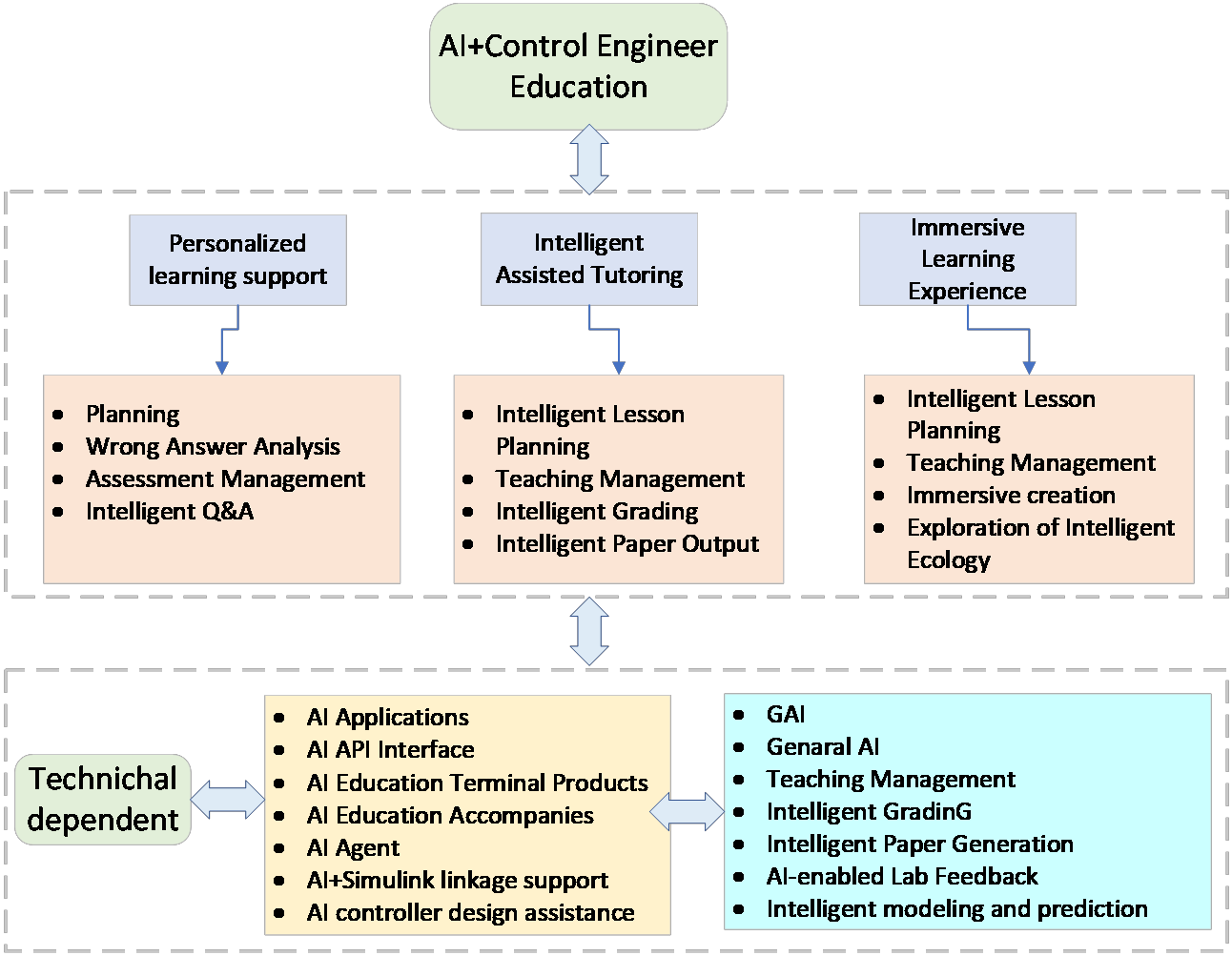
Artificial intelligence (AI) is reshaping engineering education by offering adaptive, interactive, and data-driven learning environments. This paper examines the primary roles of AI in enhancing control engineering education (CEE), with emphasis on sensing-oriented applications such as sensor-based system modelling, AI-assisted signal processing, and data-driven state estimation-domains that underpin modern sensing, communication, and control systems. The paper discusses how AI tools, particularly MATLAB and Simulink integrated with machine learning and reinforcement learning capabilities, can serve as effective pedagogical instruments for teaching complex topics including nonlinear control, adaptive control, and sensor fusion. Key benefits-such as personalised learning, real-time simulation, and automated feedback-are identified alongside significant challenges, including assessment integrity, over-reliance on AI, algorithmic bias, and ethical concerns. The central argument is that AI should function as a tool to augment the teaching-learning process rather than a shortcut to circumvent genuine intellectual engagement, and that its integration into CEE requires careful pedagogical design, ethical awareness, and balanced curriculum planning.
Graphical Abstract
Keywords
Data Availability Statement
Funding
Conflicts of Interest
Ethical Approval and Consent to Participate
References
- Nise, N. S. (2019). Control systems engineering. John Wiley & Sons.
[Google Scholar] - Zawacki-Richter, O., Marín, V. I., Bond, M., & Gouverneur, F. (2019). Systematic review of research on artificial intelligence applications in higher education–where are the educators?. International journal of educational technology in higher education, 16(1), 39.
[CrossRef] [Google Scholar] - Zhang, K., & Aslan, A. B. (2021). AI technologies for education: Recent research & future directions. Computers and Education: Artificial Intelligence, 2, 100025.
[CrossRef] [Google Scholar] - Zhai, X., Chu, X., Chai, C. S., Jong, M. S. Y., Istenic, A., Spector, M., ... & Li, Y. (2021). A Review of Artificial Intelligence (AI) in Education from 2010 to 2020. Complexity, 2021(1), 8812542.
[CrossRef] [Google Scholar] - Liu, C., Wang, G. C., & Wang, H. F. (2025). The application of artificial intelligence in engineering education: A systematic review. IEEE Access.
[CrossRef] [Google Scholar] - Rahiman, H. U., & Kodikal, R. (2024). Revolutionizing education: Artificial intelligence empowered learning in higher education. Cogent Education, 11(1), 2293431.
[CrossRef] [Google Scholar] - Tan, K., Pang, T., Fan, C., & Yu, S. (2023). Towards applying powerful large ai models in classroom teaching: Opportunities, challenges and prospects. arXiv preprint arXiv:2305.03433.
[CrossRef] [Google Scholar] - Ouyang, F., Wu, M., Zheng, L., Zhang, L., & Jiao, P. (2023). Integration of artificial intelligence performance prediction and learning analytics to improve student learning in online engineering course. International Journal of Educational Technology in Higher Education, 20(1), 4.
[CrossRef] [Google Scholar] - Rossiter, J. A., Pasik-Duncan, B., Dormido, S., Vlacic, L., Jones, B., & Murray, R. (2018). A survey of good practice in control education. European Journal of Engineering Education, 43(6), 801-823.
[CrossRef] [Google Scholar] - Rossiter, J. A., Cassandras, C. G., Hespanha, J., Dormido, S., de la Torre, L., Ranade, G., ... & Parisini, T. (2023). Control education for societal-scale challenges: A community roadmap. Annual Reviews in Control, 55, 1-17.
[CrossRef] [Google Scholar] - Ramos-Paja, C. A., Scarpetta, J. M. R. R., & Martinez-Salamero, L. (2010). Integrated learning platform for internet-based control-engineering education. IEEE Transactions on Industrial Electronics, 57(10), 3284–3296.
[CrossRef] [Google Scholar] - Meok, N. J., Kamdi, W., & Sutadji, E. (2024). Effectiveness of Matlab-based Learning and Thinking Styles (InternalExternal) on Students' Higher Order Thinking Skills. International Journal of Instruction, 17(2), 685–706.
[CrossRef] [Google Scholar] - Al-Nsour, R. (2024). AI Tools in Matlab Course Education: Instructor Point of View. Journal of Computing Sciences in Colleges, 40(2), 95–104. https://dl.acm.org/doi/abs/10.5555/3715622.3715635
[Google Scholar] - Wang, S., Wang, F., Zhu, Z., Wang, J., Tran, T., & Du, Z. (2024). Artificial intelligence in education: A systematic literature review. Expert systems with applications, 252, 124167.
[CrossRef] [Google Scholar] - Chiu, T. K. (2024). Future research recommendations for transforming higher education with generative AI. Computers and Education: Artificial Intelligence, 6, 100197.
[CrossRef] [Google Scholar] - Bachmann, J. E. C., Silveira, I. F., & Martins, V. F. (2024). Digital Twins for Education: A Literature Review. Simpósio Brasileiro de Informática na Educação (SBIE), 722-736.
[CrossRef] [Google Scholar] - Blackwell, C., & Rocke, S. (2024, October). WIP: A Review of Digital Twin Technology in Undergraduate Control Engineering Education: Applications, Challenges, and Future Directions. In 2024 IEEE Frontiers in Education Conference (FIE) (pp. 1–5). IEEE.
[CrossRef] [Google Scholar] - Selwyn, N. (2024). On the limits of artificial intelligence (AI) in education. Nordisk Tidsskrift for Pedagogikk og Kritikk, 10(1), 3–14.
[CrossRef] [Google Scholar] - Chen, H. (2024). The ethical challenges of educational artificial intelligence and coping measures: A discussion in the context of the 2024 World Digital Education Conference. Science Insights Education Frontiers, 20(2), 3263–3281.
[CrossRef] [Google Scholar] - Crompton, H., & Burke, D. (2023). Artificial intelligence in higher education: the state of the field. International Journal of Educational Technology in Higher Education, 20(1), 22.
[CrossRef] [Google Scholar] - Kock, Z. J., Salinas-Hernández, U., & Pepin, B. (2025). Engineering Students' Initial Use Schemes of ChatGPT as an Instrument for Learning. Digital Experiences in Mathematics Education, 11(1), 192-218.
[CrossRef] [Google Scholar] - Wu, F., Dang, Y., & Li, M. (2025). A Systematic Review of Responses, Attitudes, and Utilization Behaviors on Generative AI for Teaching and Learning in Higher Education. Behavioral Sciences, 15(4), 467.
[CrossRef] [Google Scholar] - Khalil, A. F., & Rostam, S. (2024). Machine learning-based predictive maintenance for fault detection in rotating machinery: A case study. Engineering, Technology & Applied Science Research, 14(2), 13181-13189.
[CrossRef] [Google Scholar] - Oliveira, P. B. D. M., & Vrančić, D. (2024). Evaluation of GPTs for control engineering education: towards artificial general intelligence. IFAC-PapersOnLine, 58(7), 97–102.
[CrossRef] [Google Scholar] - Fahad Mon, B., Wasfi, A., Hayajneh, M., Slim, A., & Abu Ali, N. (2023, September). Reinforcement learning in education: A literature review. Informatics, 10(3), 74.
[CrossRef] [Google Scholar] - Fuchs, K. (2023, May). Exploring the opportunities and challenges of NLP models in higher education: is Chat GPT a blessing or a curse?. Frontiers in education, 8, 1166682. Frontiers Media SA.
[CrossRef] [Google Scholar] - Felix, J., & Webb, L. (2024). Use of artificial intelligence in education delivery and assessment. UK Parliament POST. https://researchbriefings.files.parliament.uk/documents/POST-PN-0712/POST-PN-0712.pdf (Accessed on 20 May 2025)
[Google Scholar] - Zacher, S. (2020). Digital twins for education and study of engineering sciences. International Journal on Engineering, Science and Technology, 2(2), 61–69. https://ijonest.net/index.php/ijonest/article/view/17
[Google Scholar] - Schoen, M. P. (2023). Introduction to intelligent systems, control, and machine learning using MATLAB. Cambridge University Press.
[Google Scholar] - Yasar, C. F. Integrating intelligent control systems into engineering education with MATLAB and Simulink. Retrieved from https://uk.mathworks.com/videos/teaching-intelligent-control-systems-with-matlab-and-simulink-1738858390300.html (Accessed on 20 May 2025)
[Google Scholar] - Baker, R. S., & Hawn, A. (2022). Algorithmic bias in education. International journal of artificial intelligence in education, 32(4), 1052-1092.
[CrossRef] [Google Scholar] - Yan, L., Sha, L., Zhao, L., Li, Y., Martinez‐Maldonado, R., Chen, G., ... & Gašević, D. (2024). Practical and ethical challenges of large language models in education: A systematic scoping review. British Journal of Educational Technology, 55(1), 90–112.
[CrossRef] [Google Scholar] - Johri, A., Katz, A. S., Qadir, J., & Hingle, A. (2023). Generative artificial intelligence and engineering education. Journal of Engineering Education, 112(3).
[CrossRef] [Google Scholar] - Ambikairajah, E., Sirojan, T., Thiruvaran, T., & Sethu, V. (2024, May). ChatGPT in the Classroom: A shift in Engineering Design Education. In 2024 IEEE Global Engineering Education Conference (EDUCON) (pp. 1–5). IEEE.
[CrossRef] [Google Scholar] - Rebelo, E. M. (2025). Artificial Intelligence in Higher Education: Proposal for a Transversal Curricular Unit. Journal of Formative Design in Learning, 1–24.
[CrossRef] [Google Scholar] - Kim, J. (2024). Leading teachers' perspective on teacher-AI collaboration in education. Education and Information Technologies, 29(7), 8693–8724.
[CrossRef] [Google Scholar] - He, H. (2024, June). Exploration of Intelligent Evaluation of Teacher Teaching Reflection Evaluation Index System Based on Artificial Intelligence. In Proceedings of the 2024 International Conference on Intelligent Education and Computer Technology (pp. 129–133).
[CrossRef] [Google Scholar] - Li, L., Yu, F., & Zhang, E. (2024). A systematic review of learning task design for K-12 AI education: Trends, challenges, and opportunities. Computers and Education: Artificial Intelligence, 6, 100217.
[CrossRef] [Google Scholar]
Cited By (3)
-
Minna Liu, Xinming Guo. Enhancing dynamic gesture recognition and human–computer interaction through integrated GCN–transformer architecture with transfer learning.
Alexandria Engineering Journal, 2026 , 143 .
[CrossRef] -
Mike Wilkins, Cameron Taylor. .
2026 ASEE Annual Conference & Exposition Proceedings, 2026 .
[CrossRef] -
Rakhmatjan Tadjikuziev, Shovkat Tursunov, Ma’Rifat Ismailova, Shoirakhon Baybabaeva, Makhmudjon Shakhodjaev, Surayyo Mirzayeva. .
2025 3rd International Conference on IoT, Communication and Automation Technology (ICICAT), 2025 .
[CrossRef]
Cite This Article
TY  - JOUR
AU  - Zhu, Quanmin
AU  - Wang, Haihong
PY  - 2025
DA  - 2025/09/23
TI  - Primary Thought on Artificial Intelligence (AI) Enhanced Control Engineering Education
JO  - ICCK Transactions on Sensing, Communication, and Control
T2  - ICCK Transactions on Sensing, Communication, and Control
JF  - ICCK Transactions on Sensing, Communication, and Control
VL  - 2
IS  - 3
SP  - 215
EP  - 225
DO  - 10.62762/TSCC.2025.254228
UR  - https://www.icck.org/article/abs/TSCC.2025.254228
KW  - artificial intelligence in education
KW  - control engineering education
KW  - sensing-integrated learning
KW  - MATLAB/Simulink
KW  - reinforcement learning
KW  - AI-assisted assessment
KW  - ethical challenges
AB  - Artificial intelligence (AI) is reshaping engineering education by offering adaptive, interactive, and data-driven learning environments. This paper examines the primary roles of AI in enhancing control engineering education (CEE), with emphasis on sensing-oriented applications such as sensor-based system modelling, AI-assisted signal processing, and data-driven state estimation-domains that underpin modern sensing, communication, and control systems. The paper discusses how AI tools, particularly MATLAB and Simulink integrated with machine learning and reinforcement learning capabilities, can serve as effective pedagogical instruments for teaching complex topics including nonlinear control, adaptive control, and sensor fusion. Key benefits-such as personalised learning, real-time simulation, and automated feedback-are identified alongside significant challenges, including assessment integrity, over-reliance on AI, algorithmic bias, and ethical concerns. The central argument is that AI should function as a tool to augment the teaching-learning process rather than a shortcut to circumvent genuine intellectual engagement, and that its integration into CEE requires careful pedagogical design, ethical awareness, and balanced curriculum planning.
SN  - 3068-9287
PB  - Institute of Central Computation and Knowledge
LA  - English
ER  -
@article{Zhu2025Primary,
  author = {Quanmin Zhu and Haihong Wang},
  title = {Primary Thought on Artificial Intelligence (AI) Enhanced Control Engineering Education},
  journal = {ICCK Transactions on Sensing, Communication, and Control},
  year = {2025},
  volume = {2},
  number = {3},
  pages = {215-225},
  doi = {10.62762/TSCC.2025.254228},
  url = {https://www.icck.org/article/abs/TSCC.2025.254228},
  abstract = {Artificial intelligence (AI) is reshaping engineering education by offering adaptive, interactive, and data-driven learning environments. This paper examines the primary roles of AI in enhancing control engineering education (CEE), with emphasis on sensing-oriented applications such as sensor-based system modelling, AI-assisted signal processing, and data-driven state estimation-domains that underpin modern sensing, communication, and control systems. The paper discusses how AI tools, particularly MATLAB and Simulink integrated with machine learning and reinforcement learning capabilities, can serve as effective pedagogical instruments for teaching complex topics including nonlinear control, adaptive control, and sensor fusion. Key benefits-such as personalised learning, real-time simulation, and automated feedback-are identified alongside significant challenges, including assessment integrity, over-reliance on AI, algorithmic bias, and ethical concerns. The central argument is that AI should function as a tool to augment the teaching-learning process rather than a shortcut to circumvent genuine intellectual engagement, and that its integration into CEE requires careful pedagogical design, ethical awareness, and balanced curriculum planning.},
  keywords = {artificial intelligence in education, control engineering education, sensing-integrated learning, MATLAB/Simulink, reinforcement learning, AI-assisted assessment, ethical challenges},
  issn = {3068-9287},
  publisher = {Institute of Central Computation and Knowledge}
}
Publisher's Note
ICCK stays neutral with regard to jurisdictional claims in published maps and institutional affiliations.
Rights and Permissions


Portico
