

Vehicular Network Security Through Optimized Deep Learning Model with Feature Selection Techniques








Article Information
Abstract
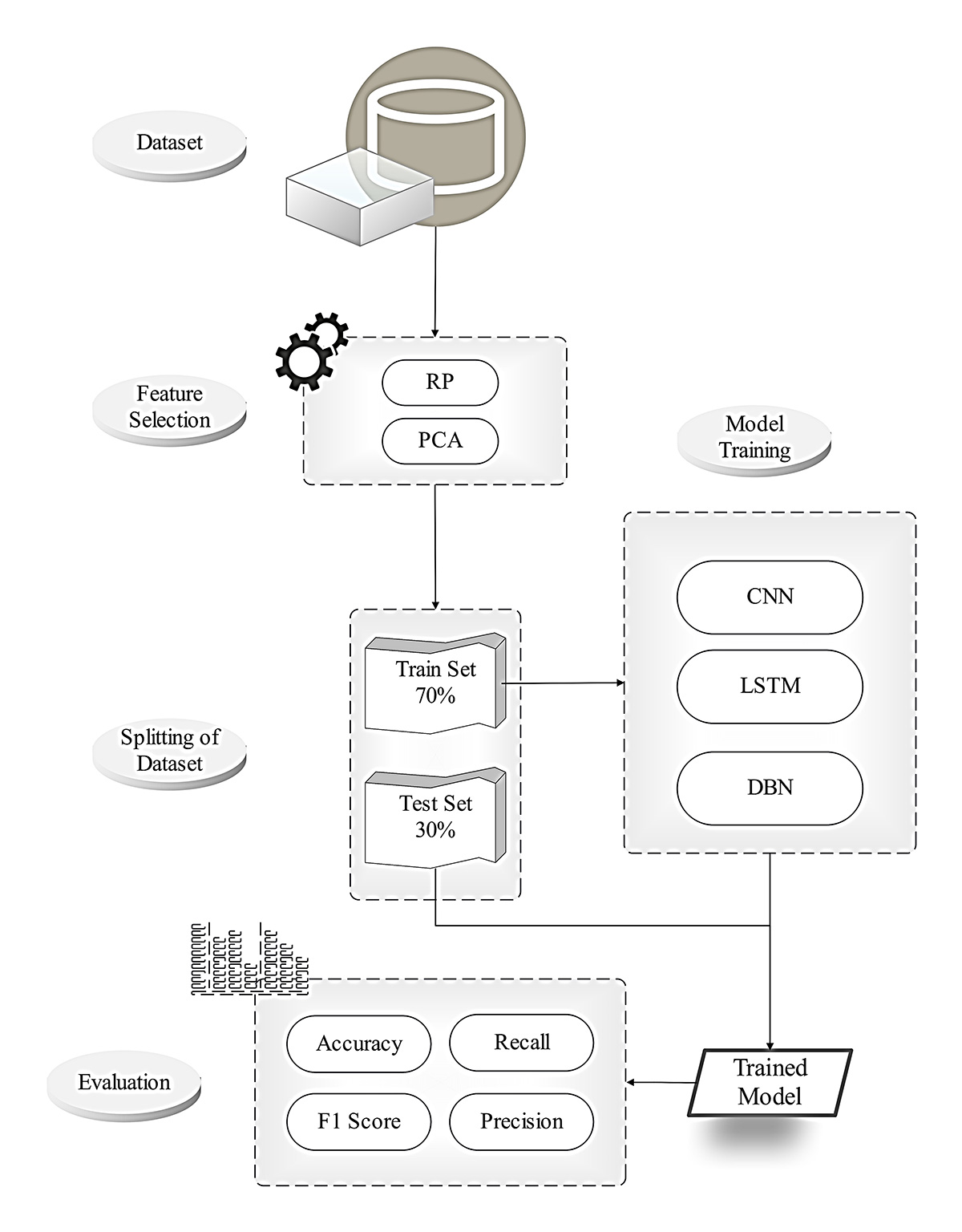
In recent years, vehicular ad hoc networks (VANETs) have faced growing security concerns, particularly from Denial of Service (DoS) and Distributed Denial of Service (DDoS) attacks. These attacks flood the network with malicious traffic, disrupting services and compromising resource availability. While various techniques have been proposed to address these threats, this study presents an optimized framework leveraging advanced deep-learning models for improved detection accuracy. The proposed Intrusion Detection System (IDS) employs Convolutional Neural Networks (CNN), Long Short-Term Memory (LSTM), and Deep Belief Networks (DBN) alongside robust feature selection techniques, Random Projection (RP) and Principal Component Analysis (PCA). This framework extracts and analyzes significant features using a publicly available application-layer DoS attack dataset, achieving higher detection accuracy than traditional methods. Experimental results indicate that combining CNN, LSTM networks, and DBN with feature selection techniques like Random Projection (RP) and PCA results in improved classification performance, achieving an accuracy of 0.994, surpassing the state-of-the-art machine learning models. This novel approach enhances the reliability and safety of vehicle communications by providing efficient, real-time threat detection. The findings contribute significantly to VANET security, laying a robust foundation for future advancements in connected vehicle protection.
Graphical Abstract
Keywords
Data Availability Statement
Funding
Conflicts of Interest
Ethical Approval and Consent to Participate
References
- Asra, S. A. (2022). Security issues of vehicular ad hoc networks (VANET): A systematic review. TIERS Information Technology Journal, 3(1), 17-27.
[CrossRef] [Google Scholar] - Gad, A. R., Nashat, A. A., & Barkat, T. M. (2021). Intrusion detection system using machine learning for vehicular ad hoc networks based on ToN-IoT dataset. IEEE access, 9, 142206-142217.
[CrossRef] [Google Scholar] - Wang, Z., Wei, H., Wang, J., Zeng, X., & Chang, Y. (2022). Security issues and solutions for connected and autonomous vehicles in a sustainable city: A survey. Sustainability, 14(19), 12409.
[CrossRef] [Google Scholar] - Dutta, A., Samaniego Campoverde, L. M., Tropea, M., & De Rango, F. (2024). A comprehensive review of recent developments in VANET for traffic, safety & remote monitoring applications. Journal of Network and Systems Management, 32(4), 73.
[CrossRef] [Google Scholar] - Zamrai, M. A. H., Yusof, K. M., & Azizan, A. (2024). Dissecting Denial of Service (DoS) Syn Flood Attack Dynamics and Impacts in Vehicular Communication Systems. In ITM Web of Conferences (Vol. 63, p. 01008). EDP Sciences.
[CrossRef] [Google Scholar] - Tariq, U. (2024). Optimized feature selection for DDoS attack recognition and mitigation in SD-VANETs. World Electric Vehicle Journal, 15(9), 395.
[CrossRef] [Google Scholar] - Setitra, M. A., & Fan, M. (2024). Detection of DDoS attacks in SDN-based VANET using optimized TabNet. Computer Standards & Interfaces, 90, 103845.
[CrossRef] [Google Scholar] - Banafshehvaragh, S. T., & Rahmani, A. M. (2023). Intrusion, anomaly, and attack detection in smart vehicles. Microprocessors and Microsystems, 96, 104726.
[CrossRef] [Google Scholar] - Han, M. L., Kwak, B. I., & Kim, H. K. (2018). Anomaly intrusion detection method for vehicular networks based on survival analysis. Vehicular communications, 14, 52-63.
[CrossRef] [Google Scholar] - Bhanja, U., Majhi, A., Sahu, S., & Parida, D. (2024). Detection of Sybil & DDoS attacks in VANET using intelligent technique. International Journal of Computers and Applications, 46(10), 811-829.
[CrossRef] [Google Scholar] - Karthiga, B., Durairaj, D., Nawaz, N., Venkatasamy, T. K., Ramasamy, G., & Hariharasudan, A. (2022). Intelligent intrusion detection system for VANET using machine learning and deep learning approaches. Wireless Communications and Mobile Computing, 2022(1), 5069104.
[CrossRef] [Google Scholar] - Rashid, K., Saeed, Y., Ali, A., Jamil, F., Alkanhel, R., & Muthanna, A. (2023). An adaptive real-time malicious node detection framework using machine learning in vehicular ad-hoc networks (VANETs). Sensors, 23(5), 2594.
[CrossRef] [Google Scholar] - Bangui, H., Ge, M., & Buhnova, B. (2022). A hybrid machine learning model for intrusion detection in VANET. Computing, 104(3), 503-531.
[CrossRef] [Google Scholar] - Barve, A., & Patheja, P. S. (2024). A hybrid deep learning based enhanced and reliable approach for VANET intrusion detection system. Cluster Computing, 27(9), 11839-11850.
[CrossRef] [Google Scholar] - Talpur, A., & Gurusamy, M. (2021). Machine learning for security in vehicular networks: A comprehensive survey. IEEE Communications Surveys & Tutorials, 24(1), 346-379.
[CrossRef] [Google Scholar] - Anyanwu, G. O., Nwakanma, C. I., Lee, J. M., & Kim, D. S. (2022). Optimization of RBF-SVM kernel using grid search algorithm for DDoS attack detection in SDN-based VANET. IEEE Internet of Things Journal, 10(10), 8477-8490.
[CrossRef] [Google Scholar] - Gopi, R., Mathapati, M., Prasad, B., Ahmad, S., Al-Wesabi, F. N., Alohali, M. A., & Hilal, A. M. (2022). Intelligent DoS Attack Detection with Congestion Control Technique for VANETs. Computers, Materials & Continua, 72(1). http://doi.org/10.32604/cmc.2022.023306
[Google Scholar] - Alsarhan, A., Alauthman, M., Alshdaifat, E. A., Al-Ghuwairi, A. R., & Al-Dubai, A. (2023). Machine Learning-driven optimization for SVM-based intrusion detection system in vehicular ad hoc networks. Journal of Ambient Intelligence and Humanized Computing, 14(5), 6113-6122.
[CrossRef] [Google Scholar] - Gyamfi, E., & Jurcut, A. (2022). Intrusion detection in internet of things systems: a review on design approaches leveraging multi-access edge computing, machine learning, and datasets. Sensors, 22(10), 3744.
[CrossRef] [Google Scholar] - Al-Shareeda, M. A., & Manickam, S. (2023). A systematic literature review on security of vehicular ad-hoc network (vanet) based on veins framework. IEEE Access, 11, 46218-46228.
[CrossRef] [Google Scholar] - Yu, Y., Zeng, X., Xue, X., & Ma, J. (2022). LSTM-based intrusion detection system for VANETs: A time series classification approach to false message detection. IEEE Transactions on Intelligent Transportation Systems, 23(12), 23906-23918.
[CrossRef] [Google Scholar] - Soares, K., & Shinde, A. A. (2024, March). Intrusion Detection Systems in VANET: A Review on Implementation Techniques and Datasets. In 2024 5th International Conference on Intelligent Communication Technologies and Virtual Mobile Networks (ICICV) (pp. 897-905). IEEE.
[CrossRef] [Google Scholar] - Otoum, Y., & Nayak, A. (2021). As-ids: Anomaly and signature based ids for the internet of things. Journal of Network and Systems Management, 29(3), 23.
[CrossRef] [Google Scholar] - Najar, A. A., & Manohar Naik, S. (2022). DDoS attack detection using MLP and Random Forest Algorithms. International Journal of Information Technology, 14(5), 2317-2327.
[CrossRef] [Google Scholar] - Wang, Y., Wang, X., Ariffin, M. M., Abolfathi, M., Alqhatani, A., & Almutairi, L. (2023). Attack detection analysis in software-defined networks using various machine learning method. Computers and Electrical Engineering, 108, 108655.
[CrossRef] [Google Scholar] - Manivannan, D. (2024). Recent endeavors in machine learning-powered intrusion detection systems for the Internet of Things. Journal of Network and Computer Applications, 103925.
[CrossRef] [Google Scholar] - Kaur, G., & Kakkar, D. (2022). Hybrid optimization enabled trust-based secure routing with deep learning-based attack detection in VANET. Ad Hoc Networks, 136, 102961.
[CrossRef] [Google Scholar] - Almehdhar, M., Albaseer, A., Khan, M. A., Abdallah, M., Menouar, H., Al-Kuwari, S., & Al-Fuqaha, A. (2024). Deep learning in the fast lane: A survey on advanced intrusion detection systems for intelligent vehicle networks. IEEE Open Journal of Vehicular Technology, 5, 869-906.
[CrossRef] [Google Scholar] - Polat, O., Oyucu, S., Türkoğlu, M., Polat, H., Aksoz, A., & Yardımcı, F. (2024). Hybrid AI-powered real-time distributed denial of service detection and traffic monitoring for software-defined-based vehicular Ad Hoc networks: A new paradigm for securing intelligent transportation networks. Applied Sciences, 14(22), 10501.
[CrossRef] [Google Scholar] - Ajjaj, S., El Houssaini, S., Hain, M., & El Houssaini, M. A. (2023, September). Incremental online machine learning for detecting malicious nodes in vehicular communications using real-time monitoring. In Telecom (Vol. 4, No. 3, pp. 629-648). MDPI.
[CrossRef] [Google Scholar] - Nabi, F., & Zhou, X. (2024). Enhancing intrusion detection systems through dimensionality reduction: A comparative study of machine learning techniques for cyber security. Cyber Security and Applications, 100033.
[CrossRef] [Google Scholar] - Prathiba, S. B., Raja, G., Anbalagan, S., KS, A., Gurumoorthy, S., & Dev, K. (2022). A hybrid deep sensor anomaly detection for autonomous vehicles in 6G-V2X environment. IEEE Transactions on Network Science and Engineering, 10(3), 1246-1255.
[CrossRef] [Google Scholar] - Sohn, I. (2021). Deep belief network based intrusion detection techniques: A survey. Expert Systems with Applications, 167, 114170.
[CrossRef] [Google Scholar] - Manderna, A., Kumar, S., Dohare, U., Aljaidi, M., Kaiwartya, O., & Lloret, J. (2023). Vehicular network intrusion detection using a cascaded deep learning approach with multi-variant metaheuristic. Sensors, 23(21), 8772.
[CrossRef] [Google Scholar] - Akande, H. B., Awoniyi, C., Ogundokun, R. O., Oloyede, A. A., Yiamiyu, O. A., & Caroline, A. T. (2024, April). Enhancing Network Security: Intrusion Detection Systems with Hybridized CNN and DNN Algorithms. In 2024 International Conference on Science, Engineering and Business for Driving Sustainable Development Goals (SEB4SDG) (pp. 1-7). IEEE.
[CrossRef] [Google Scholar] - Halbouni, A., Gunawan, T. S., Habaebi, M. H., Halbouni, M., Kartiwi, M., & Ahmad, R. (2022). CNN-LSTM: hybrid deep neural network for network intrusion detection system. IEEE Access, 10, 99837-99849.
[CrossRef] [Google Scholar] - Maabreh, M., Obeidat, I., Elsoud, E. A., Alnajjar, A., Alzyoud, R., & Darwish, O. (2022). Towards Data-Driven Network Intrusion Detection Systems: Features Dimensionality Reduction and Machine Learning. Int. J. Interact. Mob. Technol., 16(14), 123-135.
[CrossRef] [Google Scholar] - Anitha, T., Aanjankumar, S., Poonkuntran, S., & Nayyar, A. (2023). A novel methodology for malicious traffic detection in smart devices using BI-LSTM–CNN-dependent deep learning methodology. Neural Computing and Applications, 35(27), 20319-20338.
[CrossRef] [Google Scholar] - Haydari, A., & Yilmaz, Y. (2022). RSU-based online intrusion detection and mitigation for VANET. Sensors, 22(19), 7612.
[CrossRef] [Google Scholar] - A. Alissa, K., Shaiba, H., Gaddah, A., Yafoz, A., Alsini, R., Alghushairy, O., A. Aziz, A. S., & Al Duhayyim, M. (2022). Feature subset selection hybrid deep belief network based cybersecurity intrusion detection model. Electronics, 11(19), 3077.
[CrossRef] [Google Scholar]
Cited By (12)
-
Wenyi Liu, Tongming Jian, Lei Meng, Di Song, Jianbin Cao. A novel wind turbine fault diagnosis method based on improved TFMST and DSC-CNN-GRU model.
Journal of Measurements in Engineering, 2026 , 14 (1).
[CrossRef] -
Wenbo Gu, Ruizhe Ma, Yang Yu, Zongmin Ma. FPSO-Time: A Fuzzy Time Series Forecasting Method Based on Fuzzy Particle Swarm Optimization and Reprogrammed Large Language Models.
IEEE Transactions on Fuzzy Systems, 2026 , 34 (2).
[CrossRef] -
G. Mahalakshmi, G. Sumathi, M. Prakash, P. Solainayagi. Enhancing VANET Security Through ANFIS‐Based Intrusion Detection and Element Perturbation.
International Journal of Communication Systems, 2026 , 39 (1).
[CrossRef] -
Zhe Zhang, Niaona Zhang. A parallel preceding vehicle speed prediction method combining deep belief networks and gated recurrent units.
Journal of Control and Decision, 2026 , 13 (4).
[CrossRef] -
Peng You, Peng Chen, Xi Li, Ang Bian. Gated Memory-Guided Multi-scale spatio–temporal–spectral feature fusion network for unsupervised Internet of Things time series anomaly detection.
Engineering Applications of Artificial Intelligence, 2026 , 169 .
[CrossRef] -
Muhammad Shoaib Khan, Hongsong Chen, XinJian Ma. Resource-efficient anomaly detection in social media accounts using lightweight LLM models: a review of methods, challenges, and future trends.
Cluster Computing, 2026 , 29 (5).
[CrossRef] -
Qiong Li, Rongsheng Cai, Yizhao Zhu. GHPPFL: A Privacy Preserving Federated Learning Based on Gradient Compression and Homomorphic Encryption in Consumer App Security.
IEEE Transactions on Consumer Electronics, 2025 , 71 (2).
[CrossRef] -
Qiang Li, Ruidong Liu, Yalei Liu, Zhenzhong Wei. Research on Registration Methods for Coupled Errors in Maneuvering Platforms.
Entropy, 2025 , 27 (6).
[CrossRef] -
Zeeshan Ali Haider, Asim Zeb, Taj Rahman, Sushil Kumar Singh, Rizwan Akram, Ali Arishi, Inam Ullah. A Survey on anomaly detection in IoT: Techniques, challenges, and opportunities with the integration of 6G.
Computer Networks, 2025 , 270 .
[CrossRef] -
Tarak Nandy, Sananda Bhattacharyya. A Comprehensive Survey of Deep Learning for Authentication in Vehicular Communication.
Computers, Materials & Continua, 2025 , 85 (1).
[CrossRef] -
Inam Ullah Khan, Fida Muhammad Khan, Zeeshan Ali Haider, Fahad Alturise. Integrating AI, Blockchain, and Edge Computing for Zero-Trust IoT Security: A Comprehensive Review of Advanced Cybersecurity Framework.
Computers, Materials & Continua, 2025 , 85 (3).
[CrossRef] -
Yuwen Zhao, Weifang Liang, Zhi Gong, Shibing Sun, Shayan Nejadshamsi. DSEAGC: Dual-spectral embedding for attributed graph clustering.
Internet of Things, 2025 , 32 .
[CrossRef]
Cite This Article
TY  - JOUR
AU  - Khan, Fida Muhammad
AU  - Rahman, Taj
AU  - Zeb, Asim
AU  - Haider, Zeeshan Ali
AU  - Khan, Inam Ullah
AU  - Bilal, Hazrat
AU  - Khan, Muhammad Abbas
AU  - Ullah, Inam
PY  - 2024
DA  - 2024/12/31
TI  - Vehicular Network Security Through Optimized Deep Learning Model with Feature Selection Techniques
JO  - ICCK Transactions on Sensing, Communication, and Control
T2  - ICCK Transactions on Sensing, Communication, and Control
JF  - ICCK Transactions on Sensing, Communication, and Control
VL  - 1
IS  - 2
SP  - 136
EP  - 153
DO  - 10.62762/TSCC.2024.626147
UR  - https://www.icck.org/article/abs/TSCC.2024.626147
KW  - vehicular networks security
KW  - denial of service (DoS) detection
KW  - deep learning intrusion detection
KW  - feature optimization techniques
KW  - connected vehicle protection
AB  - In recent years, vehicular ad hoc networks (VANETs) have faced growing security concerns, particularly from Denial of Service (DoS) and Distributed Denial of Service (DDoS) attacks. These attacks flood the network with malicious traffic, disrupting services and compromising resource availability. While various techniques have been proposed to address these threats, this study presents an optimized framework leveraging advanced deep-learning models for improved detection accuracy. The proposed Intrusion Detection System (IDS) employs Convolutional Neural Networks (CNN), Long Short-Term Memory (LSTM), and Deep Belief Networks (DBN) alongside robust feature selection techniques, Random Projection (RP) and Principal Component Analysis (PCA). This framework extracts and analyzes significant features using a publicly available application-layer DoS attack dataset, achieving higher detection accuracy than traditional methods. Experimental results indicate that combining CNN, LSTM networks, and DBN with feature selection techniques like Random Projection (RP) and PCA results in improved classification performance, achieving an accuracy of 0.994, surpassing the state-of-the-art machine learning models. This novel approach enhances the reliability and safety of vehicle communications by providing efficient, real-time threat detection. The findings contribute significantly to VANET security, laying a robust foundation for future advancements in connected vehicle protection.
SN  - 3068-9287
PB  - Institute of Central Computation and Knowledge
LA  - English
ER  -
@article{Khan2024Vehicular,
  author = {Fida Muhammad Khan and Taj Rahman and Asim Zeb and Zeeshan Ali Haider and Inam Ullah Khan and Hazrat Bilal and Muhammad Abbas Khan and Inam Ullah},
  title = {Vehicular Network Security Through Optimized Deep Learning Model with Feature Selection Techniques},
  journal = {ICCK Transactions on Sensing, Communication, and Control},
  year = {2024},
  volume = {1},
  number = {2},
  pages = {136-153},
  doi = {10.62762/TSCC.2024.626147},
  url = {https://www.icck.org/article/abs/TSCC.2024.626147},
  abstract = {In recent years, vehicular ad hoc networks (VANETs) have faced growing security concerns, particularly from Denial of Service (DoS) and Distributed Denial of Service (DDoS) attacks. These attacks flood the network with malicious traffic, disrupting services and compromising resource availability. While various techniques have been proposed to address these threats, this study presents an optimized framework leveraging advanced deep-learning models for improved detection accuracy. The proposed Intrusion Detection System (IDS) employs Convolutional Neural Networks (CNN), Long Short-Term Memory (LSTM), and Deep Belief Networks (DBN) alongside robust feature selection techniques, Random Projection (RP) and Principal Component Analysis (PCA). This framework extracts and analyzes significant features using a publicly available application-layer DoS attack dataset, achieving higher detection accuracy than traditional methods. Experimental results indicate that combining CNN, LSTM networks, and DBN with feature selection techniques like Random Projection (RP) and PCA results in improved classification performance, achieving an accuracy of 0.994, surpassing the state-of-the-art machine learning models. This novel approach enhances the reliability and safety of vehicle communications by providing efficient, real-time threat detection. The findings contribute significantly to VANET security, laying a robust foundation for future advancements in connected vehicle protection.},
  keywords = {vehicular networks security, denial of service (DoS) detection, deep learning intrusion detection, feature optimization techniques, connected vehicle protection},
  issn = {3068-9287},
  publisher = {Institute of Central Computation and Knowledge}
}
Publisher's Note
ICCK stays neutral with regard to jurisdictional claims in published maps and institutional affiliations.
Rights and Permissions


Portico
