

Next-Generation Technologies for Secure Future Communication-Based Social-Media 3.0 and Smart Environment





Article Information
Abstract
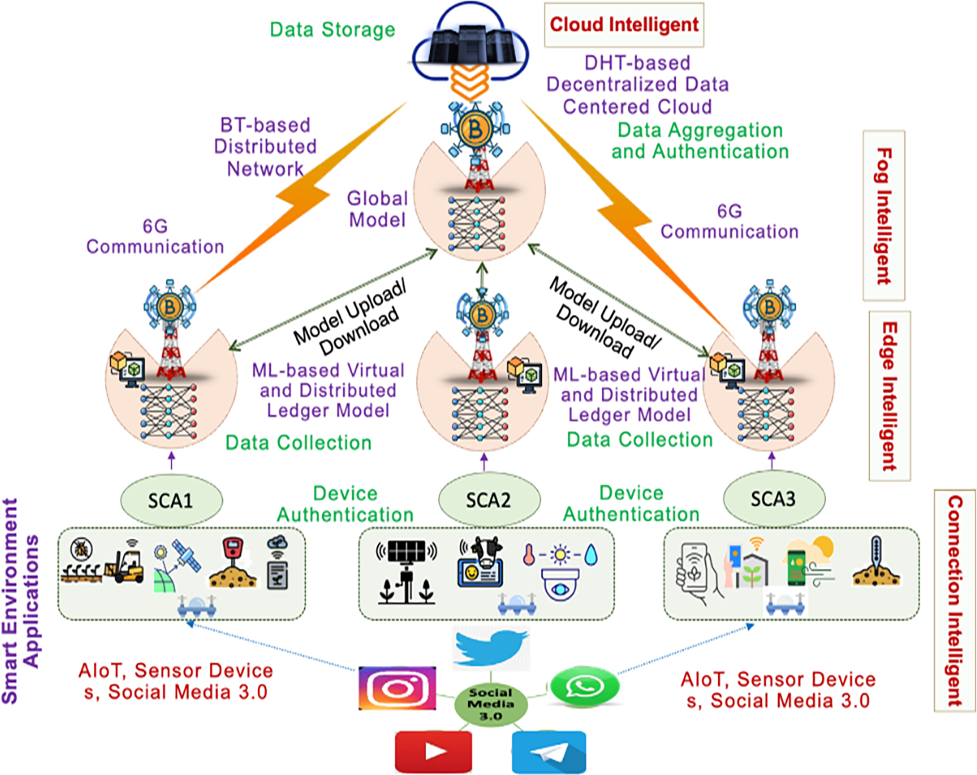
Smart Environment is rapidly growing with the inclusion of Artificial Intelligence of Things (AIoT) when it connects to future communication and social media networks. Security and privacy are significant challenges, including data integrity, account hijacking, cybersecurity, and cyberbullying. To mitigate these challenges, Social Media 3.0 is utilized with advanced emerging technologies such as Blockchain, Federated Learning (FL), and others and offers solutions in existing research. This article comprehensively reviews and proposes Next-Generation Technologies for Secure Future Communication Service Scenario for Smart Environment and Social-Media 3.0. We discuss existing attacks with their classification that can threaten the personal information of a Future Communication-based Smart Environment, then offer countermeasure solutions. FL with AIoT is discussed to preserve the privacy and security of smart environment applications with live projects under the implementation of the Dubai Blockchain Strategy, ADEPT, and many more. Blockchain is utilized at the proposed service scenario's edge, fog, and cloud intelligent layers for secure future communication; FL trains local models that aggregate to form global models trained over diverse Smart Environments. Finally, several challenges and open issues of integrating emerging technologies for Smart Environment and Social-Media 3.0 applications and future directions are discussed in the last section.
Graphical Abstract
Keywords
Data Availability Statement
Funding
Conflicts of Interest
Ethical Approval and Consent to Participate
References
- Chin, J., Callaghan, V., & Allouch, S. B. (2019). The Internet-of-Things: Reflections on the past, present and future from a user-centered and smart environment perspective. Journal of Ambient Intelligence and Smart Environments, 11(1), 45-69.
[CrossRef] [Google Scholar] - Mohanty, S. P., Choppali, U., & Kougianos, E. (2016). Everything you wanted to know about smart cities: The Internet of things is the backbone. IEEE consumer electronics magazine, 5(3), 60-70.
[CrossRef] [Google Scholar] - Pantano, E., & Timmermans, H. (2014). What is smart for retailing?. Procedia Environmental Sciences, 22, 101-107.
[CrossRef] [Google Scholar] - Ikrissi, G., & Mazri, T. (2021). IOT-based Smart Environments: State of the art, security threats and solutions. The International Archives of the Photogrammetry, Remote Sensing and Spatial Information Sciences, 46, 279-286.
[CrossRef] [Google Scholar] - Popescul, D., & Genete, L. D. (2016). Data security in smart cities: challenges and solutions. Informatica Economică, 20(1), 29-38.
[CrossRef] [Google Scholar] - Patrono, L., Atzori, L., Šolić, P., Mongiello, M., & Almeida, A. (2020). Challenges to be addressed to realize Internet of Things solutions for smart environments. Future generation computer systems, 111, 873-878.
[CrossRef] [Google Scholar] - Reyna, A., Martín, C., Chen, J., Soler, E., & Díaz, M. (2018). On blockchain and its integration with IoT. Challenges and opportunities. Future generation computer systems, 88, 173-190.
[CrossRef] [Google Scholar] - Theodorou, S., & Sklavos, N. (2019). Blockchain-based security and privacy in smart cities. In Smart cities cybersecurity and privacy (pp. 21-37). Elsevier.
[CrossRef] [Google Scholar] - Majeed, U., Khan, L. U., Yaqoob, I., Kazmi, S. A., Salah, K., & Hong, C. S. (2021). Blockchain for IoT-based smart cities: Recent advances, requirements, and future challenges. Journal of Network and Computer Applications, 181, 103007.
[CrossRef] [Google Scholar] - Michelin, R. A., Dorri, A., Steger, M., Lunardi, R. C., Kanhere, S. S., Jurdak, R., & Zorzo, A. F. (2018, November). SpeedyChain: A framework for decoupling data from blockchain for smart cities. In Proceedings of the 15th EAI international conference on mobile and ubiquitous systems: Computing, networking and services (pp. 145-154).
[CrossRef] [Google Scholar] - Makhdoom, I., Zhou, I., Abolhasan, M., Lipman, J., & Ni, W. (2020). PrivySharing: A blockchain-based framework for privacy-preserving and secure data sharing in smart cities. Computers & Security, 88, 101653.
[CrossRef] [Google Scholar] - Pandya, S., Srivastava, G., Jhaveri, R., Babu, M. R., Bhattacharya, S., Maddikunta, P. K. R., ... & Gadekallu, T. R. (2023). Federated learning for smart cities: A comprehensive survey. Sustainable Energy Technologies and Assessments, 55, 102987.
[CrossRef] [Google Scholar] - Li, Q., Wen, Z., Wu, Z., Hu, S., Wang, N., Li, Y., ... & He, B. (2021). A survey on federated learning systems: Vision, hype and reality for data privacy and protection. IEEE Transactions on Knowledge and Data Engineering, 35(4), 3347-3366.
[CrossRef] [Google Scholar] - Konečný, J., McMahan, H. B., Yu, F. X., Richtárik, P., Suresh, A. T., & Bacon, D. (2016). Federated learning: Strategies for improving communication efficiency. arXiv preprint arXiv:1610.05492.
[CrossRef] [Google Scholar] - Zhang, R., Xue, R., & Liu, L. (2021). Security and privacy for healthcare blockchains. IEEE Transactions on Services Computing, 15(6), 3668-3686.
[CrossRef] [Google Scholar] - Orecchini, F., Santiangeli, A., Zuccari, F., Pieroni, A., & Suppa, T. (2019). Blockchain technology in smart city: A new opportunity for smart environment and smart mobility. In Intelligent Computing & Optimization 1 (pp. 346-354). Springer International Publishing.
[CrossRef] [Google Scholar] - Mukherjee, P., Barik, R. K., & Pradhan, C. (2020). A comprehensive proposal for blockchain-oriented smart city. In Security and Privacy Applications for Smart City Development (pp. 55-87). Cham: Springer International Publishing.
[CrossRef] [Google Scholar] - Rehman, A., Abdullah, S., Fatima, M., Iqbal, M. W., Almarhabi, K. A., Ashraf, M. U., & Ali, S. (2022). Ensuring security and energy efficiency of wireless sensor network by using blockchain. Applied Sciences, 12(21), 10794.
[CrossRef] [Google Scholar] - Lazaroiu, C., & Roscia, M. (2017, November). Smart district through IoT and blockchain. In 2017 IEEE 6th international conference on renewable energy research and applications (ICRERA) (pp. 454-461). IEEE.
[CrossRef] [Google Scholar] - Wong, P. F., Chia, F. C., Kiu, M. S., & Lou, E. C. (2022). Potential integration of blockchain technology into smart sustainable city (SSC) developments: a systematic review. Smart and Sustainable Built Environment, 11(3), 559-574.
[CrossRef] [Google Scholar] - Yang, Q., Liu, Y., Chen, T., & Tong, Y. (2019). Federated machine learning: Concept and applications. ACM Transactions on Intelligent Systems and Technology (TIST), 10(2), 1-19.
[CrossRef] [Google Scholar] - Zheng, Z., Zhou, Y., Sun, Y., Wang, Z., Liu, B., & Li, K. (2022). Applications of federated learning in smart cities: recent advances, taxonomy, and open challenges. Connection Science, 34(1), 1-28.
[CrossRef] [Google Scholar] - Sater, R. A., & Hamza, A. B. (2021). A federated learning approach to anomaly detection in smart buildings. ACM Transactions on Internet of Things, 2(4), 1-23.
[CrossRef] [Google Scholar] - Yang, Z., Chen, M., Wong, K. K., Poor, H. V., & Cui, S. (2022). Federated learning for 6G: Applications, challenges, and opportunities. Engineering, 8, 33-41.
[CrossRef] [Google Scholar] - Huang, X., Li, P., Yu, R., Wu, Y., Xie, K., & Xie, S. (2021). FedParking: A federated learning based parking space estimation with parked vehicle assisted edge computing. IEEE Transactions on Vehicular Technology, 70(9), 9355-9368.
[CrossRef] [Google Scholar] - Li, D., Luo, Z., & Cao, B. (2022). Blockchain-based federated learning methodologies in smart environments. Cluster Computing, 25(4), 2585-2599.
[CrossRef] [Google Scholar] - Li, L., Fan, Y., Tse, M., & Lin, K. Y. (2020). A review of applications in federated learning. Computers & Industrial Engineering, 149, 106854.
[CrossRef] [Google Scholar] - Chai, H., Leng, S., Chen, Y., & Zhang, K. (2020). A hierarchical blockchain-enabled federated learning algorithm for knowledge sharing in internet of vehicles. IEEE Transactions on Intelligent Transportation Systems, 22(7), 3975-3986.
[CrossRef] [Google Scholar] - Kuang, Z., & Chen, C. (2023). Research on smart city data encryption and communication efficiency improvement under federated learning framework. Egyptian Informatics Journal, 24(2), 217-227.
[CrossRef] [Google Scholar] - Zhao, Y., Zhao, J., Jiang, L., Tan, R., Niyato, D., Li, Z., ... & Liu, Y. (2020). Privacy-preserving blockchain-based federated learning for IoT devices. IEEE Internet of Things Journal, 8(3), 1817-1829.
[CrossRef] [Google Scholar] - Jiang, J. C., Kantarci, B., Oktug, S., & Soyata, T. (2020). Federated learning in smart city sensing: Challenges and opportunities. Sensors, 20(21), 6230.
[CrossRef] [Google Scholar] - Otoum, S., Al Ridhawi, I., & Mouftah, H. (2021). Securing critical IoT infrastructures with blockchain-supported federated learning. IEEE Internet of Things Journal, 9(4), 2592-2601.
[CrossRef] [Google Scholar] - Arquam, M., Singh, A., & Sharma, R. (2021). A blockchain-based secured and trusted framework for information propagation on online social networks. Social Network Analysis and Mining, 11(1), 49.
[CrossRef] [Google Scholar] - Moulahi, T., Jabbar, R., Alabdulatif, A., Abbas, S., El Khediri, S., Zidi, S., & Rizwan, M. (2023). Privacy‐preserving federated learning cyber‐threat detection for intelligent transport systems with blockchain‐based security. Expert Systems, 40(5), e13103.
[CrossRef] [Google Scholar] - Yuan, X., Chen, J., Yang, J., Zhang, N., Yang, T., Han, T., & Taherkordi, A. (2022). Fedstn: Graph representation driven federated learning for edge computing enabled urban traffic flow prediction. IEEE Transactions on Intelligent Transportation Systems, 24(8), 8738-8748.
[CrossRef] [Google Scholar] - Ahmed, S. T., & Jeong, J. (2024). Heterogeneous Workload based Consumer Resource Recommendation Model for Smart Cities: eHealth Edge-Cloud Connectivity Using Federated Split Learning. IEEE Transactions on Consumer Electronics.
[CrossRef] [Google Scholar] - Liu, L., Tian, Y., Chakraborty, C., Feng, J., Pei, Q., Zhen, L., & Yu, K. (2023). Multilevel federated learning-based intelligent traffic flow forecasting for transportation network management. IEEE Transactions on Network and Service Management, 20(2), 1446-1458.
[CrossRef] [Google Scholar] - Farooq, K., Syed, H. J., Alqahtani, S. O., Nagmeldin, W., Ibrahim, A. O., & Gani, A. (2022). Blockchain federated learning for in-home health monitoring. Electronics, 12(1), 136.
[CrossRef] [Google Scholar] - Ayaz, F., Sheng, Z., Tian, D., & Guan, Y. L. (2021). A blockchain based federated learning for message dissemination in vehicular networks. IEEE Transactions on Vehicular Technology, 71(2), 1927-1940.
[CrossRef] [Google Scholar] - Kalapaaking, A. P., Khalil, I., Rahman, M. S., Atiquzzaman, M., Yi, X., & Almashor, M. (2022). Blockchain-based federated learning with secure aggregation in trusted execution environment for internet-of-things. IEEE Transactions on Industrial Informatics, 19(2), 1703-1714.
[CrossRef] [Google Scholar] - Liu, H., Zhang, S., Zhang, P., Zhou, X., Shao, X., Pu, G., & Zhang, Y. (2021). Blockchain and federated learning for collaborative intrusion detection in vehicular edge computing. IEEE Transactions on Vehicular Technology, 70(6), 6073-6084.
[CrossRef] [Google Scholar] - Liu, J., Chen, C., Li, Y., Sun, L., Song, Y., Zhou, J., ... & Dou, D. (2024). Enhancing trust and privacy in distributed networks: a comprehensive survey on blockchain-based federated learning. Knowledge and Information Systems, 66(8), 4377-4403.
[CrossRef] [Google Scholar] - Li, Y., Chen, C., Liu, N., Huang, H., Zheng, Z., & Yan, Q. (2020). A blockchain-based decentralized federated learning framework with committee consensus. IEEE Network, 35(1), 234-241.
[CrossRef] [Google Scholar] - Gebremariam, G. G., Panda, J., & Indu, S. (2023). Blockchain‐based secure localization against malicious nodes in IoT‐based wireless sensor networks using federated learning. Wireless communications and mobile computing, 2023(1), 8068038.
[CrossRef] [Google Scholar] - Zhang, W., Lu, Q., Yu, Q., Li, Z., Liu, Y., Lo, S. K., ... & Zhu, L. (2020). Blockchain-based federated learning for device failure detection in industrial IoT. IEEE Internet of Things Journal, 8(7), 5926-5937.
[CrossRef] [Google Scholar] - Awan, S., Li, F., Luo, B., & Liu, M. (2019, November). Poster: A reliable and accountable privacy-preserving federated learning framework using the blockchain. In Proceedings of the 2019 ACM SIGSAC conference on computer and communications security (pp. 2561-2563).
[CrossRef] [Google Scholar] - Hua, G., Zhu, L., Wu, J., Shen, C., Zhou, L., & Lin, Q. (2020). Blockchain-based federated learning for intelligent control in heavy haul railway. IEEE Access, 8, 176830-176839.
[CrossRef] [Google Scholar] - Jain, A. K., Sahoo, S. R., & Kaubiyal, J. (2021). Online social networks security and privacy: comprehensive review and analysis. Complex & Intelligent Systems, 7(5), 2157-2177.
[CrossRef] [Google Scholar] - Etuh, E., & Bakpo, F. S. (2022). Social Media Networks Attacks and their Preventive Mechanisms: A Review. arXiv preprint arXiv:2201.03330.
[CrossRef] [Google Scholar] - Salim, S., Turnbull, B., & Moustafa, N. (2021). A blockchain-enabled explainable federated learning for securing internet-of-things-based social media 3.0 networks. IEEE Transactions on Computational Social Systems.
[CrossRef] [Google Scholar] - Digital Dubai. (2022). Dubai blockchain policy. Retrieved from https://www.digitaldubai.ae/docs/default source/publications/dubaiblockchainpolicy.pdf?sfvrsn=4a4bb396\_4
[Google Scholar] - Faruk, M. J. H., Shahriar, H., Valero, M., Barsha, F. L., Sobhan, S., Khan, M. A., ... & Wu, F. (2021, December). Malware detection and prevention using artificial intelligence techniques. In 2021 IEEE international conference on big data (big data) (pp. 5369-5377). IEEE.
[CrossRef] [Google Scholar] - Wen, H., Fang, J., Wu, J., & Zheng, Z. (2022). Hide and seek: An adversarial hiding approach against phishing detection on ethereum. IEEE Transactions on Computational Social Systems, 10(6), 3512-3523.
[CrossRef] [Google Scholar] - Basit, A., Zafar, M., Liu, X., Javed, A. R., Jalil, Z., & Kifayat, K. (2021). A comprehensive survey of AI-enabled phishing attacks detection techniques. Telecommunication Systems, 76, 139-154.
[CrossRef] [Google Scholar] - Zheng, H., Ma, M., Ma, H., Chen, J., Xiong, H., & Yang, Z. (2023). Tegdetector: a phishing detector that knows evolving transaction behaviors. IEEE Transactions on Computational Social Systems.
[CrossRef] [Google Scholar] - Huang, H., Zhang, X., Wang, J., Gao, C., Li, X., Zhu, R., & Ma, Q. (2024). PEAE-GNN: Phishing Detection on Ethereum via Augmentation Ego-Graph Based on Graph Neural Network. IEEE Transactions on Computational Social Systems.
[CrossRef] [Google Scholar] - Valecha, R., Mandaokar, P., & Rao, H. R. (2021). Phishing email detection using persuasion cues. IEEE transactions on Dependable and secure computing, 19(2), 747-756.
[CrossRef] [Google Scholar] - Duman, S., Büchler, M., Egele, M., & Kirda, E. (2023). PellucidAttachment: Protecting users from attacks via e-mail attachments. IEEE Transactions on Dependable and Secure Computing, 21(3), 1342-1354.
[CrossRef] [Google Scholar] - Rafsanjani, A. S., Kamaruddin, N. B., Behjati, M., Aslam, S., Sarfaraz, A., & Amphawan, A. (2024). Enhancing malicious URL detection: A novel framework leveraging priority coefficient and feature evaluation. IEEE Access, 12, 85001-85026.
[CrossRef] [Google Scholar] - Haber, M. J., & Rolls, D. (2019). Identity attack vectors. In Identity Attack Vectors: Implementing an Effective Identity and Access Management Solution (pp. 107-116). Berkeley, CA: Apress.
[CrossRef] [Google Scholar] - Punkamol, D., & Marukatat, R. (2020, March). Detection of account cloning in online social networks. In 2020 8th International Electrical Engineering Congress (iEECON) (pp. 1-4). IEEE.
[CrossRef] [Google Scholar] - Alsaffar, M., Aljaloud, S., Mohammed, B. A., Al-Mekhlafi, Z. G., Almurayziq, T. S., Alshammari, G., & Alshammari, A. (2022). Detection of Web Cross-Site Scripting (XSS) Attacks. Electronics, 11(14), 2212.
[CrossRef] [Google Scholar] - Muñoz, F., Isaza, G., & Castillo, L. (2020, June). Smartsec4cop: smart cyber-grooming detection using natural language processing and convolutional neural networks. In International Symposium on Distributed Computing and Artificial Intelligence (pp. 11-20). Cham: Springer International Publishing.
[CrossRef] [Google Scholar] - Verma, C., & Gupta, C. P. (2024). Effect of vaccination on stability of wireless sensor network against malware attack: an epidemiological model. SN Computer Science, 5(2), 240.
[CrossRef] [Google Scholar] - Zhao, K., Zhou, H., Zhu, Y., Zhan, X., Zhou, K., Li, J., ... & Luo, X. (2021, November). Structural attack against graph based android malware detection. In Proceedings of the 2021 ACM SIGSAC conference on computer and communications security (pp. 3218-3235).
[CrossRef] [Google Scholar] - Wang, M., & Song, L. (2021). Efficient defense strategy against spam and phishing email: An evolutionary game model. Journal of Information Security and Applications, 61, 102947.
[CrossRef] [Google Scholar] - Saad, M., Kim, J., Nyang, D., & Mohaisen, D. (2021). Contra-$\ast$: Mechanisms for countering spam attacks on blockchain's memory pools. Journal of Network and Computer Applications, 179, 102971.
[CrossRef] [Google Scholar] - Bilge, L., Strufe, T., Balzarotti, D., & Kirda, E. (2009, April). All your contacts are belong to us: automated identity theft attacks on social networks. In Proceedings of the 18th international conference on World wide web (pp. 551-560).
[CrossRef] [Google Scholar] - Hang, L., & Kim, D. H. (2019). Design and implementation of an integrated iot blockchain platform for sensing data integrity. Sensors, 19(10), 2228.
[CrossRef] [Google Scholar] - Alterkavı, S., & Erbay, H. (2021). Design and analysis of a novel authorship verification framework for hijacked social media accounts compromised by a human. Security and Communication Networks, 2021(1), 8869681.
[CrossRef] [Google Scholar] - Ayeni, B. K., Sahalu, J. B., & Adeyanju, K. R. (2018). Detecting Cross‐Site Scripting in Web Applications Using Fuzzy Inference System. Journal of Computer Networks and Communications, 2018(1), 8159548.
[CrossRef] [Google Scholar] - Marashdih, A. W., Zaaba, Z. F., Suwais, K., & Mohd, N. A. (2019). Web application security: An investigation on static analysis with other algorithms to detect cross site scripting. Procedia Computer Science, 161, 1173-1181.
[CrossRef] [Google Scholar] - Zhang, Z., & Gupta, B. B. (2018). Social media security and trustworthiness: overview and new direction. Future Generation Computer Systems, 86, 914-925.
[CrossRef] [Google Scholar] - Bederna, Z., & Szadeczky, T. (2020). Cyber espionage through Botnets. Security Journal, 33(1), 43-62.
[CrossRef] [Google Scholar] - Shrivastava, P., Jamal, M. S., & Kataoka, K. (2020). EvilScout: Detection and mitigation of evil twin attack in SDN enabled WiFi. IEEE Transactions on Network and Service Management, 17(1), 89-102.
[CrossRef] [Google Scholar] - Agarwal, M., Biswas, S., & Nandi, S. (2018). An efficient scheme to detect evil twin rogue access point attack in 802.11 Wi-Fi networks. International Journal of Wireless Information Networks, 25, 130-145.
[CrossRef] [Google Scholar] - Kopecký, K., & Szotkowski, R. (2017). Cyberbullying, cyber aggression and their impact on the victim–The teacher. Telematics and informatics, 34(2), 506-517.
[CrossRef] [Google Scholar] - al-Khateeb, H. M., & Epiphaniou, G. (2016). How technology can mitigate and counteract cyber-stalking and online grooming. Computer Fraud & Security, 2016(1), 14-18.
[CrossRef] [Google Scholar] - Rybnicek, M., Poisel, R., & Tjoa, S. (2013, October). Facebook watchdog: a research agenda for detecting online grooming and bullying activities. In 2013 IEEE International Conference on Systems, Man, and Cybernetics (pp. 2854-2859). IEEE.
[CrossRef] [Google Scholar] - Upadhyay, A., Chaudhari, A., Ghale, S., & Pawar, S. S. (2017, January). Detection and prevention measures for cyberbullying and online grooming. In 2017 International Conference on Inventive Systems and Control (ICISC) (pp. 1-4). IEEE.
[CrossRef] [Google Scholar] - Altarturi, H. H. (2023). Cyber Parental Control Framework for Objectionable Web Content Classification and Filtering Based on Topic Modelling Using Enhanced Latent Dirichlet Allocation (Doctoral dissertation, University of Malaya (Malaysia)). https://knova.um.edu.my/student_works_2020s/1554/
[Google Scholar] - Zhan, Y., Xiong, Y., & Xing, X. (2023). A conceptual model and case study of blockchain-enabled social media platform. Technovation, 119, 102610.
[CrossRef] [Google Scholar] - Baucas, M. J., & Spachos, P. (2024). Secure private blockchain-based instant messaging platform for social media services. IEEE Networking Letters, 6(2), 106-109.
[CrossRef] [Google Scholar] - Zhou, X., Liang, W., Ma, J., Yan, Z., Kevin, I., & Wang, K. (2022). 2D federated learning for personalized human activity recognition in cyber-physical-social systems. IEEE Transactions on Network Science and Engineering, 9(6), 3934-3944.
[CrossRef] [Google Scholar] - Samee, N. A., Khan, U., Khan, S., Jamjoom, M. M., Sharif, M., & Kim, D. H. (2023). Safeguarding online spaces: a powerful fusion of federated learning, word embeddings, and emotional features for cyberbullying detection. IEEE Access, 11, 124524-124541.
[CrossRef] [Google Scholar] - Wati, V., Kusrini, K., Al Fatta, H., & Kapoor, N. (2021). Security of facial biometric authentication for attendance system. Multimedia Tools and Applications, 80(15), 23625-23646.
[CrossRef] [Google Scholar] - Mbarek, B., Ge, M., & Pitner, T. (2020). An efficient mutual authentication scheme for internet of things. Internet of things, 9, 100160.
[CrossRef] [Google Scholar] - El Sibai, R., Gemayel, N., Bou Abdo, J., & Demerjian, J. (2020). A survey on access control mechanisms for cloud computing. Transactions on Emerging Telecommunications Technologies, 31(2), e3720.
[CrossRef] [Google Scholar] - Kempe, E., & Massey, A. (2021, September). Perspectives on regulatory compliance in software engineering. In 2021 IEEE 29th International Requirements Engineering Conference (RE) (pp. 46-57). IEEE.
[CrossRef] [Google Scholar] - Fraga-Lamas, P., & Fernandez-Carames, T. M. (2020). Fake news, disinformation, and deepfakes: Leveraging distributed ledger technologies and blockchain to combat digital deception and counterfeit reality. IT professional, 22(2), 53-59.
[CrossRef] [Google Scholar] - Cohn, J. M., Finn, P. G., Nair, S. P., Panikkar, S. B., & Pureswaran, V. S. (2019). Device bootstrap for a distributed computing blockchain (U.S. Patent No. 10,257,270). U.S. Patent and Trademark Office. https://patents.google.com/patent/US10257270
[Google Scholar] - Sengan, S., Subramaniyaswamy, V., Nair, S. K., Indragandhi, V., Manikandan, J., & Ravi, L. (2020). Enhancing cyber–physical systems with hybrid smart city cyber security architecture for secure public data-smart network. Future generation computer systems, 112, 724-737.
[CrossRef] [Google Scholar] - Singh, S. K., Jeong, Y. S., & Park, J. H. (2020). A deep learning-based IoT-oriented infrastructure for secure smart city. Sustainable Cities and Society, 60, 102252.
[CrossRef] [Google Scholar] - Ali, Z., Chaudhry, S. A., Ramzan, M. S., & Al-Turjman, F. (2020). Securing smart city surveillance: A lightweight authentication mechanism for unmanned vehicles. IEEE Access, 8, 43711-43724.
[CrossRef] [Google Scholar] - Park, J. H., Yotxay, S., Singh, S. K., & Park, J. H. (2024). PoAh-Enabled Federated Learning Architecture for DDoS Attack Detection in IoT Networks. Human-Centric Computing And Information Sciences, 14.
[CrossRef] [Google Scholar] - Singh, S. K., Azzaoui, A. E., Choo, K. K. R., Yang, L. T., & Park, J. H. (2023). Articles A Comprehensive Survey on Blockchain for Secure IoT-enabled Smart City beyond 5G: Approaches, Processes, Challenges, and Opportunities. Hum.-Centric Comput. Inf. Sci, 13, 51.
[CrossRef] [Google Scholar] - Al Dakheel, J., Del Pero, C., Aste, N., & Leonforte, F. (2020). Smart buildings features and key performance indicators: A review. Sustainable Cities and Society, 61, 102328.
[CrossRef] [Google Scholar] - Fantin Irudaya Raj, E., & Appadurai, M. (2022). Internet of things-based smart transportation system for smart cities. In Intelligent Systems for Social Good: Theory and Practice (pp. 39-50). Singapore: Springer Nature Singapore.
[CrossRef] [Google Scholar] - Sinha, B. B., & Dhanalakshmi, R. (2022). Recent advancements and challenges of Internet of Things in smart agriculture: A survey. Future Generation Computer Systems, 126, 169-184.
[CrossRef] [Google Scholar] - Bourg, L., Chatzidimitris, T., Chatzigiannakis, I., Gavalas, D., Giannakopoulou, K., Kasapakis, V., ... & Zaroliagis, C. (2023). Enhancing shopping experiences in smart retailing. Journal of Ambient Intelligence and Humanized Computing, 14(12), 15705-15723.
[CrossRef] [Google Scholar] - Ferry, E., O Raw, J., & Curran, K. (2015). Security evaluation of the OAuth 2.0 framework. Information & Computer Security, 23(1), 73-101.
[CrossRef] [Google Scholar] - Liu, C., Li, B., Zhao, J., Liu, X., & Li, C. (2023). Malaf: Malware attack foretelling from run-time behavior graph sequence. IEEE Transactions on Dependable and Secure Computing, 21(4), 1951-1966.
[CrossRef] [Google Scholar] - Gelgi, M., Guan, Y., Arunachala, S., Samba Siva Rao, M., & Dragoni, N. (2024). Systematic literature review of IoT botnet DDOS attacks and evaluation of detection techniques. Sensors, 24(11), 3571.
[CrossRef] [Google Scholar] - Gupta, B. B., Gupta, S., Gangwar, S., Kumar, M., & Meena, P. K. (2015). Cross-site scripting (XSS) abuse and defense: exploitation on several testing bed environments and its defense. Journal of Information Privacy and Security, 11(2), 118-136.
[CrossRef] [Google Scholar] - Jacobs, D. R., Darmawaskita, N., & McDaniel, T. (2024, June). Unraveling the real-world impacts of cyber incidents on individuals. In International Conference on Human-Computer Interaction (pp. 40-55). Cham: Springer Nature Switzerland.
[CrossRef] [Google Scholar] - Lynch, J. (2005). Identity Theft in Cyberspace: Crime Control Methods and Their Effectiveness in Combating Phishing Attacks. Berkeley Technology Law Journal, 20(1), 259-300. https://www.jstor.org/stable/24117505
[Google Scholar] - Kairouz, P., & McMahan, H. B. (2021). Advances and open problems in federated learning. Foundations and trends in machine learning, 14(1-2), 1-210.
[CrossRef] [Google Scholar] - Farahani, B., Tabibian, S., & Ebrahimi, H. (2023). Towards A Personalized Clustered Federated Learning: A Speech Recognition Case Study. IEEE Internet of Things Journal.
[CrossRef] [Google Scholar] - Brecko, A., Kajati, E., Koziorek, J., & Zolotova, I. (2022). Federated learning for edge computing: A survey. Applied Sciences, 12(18), 9124.
[CrossRef] [Google Scholar] - Singh, S. K., Kumar, M., Khanna, A., & Virdee, B. (2024). Blockchain and FL-based secure architecture for enhanced external Intrusion detection in smart farming. IEEE Internet of Things Journal.
[CrossRef] [Google Scholar] - Usman, M. T., Khan, H., Singh, S. K., Lee, M. Y., & Koo, J. (2024). Efficient deepfake detection via layer-frozen assisted dual attention network for consumer imaging devices. IEEE Transactions on Consumer Electronics.
[CrossRef] [Google Scholar] - Nguyen, D. C., Ding, M., Pathirana, P. N., Seneviratne, A., Li, J., & Poor, H. V. (2021). Federated learning for internet of things: A comprehensive survey. IEEE communications surveys & tutorials, 23(3), 1622-1658.
[CrossRef] [Google Scholar] - Singh, S. K., Kumar, M., Tanwar, S., & Park, J. H. (2024). GRU-based digital twin framework for data allocation and storage in IoT-enabled smart home networks. Future Generation Computer Systems, 153, 391-402.
[CrossRef] [Google Scholar] - Pohrmen, F. H., Das, R. K., & Saha, G. (2019). Blockchain‐based security aspects in heterogeneous Internet‐of‐Things networks: a survey. Transactions on Emerging Telecommunications Technologies, 30(10), e3741.
[CrossRef] [Google Scholar] - Meng, W., Tischhauser, E. W., Wang, Q., Wang, Y., & Han, J. (2018). When intrusion detection meets blockchain technology: a review. IEEE Access, 6, 10179-10188.
[CrossRef] [Google Scholar] - Diro, A. A., & Chilamkurti, N. (2018). Distributed attack detection scheme using deep learning approach for Internet of Things. Future Generation Computer Systems, 82, 761-768.
[CrossRef] [Google Scholar] - Abuali, K. M., Nissirat, L., & Al-Samawi, A. (2023). Intrusion detection techniques in social media cloud: Review and future directions. Wireless Communications and Mobile Computing, 2023(1), 6687023.
[CrossRef] [Google Scholar] - Li, W., Tug, S., Meng, W., & Wang, Y. (2019). Designing collaborative blockchained signature-based intrusion detection in IoT environments. Future Generation Computer Systems, 96, 481-489.
[CrossRef] [Google Scholar]
Cited By (5)
-
Xinning Yu, Xiao Wang, Delanyo Kwame Bensah Kulevome, Haifeng Wang, Salah-Ud-Din Khokhar, Na Li. Multi-Scale temporal modeling via STL decomposition and dual-Transformer for resource prediction.
Future Generation Computer Systems, 2026 , 178 .
[CrossRef] -
M. Tanveer, Mohammad Tabish, Anuradha Kumari, Ashwani Kumar Malik, Weiping Ding. Support Vector Clustering Uncovered: Insights, Challenges, and Future Outlook.
IEEE/CAA Journal of Automatica Sinica, 2026 , 13 (4).
[CrossRef] -
Saleh Alharbi. A Real-Time Edge-Enabled IoT Framework with Federated Differential Privacy for Multi-Modal Crowd Monitoring in Mega Events Using SmartCrowd IoT.
Electronics, 2026 , 15 (16).
[CrossRef] -
Sushil K. Singh, Bal Virdee, Saurabh Aggarwal, Abhilash Maroju. Incorporation of XAI and Deep Learning in Biomedical Imaging: A Review.
Polytechnic Journal, 2025 , 15 (1).
[CrossRef] -
Sushil Kumar Singh, Manish Kumar, Ikram Majeed Khan, A. Jayanthiladevi, Chirag Agarwal. An Attention-Based Model for Recognition of Facial Expressions Using CNN-BiLSTM.
Polytechnic Journal, 2025 , 15 (1).
[CrossRef]
Cite This Article
TY  - JOUR
AU  - Kurde, Archana
AU  - Singh, Sushil Kumar
PY  - 2024
DA  - 2024/11/27
TI  - Next-Generation Technologies for Secure Future Communication-Based Social-Media 3.0 and Smart Environment
JO  - ICCK Transactions on Sensing, Communication, and Control
T2  - ICCK Transactions on Sensing, Communication, and Control
JF  - ICCK Transactions on Sensing, Communication, and Control
VL  - 1
IS  - 2
SP  - 101
EP  - 125
DO  - 10.62762/TSCC.2024.322898
UR  - https://www.icck.org/article/abs/TSCC.2024.322898
KW  - smart environment (SE)
KW  - blockchain
KW  - federated Learning (FL)
KW  - social media
KW  - internet of things (IoT)
AB  - Smart Environment is rapidly growing with the inclusion of Artificial Intelligence of Things (AIoT) when it connects to future communication and social media networks. Security and privacy are significant challenges, including data integrity, account hijacking, cybersecurity, and cyberbullying. To mitigate these challenges, Social Media 3.0 is utilized with advanced emerging technologies such as Blockchain, Federated Learning (FL), and others and offers solutions in existing research. This article comprehensively reviews and proposes Next-Generation Technologies for Secure Future Communication Service Scenario for Smart Environment and Social-Media 3.0. We discuss existing attacks with their classification that can threaten the personal information of a Future Communication-based Smart Environment, then offer countermeasure solutions. FL with AIoT is discussed to preserve the privacy and security of smart environment applications with live projects under the implementation of the Dubai Blockchain Strategy, ADEPT, and many more. Blockchain is utilized at the proposed service scenario's edge, fog, and cloud intelligent layers for secure future communication; FL trains local models that aggregate to form global models trained over diverse Smart Environments. Finally, several challenges and open issues of integrating emerging technologies for Smart Environment and Social-Media 3.0 applications and future directions are discussed in the last section.
SN  - 3068-9287
PB  - Institute of Central Computation and Knowledge
LA  - English
ER  -
@article{Kurde2024NextGenera,
  author = {Archana Kurde and Sushil Kumar Singh},
  title = {Next-Generation Technologies for Secure Future Communication-Based Social-Media 3.0 and Smart Environment},
  journal = {ICCK Transactions on Sensing, Communication, and Control},
  year = {2024},
  volume = {1},
  number = {2},
  pages = {101-125},
  doi = {10.62762/TSCC.2024.322898},
  url = {https://www.icck.org/article/abs/TSCC.2024.322898},
  abstract = {Smart Environment is rapidly growing with the inclusion of Artificial Intelligence of Things (AIoT) when it connects to future communication and social media networks. Security and privacy are significant challenges, including data integrity, account hijacking, cybersecurity, and cyberbullying. To mitigate these challenges, Social Media 3.0 is utilized with advanced emerging technologies such as Blockchain, Federated Learning (FL), and others and offers solutions in existing research. This article comprehensively reviews and proposes Next-Generation Technologies for Secure Future Communication Service Scenario for Smart Environment and Social-Media 3.0. We discuss existing attacks with their classification that can threaten the personal information of a Future Communication-based Smart Environment, then offer countermeasure solutions. FL with AIoT is discussed to preserve the privacy and security of smart environment applications with live projects under the implementation of the Dubai Blockchain Strategy, ADEPT, and many more. Blockchain is utilized at the proposed service scenario's edge, fog, and cloud intelligent layers for secure future communication; FL trains local models that aggregate to form global models trained over diverse Smart Environments. Finally, several challenges and open issues of integrating emerging technologies for Smart Environment and Social-Media 3.0 applications and future directions are discussed in the last section.},
  keywords = {smart environment (SE), blockchain, federated Learning (FL), social media, internet of things (IoT)},
  issn = {3068-9287},
  publisher = {Institute of Central Computation and Knowledge}
}
Publisher's Note
ICCK stays neutral with regard to jurisdictional claims in published maps and institutional affiliations.
Rights and Permissions


Portico
