

IoT-Enabled Food Freshness Detection Using Multi-Sensor Data Fusion and Mobile Sensing Interface


Article Information
Abstract
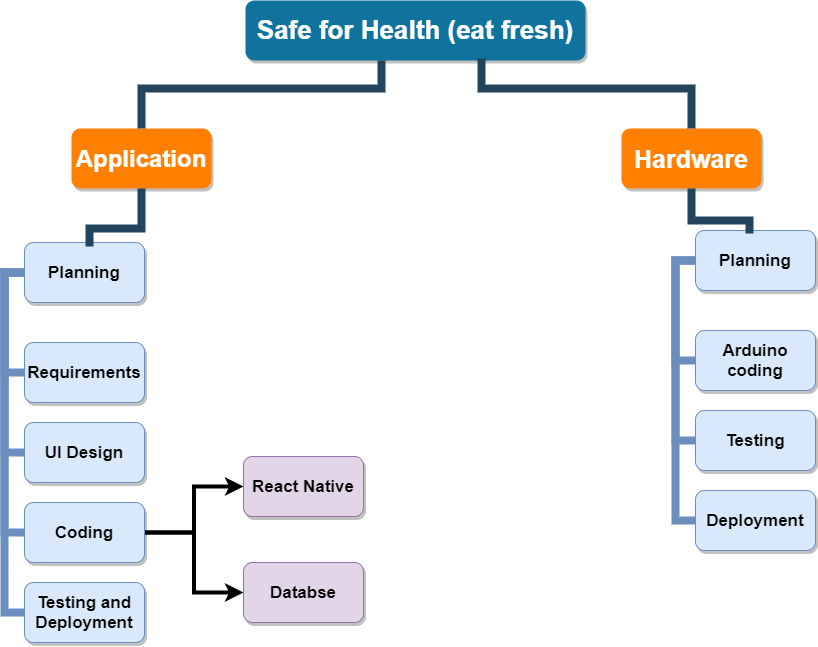
Ensuring the freshness of food products is essential for both acute and chronic health outcomes. However, significant health risks can be triggered by dietary resources subjected to improper storage protocols. Current methods are often unreliable and infeasible for detecting food freshness. This research proposes an IoT-based food freshness detection system that integrates a suite of electrochemical and gas sensors-including pH, moisture, and ethanol sensors-to assess food freshness and reduce health risks associated with spoilage in perishable items like meat, produce, and dairy. The system is integrated with a mobile application that allows users to analyze food quality in real-time, based on predefined degradation thresholds. This study assists in providing valuable insights for future research and improving food safety by contributing to the data storage of food-contextual sensor thresholds. This strategy leads to more informed decision-making by consumers, mitigating food wastage and promoting healthier food choices in the process.
Graphical Abstract
Keywords
Data Availability Statement
Funding
Conflicts of Interest
Ethical Approval and Consent to Participate
References
- Wang, D., Zhang, M., Jiang, Q., & Mujumdar, A. S. (2024). Intelligent system/equipment for quality deterioration detection of fresh food: Recent advances and application. Foods, 13(11), 1662.
[CrossRef] [Google Scholar] - Damdam, A. N., Ozay, L. O., Ozcan, C. K., Alzahrani, A., Helabi, R., & Salama, K. N. (2023). IoT-enabled electronic nose system for beef quality monitoring and spoilage detection. Foods, 12(11), 2227.
[CrossRef] [Google Scholar] - Neethirajan, S., Ragavan, V., Weng, X., & Chand, R. (2018). Biosensors for sustainable food engineering: challenges and perspectives. Biosensors, 8(1), 23.
[CrossRef] [Google Scholar] - Karanth, S., Feng, S., Patra, D., & Pradhan, A. K. (2023). Linking microbial contamination to food spoilage and food waste: The role of smart packaging, spoilage risk assessments, and date labeling. Frontiers in microbiology, 14, 1198124.
[CrossRef] [Google Scholar] - Akinsemolu, A. A., & Onyeaka, H. N. (2024). Microorganisms associated with food spoilage and foodborne diseases. In Food Safety and Quality in the Global South (pp. 489-531). Springer.
[CrossRef] [Google Scholar] - Shen, D., Zhang, M., Mujumdar, A. S., & Ma, Y. (2024). Consumer-oriented smart dynamic detection of fresh food quality: Recent advances and future prospects. Critical Reviews in Food Science and Nutrition, 64(30), 11281-11301.
[CrossRef] [Google Scholar] - Bendre, S., Shinde, K., Kale, N., & Gilda, S. (2022). Artificial intelligence in food industry: A current panorama. Asian Journal of Pharmacy and Technology, 12(3), 242-250. http://dx.doi.org/10.52711/2231-5713.2022.00040
[Google Scholar] - Kuswandi, B., Wicaksono, Y., Jayus, Abdullah, A., Heng, L. Y., & Ahmad, M. (2011). Smart packaging: sensors for monitoring of food quality and safety. Sensing and instrumentation for food quality and safety, 5(3), 137-146.
[CrossRef] [Google Scholar] - Inês, A., & Cosme, F. (2025). Biosensors for detecting food contaminants—An overview. Processes, 13(2), 380.
[CrossRef] [Google Scholar] - Chen, Y., Wang, Y., Zhang, Y., Wang, X., Zhang, C., & Cheng, N. (2024). Intelligent biosensors promise smarter solutions in Food Safety 4.0. Foods, 13(2), 235.
[CrossRef] [Google Scholar] - Pallavi, L., Prasad, P., Hariharan, G., Karthikayani, K., & Shudapreyaa, R. (2022). IoT and mobile app-based food spoilage alert system. International Journal of Health Sciences, 6, 13911-13924.
[CrossRef] [Google Scholar] - Nath, S. (2024). Advancements in food quality monitoring: Integrating biosensors for precision detection. Sustainable Food Technology, 2, 112-125.
[CrossRef] [Google Scholar] - Konfo, T. R. C., Tchekessi, C. K. C., & Baba-Moussa, F. A. K. (2024). Status report on innovations and applications of smart bio-systems for real-time monitoring of food quality. Applied Food Research, 5, 100546.
[CrossRef] [Google Scholar] - Chun, M., Yu, H. J., & Jung, H. (2024). A deep learning-based rotten food recognition app for older adults: Development and usability study. JMIR Formative Research, 8, e55342.
[CrossRef] [Google Scholar] - Stephan, T., Paramana, P. P. D., Lin, C. C., Agarwal, S., & Verma, R. (2025). Federated learning-driven IoT system for automated freshness monitoring in resource-constrained vending carts. Journal of Big Data, 12(1), 1-34.
[CrossRef] [Google Scholar] - Doğan, V., Evliya, M., Kahyaoglu, L. N., & Kılıç, V. (2024). On-site colorimetric food spoilage monitoring with smartphone embedded machine learning. Talanta, 266, 125021.
[CrossRef] [Google Scholar] - Erna, K. H., Rovina, K., & Mantihal, S. (2021). Current detection techniques for monitoring the freshness of meat-based products: A review. Journal of Packaging Technology and Research, 5(3), 127-141.
[CrossRef] [Google Scholar] - Liu, Y., Han, W., Zhang, Y., Li, L., Wang, J., & Zheng, L. (2016). An Internet-of-Things solution for food safety and quality control: A pilot project in China. Journal of Industrial Information Integration, 3, 1-7.
[CrossRef] [Google Scholar] - Ren, Q. S., Fang, K., Yang, X. T., & Han, J. W. (2022). Ensuring the quality of meat in cold chain logistics: A comprehensive review. Trends in Food Science & Technology, 119, 133-151.
[CrossRef] [Google Scholar] - Naik, A., Lee, H. S., Herrington, J., Barandun, G., Flock, G., G{\"uder, F., & Gonzalez-Macia, L. (2024). Smart Packaging with Disposable NFC-enabled Wireless Gas Sensors for Monitoring Food Spoilage. ACS sensors, 9(12), 6789-6799.
[CrossRef] [Google Scholar] - Mounica, B., Ch, G., Vishnu, K., & Kumar, I. (2020). IoT based food spoilage detection system using Arduino. International Journal of Engineering Technology and Management Sciences, 6(04), 110-116.
[CrossRef] [Google Scholar] - Mishra, N., Jain, S. K., Agrawal, N., Jain, N. K., Wadhawan, N., & Panwar, N. L. (2023). Development of drying system by using internet of things for food quality monitoring and controlling. Energy Nexus, 11, 100219.
[CrossRef] [Google Scholar] - Badamasi, Y. A. (2014, September). The working principle of an Arduino. In 2014 11th international conference on electronics, computer and computation (ICECCO) (pp. 1-4). IEEE.
[CrossRef] [Google Scholar] - Zhou, G. H., Xu, X. L., & Liu, Y. (2010). Preservation technologies for fresh meat—A review. Meat Science, 86(1), 119-128.
[CrossRef] [Google Scholar] - Papadopoulou, O. S., Panagou, E. Z., Mohareb, F. R., & Nychas, G. J. E. (2013). Sensory and microbiological quality assessment of beef fillets using a portable electronic nose in tandem with support vector machine analysis. Food Research International, 50(1), 241-249.
[CrossRef] [Google Scholar] - Misra, N. N., Dixit, Y., Al-Mallahi, A., Bhullar, M. S., Upadhyay, R., & Martynenko, A. (2020). IoT, big data, and artificial intelligence in agriculture and food industry. IEEE Internet of things Journal, 9(9), 6305-6324.
[CrossRef] [Google Scholar] - Swathi, B., Pooja, T., Shankar, Y., & Gowtham, V. (2022, March). Survey on IoT based farm freshness mobile application. In 2022 International Conference on Advanced Computing Technologies and Applications (ICACTA) (pp. 1-7). IEEE.
[CrossRef] [Google Scholar]
Cited By (9)
-
Peng Shi, Jingjing Guo, Lu Deng, Yingkai Liu, Lizhi Long, Shaopeng Xu. Enhanced recognition of low-discernibility Railway Sleeper Serial Numbers via dual-stage adaptive image enhancement and position prior-guided detection.
Engineering Applications of Artificial Intelligence, 2026 , 169 .
[CrossRef] -
Xiangyan Wang, Shuangcheng Huang, Qingbo Lu, Xinyi Guo. Environmental Control for Edible Fungi Cultivation Based on Temporal Information and Deep Learning.
Food Bioengineering, 2026 .
[CrossRef] -
Mst Suraiya Farzana, Liuxiao Feng, Peiyin Chen, Md Owahedur Rahman, Muhammad Bilal Yaseen, Sadashiv Chaturvedi. Hierarchical transformer-based adaptive cross-modal gait recognition for lower-limb exoskeletons: Advancing real-time intent detection and predictive assistance.
Biomedical Signal Processing and Control, 2026 , 125 .
[CrossRef] -
Mariana Akemi Ikegawa Bernabé, Rafael González Perea, Juan Antonio Rodríguez Díaz, Jorge García Morillo. Transformer-based artificial intelligence for forecasting energy demand in irrigation districts.
Computers and Electronics in Agriculture, 2026 , 246 .
[CrossRef] -
Riza Jane S. Banicod, Nazia Tabassum, Du-Min Jo, Aqib Javaid, Young-Mog Kim, Fazlurrahman Khan. Integration of Artificial Intelligence in Biosensors for Enhanced Detection of Foodborne Pathogens.
Biosensors, 2025 , 15 (10).
[CrossRef] -
Mooyoung Yoo. Low-Cost Gas Sensing and Machine Learning for Intelligent Refrigeration in the Built Environment.
Buildings, 2025 , 16 (1).
[CrossRef] -
Rakesh Rajendran, M. Karthick, S. Nishanthini, M. Archana, A.Fahisha Noora. .
2025 10th International Conference on Smart Structures and Systems (ICSSS), 2025 .
[CrossRef] -
Anoop Dev, Sachin Singh, Ashmeet Kaur, Neha, Satish Upadhyay, J. Refonaa. AI-ASSISTED RESTORATION OF FOLK MURALS.
ShodhKosh: Journal of Visual and Performing Arts, 2025 , 6 (1s).
[CrossRef] -
Zixuan Guo, Sameer Kumar, Houbin Wang, Jingyi Li. AI-Driven Recognition and Sustainable Preservation of Ancient Murals: The DKR-YOLO Framework.
Heritage, 2025 , 8 (10).
[CrossRef]
Cite This Article
TY  - JOUR
AU  - Iqbal, Mazhar
AU  - Yousaf, Junaid
AU  - Khan, Atif
AU  - Muhammad, Tila
PY  - 2025
DA  - 2025/06/30
TI  - IoT-Enabled Food Freshness Detection Using Multi-Sensor Data Fusion and Mobile Sensing Interface
JO  - ICCK Transactions on Sensing, Communication, and Control
T2  - ICCK Transactions on Sensing, Communication, and Control
JF  - ICCK Transactions on Sensing, Communication, and Control
VL  - 2
IS  - 2
SP  - 122
EP  - 131
DO  - 10.62762/TSCC.2025.401245
UR  - https://www.icck.org/article/abs/TSCC.2025.401245
KW  - food freshness
KW  - IoT system
KW  - biosensors
KW  - mobile application
KW  - spoilage detection
AB  - Ensuring the freshness of food products is essential for both acute and chronic health outcomes. However, significant health risks can be triggered by dietary resources subjected to improper storage protocols. Current methods are often unreliable and infeasible for detecting food freshness. This research proposes an IoT-based food freshness detection system that integrates a suite of electrochemical and gas sensors-including pH, moisture, and ethanol sensors-to assess food freshness and reduce health risks associated with spoilage in perishable items like meat, produce, and dairy. The system is integrated with a mobile application that allows users to analyze food quality in real-time, based on predefined degradation thresholds. This study assists in providing valuable insights for future research and improving food safety by contributing to the data storage of food-contextual sensor thresholds. This strategy leads to more informed decision-making by consumers, mitigating food wastage and promoting healthier food choices in the process.
SN  - 3068-9287
PB  - Institute of Central Computation and Knowledge
LA  - English
ER  -
@article{Iqbal2025IoTEnabled,
  author = {Mazhar Iqbal and Junaid Yousaf and Atif Khan and Tila Muhammad},
  title = {IoT-Enabled Food Freshness Detection Using Multi-Sensor Data Fusion and Mobile Sensing Interface},
  journal = {ICCK Transactions on Sensing, Communication, and Control},
  year = {2025},
  volume = {2},
  number = {2},
  pages = {122-131},
  doi = {10.62762/TSCC.2025.401245},
  url = {https://www.icck.org/article/abs/TSCC.2025.401245},
  abstract = {Ensuring the freshness of food products is essential for both acute and chronic health outcomes. However, significant health risks can be triggered by dietary resources subjected to improper storage protocols. Current methods are often unreliable and infeasible for detecting food freshness. This research proposes an IoT-based food freshness detection system that integrates a suite of electrochemical and gas sensors-including pH, moisture, and ethanol sensors-to assess food freshness and reduce health risks associated with spoilage in perishable items like meat, produce, and dairy. The system is integrated with a mobile application that allows users to analyze food quality in real-time, based on predefined degradation thresholds. This study assists in providing valuable insights for future research and improving food safety by contributing to the data storage of food-contextual sensor thresholds. This strategy leads to more informed decision-making by consumers, mitigating food wastage and promoting healthier food choices in the process.},
  keywords = {food freshness, IoT system, biosensors, mobile application, spoilage detection},
  issn = {3068-9287},
  publisher = {Institute of Central Computation and Knowledge}
}
Publisher's Note
ICCK stays neutral with regard to jurisdictional claims in published maps and institutional affiliations.
Rights and Permissions


Portico
