

Parameter Estimation for the Tuned Liquid Damper Model Based on Robust Extended Kalman Filter






Article Information
Abstract
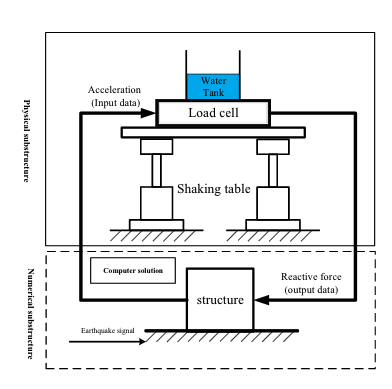
The Tuned Liquid Damper (TLD) method offers a practical and cost-effective solution for seismic design. Accurate modeling of the TLD system’s dynamic behavior is crucial for optimizing its performance. In this study, the nonlinear dynamics of the TLD system are characterized using the Housner model, with parameters estimated via a nonlinear state estimation approach. To address challenges associated with model discretization and unknown noise processes, we introduce a Robust Extended Kalman Filter (REKF) that incrementally incorporates uncertainties to more accurately capture system dynamics. The proposed method is evaluated through real-time hybrid simulation, employing seismic input signals from the El Centro and Hachinohe ground motions. Comparative analyses indicate that the robust algorithm achieves superior parameter estimation relative to conventional methods, with estimated parameters closely aligning with reference values and resulting in minimal relative error. This work underscores the efficacy of robust algorithms in TLD vibration response analysis and presents a promising approach for dynamic modeling and seismic performance optimization.
Graphical Abstract
Keywords
Data Availability Statement
Funding
Conflicts of Interest
Ethical Approval and Consent to Participate
References
- Housner, G. W. (1963). The dynamic behavior of water tanks. Bulletin of the seismological society of America, 53(2), 381-387.
[CrossRef] [Google Scholar] - Limin, S. (1991). Semi-analytical modelling of tuned liquid damper (tld) with emphasis on damping of liquid sloshing. University of Tokyo.
[CrossRef] [Google Scholar] - Kamgar, R., Gholami, F., Zarif Sanayei, H. R., & Heidarzadeh, H. (2020). Modified tuned liquid dampers for seismic protection of buildings considering soil–structure interaction effects. Iranian Journal of Science and Technology, Transactions of Civil Engineering, 44(1), 339-354.
[CrossRef] [Google Scholar] - Pandit, A. R., & Biswal, K. C. (2020, June). Seismic control of multi degree of freedom structure outfitted with sloped bottom tuned liquid damper. In Structures (Vol. 25, pp. 229-240). Elsevier.
[CrossRef] [Google Scholar] - Zorzi, M. (2017). Convergence analysis of a family of robust Kalman filters based on the contraction principle. SIAM Journal on Control and Optimization, 55(5), 3116-3131.
[CrossRef] [Google Scholar] - Reif, K., Gunther, S., Yaz, E., & Unbehauen, R. (1999). Stochastic stability of the discrete-time extended Kalman filter. IEEE Transactions on Automatic control, 44(4), 714-728.
[CrossRef] [Google Scholar] - Chang, P. M., Lou, J. Y., & Lutes, L. D. (1998). Model identification and control of a tuned liquid damper. Engineering structures, 20(3), 155-163.
[CrossRef] [Google Scholar] - Dey, S., & Moore, J. B. (1999). Finite-dimensional risk-sensitive filters and smoothers for discrete-time nonlinear systems. IEEE Transactions on Automatic Control, 44(6), 1234-1239.
[CrossRef] [Google Scholar] - Zorzi, M. (2016). Robust Kalman filtering under model perturbations. IEEE Transactions on Automatic Control, 62(6), 2902-2907.
[CrossRef] [Google Scholar] - Levy, B. C., & Zorzi, M. (2016). A contraction analysis of the convergence of risk-sensitive filters. SIAM Journal on Control and Optimization, 54(4), 2154-2173.
[CrossRef] [Google Scholar] - Longhini, A., Perbellini, M., Gottardi, S., Yi, S., Liu, H., & Zorzi, M. (2021, May). Learning the tuned liquid damper dynamics by means of a robust EKF. In 2021 American Control Conference (ACC) (pp. 60-65). IEEE.
[CrossRef] [Google Scholar] - Zorzi, M. (2017). On the robustness of the Bayes and Wiener estimators under model uncertainty. Automatica, 83, 133-140.
[CrossRef] [Google Scholar] - Levy, B. C., & Nikoukhah, R. (2004). Robust least-squares estimation with a relative entropy constraint. IEEE Transactions on Information Theory, 50(1), 89-104.
[CrossRef] [Google Scholar] - Levy, B. C., & Nikoukhah, R. (2012). Robust state space filtering under incremental model perturbations subject to a relative entropy tolerance. IEEE Transactions on Automatic Control, 58(3), 682-695.
[CrossRef] [Google Scholar] - Kim, S., Deshpande, V. M., & Bhattacharya, R. (2020). Robust Kalman filtering with probabilistic uncertainty in system parameters. IEEE Control Systems Letters, 5(1), 295-300.
[CrossRef] [Google Scholar] - Yi, S., & Zorzi, M. (2021). Robust kalman filtering under model uncertainty: The case of degenerate densities. IEEE Transactions on Automatic Control, 67(7), 3458-3471.
[CrossRef] [Google Scholar]
Cited By (3)
-
Zhongwei Hou, Jin Han, Wenbing Yu, Fenglei Han, Xuefu Zhang. Research on spatial coordinate perception technology for water-rich underground channels based on inertial signal representation analysis.
Measurement, 2026 , 280 .
[CrossRef] -
Feng Ding, Yongsong Xiao, Ling Xu, Zhiming Fang. Hierarchical Stochastic Gradient and Hierarchical Multi‐Innovation Stochastic Gradient Identification for Multivariable ARX Models.
International Journal of Adaptive Control and Signal Processing, 2026 , 40 (1).
[CrossRef] -
Kenan Can Taşan, Ahmet Akbulut. A Learning-Based Measurement Validation Approach for Cooperative Multi-UAV Navigation Using Kalman Filtering.
Drones, 2025 , 9 (12).
[CrossRef]
Cite This Article
TY  - JOUR
AU  - Su, Tingli
AU  - Zhang, Yao
AU  - Tang, Zhenyun
PY  - 2025
DA  - 2025/04/30
TI  - Parameter Estimation for the Tuned Liquid Damper Model Based on Robust Extended Kalman Filter
JO  - ICCK Transactions on Sensing, Communication, and Control
T2  - ICCK Transactions on Sensing, Communication, and Control
JF  - ICCK Transactions on Sensing, Communication, and Control
VL  - 2
IS  - 2
SP  - 75
EP  - 84
DO  - 10.62762/TSCC.2025.663633
UR  - https://www.icck.org/article/abs/TSCC.2025.663633
KW  - nonlinear state estimation
KW  - robust kalman filter
KW  - TLD
AB  - The Tuned Liquid Damper (TLD) method offers a practical and cost-effective solution for seismic design. Accurate modeling of the TLD system’s dynamic behavior is crucial for optimizing its performance. In this study, the nonlinear dynamics of the TLD system are characterized using the Housner model, with parameters estimated via a nonlinear state estimation approach. To address challenges associated with model discretization and unknown noise processes, we introduce a Robust Extended Kalman Filter (REKF) that incrementally incorporates uncertainties to more accurately capture system dynamics. The proposed method is evaluated through real-time hybrid simulation, employing seismic input signals from the El Centro and Hachinohe ground motions. Comparative analyses indicate that the robust algorithm achieves superior parameter estimation relative to conventional methods, with estimated parameters closely aligning with reference values and resulting in minimal relative error. This work underscores the efficacy of robust algorithms in TLD vibration response analysis and presents a promising approach for dynamic modeling and seismic performance optimization.
SN  - 3068-9287
PB  - Institute of Central Computation and Knowledge
LA  - English
ER  -
@article{Su2025Parameter,
  author = {Tingli Su and Yao Zhang and Zhenyun Tang},
  title = {Parameter Estimation for the Tuned Liquid Damper Model Based on Robust Extended Kalman Filter},
  journal = {ICCK Transactions on Sensing, Communication, and Control},
  year = {2025},
  volume = {2},
  number = {2},
  pages = {75-84},
  doi = {10.62762/TSCC.2025.663633},
  url = {https://www.icck.org/article/abs/TSCC.2025.663633},
  abstract = {The Tuned Liquid Damper (TLD) method offers a practical and cost-effective solution for seismic design. Accurate modeling of the TLD system’s dynamic behavior is crucial for optimizing its performance. In this study, the nonlinear dynamics of the TLD system are characterized using the Housner model, with parameters estimated via a nonlinear state estimation approach. To address challenges associated with model discretization and unknown noise processes, we introduce a Robust Extended Kalman Filter (REKF) that incrementally incorporates uncertainties to more accurately capture system dynamics. The proposed method is evaluated through real-time hybrid simulation, employing seismic input signals from the El Centro and Hachinohe ground motions. Comparative analyses indicate that the robust algorithm achieves superior parameter estimation relative to conventional methods, with estimated parameters closely aligning with reference values and resulting in minimal relative error. This work underscores the efficacy of robust algorithms in TLD vibration response analysis and presents a promising approach for dynamic modeling and seismic performance optimization.},
  keywords = {nonlinear state estimation, robust kalman filter, TLD},
  issn = {3068-9287},
  publisher = {Institute of Central Computation and Knowledge}
}
Publisher's Note
ICCK stays neutral with regard to jurisdictional claims in published maps and institutional affiliations.
Rights and Permissions


Portico
