

Recommender System: A Comprehensive Overview of Technical Challenges and Social Implications





Article Information
Abstract
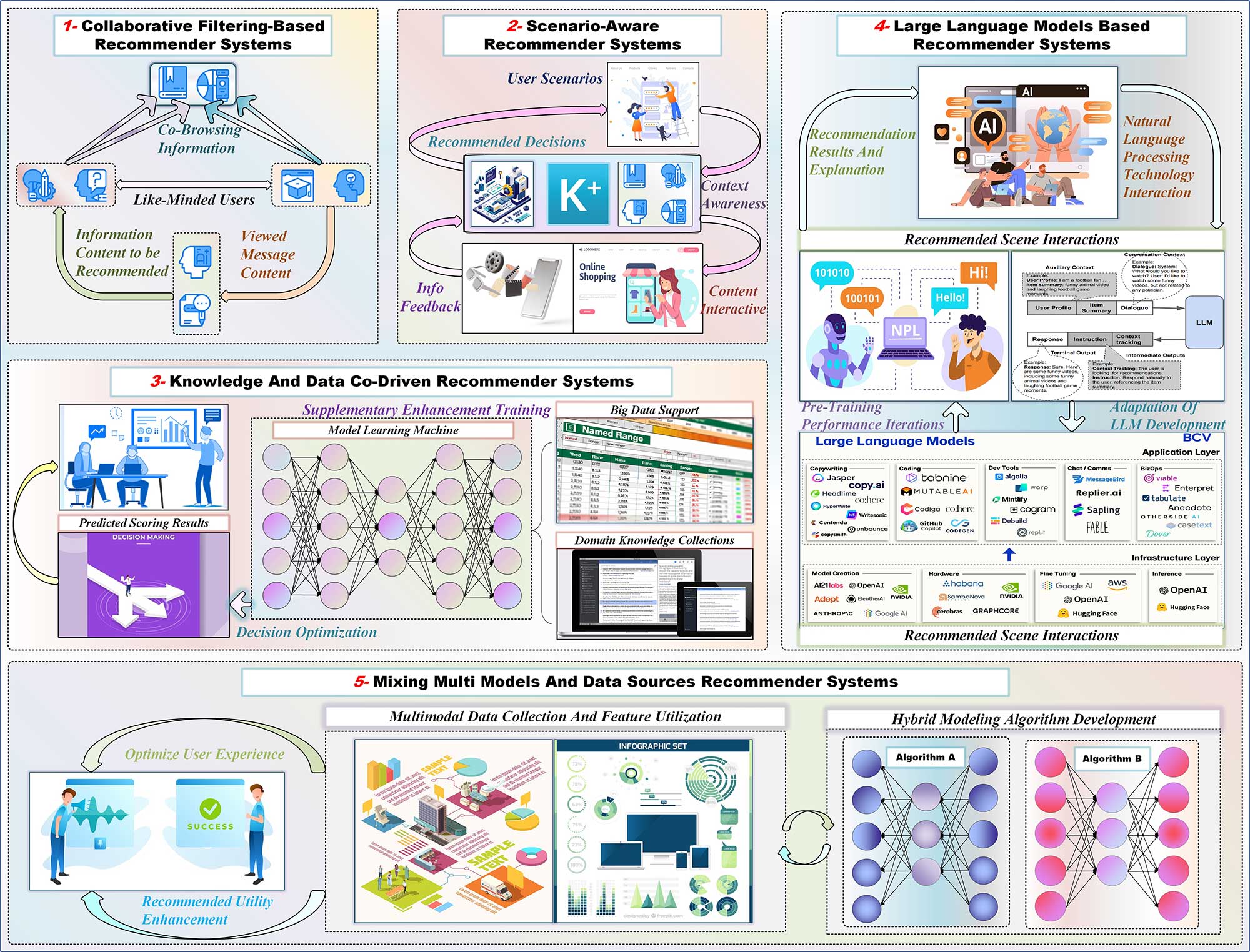
The proliferation of Recommender Systems (RecSys), driven by their expanding deployment within Sensing-Communication-Control (SCC) architectures and explosive growth of multi-sensor data streams, has cultivated a dynamic research landscape at the intersection of artificial intelligence and cyber-physical systems. Embedded in SCC pipelines, RecSys transforms heterogeneous sensor-acquired data-spanning behavioral signals, physiological measurements, spatial context, and environmental conditions-into personalized control directives for smart homes, industrial IoT platforms, intelligent transportation systems, and precision healthcare environments. This paper comprehensively reviews RecSys foundational concepts, methodologies, and challenges from algorithmic and SCC system-integration perspectives. It categorizes RecSys solutions into five paradigms-collaborative filtering, scenario-aware, knowledge & data co-driven, large language models, and hybrid approaches-analyzing how each interfaces with sensing modalities, communication constraints, and control objectives. Five technical challenges critical to SCC deployment are then examined: robustness under sensing noise, recommendation accuracy under real-time constraints, cold-start problems in sensor-sparse environments, explainability for human-in-the-loop control, and privacy-preserving sensing and communication. The review further addresses how behavioral sensing data encodes biases that propagate into control outputs, and how human factors principles inform the design of transparent, trustworthy recommendation-driven control systems. Future directions include edge-native inference, sensor-adaptive learning, and communication-aware algorithm co-design.
Graphical Abstract
Keywords
Data Availability Statement
Funding
Conflicts of Interest
Ethical Approval and Consent to Participate
References
- Ricci, F., Rokach, L., & Shapira, B. (2010). Introduction to recommender systems handbook. In Recommender systems handbook (pp. 1-35). Boston, MA: springer US.
[CrossRef] [Google Scholar] - Konstan, J. A., Miller, B. N., Maltz, D., Herlocker, J. L., Gordon, L. R., & Riedl, J. (1997). Grouplens: Applying collaborative filtering to usenet news. Communications of the ACM, 40(3), 77-87.
[CrossRef] [Google Scholar] - Burke, R. (2002). Hybrid recommender systems: Survey and experiments. User modeling and user-adapted interaction, 12, 331-370.
[CrossRef] [Google Scholar] - Zhang, S., Yao, L., Sun, A., & Tay, Y. (2019). Deep learning based recommender system: A survey and new perspectives. ACM computing surveys (CSUR), 52(1), 1-38.
[CrossRef] [Google Scholar] - Pan, W., Xiang, E., Liu, N., & Yang, Q. (2010, July). Transfer learning in collaborative filtering for sparsity reduction. In Proceedings of the AAAI conference on artificial intelligence (Vol. 24, No. 1, pp. 230-235).
[CrossRef] [Google Scholar] - Schein, A. I., Popescul, A., Ungar, L. H., & Pennock, D. M. (2002, August). Methods and metrics for cold-start recommendations. In Proceedings of the 25th annual international ACM SIGIR conference on Research and development in information retrieval (pp. 253-260).
[CrossRef] [Google Scholar] - Ramadhan, G., & Setiawan, E. B. (2022, November). Collaborative filtering recommender system based on memory based in twitter using decision tree learning classification (case study: Movie on netflix). In 2022 International Conference on Advanced Creative Networks and Intelligent Systems (ICACNIS) (pp. 1-6). IEEE.
[CrossRef] [Google Scholar] - Rifai, A. F., & Setiawan, E. B. (2022). Memory-based collaborative filtering on twitter using support vector machine classification. Jurnal RESTI (Rekayasa Sistem dan Teknologi Informasi), 6(5), 702-709.
[CrossRef] [Google Scholar] - Valcarce, D., Landin, A., Parapar, J., & Barreiro, Á. (2019). Collaborative filtering embeddings for memory-based recommender systems. Engineering Applications of Artificial Intelligence, 85, 347-356.
[CrossRef] [Google Scholar] - Chen, C. M., Wang, C. J., Tsai, M. F., & Yang, Y. H. (2019, May). Collaborative similarity embedding for recommender systems. In The World Wide Web Conference (pp. 2637-2643).
[CrossRef] [Google Scholar] - Barkan, O., Hirsch, R., Katz, O., Caciularu, A., & Koenigstein, N. (2021, October). Anchor-based collaborative filtering. In Proceedings of the 30th ACM International Conference on Information & Knowledge Management (pp. 2877-2881).
[CrossRef] [Google Scholar] - Malandri, L., Porcel, C., Xing, F., Serrano-Guerrero, J., & Cambria, E. (2022). Soft computing for recommender systems and sentiment analysis. Applied Soft Computing, 118, 108246.
[CrossRef] [Google Scholar] - Zheng, L., Noroozi, V., & Yu, P. S. (2017, February). Joint deep modeling of users and items using reviews for recommendation. In Proceedings of the tenth ACM international conference on web search and data mining (pp. 425-434).
[CrossRef] [Google Scholar] - Seo, S., Huang, J., Yang, H., & Liu, Y. (2017, August). Interpretable convolutional neural networks with dual local and global attention for review rating prediction. In Proceedings of the eleventh ACM conference on recommender systems (pp. 297-305).
[CrossRef] [Google Scholar] - Chin, J. Y., Zhao, K., Joty, S., & Cong, G. (2018, October). ANR: Aspect-based neural recommender. In Proceedings of the 27th ACM International conference on information and knowledge management (pp. 147-156).
[CrossRef] [Google Scholar] - Li, C., Quan, C., Peng, L., Qi, Y., Deng, Y., & Wu, L. (2019, July). A capsule network for recommendation and explaining what you like and dislike. In Proceedings of the 42nd international ACM SIGIR conference on research and development in information retrieval (pp. 275-284).
[CrossRef] [Google Scholar] - Wu, C., Wu, F., An, M., Huang, J., Huang, Y., & Xie, X. (2019, July). NPA: neural news recommendation with personalized attention. In Proceedings of the 25th ACM SIGKDD international conference on knowledge discovery & data mining (pp. 2576-2584).
[CrossRef] [Google Scholar] - Liu, N., Ge, Y., Li, L., Hu, X., Chen, R., & Choi, S. H. (2020, October). Explainable recommender systems via resolving learning representations. In Proceedings of the 29th ACM international conference on information & knowledge management (pp. 895-904).
[CrossRef] [Google Scholar] - Fang, L., Du, B., & Wu, C. (2022). Differentially private recommender system with variational autoencoders. Knowledge-Based Systems, 250, 109044.
[CrossRef] [Google Scholar] - Wu, J., Wang, X., Feng, F., He, X., Chen, L., Lian, J., & Xie, X. (2021, July). Self-supervised graph learning for recommendation. In Proceedings of the 44th international ACM SIGIR conference on research and development in information retrieval (pp. 726-735).
[CrossRef] [Google Scholar] - Xia, J., Li, D., Gu, H., Lu, T., Zhang, P., & Gu, N. (2021, October). Incremental graph convolutional network for collaborative filtering. In Proceedings of the 30th ACM International Conference on Information & Knowledge Management (pp. 2170-2179).
[CrossRef] [Google Scholar] - Lin, Z., Tian, C., Hou, Y., & Zhao, W. X. (2022, April). Improving graph collaborative filtering with neighborhood-enriched contrastive learning. In Proceedings of the ACM web conference 2022 (pp. 2320-2329).
[CrossRef] [Google Scholar] - Zhao, M., Wu, L., Liang, Y., Chen, L., Zhang, J., Deng, Q., ... & Wu, R. (2022, July). Investigating accuracy-novelty performance for graph-based collaborative filtering. In Proceedings of the 45th international ACM SIGIR conference on research and development in information retrieval (pp. 50-59).
[CrossRef] [Google Scholar] - Adomavicius, G., & Tuzhilin, A. (2010). Context-aware recommender systems. In Recommender systems handbook (pp. 217-253). Boston, MA: Springer US.
[CrossRef] [Google Scholar] - del Carmen Rodríguez-Hernández, M., & Ilarri, S. (2021). AI-based mobile context-aware recommender systems from an information management perspective: Progress and directions. Knowledge-Based Systems, 215, 106740.
[CrossRef] [Google Scholar] - Mei, L., Ren, P., Chen, Z., Nie, L., Ma, J., & Nie, J. Y. (2018, October). An attentive interaction network for context-aware recommendations. In Proceedings of the 27th ACM international conference on information and knowledge management (pp. 157-166).
[CrossRef] [Google Scholar] - Unger, M., & Tuzhilin, A. (2020). Hierarchical latent context representation for context-aware recommendations. IEEE Transactions on Knowledge and Data Engineering, 34(7), 3322-3334.
[CrossRef] [Google Scholar] - Unger, M., Shapira, B., Rokach, L., & Bar, A. (2017, July). Inferring contextual preferences using deep auto-encoding. In Proceedings of the 25th Conference on User Modeling, Adaptation and Personalization (pp. 221-229).
[CrossRef] [Google Scholar] - Ouyang, Y., Wu, P., & Pan, L. (2022, October). Asymmetrical context-aware modulation for collaborative filtering recommendation. In Proceedings of the 31st ACM International Conference on Information & Knowledge Management (pp. 1595-1604).
[CrossRef] [Google Scholar] - Nawara, D., & Kashef, R. (2022, April). Context-aware recommendation systems using consensus-clustering. In 2022 IEEE International Systems Conference (SysCon) (pp. 1-8). IEEE.
[CrossRef] [Google Scholar] - Ebesu, T., & Fang, Y. (2017, August). Neural citation network for context-aware citation recommendation. In Proceedings of the 40th international ACM SIGIR conference on research and development in information retrieval (pp. 1093-1096).
[CrossRef] [Google Scholar] - Al Jawarneh, I. M., Bellavista, P., Corradi, A., Foschini, L., Montanari, R., Berrocal, J., & Murillo, J. M. (2020). A pre-filtering approach for incorporating contextual information into deep learning based recommender systems. IEEE Access, 8, 40485-40498.
[CrossRef] [Google Scholar] - Wu, J., He, X., Wang, X., Wang, Q., Chen, W., Lian, J., & Xie, X. (2022). Graph convolution machine for context-aware recommender system. Frontiers of Computer Science, 16(6), 166614.
[CrossRef] [Google Scholar] - Deldjoo, Y., Schedl, M., Cremonesi, P., & Pasi, G. (2020). Recommender systems leveraging multimedia content. ACM Computing Surveys (CSUR), 53(5), 1-38.
[CrossRef] [Google Scholar] - Van Dat, N., Van Toan, P., & Thanh, T. M. (2022). Solving distribution problems in content-based recommendation system with gaussian mixture model. Applied Intelligence, 52(2), 1602-1614.
[CrossRef] [Google Scholar] - Yang, Y., Zhu, Y., & Li, Y. (2022). Personalized recommendation with knowledge graph via dual-autoencoder. Applied Intelligence, 52(6), 6196-6207.
[CrossRef] [Google Scholar] - Deldjoo, Y., Elahi, M., Quadrana, M., & Cremonesi, P. (2018). Using visual features based on MPEG-7 and deep learning for movie recommendation. International journal of multimedia information retrieval, 7, 207-219.
[CrossRef] [Google Scholar] - Cami, B. R., Hassanpour, H., & Mashayekhi, H. (2019). User preferences modeling using dirichlet process mixture model for a content-based recommender system. Knowledge-Based Systems, 163, 644-655.
[CrossRef] [Google Scholar] - Wang, C., Zhou, T., Chen, C., Hu, T., & Chen, G. (2019, July). CAMO: A collaborative ranking method for content based recommendation. In Proceedings of the AAAI Conference on Artificial Intelligence (Vol. 33, No. 01, pp. 5224-5231).
[CrossRef] [Google Scholar] - Serrano-Guerrero, J., Olivas, J. A., & Romero, F. P. (2020). A T1OWA and aspect-based model for customizing recommendations on eCommerce. Applied Soft Computing, 97, 106768.
[CrossRef] [Google Scholar] - Polignano, M., Narducci, F., de Gemmis, M., & Semeraro, G. (2021). Towards emotion-aware recommender systems: an affective coherence model based on emotion-driven behaviors. Expert Systems with Applications, 170, 114382.
[CrossRef] [Google Scholar] - Amato, F., Moscato, V., Picariello, A., & Piccialli, F. (2019). SOS: a multimedia recommender system for online social networks. Future generation computer systems, 93, 914-923.
[CrossRef] [Google Scholar] - Zhang, Y., Shen, G., Han, X., Wang, W., & Kong, X. (2022). Spatio-temporal digraph convolutional network-based taxi pickup location recommendation. IEEE Transactions on Industrial Informatics, 19(1), 394-403.
[CrossRef] [Google Scholar] - Ma, X., Zhang, Y., & Zeng, J. (2019). Newly published scientific papers recommendation in heterogeneous information networks. Mobile Networks and Applications, 24, 69-79.
[CrossRef] [Google Scholar] - Pham, P., Nguyen, L. T., Nguyen, N. T., Kozma, R., & Vo, B. (2023). A hierarchical fused fuzzy deep neural network with heterogeneous network embedding for recommendation. Information Sciences, 620, 105-124.
[CrossRef] [Google Scholar] - Chen, Q., Lin, J., Zhang, Y., Ding, M., Cen, Y., Yang, H., & Tang, J. (2019). Towards knowledge-based recommender dialog system. arXiv preprint arXiv:1908.05391.
[Google Scholar] - Anelli, V. W., Di Noia, T., Di Sciascio, E., Ferrara, A., & Mancino, A. C. M. (2021, September). Sparse feature factorization for recommender systems with knowledge graphs. In Proceedings of the 15th ACM Conference on Recommender Systems (pp. 154-165).
[CrossRef] [Google Scholar] - Huang, R., Han, C., & Cui, L. (2021, October). Entity-aware collaborative relation network with knowledge graph for recommendation. In Proceedings of the 30th ACM International Conference on Information & Knowledge Management (pp. 3098-3102).
[CrossRef] [Google Scholar] - Xia, L., Huang, C., Xu, Y., Dai, P., Zhang, X., Yang, H., ... & Bo, L. (2021, May). Knowledge-enhanced hierarchical graph transformer network for multi-behavior recommendation. In Proceedings of the AAAI conference on artificial intelligence (Vol. 35, No. 5, pp. 4486-4493).
[CrossRef] [Google Scholar] - Wang, H., Zhao, M., Xie, X., Li, W., & Guo, M. (2019, May). Knowledge graph convolutional networks for recommender systems. In The world wide web conference (pp. 3307-3313).
[CrossRef] [Google Scholar] - Vijayakumar, V., Vairavasundaram, S., Logesh, R., & Sivapathi, A. (2019). Effective knowledge based recommender system for tailored multiple point of interest recommendation. International Journal of Web Portals (IJWP), 11(1), 1-18.
[CrossRef] [Google Scholar] - Huang, C., Xu, H., Xu, Y., Dai, P., Xia, L., Lu, M., ... & Ye, Y. (2021, May). Knowledge-aware coupled graph neural network for social recommendation. In Proceedings of the AAAI conference on artificial intelligence (Vol. 35, No. 5, pp. 4115-4122).
[CrossRef] [Google Scholar] - Wang, X., Huang, T., Wang, D., Yuan, Y., Liu, Z., He, X., & Chua, T. S. (2021, April). Learning intents behind interactions with knowledge graph for recommendation. In Proceedings of the web conference 2021 (pp. 878-887).
[CrossRef] [Google Scholar] - Liu, D., Lian, J., Liu, Z., Wang, X., Sun, G., & Xie, X. (2021, August). Reinforced anchor knowledge graph generation for news recommendation reasoning. In Proceedings of the 27th ACM SIGKDD Conference on Knowledge Discovery & Data Mining (pp. 1055-1065).
[CrossRef] [Google Scholar] - Gong, F., Wang, M., Wang, H., Wang, S., & Liu, M. (2021). SMR: medical knowledge graph embedding for safe medicine recommendation. Big Data Research, 23, 100174.
[CrossRef] [Google Scholar] - Abu-Salih, B., Alsawalqah, H., Elshqeirat, B., Issa, T., & Wongthongtham, P. (2019). Toward a knowledge-based personalised recommender system for mobile app development. arXiv preprint arXiv:1909.03733.
[Google Scholar] - Cui, L., & Lee, D. (2022, July). Ketch: Knowledge graph enhanced thread recommendation in healthcare forums. In Proceedings of the 45th international acm sigir conference on research and development in information retrieval (pp. 492-501).
[CrossRef] [Google Scholar] - Gao, Y., Sheng, T., Xiang, Y., Xiong, Y., Wang, H., & Zhang, J. (2023). Chat-rec: Towards interactive and explainable llms-augmented recommender system. arXiv preprint arXiv:2303.14524.
[Google Scholar] - Friedman, L., Ahuja, S., Allen, D., Tan, Z., Sidahmed, H., Long, C., ... & Tiwari, M. (2023). Leveraging large language models in conversational recommender systems. arXiv preprint arXiv:2305.07961.
[Google Scholar] - Bao, K., Zhang, J., Wang, W., Zhang, Y., Yang, Z., Luo, Y., ... & Tian, Q. (2023). A bi-step grounding paradigm for large language models in recommendation systems. arXiv preprint arXiv:2308.08434.
[Google Scholar] - Chu, Z., Hao, H., Ouyang, X., Wang, S., Wang, Y., Shen, Y., ... & Li, S. (2023). Leveraging large language models for pre-trained recommender systems. arXiv preprint arXiv:2308.10837.
[Google Scholar] - Hou, Y., Zhang, J., Lin, Z., Lu, H., Xie, R., McAuley, J., & Zhao, W. X. (2024, March). Large language models are zero-shot rankers for recommender systems. In European Conference on Information Retrieval (pp. 364-381).
[CrossRef] [Google Scholar] - Wang, Y., Chu, Z., Ouyang, X., Wang, S., Hao, H., Shen, Y., ... & Li, S. (2023). Enhancing recommender systems with large language model reasoning graphs. arXiv preprint arXiv:2308.10835.
[Google Scholar] - Carranza, A. G., Farahani, R., Ponomareva, N., Kurakin, A., Jagielski, M., & Nasr, M. (2023). Synthetic Query Generation for Privacy-Preserving Deep Retrieval Systems using Differentially Private Language Models. arXiv preprint arXiv:2305.05973.
[Google Scholar] - Kiran, R., Kumar, P., & Bhasker, B. (2020). DNNRec: A novel deep learning based hybrid recommender system. Expert Systems with Applications, 144, 113054.
[CrossRef] [Google Scholar] - Burke, R., Felfernig, A., & Göker, M. H. (2011). Recommender systems: An overview. Ai Magazine, 32(3), 13-18.
[CrossRef] [Google Scholar] - Polignano, M., Musto, C., de Gemmis, M., Lops, P., & Semeraro, G. (2021, September). Together is better: Hybrid recommendations combining graph embeddings and contextualized word representations. In Proceedings of the 15th ACM conference on recommender systems (pp. 187-198).
[CrossRef] [Google Scholar] - Luo, S., Zhang, X., Xiao, Y., & Song, L. (2022, October). HySAGE: A hybrid static and adaptive graph embedding network for context-drifting recommendations. In Proceedings of the 31st ACM International Conference on Information & Knowledge Management (pp. 1389-1398).
[CrossRef] [Google Scholar] - Lops, P., De Gemmis, M., & Semeraro, G. (2010). Content-based recommender systems: State of the art and trends. Recommender systems handbook, 73-105.
[CrossRef] [Google Scholar] - He, X., He, Z., Du, X., & Chua, T. S. (2018, June). Adversarial personalized ranking for recommendation. In The 41st International ACM SIGIR conference on research & development in information retrieval (pp. 355-364).
[CrossRef] [Google Scholar] - Tang, J., Du, X., He, X., Yuan, F., Tian, Q., & Chua, T. S. (2019). Adversarial training towards robust multimedia recommender system. IEEE Transactions on Knowledge and Data Engineering, 32(5), 855-867.
[CrossRef] [Google Scholar] - Christakopoulou, K., & Banerjee, A. (2019, September). Adversarial attacks on an oblivious recommender. In Proceedings of the 13th ACM Conference on Recommender Systems (pp. 322-330).
[CrossRef] [Google Scholar] - Du, Y., Fang, M., Yi, J., Xu, C., Cheng, J., & Tao, D. (2018). Enhancing the robustness of neural collaborative filtering systems under malicious attacks. IEEE Transactions on Multimedia, 21(3), 555-565.
[CrossRef] [Google Scholar] - Yue, Z., Zeng, H., Kou, Z., Shang, L., & Wang, D. (2022, September). Defending substitution-based profile pollution attacks on sequential recommenders. In Proceedings of the 16th ACM Conference on Recommender Systems (pp. 59-70).
[CrossRef] [Google Scholar] - Li, J., Ren, Y., & Deng, K. (2022, April). FairGAN: GANs-based fairness-aware learning for recommendations with implicit feedback. In Proceedings of the ACM web conference 2022 (pp. 297-307).
[CrossRef] [Google Scholar] - Xie, Y., Wang, Z., Yang, C., Li, Y., Ding, B., Deng, H., & Han, J. (2022, April). Komen: Domain knowledge guided interaction recommendation for emerging scenarios. In Proceedings of the ACM Web Conference 2022 (pp. 1301-1310).
[CrossRef] [Google Scholar] - Huang, J., Oosterhuis, H., & De Rijke, M. (2022, February). It is different when items are older: Debiasing recommendations when selection bias and user preferences are dynamic. In Proceedings of the fifteenth ACM international conference on web search and data mining (pp. 381-389).
[CrossRef] [Google Scholar] - Shi, L., Li, S., Ding, X., & Bu, Z. (2023). Selection bias mitigation in recommender system using uninteresting items based on temporal visibility. Expert Systems with Applications, 213, 118932.
[CrossRef] [Google Scholar] - Wang, Z., Shen, S., Wang, Z., Chen, B., Chen, X., & Wen, J. R. (2022, April). Unbiased sequential recommendation with latent confounders. In Proceedings of the ACM Web Conference 2022 (pp. 2195-2204).
[CrossRef] [Google Scholar] - Zhou, C., Ma, J., Zhang, J., Zhou, J., & Yang, H. (2021, August). Contrastive learning for debiased candidate generation in large-scale recommender systems. In Proceedings of the 27th ACM SIGKDD Conference on Knowledge Discovery & Data Mining (pp. 3985-3995).
[CrossRef] [Google Scholar] - Wang, X., Zhang, R., Sun, Y., & Qi, J. (2021, March). Combating selection biases in recommender systems with a few unbiased ratings. In Proceedings of the 14th ACM International Conference on Web Search and Data Mining (pp. 427-435).
[CrossRef] [Google Scholar] - Liu, H., Lin, H., Fan, W., Ren, Y., Xu, B., Zhang, X., ... & Yang, L. (2022). Self-supervised learning for fair recommender systems. Applied Soft Computing, 125, 109126.
[CrossRef] [Google Scholar] - Li, Y., Chen, H., Fu, Z., Ge, Y., & Zhang, Y. (2021, April). User-oriented fairness in recommendation. In Proceedings of the web conference 2021 (pp. 624-632).
[CrossRef] [Google Scholar] - Shivaswamy, P., & Garcia-Garcia, D. (2022, September). Adversary or friend? an adversarial approach to improving recommender systems. In Proceedings of the 16th ACM Conference on Recommender Systems (pp. 369-377).
[CrossRef] [Google Scholar] - Liu, S., Ge, Y., Xu, S., Zhang, Y., & Marian, A. (2022, September). Fairness-aware federated matrix factorization. In Proceedings of the 16th ACM conference on recommender systems (pp. 168-178).
[CrossRef] [Google Scholar] - Do, V., Corbett-Davies, S., Atif, J., & Usunier, N. (2022, June). Online certification of preference-based fairness for personalized recommender systems. In Proceedings of the AAAI Conference on Artificial Intelligence (Vol. 36, No. 6, pp. 6532-6540).
[CrossRef] [Google Scholar] - Gupta, P., Sharma, A., Malhotra, P., Vig, L., & Shroff, G. (2021, October). Causer: Causal session-based recommendations for handling popularity bias. In Proceedings of the 30th ACM international conference on information & knowledge management (pp. 3048-3052).
[CrossRef] [Google Scholar] - Anelli, V. W., Di Noia, T., & Merra, F. A. (2021, September). The idiosyncratic effects of adversarial training on bias in personalized recommendation learning. In Proceedings of the 15th ACM Conference on Recommender Systems (pp. 730-735).
[CrossRef] [Google Scholar] - Ji, L., Qin, Q., Han, B., & Yang, H. (2021, October). Reinforcement learning to optimize lifetime value in cold-start recommendation. In Proceedings of the 30th ACM International Conference on Information & Knowledge Management (pp. 782-791).
[CrossRef] [Google Scholar] - Sedhain, S., Menon, A. K., Sanner, S., & Xie, L. (2015, May). Autorec: Autoencoders meet collaborative filtering. In Proceedings of the 24th international conference on World Wide Web (pp. 111-112).
[CrossRef] [Google Scholar] - Afsar, M. M., Crump, T., & Far, B. (2022). Reinforcement learning based recommender systems: A survey. ACM Computing Surveys, 55(7), 1-38.
[CrossRef] [Google Scholar] - Zhao, X., Zhang, L., Ding, Z., Xia, L., Tang, J., & Yin, D. (2018, July). Recommendations with negative feedback via pairwise deep reinforcement learning. In Proceedings of the 24th ACM SIGKDD international conference on knowledge discovery & data mining (pp. 1040-1048).
[CrossRef] [Google Scholar] - Zheng, G., Zhang, F., Zheng, Z., Xiang, Y., Yuan, N. J., Xie, X., & Li, Z. (2018, April). DRN: A deep reinforcement learning framework for news recommendation. In Proceedings of the 2018 world wide web conference (pp. 167-176).
[CrossRef] [Google Scholar] - Chen, X., Li, S., Li, H., Jiang, S., Qi, Y., & Song, L. (2019, May). Generative adversarial user model for reinforcement learning based recommendation system. In International Conference on Machine Learning (pp. 1052-1061). PMLR.
[Google Scholar] - Zou, L., Xia, L., Du, P., Zhang, Z., Bai, T., Liu, W., ... & Yin, D. (2020, January). Pseudo Dyna-Q: A reinforcement learning framework for interactive recommendation. In Proceedings of the 13th International Conference on Web Search and Data Mining (pp. 816-824).
[CrossRef] [Google Scholar] - Wang, K., Zou, Z., Deng, Q., Tao, J., Wu, R., Fan, C., ... & Cui, P. (2021, May). Reinforcement learning with a disentangled universal value function for item recommendation. In Proceedings of the AAAI conference on artificial intelligence (Vol. 35, No. 5, pp. 4427-4435).
[CrossRef] [Google Scholar] - Zhao, X., Xia, L., Zou, L., Liu, H., Yin, D., & Tang, J. (2020, October). Whole-chain recommendations. In \emph{Proceedings of the 29th ACM international conference on information & knowledge management (pp. 1883-1891).
[CrossRef] [Google Scholar] - Montazeralghaem, A., & Allan, J. (2022, August). Extracting Relevant Information from User's Utterances in Conversational Search and Recommendation. In Proceedings of the 28th ACM SIGKDD Conference on Knowledge Discovery and Data Mining (pp. 1275-1283).
[CrossRef] [Google Scholar] - Bai, X., Guan, J., & Wang, H. (2019). A model-based reinforcement learning with adversarial training for online recommendation. Advances in Neural Information Processing Systems, 32.
[Google Scholar] - Hong, D., Li, Y., & Dong, Q. (2020, July). Nonintrusive-sensing and reinforcement-learning based adaptive personalized music recommendation. In Proceedings of the 43rd international ACM SIGIR conference on research and development in information retrieval (pp. 1721-1724).
[CrossRef] [Google Scholar] - Zhang, J. D., Chow, C. Y., & Xu, J. (2016). Enabling kernel-based attribute-aware matrix factorization for rating prediction. IEEE Transactions on Knowledge and Data Engineering, 29(4), 798-812.
[CrossRef] [Google Scholar] - Xu, X., & Yuan, D. (2017, April). A novel matrix factorization recommendation algorithm fusing social trust and behaviors in micro-blogs. In 2017 IEEE 2nd International Conference on Cloud Computing and Big Data Analysis (ICCCBDA) (pp. 283-287). IEEE.
[CrossRef] [Google Scholar] - Zhang, Y., & Chen, X. (2020). Explainable recommendation: A survey and new perspectives. Foundations and Trends® in Information Retrieval, 14(1), 1-101.
[CrossRef] [Google Scholar] - Tintarev, N., & Masthoff, J. (2012). Evaluating the effectiveness of explanations for recommender systems: Methodological issues and empirical studies on the impact of personalization. User Modeling and User-Adapted Interaction, 22(4), 399-439.
[CrossRef] [Google Scholar] - Bauman, K., Liu, B., & Tuzhilin, A. (2017, August). Aspect based recommendations: Recommending items with the most valuable aspects based on user reviews. In Proceedings of the 23rd ACM SIGKDD international conference on knowledge discovery and data mining (pp. 717-725).
[CrossRef] [Google Scholar] - Park, H., Jeon, H., Kim, J., Ahn, B., & Kang, U. (2017). Uniwalk: Explainable and accurate recommendation for rating and network data. arXiv preprint arXiv:1710.07134.
[Google Scholar] - Kouki, P., Schaffer, J., Pujara, J., O'Donovan, J., & Getoor, L. (2017, August). User preferences for hybrid explanations. In Proceedings of the Eleventh ACM Conference on Recommender Systems (pp. 84-88).
[CrossRef] [Google Scholar] - Wang, X., Wang, D., Xu, C., He, X., Cao, Y., & Chua, T. S. (2019, July). Explainable reasoning over knowledge graphs for recommendation. In Proceedings of the AAAI conference on artificial intelligence (Vol. 33, No. 01, pp. 5329-5336).
[CrossRef] [Google Scholar] - Ma, W., Zhang, M., Cao, Y., Jin, W., Wang, C., Liu, Y., ... & Ren, X. (2019, May). Jointly learning explainable rules for recommendation with knowledge graph. In The world wide web conference (pp. 1210-1221).
[CrossRef] [Google Scholar] - Wang, Q., Mao, Z., Wang, B., & Guo, L. (2017). Knowledge graph embedding: A survey of approaches and applications. IEEE transactions on knowledge and data engineering, 29(12), 2724-2743.
[CrossRef] [Google Scholar] - Kim, S., Kim, J., Koo, D., Kim, Y., Yoon, H., & Shin, J. (2016, May). Efficient privacy-preserving matrix factorization via fully homomorphic encryption. In Proceedings of the 11th ACM on Asia conference on computer and communications security (pp. 617-628).
[CrossRef] [Google Scholar] - Badsha, S., Yi, X., Khalil, I., Liu, D., Nepal, S., & Lam, K. Y. (2018). Privacy preserving user based web service recommendations. IEEE Access, 6, 56647-56657.
[CrossRef] [Google Scholar] - Zhang, S., Li, X., Liu, H., Lin, Y., & Sangaiah, A. K. (2018). A privacy-preserving friend recommendation scheme in online social networks. Sustainable cities and society, 38, 275-285.
[CrossRef] [Google Scholar] - Baglioni, E., Becchetti, L., Bergamini, L., Colesanti, U., Filipponi, L., Vitaletti, A., & Persiano, G. (2010, September). A lightweight privacy preserving SMS-based recommendation system for mobile users. In Proceedings of the fourth ACM Conference on Recommender systems (pp. 191-198).
[CrossRef] [Google Scholar] - Guo, Y., Liu, F., Cai, Z., Zeng, H., Chen, L., Zhou, T., & Xiao, N. (2021). PREFER: Point-of-interest REcommendation with efficiency and privacy-preservation via Federated Edge leaRning. Proceedings of the ACM on Interactive, Mobile, Wearable and Ubiquitous Technologies, 5(1), 1-25.
[CrossRef] [Google Scholar] - Flanagan, A., Oyomno, W., Grigorievskiy, A., Tan, K. E., Khan, S. A., & Ammad-Ud-Din, M. (2020, September). Federated multi-view matrix factorization for personalized recommendations. In Joint European conference on machine learning and knowledge discovery in databases (pp. 324-347). Cham: Springer International Publishing.
[CrossRef] [Google Scholar] - Shin, H., Kim, S., Shin, J., & Xiao, X. (2018). Privacy enhanced matrix factorization for recommendation with local differential privacy. IEEE Transactions on Knowledge and Data Engineering, 30(9), 1770-1782.
[CrossRef] [Google Scholar] - Gillespie, T., Boczkowski, P. J., & Foot, K. A. (Eds.). (2014). Media technologies: Essays on communication, materiality, and society. MIT Press, pp. 167-193.
[Google Scholar] - Areeb, Q., Nadeem, M., Sohail, S., Imam, R., Doctor, F., Himeur, Y., Hussain, A. & Amira, A. (2023). Filter bubbles in recommender systems: Fact or fallacy—A systematic review. Wiley Interdisciplinary Reviews: Data Mining And Knowledge Discovery, 13(6), e1512.
[CrossRef] [Google Scholar] - Ferraro, A., Ferreira, G., Diaz, F. & Born, G. (2022). Measuring commonality in recommendation of cultural content: Recommender systems to enhance cultural citizenship. Proceedings Of The 16th ACM Conference On Recommender Systems (pp. 567-572).
[CrossRef] [Google Scholar] - Ross Arguedas, A., Robertson, C., Fletcher, R., & Nielsen, R. (2022). Echo chambers, filter bubbles, and polarisation: A literature review. http://dx.doi.org/10.60625/risj-etxj-7k60
[Google Scholar] - Cinus, F., Minici, M., Monti, C. & Bonchi, F. (2022). The effect of people recommenders on echo chambers and polarization. Proceedings Of The International AAAI Conference On Web And Social Media, (Vol. 16, pp. 90-101).
[CrossRef] [Google Scholar] - Eslami, M., Rickman, A., Vaccaro, K., Aleyasen, A., Vuong, A., Karahalios, K., ... & Sandvig, C. (2015, April). " I always assumed that I wasn't really that close to [her]" Reasoning about invisible algorithms in news feeds. In Proceedings of the 33rd annual ACM conference on human factors in computing systems (pp. 153-162).
[CrossRef] [Google Scholar] - Flaxman, S., Goel, S., & Rao, J. M. (2016). Filter bubbles, echo chambers, and online news consumption. Public opinion quarterly, 80(S1), 298-320.
[CrossRef] [Google Scholar] - Cotter, K., & Reisdorf, B. C. (2020). Algorithmic knowledge gaps: A new horizon of (digital) inequality. International Journal of Communication, 14, 21-21. https://ijoc.org/index.php/ijoc/article/view/12450
[Google Scholar] - Nguyen, T. T., Hui, P. M., Harper, F. M., Terveen, L., & Konstan, J. A. (2014, April). Exploring the filter bubble: the effect of using recommender systems on content diversity. In Proceedings of the 23rd international conference on World wide web (pp. 677-686).
[CrossRef] [Google Scholar] - Ekstrand, M. D., Tian, M., Azpiazu, I. M., Ekstrand, J. D., Anuyah, O., McNeill, D., & Pera, M. S. (2018, January). All the cool kids, how do they fit in?: Popularity and demographic biases in recommender evaluation and effectiveness. In Conference on fairness, accountability and transparency (pp. 172-186). PMLR.
[Google Scholar] - Pitoura, E., Stefanidis, K. & Koutrika, G. (2022). Fairness in rankings and recommendations: an overview. The VLDB Journal. pp. 1-28.
[CrossRef] [Google Scholar] - Deldjoo, Y., Jannach, D., Bellogin, A., Difonzo, A., & Zanzonelli, D. (2024). Fairness in recommender systems: research landscape and future directions. User Modeling and User-Adapted Interaction, 34(1), 59-108.
[CrossRef] [Google Scholar] - Pu, P., Chen, L., & Hu, R. (2011, October). A user-centric evaluation framework for recommender systems. In Proceedings of the fifth ACM conference on Recommender systems (pp. 157-164).
[CrossRef] [Google Scholar] - Cosley, D., Lam, S. K., Albert, I., Konstan, J. A., & Riedl, J. (2003, April). Is seeing believing? How recommender system interfaces affect users' opinions. In Proceedings of the SIGCHI conference on Human factors in computing systems (pp. 585-592).
[CrossRef] [Google Scholar] - Milano, S., Taddeo, M., & Floridi, L. (2020). Recommender systems and their ethical challenges. Ai & Society, 35, 957-967.
[CrossRef] [Google Scholar] - Mu, R. (2018). A survey of recommender systems based on deep learning. IEEE Access, 6, 69009-69022.
[CrossRef] [Google Scholar] - Bollen, D., Knijnenburg, B. P., Willemsen, M. C., & Graus, M. (2010, September). Understanding choice overload in recommender systems. In Proceedings of the fourth ACM conference on Recommender systems (pp. 63-70).
[CrossRef] [Google Scholar] - Konstan, J. A., & Riedl, J. (2012). Recommender systems: from algorithms to user experience. User modeling and user-adapted interaction, 22, 101-123.
[CrossRef] [Google Scholar] - Linden, G., Smith, B., & York, J. (2003). Amazon. com recommendations: Item-to-item collaborative filtering. IEEE Internet computing, 7(1), 76-80.
[CrossRef] [Google Scholar] - Knijnenburg, B. P., Willemsen, M. C., Gantner, Z., Soncu, H., & Newell, C. (2012). Explaining the user experience of recommender systems. User modeling and user-adapted interaction, 22, 441-504.
[CrossRef] [Google Scholar] - Falconnet, A., Coursaris, C., Beringer, J., Van Osch, W., Sénécal, S. & Léger, P. (2023). Improving User Experience with Recommender Systems by Informing the Design of Recommendation Messages. Applied Sciences, 13(4), 2706.
[CrossRef] [Google Scholar] - Roy, D. & Dutta, M. (2022). A systematic review and research perspective on recommender systems. Journal Of Big Data, 9(1), 59.
[CrossRef] [Google Scholar] - Lex, E., Kowald, D., Seitlinger, P., Tran, T., Felfernig, A., & Schedl, M. (2021). Psychology-informed recommender systems. Foundations And Trends® In Information Retrieval. 15(2), 134-242. http://dx.doi.org/10.1561/1500000090
[Google Scholar] - Cotter, K. (2019). Playing the visibility game: How digital influencers and algorithms negotiate influence on Instagram. New media & society, 21(4), 895-913.
[CrossRef] [Google Scholar] - Cinelli, M., De Francisci Morales, G., Galeazzi, A., Quattrociocchi, W. & Starnini, M. (2021). The echo chamber effect on social media. Proceedings Of The National Academy Of Sciences, 118(9), e2023301118.
[CrossRef] [Google Scholar] - Kleinberg, J., Mullainathan, S., & Raghavan, M. (2022). The Challenge of Understanding What Users Want: Inconsistent Preferences and Engagement Optimization. arXiv preprint arXiv:2202.11776.
[CrossRef] [Google Scholar] - Chen, Y., Harper, F. M., Konstan, J., & Li, S. X. (2010). Social comparisons and contributions to online communities: A field experiment on movielens. American Economic Review, 100(4), 1358-1398.
[CrossRef] [Google Scholar]
Cited By (8)
-
Xinning Yu, Xiao Wang, Delanyo Kwame Bensah Kulevome, Haifeng Wang, Salah-Ud-Din Khokhar, Na Li. Multi-Scale temporal modeling via STL decomposition and dual-Transformer for resource prediction.
Future Generation Computer Systems, 2026 , 178 .
[CrossRef] -
Luong Vuong Nguyen. .
Explainable Intelligence in Digital Twins, 2026 , 1531 .
[CrossRef] -
Janderson Jason Barbosa Aguiar. Sistemas de recomendação na formação intercultural: desafios e caminhos para a etnoeducação na América Latina.
Voces y Silencios. Revista Latinoamericana de Educación, 2025 , 16 (2).
[CrossRef] -
Jianlei Kong, Shunong Tang, Jiameng Feng, Lipo Mo, Xuebo Jin. AASNet: A Novel Image Instance Segmentation Framework for Fine-Grained Fish Recognition via Linear Correlation Attention and Dynamic Adaptive Focal Loss.
Applied Sciences, 2025 , 15 (7).
[CrossRef] -
Mengjie Qian, Yunfei Chen, Jing Li. HGDCN: A Multi-Scale Representation Learning Method for Knowledge Discovery and Social Networks.
IEEE Transactions on Consumer Electronics, 2025 , 71 (2).
[CrossRef] -
Lucas Nóbrega de Araújo, Janderson Jason Barbosa Aguiar. .
Anais do VI Workshop sobre as Implicações da Computação na Sociedade (WICS 2025), 2025 .
[CrossRef] -
Jianlei Kong, Xueqi Zhao, Wenjuan He, Xiaobo Yang, Xuebo Jin. EL-MTSA: Stock Prediction Model Based on Ensemble Learning and Multimodal Time Series Analysis.
Applied Sciences, 2025 , 15 (9).
[CrossRef] -
Lina Lai, Yongzhong Qiao. Effects of Primary Energy Consumption and Alternative Energy Patents on CO2 Emissions in China.
Sustainability, 2024 , 16 (24).
[CrossRef]
Cite This Article
TY  - JOUR
AU  - An, Yiquan
AU  - Tan, Yingxin
AU  - Sun, Xi
AU  - Ferrari, Giovannipaolo
PY  - 2024
DA  - 2024/10/15
TI  - Recommender System: A Comprehensive Overview of Technical Challenges and Social Implications
JO  - ICCK Transactions on Sensing, Communication, and Control
T2  - ICCK Transactions on Sensing, Communication, and Control
JF  - ICCK Transactions on Sensing, Communication, and Control
VL  - 1
IS  - 1
SP  - 30
EP  - 51
DO  - 10.62762/TSCC.2024.898503
UR  - https://www.icck.org/article/abs/TSCC.2024.898503
KW  - recommender system
KW  - sensing-communication-control
KW  - cyber-physical  systems
KW  - IoT-driven recommendation
KW  - human-in-the-loop control
KW  - privacy-preserving communication
KW  - edge-native inference
AB  - The proliferation of Recommender Systems (RecSys), driven by their expanding deployment within Sensing-Communication-Control (SCC) architectures and explosive growth of multi-sensor data streams, has cultivated a dynamic research landscape at the intersection of artificial intelligence and cyber-physical systems. Embedded in SCC pipelines, RecSys transforms heterogeneous sensor-acquired data-spanning behavioral signals, physiological measurements, spatial context, and environmental conditions-into personalized control directives for smart homes, industrial IoT platforms, intelligent transportation systems, and precision healthcare environments. This paper comprehensively reviews RecSys foundational concepts, methodologies, and challenges from algorithmic and SCC system-integration perspectives. It categorizes RecSys solutions into five paradigms-collaborative filtering, scenario-aware, knowledge & data co-driven, large language models, and hybrid approaches-analyzing how each interfaces with sensing modalities, communication constraints, and control objectives. Five technical challenges critical to SCC deployment are then examined: robustness under sensing noise, recommendation accuracy under real-time constraints, cold-start problems in sensor-sparse environments, explainability for human-in-the-loop control, and privacy-preserving sensing and communication. The review further addresses how behavioral sensing data encodes biases that propagate into control outputs, and how human factors principles inform the design of transparent, trustworthy recommendation-driven control systems. Future directions include edge-native inference, sensor-adaptive learning, and communication-aware algorithm co-design.
SN  - 3068-9287
PB  - Institute of Central Computation and Knowledge
LA  - English
ER  -
@article{An2024Recommende,
  author = {Yiquan An and Yingxin Tan and Xi Sun and Giovannipaolo Ferrari},
  title = {Recommender System: A Comprehensive Overview of Technical Challenges and Social Implications},
  journal = {ICCK Transactions on Sensing, Communication, and Control},
  year = {2024},
  volume = {1},
  number = {1},
  pages = {30-51},
  doi = {10.62762/TSCC.2024.898503},
  url = {https://www.icck.org/article/abs/TSCC.2024.898503},
  abstract = {The proliferation of Recommender Systems (RecSys), driven by their expanding deployment within Sensing-Communication-Control (SCC) architectures and explosive growth of multi-sensor data streams, has cultivated a dynamic research landscape at the intersection of artificial intelligence and cyber-physical systems. Embedded in SCC pipelines, RecSys transforms heterogeneous sensor-acquired data-spanning behavioral signals, physiological measurements, spatial context, and environmental conditions-into personalized control directives for smart homes, industrial IoT platforms, intelligent transportation systems, and precision healthcare environments. This paper comprehensively reviews RecSys foundational concepts, methodologies, and challenges from algorithmic and SCC system-integration perspectives. It categorizes RecSys solutions into five paradigms-collaborative filtering, scenario-aware, knowledge \& data co-driven, large language models, and hybrid approaches-analyzing how each interfaces with sensing modalities, communication constraints, and control objectives. Five technical challenges critical to SCC deployment are then examined: robustness under sensing noise, recommendation accuracy under real-time constraints, cold-start problems in sensor-sparse environments, explainability for human-in-the-loop control, and privacy-preserving sensing and communication. The review further addresses how behavioral sensing data encodes biases that propagate into control outputs, and how human factors principles inform the design of transparent, trustworthy recommendation-driven control systems. Future directions include edge-native inference, sensor-adaptive learning, and communication-aware algorithm co-design.},
  keywords = {recommender system, sensing-communication-control, cyber-physical  systems, IoT-driven recommendation, human-in-the-loop control, privacy-preserving communication, edge-native inference},
  issn = {3068-9287},
  publisher = {Institute of Central Computation and Knowledge}
}
Publisher's Note
ICCK stays neutral with regard to jurisdictional claims in published maps and institutional affiliations.
Rights and Permissions


Portico
