

Genetic Algorithm Based PFOID-SMC with a Sliding Mode Observer for a Quadcopter under Sensing and Communication Constraints



Article Information
Abstract
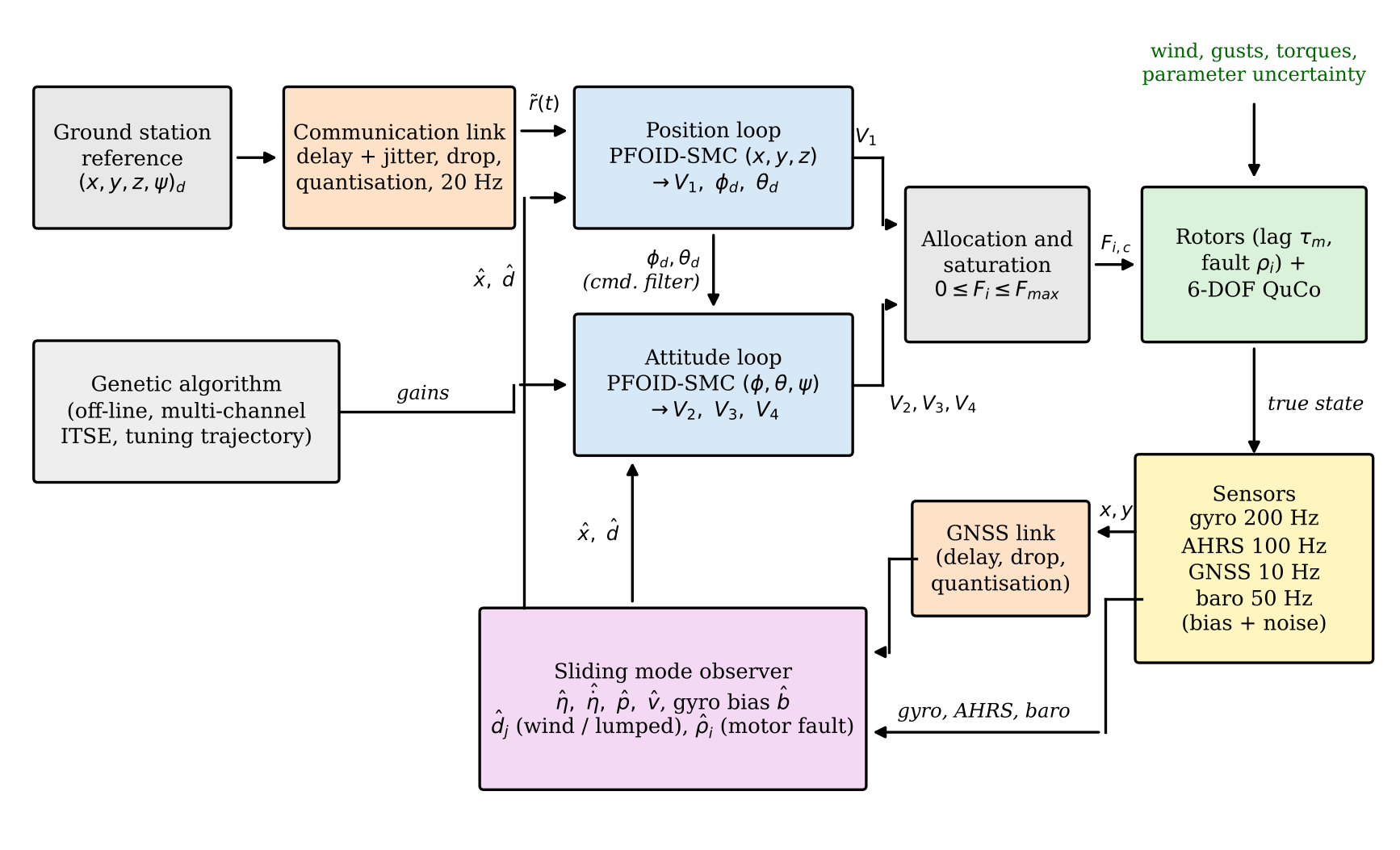
This paper presents a genetic algorithm (GA)-tuned sliding mode controller for a quadcopter (QuCo) in which the sliding surface is built from a proportional-fractional-order-integral-derivative (PFOID) error function (PFOID-SMC). The aim is to achieve accurate trajectory tracking in the presence of aerodynamic drag, wind, sensor noise and parametric uncertainty. Sensing and communication are kept inside the closed loop. The controller receives only measured or estimated states from a gyroscope (200~Hz), an attitude and heading reference system (100~Hz), an RTK-GNSS receiver (10~Hz) and a barometer (50~Hz), each with its own bias and noise, while the reference and the GNSS position are sent over a link with delay, packet loss and quantization. A sliding mode observer reconstructs attitude, angular rates, velocities, wind and disturbance accelerations and motor faults, and its disturbance estimates enter the equivalent control. Finite-time reaching and exponential convergence of the sliding variables are proved channel by channel with Lyapunov functions, and the stability of the complete cascade is checked numerically. The controller is compared with GA-tuned PID, conventional SMC, FOPID, super-twisting SMC and the earlier PFOID-SMC law in 15 scenarios, each with five noise realizations. In nominal conditions, it is not the most accurate (3-D position RMSE 0.119~m, against 0.071~m for FOPID). It gives the lowest error, however, under the strongest wind (0.134~m), under a 30% increase in mass and inertia (0.179~m, against at least 0.82~m for all baselines) and after a 40% loss of effectiveness of one motor (0.147~m). Without the observer, the same controller diverges.
Graphical Abstract
Keywords
Data Availability Statement
Funding
Conflicts of Interest
AI Use Statement
Ethical Approval and Consent to Participate
References
- Van Nguyen, C., & Nguyen, M. T. (2023, December). Design and simulation of PID-based control system for UAV quadcopters. In International Conference on Advances in Information and Communication Technology (pp. 146-153). Cham: Springer Nature Switzerland.
[CrossRef] [Google Scholar] - Shakhatreh, H., Sawalmeh, A. H., Al-Fuqaha, A., Dou, Z., Almaita, E., Khalil, I., ... & Guizani, M. (2019). Unmanned aerial vehicles (UAVs): A survey on civil applications and key research challenges. IEEE Access, 7, 48572-48634.
[CrossRef] [Google Scholar] - Mahony, R., Kumar, V., & Corke, P. (2012). Multirotor aerial vehicles: Modeling, estimation, and control of quadrotor. IEEE robotics & automation magazine, 19(3), 20-32.
[CrossRef] [Google Scholar] - Dalwadi, N., Deb, D., & Ozana, S. (2023). Dual observer based adaptive controller for hybrid drones. Drones, 7(1), 48.
[CrossRef] [Google Scholar] - Hassanalian, M., & Abdelkefi, A. (2017). Classifications, applications, and design challenges of drones: A review. Progress in Aerospace sciences, 91, 99-131.
[CrossRef] [Google Scholar] - Idrissi, M., Salami, M., & Annaz, F. (2022). A review of quadrotor unmanned aerial vehicles: Applications, architectural design and control algorithms. Journal of Intelligent & Robotic Systems, 104(2), 22.
[CrossRef] [Google Scholar] - Khalid, A., Mushtaq, Z., Arif, S., Zeb, K., Khan, M. A., & Bakshi, S. (2023). Control schemes for quadrotor UAV: taxonomy and survey. ACM Computing Surveys, 56(5), 1-32.
[CrossRef] [Google Scholar] - Hua, M. D., Hamel, T., Morin, P., & Samson, C. (2013). Introduction to feedback control of underactuated VTOLvehicles: A review of basic control design ideas and principles. IEEE Control systems magazine, 33(1), 61-75.
[CrossRef] [Google Scholar] - Ma'arif, A., Suwarno, I., Nur'aini, E., & Raharja, N. M. (2023, January). Altitude control of UAV quadrotor using PID and integral state feedback. In BIO Web of Conferences (Vol. 65, p. 07011). EDP Sciences.
[CrossRef] [Google Scholar] - Maaruf, M., Hamanah, W. M., & Abido, M. A. (2023). Hybrid backstepping control of a quadrotor using a radial basis function neural network. Mathematics, 11(4), 991.
[CrossRef] [Google Scholar] - Kim, J., Gadsden, S. A., & Wilkerson, S. A. (2019). A comprehensive survey of control strategies for autonomous quadrotors. Canadian Journal of Electrical and Computer Engineering, 43(1), 3-16.
[CrossRef] [Google Scholar] - Danesh, M., Jalalaei, A., & Derakhshan, R. E. (2023). Auto-landing algorithm for quadrotor UAV using super-twisting second-order sliding mode control in the presence of external disturbances. International Journal of Dynamics and Control, 11(6), 2940-2957.
[CrossRef] [Google Scholar] - Åström, K. J., & Hägglund, T. (2001). The future of PID control. Control engineering practice, 9(11), 1163-1175.
[CrossRef] [Google Scholar] - Shah, P., & Agashe, S. (2016). Review of fractional PID controller. Mechatronics, 38, 29-41.
[CrossRef] [Google Scholar] - Efe, M. Ö. (2011). Integral sliding mode control of a quadrotor with fractional order reaching dynamics. Transactions of the Institute of Measurement and Control, 33(8), 985-1003.
[CrossRef] [Google Scholar] - Izaguirre‐Espinosa, C., Muñoz‐Vázquez, A. J., Sánchez‐Orta, A., Parra‐Vega, V., & Castillo, P. (2016). Attitude control of quadrotors based on fractional sliding modes: theory and experiments. IET Control Theory & Applications, 10(7), 825-832.
[CrossRef] [Google Scholar] - Shi, X., Cheng, Y., Yin, C., Dadras, S., & Huang, X. (2019). Design of fractional‐order backstepping sliding mode control for quadrotor UAV. Asian Journal of Control, 21(1), 156-171.
[CrossRef] [Google Scholar] - Labbadi, M., Boukal, Y., & Cherkaoui, M. (2020). Path following control of quadrotor UAV with continuous fractional-order super twisting sliding mode. Journal of Intelligent & Robotic Systems, 100(3-4), 1429-1451.
[CrossRef] [Google Scholar] - Pazooki, M., & Mazinan, A. H. (2018). Hybrid fuzzy-based sliding-mode control approach, optimized by genetic algorithm for quadrotor unmanned aerial vehicles. Complex & Intelligent Systems, 4(2), 79-93.
[CrossRef] [Google Scholar] - Kumar, S., & Dewan, L. (2023). Control the quadcopter using hybrid controller under the disturbed environment. In Proceedings of the International Conference of Control, Dynamic Systems, and Robotics (CDSR'23), Paper No.~204. Ottawa: Avestia.
[CrossRef] [Google Scholar] - Kumar, S., & Dewan, L. (2023). Quadcopter stabilization using hybrid controller under mass variation and disturbances. Journal of Vibration and Control, 29(21-22), 4857-4874.
[CrossRef] [Google Scholar] - Abro, G. E. M., & Abdallah, A. M. (2025). A synergistic fractional-order control for precise helical trajectory tracking and formation stability in multi-agent quadrotor uavs. Arabian Journal for Science and Engineering, 50(8), 6121-6140.
[CrossRef] [Google Scholar] - Nguyen, C. V., Nguyen, M. T., Tran, H. T., Trinh, M. L., La, H. M., & Nguyen, H. T. (2024). Trajectory tracking control for a quadcopter under external disturbances. Engineering, Technology & Applied Science Research, 14(6), 17620-17628.
[CrossRef] [Google Scholar] - Jijun, S., & Daogang, P. (2024). Application research on improved genetic algorithm and active disturbance rejection control on quadcopters. Measurement and Control, 57(9), 1347-1357.
[CrossRef] [Google Scholar] - Li, K., Bai, Y., & Zhou, H. (2024). Research on quadrotor control based on genetic algorithm and particle swarm optimization for pid tuning and fuzzy control-based linear active disturbance rejection control. Electronics, 13(22), 4386.
[CrossRef] [Google Scholar] - Derafa, L., Benallegue, A., & Fridman, L. (2012). Super twisting control algorithm for the attitude tracking of a four rotors UAV. Journal of the Franklin Institute, 349(2), 685-699.
[CrossRef] [Google Scholar] - Brahim, K. S., El Hajjaji, A., Terki, N., & Alabazares, D. L. (2023). Finite time adaptive SMC for UAV trajectory tracking under unknown disturbances and actuators constraints. IEEE Access, 11, 66177-66193.
[CrossRef] [Google Scholar] - Khaled, T., & Boumehraz, M. (2023). Adaptive sliding mode controller and observer for altitude and attitude control of a quadrotor. arXiv preprint arXiv:2308.00572.
[CrossRef] [Google Scholar] - Kumar, S., & Dewan, L. (2022). PFOID-SMC approach to mitigate the effect of disturbance and parametric uncertainty on the quadcopter. International Journal of Modelling, Identification and Control, 40(4), 343-355.
[CrossRef] [Google Scholar] - Hespanha, J. P., Naghshtabrizi, P., & Xu, Y. (2007). A survey of recent results in networked control systems. Proceedings of the IEEE, 95(1), 138-162.
[CrossRef] [Google Scholar] - Jin, G. G., Pal, P., Chung, Y. K., Kang, H. K., Yetayew, T. T., & Bhakta, S. (2023). Modelling, control and development of GUI-based simulator for a quadcopter using nonlinear PID control. Australian Journal of Electrical and Electronics Engineering, 20(4), 387-399.
[CrossRef] [Google Scholar] - Tripathi, V. K., Kamath, A. K., Behera, L., Verma, N. K., & Nahavandi, S. (2020). Finite-time super twisting sliding mode controller based on higher-order sliding mode observer for real-time trajectory tracking of a quadrotor. IET Control Theory & Applications, 14(16), 2359-2371.
[CrossRef] [Google Scholar] - Thanh, H. L. N. N., & Hong, S. K. (2018). Quadcopter robust adaptive second order sliding mode control based on PID sliding surface. IEEE Access, 6, 66850-66860.
[CrossRef] [Google Scholar] - Mian, A. A., & Daobo, W. (2008). Modeling and backstepping-based nonlinear control strategy for a 6 DOF quadrotor helicopter. Chinese Journal of Aeronautics, 21(3), 261-268.
[CrossRef] [Google Scholar] - Bouabdallah, S., & Siegwart, R. (2005, April). Backstepping and sliding-mode techniques applied to an indoor micro quadrotor. In Proceedings of the 2005 IEEE international conference on robotics and automation (pp. 2247-2252). IEEE.
[CrossRef] [Google Scholar] - Das, A., Lewis, F. L., & Subbarao, K. (2011). Sliding mode approach to control quadrotor using dynamic inversion. Challenges and paradigms in applied robust control, 3-24.
[CrossRef] [Google Scholar] - Ahmadi, K., Asadi, D., Merheb, A., Nabavi-Chashmi, S. Y., & Tutsoy, O. (2023). Active fault-tolerant control of quadrotor UAVs with nonlinear observer-based sliding mode control validated through hardware in the loop experiments. Control Engineering Practice, 137, 105557.
[CrossRef] [Google Scholar] - Emran, B. J., & Najjaran, H. (2018). A review of quadrotor: An underactuated mechanical system. Annual Reviews in Control, 46, 165-180.
[CrossRef] [Google Scholar] - Davila, J., Fridman, L., & Levant, A. (2005). Second-order sliding-mode observer for mechanical systems. IEEE transactions on automatic control, 50(11), 1785-1789.
[CrossRef] [Google Scholar] - Moreno, J. A., & Osorio, M. (2012). Strict Lyapunov functions for the super-twisting algorithm. IEEE transactions on automatic control, 57(4), 1035-1040.
[CrossRef] [Google Scholar] - Levant, A. (2003). Higher-order sliding modes, differentiation and output-feedback control. International journal of Control, 76(9-10), 924-941.
[CrossRef] [Google Scholar] - Monje, C. A., Vinagre, B. M., Feliu, V., & Chen, Y. (2008). Tuning and auto-tuning of fractional order controllers for industry applications. Control engineering practice, 16(7), 798-812.
[CrossRef] [Google Scholar] - Ayad, R., Nouibat, W., Zareb, M., & Bestaoui Sebanne, Y. (2019). Full control of quadrotor aerial robot using fractional-order FOPID. Iranian Journal of Science and Technology, Transactions of Electrical Engineering, 43(Suppl 1), 349-360.
[CrossRef] [Google Scholar] - Goldberg, D. E. (1989). Genetic Algorithms in Search, Optimization, and Machine Learning. Reading, MA: Addison-Wesley. https://dl.acm.org/doi/10.5555/534133
[Google Scholar] - Eker, I. (2006). Sliding mode control with PID sliding surface and experimental application to an electromechanical plant. ISA transactions, 45(1), 109-118.
[CrossRef] [Google Scholar] - Eker, I. (2010). Second-order sliding mode control with experimental application. ISA transactions, 49(3), 394-405.
[CrossRef] [Google Scholar] - Oustaloup, A., Levron, F., Mathieu, B., & Nanot, F. M. (2000). Frequency-band complex noninteger differentiator: characterization and synthesis. IEEE Transactions on circuits and systems I: Fundamental theory and applications, 47(1), 25-39.
[CrossRef] [Google Scholar] - Khalil, H. K. (2002). Nonlinear Systems (3rd ed.). Upper Saddle River, NJ: Prentice Hall. https://flyingv.ucsd.edu/krstic/files/Khalil-3rd.pdf
[Google Scholar] - Matignon, D. (1996, July). Stability results for fractional differential equations with applications to control processing. In Computational engineering in systems applications (Vol. 2, No. 1, pp. 963-968). https://www.researchgate.net/publication/2581881
[Google Scholar] - Li, Y., Chen, Y., & Podlubny, I. (2009). Mittag–Leffler stability of fractional order nonlinear dynamic systems. Automatica, 45(8), 1965-1969.
[CrossRef] [Google Scholar] - U.S. Department of Defense. (1980). MIL-F-8785C: Military Specification, Flying Qualities of Piloted Airplanes. Washington, DC. Retrieved from https://everyspec.com/MIL-SPECS/MIL-SPECS-MIL-F/MIL-F-8785C_5295/
[Google Scholar] - Podlubny, I. (1999). Fractional-order systems and PI$^{\lambda$D$^{\mu$-controllers. IEEE Transactions on Automatic Control, 44(1), 208-214.
[CrossRef] [Google Scholar] - Shtessel, Y., Edwards, C., Fridman, L., & Levant, A. (2014). Sliding mode control and observation (Vol. 10, pp. 978-970). New York: Birkhäuser.
[CrossRef] [Google Scholar]
Cite This Article
TY  - JOUR
AU  - Singh, Nidhi
AU  - Nigam, Prashant
AU  - Dewan, Lillie
PY  - 2026
DA  - 2026/11/02
TI  - Genetic Algorithm Based PFOID-SMC with a Sliding Mode Observer for a Quadcopter under Sensing and Communication Constraints
JO  - ICCK Transactions on Sensing, Communication, and Control
T2  - ICCK Transactions on Sensing, Communication, and Control
JF  - ICCK Transactions on Sensing, Communication, and Control
VL  - 3
IS  - 4
SP  - 210
EP  - 236
DO  - 10.62762/TSCC.2026.637136
UR  - https://www.icck.org/article/abs/TSCC.2026.637136
KW  - Genetic algorithm
KW  - fractional-order control
KW  - sliding mode control
KW  - sliding mode observer
KW  - parametric uncertainty
KW  - unmanned aerial vehicle
KW  - sensor modelling
KW  - networked control
AB  - This paper presents a genetic algorithm (GA)-tuned sliding mode controller for a quadcopter (QuCo) in which the sliding surface is built from a proportional-fractional-order-integral-derivative (PFOID) error function (PFOID-SMC). The aim is to achieve accurate trajectory tracking in the presence of aerodynamic drag, wind, sensor noise and parametric uncertainty. Sensing and communication are kept inside the closed loop. The controller receives only measured or estimated states from a gyroscope (200~Hz), an attitude and heading reference system (100~Hz), an RTK-GNSS receiver (10~Hz) and a barometer (50~Hz), each with its own bias and noise, while the reference and the GNSS position are sent over a link with delay, packet loss and quantization. A sliding mode observer reconstructs attitude, angular rates, velocities, wind and disturbance accelerations and motor faults, and its disturbance estimates enter the equivalent control. Finite-time reaching and exponential convergence of the sliding variables are proved channel by channel with Lyapunov functions, and the stability of the complete cascade is checked numerically. The controller is compared with GA-tuned PID, conventional SMC, FOPID, super-twisting SMC and the earlier PFOID-SMC law in 15 scenarios, each with five noise realizations. In nominal conditions, it is not the most accurate (3-D position RMSE 0.119~m, against 0.071~m for FOPID). It gives the lowest error, however, under the strongest wind (0.134~m), under a 30% increase in mass and inertia (0.179~m, against at least 0.82~m for all baselines) and after a 40% loss of effectiveness of one motor (0.147~m). Without the observer, the same controller diverges.
SN  - 3068-9287
PB  - Institute of Central Computation and Knowledge
LA  - English
ER  -
@article{Singh2026Genetic,
  author = {Nidhi Singh and Prashant Nigam and Lillie Dewan},
  title = {Genetic Algorithm Based PFOID-SMC with a Sliding Mode Observer for a Quadcopter under Sensing and Communication Constraints},
  journal = {ICCK Transactions on Sensing, Communication, and Control},
  year = {2026},
  volume = {3},
  number = {4},
  pages = {210-236},
  doi = {10.62762/TSCC.2026.637136},
  url = {https://www.icck.org/article/abs/TSCC.2026.637136},
  abstract = {This paper presents a genetic algorithm (GA)-tuned sliding mode controller for a quadcopter (QuCo) in which the sliding surface is built from a proportional-fractional-order-integral-derivative (PFOID) error function (PFOID-SMC). The aim is to achieve accurate trajectory tracking in the presence of aerodynamic drag, wind, sensor noise and parametric uncertainty. Sensing and communication are kept inside the closed loop. The controller receives only measured or estimated states from a gyroscope (200~Hz), an attitude and heading reference system (100~Hz), an RTK-GNSS receiver (10~Hz) and a barometer (50~Hz), each with its own bias and noise, while the reference and the GNSS position are sent over a link with delay, packet loss and quantization. A sliding mode observer reconstructs attitude, angular rates, velocities, wind and disturbance accelerations and motor faults, and its disturbance estimates enter the equivalent control. Finite-time reaching and exponential convergence of the sliding variables are proved channel by channel with Lyapunov functions, and the stability of the complete cascade is checked numerically. The controller is compared with GA-tuned PID, conventional SMC, FOPID, super-twisting SMC and the earlier PFOID-SMC law in 15 scenarios, each with five noise realizations. In nominal conditions, it is not the most accurate (3-D position RMSE 0.119~m, against 0.071~m for FOPID). It gives the lowest error, however, under the strongest wind (0.134~m), under a 30\% increase in mass and inertia (0.179~m, against at least 0.82~m for all baselines) and after a 40\% loss of effectiveness of one motor (0.147~m). Without the observer, the same controller diverges.},
  keywords = {Genetic algorithm, fractional-order control, sliding mode control, sliding mode observer, parametric uncertainty, unmanned aerial vehicle, sensor modelling, networked control},
  issn = {3068-9287},
  publisher = {Institute of Central Computation and Knowledge}
}
Article Metrics
Publisher's Note
ICCK stays neutral with regard to jurisdictional claims in published maps and institutional affiliations.
Rights and Permissions


Portico
