Design and Verification of a Centralized Multi-Agent Visual SLAM System Based on Cloud Native Architecture




Article Information
Abstract
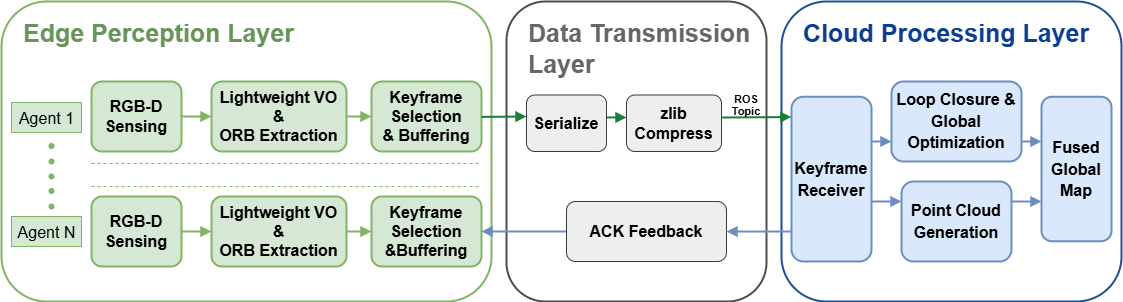
To alleviate the computational and memory pressure faced by resource-constrained edge platforms in large-scale homogeneous multi-agent visual SLAM tasks, this paper designs and validates a centralized homogeneous multi-agent visual SLAM system based on a cloud-native architecture. The system adopts a cloud-edge functional decoupling strategy: real-time perception modules, such as visual odometry, keyframe extraction, and local tracking, are retained on the edge side, while computationally intensive tasks, including loop-closure detection, pose graph optimization, global map management, and multi-source map fusion, are centrally executed in the cloud. To accommodate bandwidth fluctuations, transmission latency, and short-term packet loss, the system establishes a ROS-based bidirectional asynchronous communication mechanism and combines keyframe-level compression, serialization, and ACK confirmation feedback to support reliable keyframe uploading. Meanwhile, an edge-side resource management workflow based on ``upload--acknowledge--release'' is designed to limit the growth of unacknowledged keyframe caches and improve long-term operational stability. For map fusion, the system adopts probabilistic occupancy-grid updating based on log-odds representation and, under homogeneous sensor conditions and constraints from globally optimized poses, projects local maps from multiple agents into a shared coordinate system for normalized equal-weight fusion. Experiments on public datasets, Gazebo collaborative simulations, baseline comparisons, communication-constrained tests, and long-horizon stress tests show that, under controlled experimental conditions, the proposed system reduces the edge-side load while maintaining localization accuracy and improves the stability of cloud-side map updating and long-term operation. Communication-disturbance experiments further analyze the influence of bandwidth limitation, transmission latency, random jitter, packet loss, and short-term outage on system performance, confirming the operational adaptability of the system under weak-network conditions.
Graphical Abstract
Keywords
Data Availability Statement
Funding
Conflicts of Interest
AI Use Statement
Ethical Approval and Consent to Participate
References
- Cadena, C., Carlone, L., Carrillo, H., Latif, Y., Scaramuzza, D., Neira, J., ... & Leonard, J. J. (2016). Past, present, and future of simultaneous localization and mapping: Toward the robust-perception age. IEEE Transactions on robotics, 32(6), 1309-1332.
[CrossRef] [Google Scholar] - Campos, C., Elvira, R., Rodríguez, J. J. G., Montiel, J. M., & Tardós, J. D. (2021). Orb-slam3: An accurate open-source library for visual, visual–inertial, and multimap slam. IEEE transactions on robotics, 37(6), 1874-1890.
[CrossRef] [Google Scholar] - Mur-Artal, R., Montiel, J. M. M., & Tardos, J. D. (2015). ORB-SLAM: A versatile and accurate monocular SLAM system. IEEE transactions on robotics, 31(5), 1147-1163.
[CrossRef] [Google Scholar] - Mur-Artal, R., & Tardós, J. D. (2017). Orb-slam2: An open-source slam system for monocular, stereo, and rgb-d cameras. IEEE transactions on robotics, 33(5), 1255-1262.
[CrossRef] [Google Scholar] - Zou, D., Tan, P., & Yu, W. (2019). Collaborative visual SLAM for multiple agents: A brief survey. Virtual Reality & Intelligent Hardware, 1(5), 461-482.
[CrossRef] [Google Scholar] - Zhuang, L., Zhong, X., Xu, L., Tian, C., & Yu, W. (2024). Visual SLAM for unmanned aerial vehicles: Localization and perception. Sensors, 24(10), 2980.
[CrossRef] [Google Scholar] - Huang, P., Zeng, L., Chen, X., Luo, K., Zhou, Z., & Yu, S. (2022). Edge robotics: Edge-computing-accelerated multirobot simultaneous localization and mapping. IEEE Internet of Things Journal, 9(15), 14087-14102.
[CrossRef] [Google Scholar] - Zhang, T., Zhang, L., Chen, Y., & Zhou, Y. (2022). CVIDS: A collaborative localization and dense mapping framework for multi-agent based visual-inertial SLAM. IEEE transactions on image processing, 31, 6562-6576.
[CrossRef] [Google Scholar] - Macario Barros, A., Michel, M., Moline, Y., Corre, G., & Carrel, F. (2022). A Comprehensive Survey of Visual SLAM Algorithms. Robotics, 11(1), 24.
[CrossRef] [Google Scholar] - Lajoie, P. Y., Ramtoula, B., Chang, Y., Carlone, L., & Beltrame, G. (2020). DOOR-SLAM: Distributed, online, and outlier resilient SLAM for robotic teams. IEEE Robotics and Automation Letters, 5(2), 1656-1663.
[CrossRef] [Google Scholar] - Lajoie, P. Y., & Beltrame, G. (2023). Swarm-slam: Sparse decentralized collaborative simultaneous localization and mapping framework for multi-robot systems. IEEE robotics and automation letters, 9(1), 475-482.
[CrossRef] [Google Scholar] - Schmuck, P., & Chli, M. (2019). CCM‐SLAM: Robust and efficient centralized collaborative monocular simultaneous localization and mapping for robotic teams. Journal of Field Robotics, 36(4), 763-781.
[CrossRef] [Google Scholar] - Delmerico, J., & Scaramuzza, D. (2018, May). A benchmark comparison of monocular visual-inertial odometry algorithms for flying robots. In 2018 IEEE international conference on robotics and automation (ICRA) (pp. 2502-2509). IEEE.
[CrossRef] [Google Scholar] - Tang, J., Ericson, L., Folkesson, J., & Jensfelt, P. (2019). GCNv2: Efficient correspondence prediction for real-time SLAM. IEEE Robotics and Automation Letters, 4(4), 3505-3512.
[CrossRef] [Google Scholar] - Chen, W., Chen, S., Leng, J., Wang, J., Guan, Y., Meng, M. Q. H., & Zhang, H. (2024). A review of cloud-edge SLAM: Toward asynchronous collaboration and implicit representation transmission. IEEE Transactions on Intelligent Transportation Systems, 25(11), 15437-15453.
[CrossRef] [Google Scholar] - Chen, W., Yaguchi, Y., Naruse, K., Watanobe, Y., Nakamura, K., & Ogawa, J. (2018). A study of robotic cooperation in cloud robotics: Architecture and challenges. IEEE Access, 6, 36662-36682.
[CrossRef] [Google Scholar] - Chen, W., Lin, Z., Zhu, L., Chen, S., Zhu, H., Guan, Y., & Zhang, H. (2024). Cloud-edge collaborative submap-based VSLAM using implicit representation transmission. IEEE Transactions on Vehicular Technology, 73(10), 14537-14546.
[CrossRef] [Google Scholar] - Li, D., Zhao, Y., Xu, J., Zhang, S., Shangguan, L., & Yang, Z. (2024, May). EdgeSLAM2: Rethinking edge-assisted visual SLAM with on-chip intelligence. In IEEE INFOCOM 2024-IEEE Conference on Computer Communications (pp. 1481-1490). IEEE.
[CrossRef] [Google Scholar] - Sossalla, P., Rischke, J., Hofer, J., & Fitzek, F. H. (2021, September). Evaluating the advantages of remote SLAM on an edge cloud. In 2021 26th IEEE International Conference on Emerging Technologies and Factory Automation (ETFA) (pp. 01-04). IEEE.
[CrossRef] [Google Scholar] - Yanık, Ö. F., & Ilgın, H. A. (2023). A comprehensive computational cost analysis for state-of-the-art visual slam methods for autonomous mapping. Communications Faculty of Sciences University of Ankara Series A2-A3 Physical Sciences and Engineering, 65(1), 1-15.
[CrossRef] [Google Scholar] - Wu, Y., Li, Z., Palaiahnakote, S., & Lu, T. (2018, August). Em-SLAM: a fast and robust monocular SLAM method for embedded systems. In 2018 24th International Conference on Pattern Recognition (ICPR) (pp. 1882-1887). IEEE.
[CrossRef] [Google Scholar] - Picard, Q., Chevobbe, S., Darouich, M., & Didier, J. Y. (2022, October). Image quantization towards data reduction: robustness analysis for SLAM methods on embedded platforms. In 2022 IEEE International Conference on Image Processing (ICIP) (pp. 4158-4162). IEEE.
[CrossRef] [Google Scholar] - Khalufa, A., Riley, G., & Lujan, M. (2019, September). Poster: Runtime adaptations for energy-efficient vslam. In 2019 28th International Conference on Parallel Architectures and Compilation Techniques (PACT) (pp. 475-476). IEEE.
[CrossRef] [Google Scholar] - Eger, S., Pries, R., & Steinbach, E. (2020, September). Evaluation of different task distributions for edge cloud-based collaborative visual SLAM. In 2020 IEEE 22nd International Workshop on Multimedia Signal Processing (MMSP) (pp. 1-6). IEEE.
[CrossRef] [Google Scholar] - Sossalla, P., Hofer, J., Rischke, J., Busch, J., Nguyen, G. T., Reisslein, M., & Fitzek, F. H. (2022, December). Optimizing Edge SLAM: Judicious parameter settings and parallelized map updates. In GLOBECOM 2022-2022 IEEE Global Communications Conference (pp. 1954-1959). IEEE.
[CrossRef] [Google Scholar] - Xu, J., Cao, H., Li, D., Huang, K., Qian, C., Shangguan, L., & Yang, Z. (2020, July). Edge assisted mobile semantic visual SLAM. In IEEE INFOCOM 2020-IEEE Conference on computer communications (pp. 1828-1837). IEEE.
[CrossRef] [Google Scholar] - Gao, S., Zhu, J., Wang, Z., Ren, S., Zhang, K., & Chen, P. (2023, December). FAES-SLAM: Fast and Accurate Edge-Assisted Semantic SLAM Towards Dynamic Environments. In GLOBECOM 2023-2023 IEEE Global Communications Conference (pp. 3591-3596). IEEE.
[CrossRef] [Google Scholar] - Chen, Y., Inaltekin, H., & Gorlatova, M. (2023, May). AdaptSLAM: Edge-assisted adaptive SLAM with resource constraints via uncertainty minimization. In IEEE INFOCOM 2023-IEEE Conference on computer communications (pp. 1-10). IEEE.
[CrossRef] [Google Scholar] - Zhang, Y., Mao, Y., Wang, H., Yu, Z., Guo, S., Zhang, J., ... & Guo, B. (2025). Orchestrating joint offloading and scheduling for low-latency edge slam. IEEE transactions on mobile computing, 24(8), 6901-6917.
[CrossRef] [Google Scholar]
Cite This Article
TY  - JOUR
AU  - Yu, Lian
AU  - Li, Dongsheng
AU  - Wang, Guoyan
AU  - Zhao, Fei
PY  - 2026
DA  - 2026/09/28
TI  - Design and Verification of a Centralized Multi-Agent Visual SLAM System Based on Cloud Native Architecture
JO  - Chinese Journal of Information Fusion
T2  - Chinese Journal of Information Fusion
JF  - Chinese Journal of Information Fusion
VL  - 3
IS  - 3
SP  - 209
EP  - 225
DO  - 10.62762/CJIF.2026.632794
UR  - https://www.icck.org/article/abs/CJIF.2026.632794
KW  - cloud-native architecture
KW  - multi-agent SLAM
KW  - map fusion
KW  - edge computing
AB  - To alleviate the computational and memory pressure faced by resource-constrained edge platforms in large-scale homogeneous multi-agent visual SLAM tasks, this paper designs and validates a centralized homogeneous multi-agent visual SLAM system based on a cloud-native architecture. The system adopts a cloud-edge functional decoupling strategy: real-time perception modules, such as visual odometry, keyframe extraction, and local tracking, are retained on the edge side, while computationally intensive tasks, including loop-closure detection, pose graph optimization, global map management, and multi-source map fusion, are centrally executed in the cloud. To accommodate bandwidth fluctuations, transmission latency, and short-term packet loss, the system establishes a ROS-based bidirectional asynchronous communication mechanism and combines keyframe-level compression, serialization, and ACK confirmation feedback to support reliable keyframe uploading. Meanwhile, an edge-side resource management workflow based on ``upload--acknowledge--release'' is designed to limit the growth of unacknowledged keyframe caches and improve long-term operational stability. For map fusion, the system adopts probabilistic occupancy-grid updating based on log-odds representation and, under homogeneous sensor conditions and constraints from globally optimized poses, projects local maps from multiple agents into a shared coordinate system for normalized equal-weight fusion. Experiments on public datasets, Gazebo collaborative simulations, baseline comparisons, communication-constrained tests, and long-horizon stress tests show that, under controlled experimental conditions, the proposed system reduces the edge-side load while maintaining localization accuracy and improves the stability of cloud-side map updating and long-term operation. Communication-disturbance experiments further analyze the influence of bandwidth limitation, transmission latency, random jitter, packet loss, and short-term outage on system performance, confirming the operational adaptability of the system under weak-network conditions.
SN  - 2998-3371
PB  - Institute of Central Computation and Knowledge
LA  - English
ER  -
@article{Yu2026Design,
  author = {Lian Yu and Dongsheng Li and Guoyan Wang and Fei Zhao},
  title = {Design and Verification of a Centralized Multi-Agent Visual SLAM System Based on Cloud Native Architecture},
  journal = {Chinese Journal of Information Fusion},
  year = {2026},
  volume = {3},
  number = {3},
  pages = {209-225},
  doi = {10.62762/CJIF.2026.632794},
  url = {https://www.icck.org/article/abs/CJIF.2026.632794},
  abstract = {To alleviate the computational and memory pressure faced by resource-constrained edge platforms in large-scale homogeneous multi-agent visual SLAM tasks, this paper designs and validates a centralized homogeneous multi-agent visual SLAM system based on a cloud-native architecture. The system adopts a cloud-edge functional decoupling strategy: real-time perception modules, such as visual odometry, keyframe extraction, and local tracking, are retained on the edge side, while computationally intensive tasks, including loop-closure detection, pose graph optimization, global map management, and multi-source map fusion, are centrally executed in the cloud. To accommodate bandwidth fluctuations, transmission latency, and short-term packet loss, the system establishes a ROS-based bidirectional asynchronous communication mechanism and combines keyframe-level compression, serialization, and ACK confirmation feedback to support reliable keyframe uploading. Meanwhile, an edge-side resource management workflow based on ``upload--acknowledge--release'' is designed to limit the growth of unacknowledged keyframe caches and improve long-term operational stability. For map fusion, the system adopts probabilistic occupancy-grid updating based on log-odds representation and, under homogeneous sensor conditions and constraints from globally optimized poses, projects local maps from multiple agents into a shared coordinate system for normalized equal-weight fusion. Experiments on public datasets, Gazebo collaborative simulations, baseline comparisons, communication-constrained tests, and long-horizon stress tests show that, under controlled experimental conditions, the proposed system reduces the edge-side load while maintaining localization accuracy and improves the stability of cloud-side map updating and long-term operation. Communication-disturbance experiments further analyze the influence of bandwidth limitation, transmission latency, random jitter, packet loss, and short-term outage on system performance, confirming the operational adaptability of the system under weak-network conditions.},
  keywords = {cloud-native architecture, multi-agent SLAM, map fusion, edge computing},
  issn = {2998-3371},
  publisher = {Institute of Central Computation and Knowledge}
}
Article Metrics
Publisher's Note
ICCK stays neutral with regard to jurisdictional claims in published maps and institutional affiliations.
Rights and Permissions
 Copyright © 2026 by the Author(s). Published by Institute of Central Computation and Knowledge. This article is an open access article distributed under the terms and conditions of the Creative Commons Attribution (CC BY) license (https://creativecommons.org/licenses/by/4.0/), which permits use, sharing, adaptation, distribution and reproduction in any medium or format, as long as you give appropriate credit to the original author(s) and the source, provide a link to the Creative Commons licence, and indicate if changes were made.


Portico